
Everyone said Grandpa Terrence was a quiet man. Served in Vietnam, came home, never talked about it. Worked at the post office for 38 years. Died in his recliner watching Jeopardy on a Tuesday.
I was the only grandkid who showed up to clean out his house.
The footlocker was in the back of his closet, behind mothball-stinking coats and a box of Reader’s Digest magazines from 1987. It had three padlocks on it. Not one. Three.
I almost left it alone. But then I found the key taped inside his Bible. Just one key. It opened all three locks.
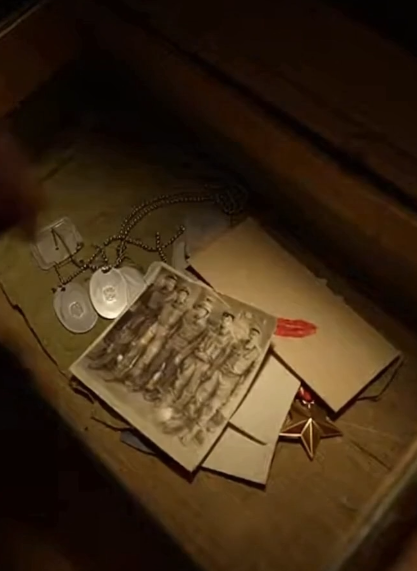
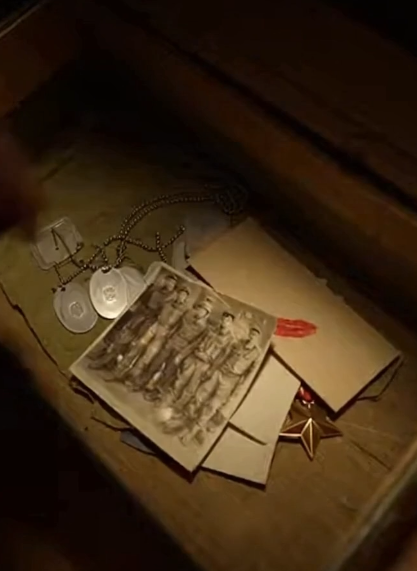
Inside was what you’d expect at first. Dog tags. A faded photo of his platoon. A Bronze Star I never knew he earned. A letter from someone named Darlene that smelled like perfume even after fifty years.
Then I found the false bottom.
Underneath was a manila envelope stamped CLASSIFIED – DO NOT REPRODUCE with a serial number and a Department of Defense seal. Inside were eight photographs, a reel-to-reel tape, and a handwritten list of eleven names. Every single name had a line through it except the last one.
The last name on the list was my grandmother’s maiden name.
I called my mom. She didn’t answer. I called my uncle Rodney. He picked up on the first ring, which he never does. Before I could say anything, he said, “You found it.”
I said, “Found what?”
He went silent for a long time. Then he said, “Put it back. Lock it. Burn the key.”
I didn’t listen.
I took the tape to a buddy of mine, Garrett, who restores old audio equipment. He transferred it to digital. We sat in his garage and pressed play.
It was Grandpa Terrence’s voice. Young. Sharp. Nothing like the soft-spoken man I knew. He was giving coordinates. Dates. Names that matched the ones on the list. And then he said something that made Garrett pause the recording and look at me like I’d brought a bomb into his house.
“That’s not a war story,” Garrett whispered. “That’s a confession.”
The next morning, two men in plain clothes knocked on my front door. They didn’t show badges. They didn’t introduce themselves. The taller one just said, “We understand you’ve come into possession of Terrence Holliday’s personal effects.”
I told them I had a right to my grandfather’s things.
The shorter one smiled. Not a friendly smile. The kind that says you have no idea what you’re standing in.
He handed me a single sheet of paper. It was a non-disclosure agreement dated 1971 – signed by my grandfather, witnessed by someone at the Pentagon, and co-signed at the bottom by a name I recognized immediately.
It was the current sitting U.S. Senator from our state.
I looked up from the paper. The tall one leaned in close and said, “Your grandfather wasn’t a postal worker, son. He was never supposed to come home. And the people on that list?”
He tapped the paper.
“They didn’t.”
I opened my mouth to respond, but the short one was already placing a second document on my kitchen table. This one had my name on it. My full legal name. My Social Security number. And a date.
Tomorrow’s date.
Underneath, in my dead grandfather’s handwriting, were four words I will never forget:
“They’ll come for you next.”
For a full minute after they left, I just stood there. My kitchen clock was ticking, each second a hammer blow against the silence.
The paper with my name on it felt cold. It wasn’t just a threat. It was a schedule.
My heart was doing a drum solo against my ribs. I thought about calling the police, but the Senator’s name on that first document was like a brick wall in my mind. Who do you report a Senator to?
My hands shook as I grabbed my laptop. I had the audio file Garrett sent me. I dragged it, along with scanned copies of the photos and the list, into a secure cloud drive. Then I wiped my computer completely.
I stuffed the original contents of the envelope into my backpack. I grabbed a burner phone I’d bought ages ago for a festival and never used.
I looked around my apartment. It wasn’t my home anymore. It was a trap.
My gaze fell on a photo of my grandparents on the mantelpiece. They were young, standing by a lake. He looked proud. She looked radiant. And her maiden name was on a kill list.
I had to understand why.
I called my uncle Rodney again. This time, the line was disconnected.
That settled it. He’d run. I had to do the same.
I left my car in the driveway, my whole life behind me, and walked out the back door. I caught a bus heading two towns over, my hood pulled low, just another face in the crowd.
On the bus, I put in my headphones and listened to the tape again. Garrett was right. It was a confession. My grandfather methodically detailed the termination of ten individuals.
But something was different this time. I wasn’t just hearing a killer. I was listening for the quiet man who taught me how to fish. I heard the hesitation in his voice. The deep breath he took before reading the sixth name.
He wasn’t bragging. He was recording evidence. He was leaving a trail.
Then I looked at the photos again. They were candid shots. A man laughing at a bar. A woman reading a book on a park bench. They didn’t look like enemy spies or soldiers.
They looked like Americans. They looked like neighbors.
One photo showed a man with a distinctive tattoo on his forearm, a coiled serpent. I zoomed in on the scan I’d made. Faintly, in the background, was a sign for a tavern: “The Serpent’s Coil.”
It was a long shot, but it was the only shot I had. A quick search on the burner phone showed a bar with that name still existed, three states away. It was in a town I’d never heard of.
I bought a ticket for the next bus heading south. Sleep wasn’t an option. Every time I closed my eyes, I saw the date on that paper. Tomorrow’s date.
I felt like I was racing the sunrise.
The bus ride was a blur of highway lights and cheap coffee. I got to the town just after dawn. It was a small, forgotten place where the buildings seemed to lean on each other for support.
“The Serpent’s Coil” was exactly what it sounded like. Dark wood, sticky floors, and the smell of stale beer.
An old man with a face like a roadmap was wiping down the bar. He looked up as I walked in.
“A bit early, ain’t it?” he grunted.
I slid the photo of the man with the tattoo across the bar. “I’m looking for information about this man. He might have been a regular here a long, long time ago.”
The bartender squinted at it. He picked it up, holding it close to his one good eye.
“Don’t know him,” he said, pushing it back. But his hand trembled slightly. He was lying.
“He served with my grandfather,” I pressed, my voice soft. “I’m just trying to piece together his story.”
The old man sighed, a weary, rattling sound. He looked toward the door as if expecting trouble to walk in.
“People who asked about that crew back in the day had a habit of disappearing,” he said, his voice dropping to a whisper. “They were a team. Came through here a few times. Government work, they said. Secret stuff.”
My heart hammered. A team.
“They called themselves the Phantoms,” the bartender continued. “Because they weren’t ever really there. Eleven of them. Ten guys, one girl.”
One girl.
My blood ran cold. “What do you know about the woman?”
He shrugged. “Tough as any of them. Pretty girl, red hair. Eleanor, I think her name was.”
Eleanor. My grandmother’s name.
It hit me like a physical blow. The list wasn’t a list of targets. It was a roster. The roster of my grandfather’s own team.
And my grandmother was on it.
The bartender leaned in. “One day, they just stopped coming. The stories started a year later. That they were being hunted. Picked off, one by one. By one of their own.”
He thought my grandfather was a monster who turned on his friends. But I was beginning to see a different picture.
My grandmother wasn’t a target he was assigned. She was the last member of his team left alive, besides him. The line wasn’t through her name because he couldn’t bring himself to finish the job. He chose her. He chose love.
They didn’t just meet and fall in love. They survived together.
The whole story shifted in my mind. The Senator wasn’t just some politician my grandfather knew. He was their handler. The man who gave the orders. When their mission was over, he must have decided to tie up loose ends. Permanently.
He ordered the Phantoms to eliminate each other. A perfect, self-cleaning operation. My grandfather was just the one who was best at his job. He was the last one standing.
He followed his orders, hating every second of it, until only one name was left on the list. Eleanor Vance. The woman he loved.
So he faked her death. He took her and they vanished, becoming Terrence and Eleanor Holliday, a quiet couple who worked civil service jobs and raised a family.
The footlocker wasn’t a box of dark secrets. It was an insurance policy. It was a dead man’s switch. Proof of what the Senator had done, waiting to be found if they ever came for his family.
And Grandpa Terrence, that quiet postal worker, had known this day might come. He’d known they might come for me.
The note wasn’t just a warning. It was instructions.
I thanked the bartender and left, my mind racing. I was no longer running from a ghost. I was carrying a weapon.
I couldn’t fight these people. I didn’t have guns or training. But my grandfather had left me something better. He’d left me the truth.
I spent the next few hours in a small town library, using their public computers. I found a journalist, an old-school investigative reporter known for taking on powerful people and winning. She had a reputation for being fearless and protecting her sources.
I sent her an anonymous, encrypted email. I attached the audio file, the scanned list, the photos, and the Senator’s name. I explained everything I had pieced together.
Then I walked out of the library, deleted the email account, and snapped the burner phone in half, tossing the pieces in two different trash cans.
I had fired the shot. Now I just had to hope it hit the target.
I spent that night in a cheap motel, the one with my name on it from the men in suits. I didn’t sleep. I just waited. For a knock on the door. For the end.
But it never came.
The next morning, the sun rose, and I was still alive. My “expiration date” had passed.
Two days later, the story broke. It was everywhere. A national scandal. An unnamed source had provided irrefutable proof of a decades-old illegal termination program, sanctioned by a then-junior official who was now a powerful U.S. Senator.
The Senator denied everything, of course. But the tape was my grandfather’s voice. The list was his handwriting. The evidence was overwhelming.
His career was over. Investigations were launched. The whole shadowy structure my grandfather had been a part of began to crumble under the weight of the sudden sunlight.
I watched it all unfold on a TV in a bus station diner, on my way to a new town, a new life. I knew I could never go back to my old one. But I was free.
I finally understood my grandfather. He wasn’t a quiet man because he was haunted. He was quiet because he was hiding. He was guarding a secret, not just of what he’d done, but of who he’d saved. He’d spent nearly fifty years in a state of silent, constant vigilance to protect his family.
His greatest mission wasn’t in the jungles of Vietnam. It was in that small house, working at the post office, and loving his wife. He did monstrous things, but he did them to protect the last good thing in his life. He played the long game, and his final move, made from beyond the grave, was to checkmate the king.
The world will remember him as a footnote in a political scandal. But I’ll remember him as the man who fought a fifty-year war all by himself and, in the end, he won. He saved his family. He saved me.
Sometimes the quietest people carry the heaviest burdens, and the simplest lives hide the most epic stories of sacrifice and love. The truth, no matter how long it’s buried, always finds its way to the light.



