
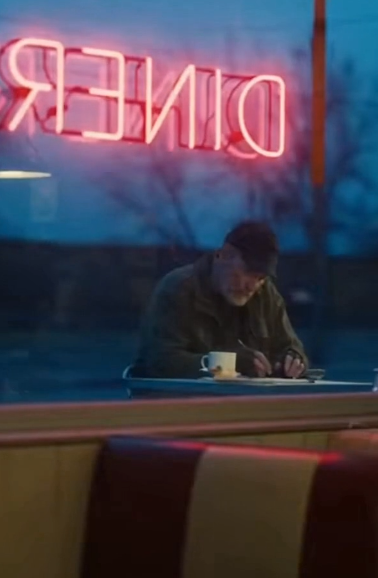
Every day at 6 AM, the same guy sat outside my diner. Gray beard, army jacket, the whole deal. He never asked for money. He just sat there with a small spiral notebook, scribbling.
My waitress Pam called him “The Ghost.” He’d order one coffee, leave exact change, and write for hours.
I felt bad. I started slipping him free toast. He’d nod, never smile.
One Tuesday, he left the notebook on his chair. I grabbed it, planning to return it.
I shouldn’t have opened it.
But I did.
Page after page of names. Hundreds of them. Dates. Locations. Next to each name was a single word: “FOUND” or “UNFOUND.”
My hands started shaking when I got to page 47.
Because there, circled in red, was my maiden name. My address. And the date of my birth.
Next to it, in fresh ink, he’d written: “Confirmed. She doesn’t know.”
I dropped the notebook. When I looked up, he was standing in the doorway.
He wasn’t homeless. He was watching me.
He took one step forward and said, “I’ve been looking for you for thirty-two years. Because you’re not who your parents told you you were.”
The clatter of the notebook hitting the linoleum floor echoed in the sudden silence of the diner. My heart felt like it was trying to beat its way out of my chest.
His eyes, which I’d always seen as distant and clouded, were now sharp and clear. They held a profound sadness.
“My name is Arthur,” he said, his voice raspy but steady. “And I served with your father.”
My father? My father was an accountant named Mark who hated camping and had never held a weapon in his life.
“You’re mistaken,” I stammered, backing away toward the kitchen. “My father is Mark Peterson. He lives two towns over.”
Arthur shook his head slowly, a gesture of immense patience. “Mark and Helen Peterson raised you, Sarah. They loved you. But they are not your birth parents.”
The words didn’t make sense. It was like he was speaking a foreign language. My entire life, my reality, was built on the foundation of being Sarah Peterson.
“Your real father was Sergeant David Sterling,” Arthur continued, his voice softening. “He was my best friend. My brother.”
He took another careful step inside, his gaze never leaving mine. He wasn’t threatening, but the intensity was overwhelming.
“We were in a transport that went down overseas. He didn’t make it. But before he… before the end, he made me promise him something.”
I leaned against the counter for support, my legs feeling like jelly. Pam had frozen by the coffee machine, her eyes wide with alarm.
“He made me promise to find his little girl. He and your mother, Anna, had just had you. He’d only seen you in pictures.”
Arthur’s eyes welled up, and for the first time, I saw the man behind the stoic facade. I saw the soldier.
“He gave me this,” Arthur said, reaching into his worn army jacket. He pulled out a small, tarnished silver locket.
He placed it on the counter and slid it toward me. My hand trembled as I reached for it.
The clasp was stiff, but I managed to pry it open. Inside were two tiny, faded photographs.
On one side was a handsome young man in a crisp army uniform, his smile bright and full of life. On the other was a beautiful woman with kind eyes, holding a bundled-up newborn.
My eyes. She had my eyes.
A sob escaped my lips, a sound I didn’t recognize as my own. It couldn’t be. This was a nightmare.
“What happened to her?” I whispered, my voice cracking. “My… my mother?”
Arthur’s face hardened with grief. “There was a fire at the hospital a week after you were born. A terrible accident. The records were destroyed, chaos everywhere. Anna didn’t survive.”
He paused, letting the weight of his words sink in. “By the time I got back stateside and started looking, you were gone. No records, no trace. The hospital staff thought you’d perished with your mother.”
I stared at the picture, at the woman with my eyes. Anna. A name that was a ghost on my tongue.
“But your father refused to believe you were gone,” Arthur said. “He had a feeling. A certainty. He made me swear I would never stop looking. That I would find you and tell you who you were, and that your parents loved you more than life itself.”
The notebook lay on the floor between us. The list of names. “FOUND.” “UNFOUND.”
“That book,” I said, pointing. “It’s…?”
“Promises I’ve made,” he said quietly. “Men I served with. Lost family, debts to pay, messages to deliver. For thirty-two years, I’ve been crossing names off that list. But yours… yours was the most important.”
The diner door chimed, and a regular customer walked in, oblivious. Pam quickly intercepted him, murmuring something about a gas leak and guiding him back out.
“Why the… the disguise?” I asked, gesturing to his worn clothes. “Why sit out there for months?”
“I found you six months ago,” he explained. “I couldn’t just walk in and drop a bomb on your life. I had to be sure. I had to know you were okay. That you were happy.”
He looked around my little diner, at the cozy booths and the photos of smiling customers on the wall. “I watched you. I saw how you treated people. Giving me free toast when you thought I was a bum. You have your mother’s kindness. And your father’s grit.”
Tears streamed down my face. My whole world was tilting on its axis.
I picked up my phone and dialed my mom’s number. My Helen’s number.
She answered on the second ring, her voice warm and familiar. “Sarah, honey! Is everything alright?”
“Mom,” I said, my voice thick with unshed tears. “I need you to tell me the truth. About where I came from.”
There was a long silence on the other end of the line. A silence that confirmed everything.
When she finally spoke, her voice was a choked whisper. “Oh, Sarah. We always knew this day might come.”
I drove the forty-five minutes to my parents’ house in a daze. Arthur sat in the passenger seat, silent, giving me the space I needed. He had offered to wait, but I couldn’t face this alone.
My parents, Mark and Helen, were standing on the porch when I pulled into the driveway. Their faces were etched with a mixture of fear and resignation.
We sat in the living room, the same room where I’d opened Christmas presents and celebrated birthdays. It all felt strangely foreign now.
Helen began, her hands twisting a tissue in her lap. “We had a baby, Sarah. A little girl. She was born with a heart defect. We lost her after only three days.”
The pain in her voice was as fresh as if it had happened yesterday.
“We were shattered,” Mark added, his arm around his wife. “A week later, Helen was volunteering at the hospital, trying to… to be near other babies. Then the fire started.”
He described the panic, the smoke, the screaming. In the chaos of the evacuation, a nurse had thrust a baby into Helen’s arms, yelling at her to get out.
“It was you,” Helen said, tears finally spilling over. “You were in a bassinet at the end of the hall, away from the main nursery. In the confusion, everyone must have missed you.”
They took me home. In their grief, they saw it as a miracle. A sign.
They went back days later, but the records were a mess. So many lives were lost. They convinced themselves that my parents had died in the fire.
“We were wrong, Sarah. We were selfish,” Mark said, his voice heavy with guilt. “But we loved you so instantly. We couldn’t bear the thought of losing you too. So we just… raised you as our own.”
I looked at their faces, these two people who had tucked me in at night, who had taught me to ride a bike, who had loved me unconditionally my entire life.
I wasn’t angry. I was heartbroken, but not with anger. All I felt was a profound sense of loss for a life I never knew, and a deep, complicated love for the parents who had saved me.
I looked at Arthur, who had been standing quietly by the door. He gave me a small, encouraging nod.
“Your father, David,” Arthur said gently, stepping forward. “There’s more you should know. He came from a very wealthy family. The Sterlings.”
This was another shock. I had always been a working-class girl, proud of my little diner built on hard work and loans.
“He and his father had a falling out,” Arthur explained. “David didn’t want the corporate life his father had planned for him. He wanted to serve his country. His father disowned him.”
It was a classic story of a stubborn father and a rebellious son.
“His father, your grandfather, has spent the last three decades trying to find you,” Arthur said. “He’s used private investigators, law firms… millions of dollars. But they were looking for a ‘Sterling.’ They never found Sarah Peterson.”
My grandfather was alive. He was looking for me.
The next day, Arthur drove me to a part of the state I’d only ever seen in magazines. We pulled up to a massive stone gate that opened onto a long, winding driveway lined with ancient oak trees.
The mansion at the end of the drive was more like a castle. A stern-looking, elderly man was waiting on the steps. He was impeccably dressed in a tailored suit, but his eyes were filled with a desperate, hopeful anxiety.
This was Thomas Sterling. My grandfather.
When I stepped out of the car, his composure broke. He let out a soft gasp.
“Anna,” he breathed, taking a tentative step forward. “You look just like your mother.”
He stopped in front of me, his eyes searching my face. “I was a fool,” he said, his voice trembling with emotion. “I let my pride steal my son from me. And then I lost you. I am so sorry.”
He opened his arms, and I stepped into them. I felt the decades of his regret and his loneliness melt away in that embrace. I was a missing piece of his life, and he was a missing piece of mine.
We spent the rest of the day talking. He told me stories about my father, about his stubborn streak and his big heart. He showed me pictures of my mother, a vibrant artist who had captured his son’s heart.
Later that evening, Thomas Sterling turned to Arthur. He wrote out a check and tried to hand it to him. The number of zeroes on it made my head spin.
Arthur pushed it back gently. “I didn’t do it for money, sir. I did it for David. It was a promise between soldiers.”
Thomas nodded, a look of deep respect on his face. “Then tell me what you want. Anything.”
A slow smile spread across Arthur’s face. It was the first real smile I had ever seen from him.
“There are still names in that notebook,” Arthur said. “Veterans who are lost, who need help getting back on their feet. Families who need to be reconnected. ‘UNFOUNDS’ who deserve to be ‘FOUND.’”
And so, the Sterling Foundation for Veterans was born, funded by my grandfather and run by Arthur. His new mission was to help other soldiers fulfill their promises and find their way home.
My life had changed in a flash, but I didn’t change with it. I didn’t sell the diner.
Instead, I used some of the Sterling resources to expand it. We opened a community kitchen next door, offering free, hot meals to anyone who needed one, no questions asked. The first person in line every morning was a veteran, and Arthur made sure they always had what they needed.
My parents, Mark and Helen, were not pushed aside. They were welcomed with open arms by my grandfather, who thanked them through tears for raising me, for loving me when he couldn’t. My family didn’t break; it grew, becoming a beautiful, messy, wonderful patchwork of people bound by love, not just blood.
Sometimes, when the diner is quiet in the early morning, I take out the silver locket. I look at the smiling faces of David and Anna, the parents I never knew, and I feel an overwhelming sense of peace.
Their story didn’t end in that fire or on that battlefield. It lives on. It lives on in a grandfather’s redemption, in a soldier’s fulfilled promise, and in the little diner where a lost girl was finally found.
Life has a way of writing the most unexpected stories. We learn that family isn’t just the one we are born into, but the one we build. It’s forged in promises kept across decades, in the kindness of strangers, and in the courage to embrace a truth that changes everything. The greatest fortunes are not measured in dollars, but in the connections we make and the love we find in the most unlikely of places.



