
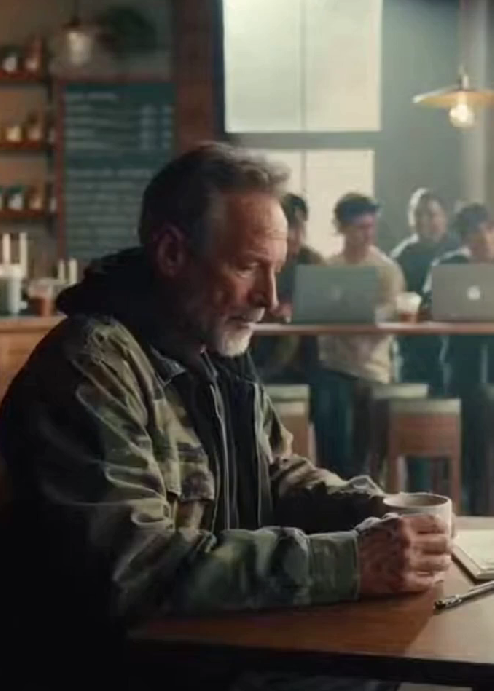
I was sitting at my usual corner table, nursing cold coffee, when the group of college kids started up.
“Look at that old guy in the camo jacket,” one of them snickered. “Still living in 2003.”
I didn’t react. Thirty years of service teaches you to ignore noise.
Another one chimed in: “Bet he sits here all day because nobody wants to hire him. Probably can’t even use a computer.”
They laughed. The barista looked uncomfortable but said nothing.
Then the door opened.
A woman in a tailored black suit walked straight to my table. Everyone in the coffee shop went quiet. She placed her hand on my shoulder.
“Dad?” she said. “Sorry I’m late. The board meeting ran over.”
The college kids stared.
She pulled out a chair. “How was your morning? Did you review those acquisition papers I emailed?”
I played along. “Just got to them.”
She turned to the group of kids, cold as ice. “You should know who you’re mocking. That’s my father. He’s on the board of three Fortune 500 companies. He consults for the Pentagon. And he’s sitting here because he chooses to.”
She looked back at me. “Ready? The investors are waiting, and they specifically asked for you.”
One of the kids opened his mouth. Nothing came out.
But here’s what they didn’t see: my daughter slipped me a photograph from her purse. It was from this morning’s meeting. In the photo, there was someone sitting at the table next to hers. Someone I thought died in my arms twenty years ago.
The slick performance in the coffee shop evaporated the moment we were inside her car. The engine purred to life, a low hum that filled the silence between us.
Eleanor wasn’t my daughter. Not by blood, anyway.
Her father was my commanding officer, a man who fell in the same firefight that I thought had claimed my best friend. I’d made a promise to him on a dusty, forgotten battlefield. A promise to look out for his little girl.
She had been ten then. Now she was a vice president at a tech firm, sharper than anyone I’d ever met.
“Let me see it again,” I said, my voice rough.
She passed the phone over without a word. I zoomed in on the photograph.
It was a generic corporate conference room. Polished mahogany table, bottled water, men in suits. And there, just over Eleanor’s shoulder, was a face I saw every time I closed my eyes.
A little older, lines around the eyes, hair flecked with gray. But it was him.
Marcus Thorne.
My hand trembled. The last time I saw him, he was pushing me into a ditch as a mortar shell whistled overhead. There was a blast, a cloud of smoke and fire, and then… nothing.
They told me he was gone. No body to recover, just a memory. A hero who saved my life.
“Who is he, Eleanor?”
“He was an advisor for the other side,” she said softly. “His name tag said ‘David Stone.’ He works for a small logistics company out of Oregon.”
David Stone. The name meant nothing. The face meant everything.
“The meeting was about a potential partnership,” she continued. “He didn’t say much, just listened. But I saw his hands, Arthur. He has that same scar on his left thumb. The one from the training exercise at Fort Bragg.”
I remembered it clearly. A frayed rope, a clumsy fall, and a lot of laughter that ended with a trip to the infirmary.
The kids in the coffee shop saw an old man in a camo jacket. They saw someone irrelevant, a relic.
They didn’t see the ghost that had just walked back into my life.
For the next two days, I didn’t sleep. I used every resource I had. The consulting work for the Pentagon wasn’t just a title; it was a network.
I made a single, encrypted call to a man I trusted, a general who still owed me a favor.
“I need you to look into a name for me,” I said. “Marcus Thorne. Officially KIA, Afghanistan, two decades ago.”
There was a long pause on the other end. “That’s a sealed file, Arthur. Top-level.”
“Unseal it.”
I could hear him sigh. “This is going to cost me.”
“I know.”
While I pulled military strings, Eleanor attacked it from the corporate side. She was a wizard with data, a digital ghost herself. She dug into the logistics company, the one “David Stone” worked for.
It was a small, unassuming firm. On the surface, it moved medical supplies. But Eleanor found irregularities. Odd shipping routes, shell corporations, and encrypted funding that traced back to a government black budget.
It was a front. A clean, boring company designed to hide people.
The general called me back forty-eight hours later. His voice was strained.
“The file’s not just sealed, Arthur. It’s been scrubbed. The official report is a fabrication. According to this, Marcus Thorne never died. He was reassigned.”
My heart hammered against my ribs. “Reassigned where?”
“It doesn’t say. He just… vanished from the system. He became a ghost. Whoever did this had the authority to rewrite history.”
Eleanor walked into my study, holding her tablet. Her face was pale.
“I found him,” she whispered.
She had cross-referenced the photo with public records, DMV databases, property deeds. It was a long shot, but it paid off.
David Stone lived in a small town called Havenwood, about three hours north. Population two thousand. He owned a small cottage on the edge of a lake. He worked part-time at the town’s public library.
A ghost hiding in plain sight.
“Let’s go,” I said, grabbing my keys. The camo jacket felt heavier than usual.
The drive was quiet. We passed rolling hills and sleepy towns. Each mile brought a fresh wave of questions.
Why would he do it? Why fake his own death and leave me with that memory, that guilt?
Was he in trouble? Was he being forced to hide?
Or the worst thought of all: did he want to get away from me?
Havenwood was exactly what it sounded like. A peaceful, quiet place where everyone knew each other. The library was a quaint brick building with ivy climbing its walls.
We parked across the street. I just watched the front door for a while, my knuckles white on the steering wheel.
“What if he doesn’t want to see me?” I asked, the words barely audible.
Eleanor placed her hand on my arm. Her touch was steady, reassuring.
“His past is still a part of him, Arthur. He deserves to face it. And you deserve answers.”
I took a deep breath and got out of the car.
The library was warm and smelled of old paper and wood polish. A few people were scattered among the shelves. A woman at the front desk looked up and smiled.
“Can I help you?”
“I’m looking for David Stone,” I said.
Her smile widened. “Oh, Dave’s in the back, repairing some old bindings. He’s wonderful with his hands. Just through that door.”
My legs felt like lead as I walked toward the back room. I pushed the door open.
There he was.
He was sitting at a heavy wooden table, a delicate, leather-bound book in his hands. He wore simple glasses perched on his nose. He looked… content. Peaceful.
He glanced up as I entered, a polite, librarian’s smile on his face. Then his eyes met mine.
The smile vanished. The color drained from his face. The tool in his hand clattered onto the table.
“Arthur,” he breathed. It wasn’t a question.
Twenty years melted away in an instant. It was him. It was Marcus.
I couldn’t speak. All the anger, the confusion, the grief I’d carried for two decades swirled inside me, choking me.
He stood up slowly, his eyes filled with a sorrow so deep it took my breath away.
“I never thought… I never thought you’d find me,” he said.
“Why, Marcus?” I finally managed to say. “Why did you let me think you were dead?”
He gestured for me to sit. Eleanor stood quietly in the doorway, a silent guardian.
Marcus sat back down, his hands trembling slightly. He stared at the old book in front of him.
“Because the man who died in that ditch was a hero,” he said, his voice raspy with disuse. “The man who survived was a monster.”
He told me the story. The real story of that day.
The mortar shell I remembered was a diversion. Our primary target was a high-value operative hiding in a nearby village. The intelligence was wrong. The operative wasn’t there.
But a family was. A man, a woman, and their two small children.
In the confusion, in the smoke and chaos, a mistake was made. A terrible, irreversible mistake. Our unit was responsible for civilian casualties.
“There was an inquiry,” Marcus said, his gaze distant. “It was going to be buried. A footnote in a redacted report. The brass wanted to protect the mission, protect us. They called it collateral damage.”
He looked at me, his eyes pleading for me to understand.
“But I saw their faces, Arthur. I was the one who gave the order. It was my mistake. I couldn’t live with a medal on my chest while that family was in the ground because of me.”
So he made a deal. He would take the fall, but not publicly. He would become a ghost. The official story would be his heroic death, saving his comrade. The mission would be sanitized. My record, and the records of the other men, would remain clean.
In exchange, Marcus Thorne would cease to exist. He would be given a new life, a quiet life, where he could live with his ghosts in peace.
“I let you believe I was a hero because it was easier than letting you know I was a failure,” he whispered. “It was my penance. To give up everything. My name, my life, my best friend.”
The weight of his confession settled in the small, dusty room. There was no anger left in me. Only a profound sadness.
He hadn’t run from me. He had run from himself. He had chosen a life of quiet atonement over a life of celebrated lies.
We talked for hours. About the lives we’d lived. About the families we never had. Eleanor joined us, and I told him how I’d watched over his commander’s daughter. A smile touched his lips for the first time.
As dusk began to settle outside, we walked out of the library. We were two old soldiers, weathered and worn, but together again.
And that’s when I saw him.
Leaning against a car across the street was one of the college kids from the coffee shop. The main one, the loudest one. He was talking to an elderly man.
The kid looked over, saw me, and froze. His face went from cocky to horrified in a split second.
The elderly man he was with turned. It was the head librarian, a kind-looking man who had greeted us earlier.
The man smiled warmly. “Dave! Just the man I wanted to see. I wanted you to meet my grandson, Ben. He’s visiting for the weekend.”
Ben looked like he wanted the ground to swallow him whole. He stared at me, then at Marcus, his mouth hanging open.
He saw me, the old guy from the coffee shop. He saw Eleanor, the powerful woman in the suit. And he saw Marcus, the quiet librarian his grandfather respected. Three people he couldn’t possibly reconcile with the joke he’d made two days ago.
I walked over, Marcus at my side.
“Ben,” his grandfather said. “This is Arthur, a friend of Dave’s.”
Ben couldn’t look me in the eye. “Sir,” he mumbled, his voice cracking. “I… I am so sorry. About the other day. I was an idiot. There’s no excuse.”
I looked at this young man, so full of bravado and so utterly humbled. I could have shamed him. I could have let Eleanor slice him to pieces with a few well-chosen words.
But I looked at Marcus, a man who had lived with a much heavier burden than a foolish comment. I thought about the grace of a second chance.
“We all make assumptions, son,” I said, my voice even. “The important thing is what we learn from them.”
I put my hand on Marcus’s shoulder. “This is my friend. He served his country with more honor than most people will ever understand. He just does it quietly.”
Ben looked at Marcus, then back at me. For the first time, he wasn’t seeing a camo jacket or a librarian’s cardigan. He was seeing the stories underneath.
The story didn’t end there. Marcus didn’t stay a ghost.
Slowly, carefully, he started to reconnect with the world. He and I would meet for coffee, not as a CEO and a librarian, but as two old friends who had found their way back. Eleanor made him a part of her life, a living link to the father she barely remembered.
As for Ben, he wrote me a letter. A long, heartfelt apology. He asked if there was any way he could volunteer to help veterans, to understand what people like us had been through. I connected him with a local charity I supported. Last I heard, he spends every Saturday there, listening to stories far more incredible than mine.
The lesson in all of this isn’t just about judging a book by its cover. It’s about realizing that every single person is an entire library.
They are filled with stories of love and loss, of triumph and regret, of quiet heroism and silent burdens. You might only see the worn-out jacket on the outside, but you have no idea of the wars, the peace, and the poetry hidden within the pages.
True strength isn’t found in a boardroom or on a battlefield. It’s found in the quiet dignity of a man repairing a broken book. It’s found in the courage to face the ghosts of your past. And sometimes, it’s found over a simple cup of coffee, when a long-lost friend walks back into your life.



