
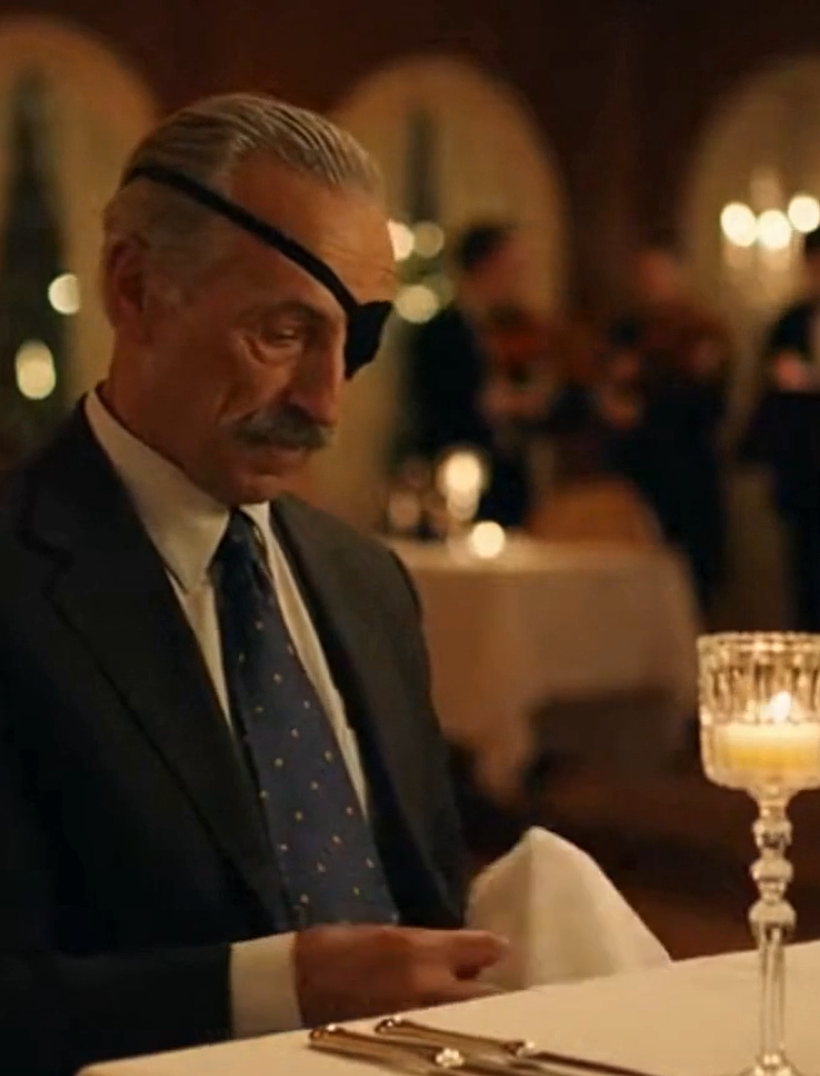
The silverware clinked softly at La Fontaine, the kind of restaurant where a glass of wine cost more than most people’s grocery bill. White tablecloths. Candles flickering in crystal holders. A string quartet playing near the entrance.
Walter Harris sat alone at table nine.
His hands shook as he unfolded the napkin. They always shook now. Had since 2004, since the blast outside Fallujah that took his left eye and three fingers on his right hand. He wore a simple dark suit, pressed but outdated, and a tie his late wife Dorothy had picked out for their 40th anniversary. Tonight would have been their 52nd.
He’d saved for three months to eat here. Dorothy always wanted to try it.
The couple at table twelve noticed him first.
“Oh my God, look,” the woman whispered, loud enough for the tables around her to hear. She wore a diamond tennis bracelet and a smile that looked like it had never known hardship. “He’s going to spill everywhere. Why do they let people like that in here?”
Her husband laughed. “Probably wandered in from the VA shelter down the block.”
Walter heard them. His jaw tightened, but he said nothing. He picked up the menu with his three-fingered hand, the print blurring slightly in his one good eye.
The waiter, a college kid named Marcus, brought his water. Walter’s hand trembled so badly that the glass knocked against his teeth. Water dribbled down his chin.
The woman at table twelve snorted. “This is a five-star restaurant, not a nursing home.” She raised her hand and snapped her fingers at a passing server. “Excuse me? Can you move us? We’re trying to enjoy a $400 meal and that man over there is making it impossible.”
Heads turned. Several diners looked at Walter. Some looked away fast. Nobody said anything.
Walter set down his glass carefully. He wiped his chin with the napkin. His remaining fingers gripped the table edge, knuckles white.
“I’m sorry,” he said quietly to Marcus. “I’ll try to be more careful.”
“Sir, you’re fine,” Marcus said, but his voice was barely a whisper.
The woman stood up. “This is ridiculous. Where is the manager? I want the manager right now.”
The kitchen doors swung open. Out walked David Chen, owner and head chef, holding a small leather folder. He was a tall man, former Marine, with a crew cut and steady eyes.
He walked past the woman without acknowledging her.
He walked straight to table nine.
“Sergeant Major Harris,” David said, and his voice carried across the silent dining room. He set the leather folder on the table and opened it. “I received your reservation request last week. I looked up your name.”
David’s voice cracked.
“Ladies and gentlemen.” He turned to face the room. “This man led the rescue convoy that saved thirty-one Marines in Fallujah, November 2004. He lost his eye, three fingers, and sixty percent of the hearing in his left ear pulling men from a burning vehicle while under enemy fire. He received the Navy Cross. He spent eleven months in a military hospital learning to walk again.” David paused. “His wife Dorothy wrote to our restaurant eight years ago, saying it was her dream to eat here with her husband. She passed before they could.”
The room was completely still.
David turned back to Walter. “Your money is no good here tonight, Sergeant Major. Not tonight. Not ever.”
Walter’s chin trembled. He pressed his three fingers against his eyes.
The woman at table twelve had gone pale. Her husband was staring at his plate.
Then a man at table four pushed back his chair and stood. Then a woman near the window. Then Marcus. Then another couple. Then another.
One by one, every person in that restaurant rose to their feet.
Except the couple at table twelve.
David Chen turned to look at them, and the leather folder in his hand wasn’t a menu. It was a frame. Inside was a photograph, faded and creased, of a young woman standing outside La Fontaine’s entrance, smiling, holding a handwritten sign that read –
“One day, my friend will own this place. And when he does, his first meal is on me.”
Walter stared at the picture. He blinked his good eye, trying to clear the haze of tears and memory.
The woman in the photograph was his Dorothy.
She was younger, her hair a shade darker, but the smile was unmistakable. It was the same smile that had greeted him at the airport after every tour of duty. The same one he saw in his dreams.
The restaurant, still standing, held its collective breath. The string quartet had stopped playing.
David Chen gently placed the framed picture on Walter’s table, propping it against the small vase of flowers. His voice was softer now, meant only for Walter.
“I was a dishwasher here, eighteen years ago. Fresh out of the service myself, trying to figure out what to do with my life.”
He pulled out the chair across from Walter and sat down, a move that broke every rule of fine dining etiquette.
“I worked a second job at a little diner down the street, the one with the cracked vinyl booths. That’s where I met her.”
Walter looked from the picture to David’s face, confusion warring with a deep, rising tide of emotion.
“Dorothy,” David clarified, his gaze fixed on the photo. “She came in every Tuesday for the meatloaf special. She always sat at the counter.”
He smiled, a sad, fond memory playing across his face.
“She’d ask me about my day. I told her I wanted to be a chef, that I dreamed of owning La Fontaine. Everyone else laughed. I was a kid with no money, no connections.”
David shook his head slightly.
“But not Dorothy. She never laughed.”
“She told me my dream was valid. She said hard work and a good heart were better than any inheritance. She’d leave me a five dollar tip on a four dollar meal, every single time.”
Walter’s hand, the one with all its fingers, covered his mouth. He remembered those Tuesdays. Dorothy always said she was meeting her book club.
“One day, I was about to quit,” David continued, his voice low. “I was tired, broke. I told her I was giving up. The next day, she showed up at the diner with this picture. Her friend took it. She told me to keep it, to look at it whenever I felt like I couldn’t go on.”
He pointed to the handwritten sign in the photo.
“She made me promise that when I finally bought this place, I’d let her buy me the first meal. It was her way of investing in me.”
David looked up, and his steady eyes were now shining with unshed tears.
“I bought this place seven years ago, sir. I tried to find her. I called every Harris in the phone book. By the time I found an old address, I learned she had passed away.”
The silence in the room was a heavy blanket. The story hung in the air, a testament to a quiet kindness that had blossomed into this very moment.
Walter finally found his voice. It was a ragged whisper. “I never knew.”
“She was my angel, Sergeant Major,” David said. “When your reservation came through, with her last name… I had to know. And when I saw your history, I understood. She came from a generation that understood sacrifice.”
The standing ovation had long since ended. People were sitting back down, but not a single person had resumed their meal. They were all witnesses.
The couple at table twelve remained seated, a small island of shame in a sea of respect. The woman, Beatrice, had her clutch bag open on her lap and was pretending to search for something inside. Her husband, Richard, cleared his throat.
“Well,” Richard said, his voice too loud, too forced. “That’s quite a story. We had no idea, of course.”
He pulled out a thick wallet. “Let me, uh, cover this gentleman’s meal. And perhaps a round of drinks for the room, for the misunderstanding.”
David Chen slowly rose from Walter’s table. He walked over to table twelve. He didn’t look angry. He looked tired.
“Your money is as worthless here as your apology, sir,” David said, his voice calm but sharp as a chef’s knife.
“We value character in this establishment. Not the balance in your bank account.”
Beatrice snapped her clutch shut. “How dare you? Do you know who we are?”
“No,” David said plainly. “And I have no desire to. What I do know is that I saw a man, a decorated veteran, a widower honoring his wife, being treated with contempt. And that is something I will not have in my restaurant.”
He gestured to Marcus, the young waiter. “Marcus, please bring Mr. and Mrs. Albright their check. For the water they drank.”
Richard Albright’s face turned a shade of purple. “This is an outrage! I’ll have you know I’m a very influential person in this city!”
As he spoke, a man from a nearby table stood up. He was older, with a kind face and a sharp suit.
“You’re Richard Albright, of Albright Development, aren’t you?” the man asked.
Richard puffed out his chest, relieved to be recognized. “That’s right.”
The man’s kind expression hardened. “I thought I recognized you. You’re the one who bought the old VFW building on Elm Street and turned it into luxury lofts.”
A murmur went through the room.
“You evicted two dozen veterans, some of them disabled, to do it,” the man continued, his voice growing stronger. “My uncle was one of them. He lived there for thirty years.”
The air crackled. The karmic circle was closing.
Richard Albright stammered, his face now pale. “That was a business transaction. It was perfectly legal.”
“Some things that are legal are not right,” David Chen said quietly. He placed a small, single-item bill on their table. “Please pay and leave. You are no longer welcome here.”
Beatrice stood up so quickly her chair nearly toppled over. She grabbed her husband’s arm, her face a mask of fury and humiliation, and pulled him towards the door. They didn’t look back.
The door to La Fontaine swung shut behind them, and the entire restaurant seemed to exhale at once.
The tension broke. The string quartet softly began to play again, a gentle, soothing melody.
David returned to Walter’s table. “Sergeant Major, I apologize for that scene. Tonight was meant to be for you and Dorothy.”
Walter shook his head, looking at his wife’s smiling face in the frame. “She’s here,” he said, tapping the glass. “You brought her here.”
What happened next was slow, and organic. It started with the man whose uncle had been evicted. He walked over, a glass of red wine in his hand.
“Sergeant Major Harris,” he said. “My name is Tom. I never served, but my father was at Normandy. I’d be honored if you’d let me toast your service, and your wife’s incredible spirit.”
He raised his glass. Walter, his hand trembling slightly less now, picked up his water glass.
Soon, others followed. A young woman came by, explaining that her brother was currently serving in the Air Force. An elderly couple shared that they, too, were celebrating an anniversary, their 60th, and that they understood the feeling of missing a loved one.
Table nine, once a lonely outpost, became the heart of the restaurant.
Walter, a man who rarely spoke of his time in the service, found himself sharing small stories. Not of the battle, but of the camaraderie. He spoke about Dorothy’s care packages, how her letters were passed around and read by a dozen homesick Marines.
David disappeared into the kitchen and returned not with a menu, but with two plates.
“The Tuesday meatloaf special,” he said, placing one in front of Walter. “It’s not on the menu. I haven’t made it in years. But I think Dorothy would want you to have it.”
The other plate he placed in the empty seat across from Walter. “And one for the lady who started it all.”
Tears streamed freely down Walter’s face now, but he wasn’t trying to hide them. They weren’t tears of sorrow, but of overwhelming gratitude. He had come here to feel close to Dorothy in his loneliness, and instead, he found himself surrounded by her love, a living legacy of her kindness.
He ate the meal, the best meatloaf he had ever tasted. Each bite was a memory, a conversation, a connection to the woman he had loved for over fifty years. He was no longer just a man with trembling hands. He was a husband, a hero, a keeper of stories.
When he was finished, the restaurant was beginning to empty out. David walked him to the door.
“Please, come back any time,” David said. “This is as much your place as it is mine.”
He handed Walter a small, carefully wrapped package. “I want you to have this.”
Walter opened it. It was the framed photograph of Dorothy.
He clutched it to his chest. “Thank you, son. For everything. For remembering her.”
“How could I forget?” David replied. “She taught me that the best ingredients in any recipe are kindness and respect.”
Walter walked out into the cool night air, the sounds of the city a distant hum. He looked up at the stars, the same stars that had watched over him in the desert, the same ones that had shone down on his wedding day.
He had walked into the restaurant a lonely old man, judged by his appearance, weighed down by his past. He walked out carrying a piece of his wife’s secret life, his heart full, his spirit seen.
The story of that night at La Fontaine would be told for years. It was a simple story, really. It wasn’t about the public shaming of a wealthy couple or the celebration of a war hero. It was about the quiet power of a single, unseen act of kindness. It was a lesson that we never truly know the battles people have fought, the burdens they carry, or the beautiful, invisible legacies they leave behind. And that true wealth is not measured by what you have, but by the positive impact you have on the lives of others, an impact that can ripple through years and turn a lonely dinner into a feast of the human spirit.



