
“Is today special, sir? Or do your hands always tremble like that?”
Corporal Mallerie made sure everyone heard him, his voice booming across the Exchange. It was loud enough to humiliate.
There I was, stepping down the snack aisle, water bottle halfway to my lips, when an uncomfortable silence took hold. Everyone’s attention turned to the exchange.
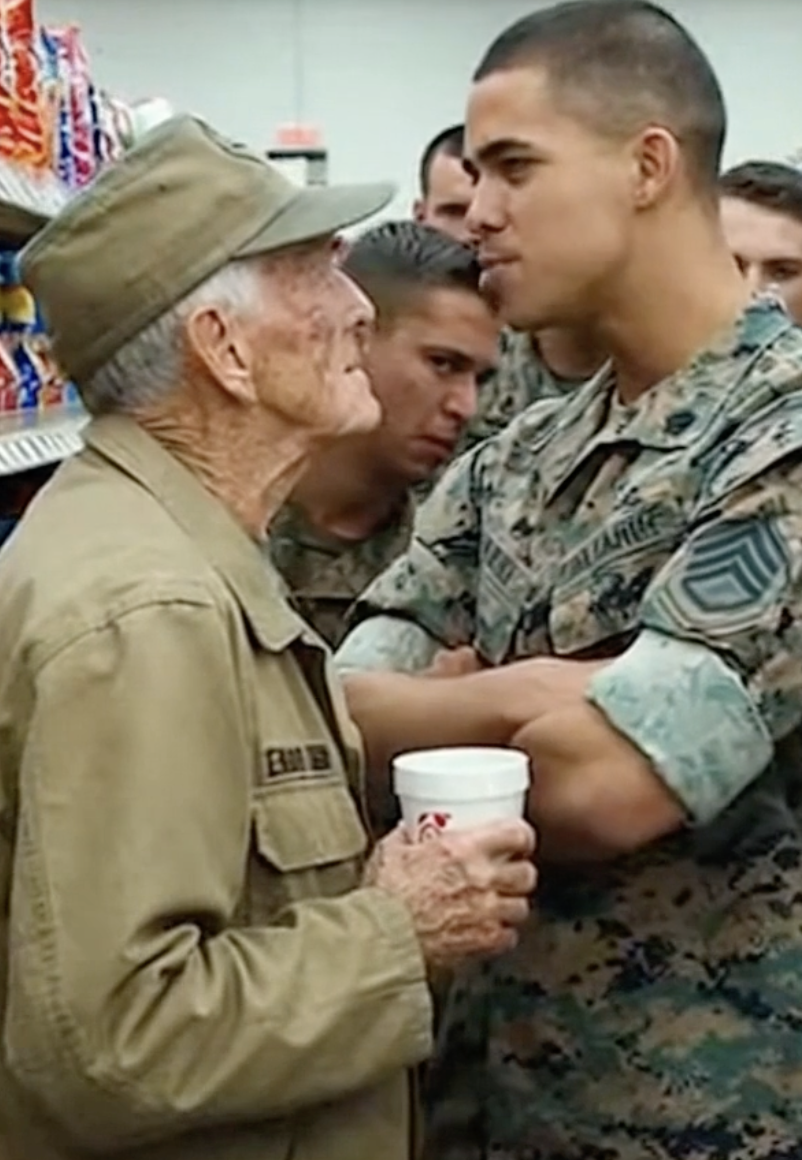
The elderly gentleman at the register didn’t flinch. He was frail, his coffee cup barely staying upright, yet he carried an air of quiet authority. The kind of backbone that comes from years of standing tall, a veteran’s backbone.
Mallerie, however, was on a misguided power trip. His posture screamed arrogance: feet planted apart, arms crossed, his chin raised. Riding a high from his first promotion, he confused rank with actual respect.
He took a step closer.
“Did you steal those ribbons, Grandpa? Or pick ’em up on eBay?”
Not a single person moved to stop him.
And I’ll admit, that’s partly my fault. I’m Lieutenant Harris, and I did nothing. It wasn’t because of fear. I outranked Mallerie, but something about the old man seemed sacred, like he commanded a certain reverence.
Then Mallerie crossed a line.
“Impersonating a Marine is a felony, you know. Should I report this?”
That’s when I noticed something on the man’s belt—a canteen, worn and scratched, bearing a name that made my heart skip.
COLE.
I felt a drop in my stomach. My fingers moved swiftly as I typed, scarcely believing the results that appeared.
Master Sergeant Everett Cole.
The name was legendary, whispered at Officer Candidate School. Stories of valor and sacrifice echoed in those halls, tales of a man who walked through fire so others could live.
I quickly made a call.
“Sir,” I whispered, turning away from the freezer’s glare, “I believe you need to come to the Exchange, urgently.”
“I’m in a meeting, Harris,” the voice on the line replied, tense.
“Sir. The name on the canteen says Cole.”
Silence followed. Then came the sound of a chair scraping back.
“Ensure he doesn’t leave.”
I turned around just as Mallerie reached for the old man’s chest.
“Let’s see if those are real or plastic—”
“Corporal!” I called out, stepping up.
But it was not my voice that halted him.
It was the swift slamming of doors.
The Base Commander raced inside.
Colonel Briggs bypassed everyone. No words spoken. He moved straight toward the old man, dropped to one knee as if before a cherished flag, and said—
“Master Sergeant Cole, sir. It’s an honor. Welcome home.”
The mood in the room shifted profoundly.
It felt like the gravity had changed.
Mallerie stumbled back, his face drained of color. He tried to speak, yet nothing emerged.
Cole gazed down at Briggs, eyes steady. No signs of arrogance or triumph, just quiet patience—as if he’d seen it all before.
“Please rise, Colonel. You’re creating a scene.”
Slowly, Briggs stood, eyes never leaving Cole’s. They were moist. The kind of tears men like him rarely let fall.
“Yes, sir,” he murmured gently.
That’s when Mallerie committed another blunder.
He scoffed again.
“I don’t get it. It’s just some old guy, and he’s supposedly a legend?”
Briggs turned sharply.
“Corporal, you’re dismissed.”
“What? Sir, I didn’t—”
“I said dismissed.”
“But I never even touched him!”
Briggs didn’t need to raise his voice.
“Corporal, leave now, or I’ll have you escorted out in cuffs.”
Mallerie hesitated briefly, then stormed out. But not without absorbing the weighty stares around him. Not filled with anger or disgust.
Disappointment.
The kind that hangs heavy.
I approached cautiously, debating if I should speak.
“Master Sergeant Cole,” I started, trying to sound less like a nervous schoolboy, “I… I apologize.”
His eyes softened as he looked at me.
“Son, don’t apologize for another’s ignorance. Just ensure you don’t become them.”
This pierced deeper than any reprimand could.
Cole returned to the register, his hands still slightly trembling as he fetched a ten-dollar bill. The cashier appeared more shaken than him.
Briggs intervened.
“Sir, allow me to handle this.”
Cole offered a slight smile. “I believe I can afford coffee, Colonel.”
“That’s not the point,” Briggs said, voice filled with emotion. “Today, you don’t pay here.”
The room parted quietly as they exited, like friends reuniting after a long journey.
I stood there, trying to absorb what had transpired. Even men with stars on their shoulders didn’t command that level of respect.
One of the younger privates beside me finally asked.
“Who was he?”
I turned to respond, but someone else stepped forward.
A woman in her late fifties approached. Her hair was a tightly managed bun. She wore civilian attire, yet her posture spoke of military discipline.
She spoke softly, her eyes still on the exit where Cole disappeared.
“That’s my father. He didn’t want anyone to know he was here.”
We all turned.
She cast a long gaze at each of us. Not with anger, but with a quiet warning.
“He’s here for a funeral. His last surviving squadmate. The burial’s at the cemetery by the old training grounds.”
We maintained our silence.
She continued calmly.
“Attention never appealed to him. Not when they awarded him the Silver Star. Not when he rescued two men from a burning Humvee. Not when he ran miles through enemy lines with a shattered leg.”
A low whistle escaped someone at the back.
She met my gaze.
“Lieutenant, you did the right thing.”
“I hesitated.”
“You noticed. You acted. That counts.”
A small nod, then she moved to leave.
But at the door, she turned once more.
“As for the Corporal… don’t be too harsh. Arrogance often mirrors fear. Dad used to say the loudest ones are frequently the most scared.”
She departed.
We lingered in the ensuing silence.
Later, Colonel Briggs summoned me to his office.
He seemed weary. Older, somehow.
“He’s staying on base for the night,” he informed me. “In the officer’s guest quarters.”
I nodded. “Understood, sir.”
“Dinner invitation. With him.”
My eyes widened. “Sir?”
“He’s requested your presence.”
That night, I sat across from a man whose name was synonymous with history. You wouldn’t recognize him if you passed him on the street.
We dined slowly. Conversations were measured, each word carrying weight.
He recounted stories absent from the official records.
Like the time he sacrificed his rations for a week, allowing a young recruit to send money home.
Or when he carried a letter for months, belonging to a soldier who never returned.
Yet, he also revealed the burdens.
The medals didn’t erase the nightmares. They couldn’t revive his fallen friends.
Yet he wore them.
“Not for me,” he explained. “For those who couldn’t return to wear theirs.”
I enquired why he didn’t correct Mallerie.
He merely shrugged.
“I was once a corporal, convinced I knew everything.”
I chuckled, but he remained serious.
“The most merciful lessons are often those we learn through our own embarrassment.”
That resonated with me.
Post-dinner, he stood, hands still unsteady, and saluted me.
“You’ll be a commendable officer, Harris. Never lose sight of why you wear that uniform.”
With a lump in my throat, I returned the salute.
“Thank you, Master Sergeant.”
Two weeks rolled by.
The tale spread across the base, but Cole was already gone. Departed as quietly as he came.
Mallerie? He was transferred.
No dismissal. No demotion.
Briggs took a different approach.
He assigned him to the veteran rehabilitation unit, where he became an assistant among the physical therapy team.
It seemed a punishment at first glance.
But it wasn’t.
One afternoon, I spotted Mallerie at the gym. He was tenderly aiding a double amputee Marine with his prosthetic—displaying a gentleness I hadn’t expected.
He noticed me. Approached.
“I owe you an apology,” he confessed. “I was utterly wrong.”
I nodded. “Seems you’ve realized that now.”
He lowered his gaze, then met my eyes.
“I sent him a letter. Not sure he’ll read it, but I had to do it.”
“That’s commendable.”
Before departing, he paused.
“Thanks for not making things worse.”
I shrugged. “That was never my intention.”
Months slipped by.
Then one day, an unexpected package lay on my desk.
No return address. Merely a name.
Cole.
Inside, a worn photograph of soldiers gathered in front of a tent, grinning, arms draped over each other’s shoulders. Dusty. Exhausted. Alive.
On the reverse side, neatly written:
“Only one left. Keep the story alive.”
Beside it was a brief note.
Lieutenant Harris,
You noticed when others might have overlooked. You saw deeper. That is noteworthy.
Someday, you’ll face scrutiny. Others may question if you’ve earned your place. Smile warmly. Let them doubt. And continue earning it, regardless.
— E.C.
That photo resides on my wall.
Not as a display piece, but as a reminder.
A daily reminder that respect isn’t freely given—it’s continually earned. Through our words. Our listening. Our perception of one another.
Master Sergeant Cole never raised his voice to impart a lesson. He needed no rank to hold a room. His mere presence was a lesson in true honor.
And Corporal Mallerie? He evolved.
Last I heard, he pursued a career in physical therapy. Said he aims to help those who return fragmented feel complete again.
It’s intriguing how one moment—just a trembling hand—can initiate profound changes in us all.
If this tale moved you… share it.
Because many out there deserve a reminder:
Respect is not rooted in medals, age, or titles. It’s grounded in our demeanor—especially when no one’s watching.



