
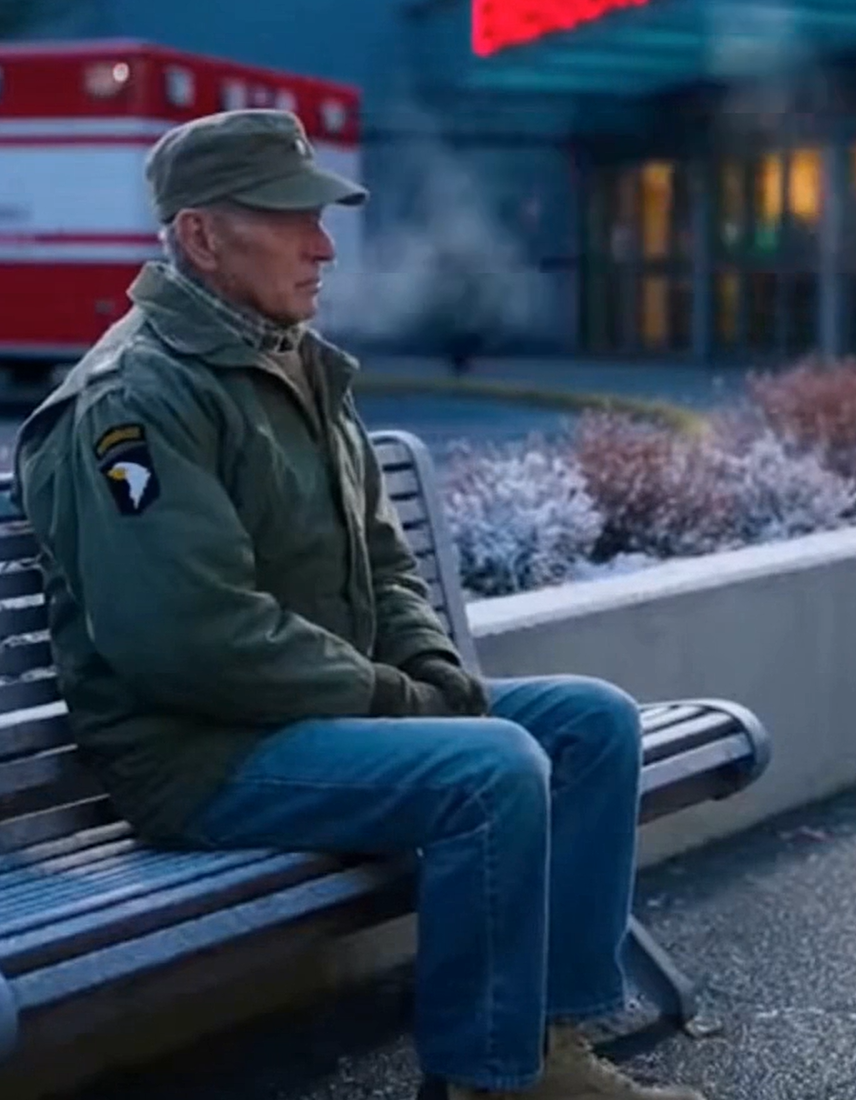
The nurses at St. Luke’s Memorial called him “the Colonel.”
Nobody knew if he’d actually been a colonel. Nobody had bothered to ask.
He was just the old man on the bench outside the emergency room entrance, rain or shine, every single day from 7 a.m. to 6 p.m., wearing the same faded green Army jacket with a 101st Airborne patch on the shoulder.
He never panhandled. Never caused trouble.
He just sat there with his hands folded in his lap, watching the ambulances come and go.
For three years.
Hospital security had tried to move him twice. Both times, he left quietly, then came back the next morning before the shift change.
Eventually, they stopped asking. He became part of the scenery, like the concrete planters and the automatic doors.
Some of the younger staff made jokes. “There’s your boyfriend, Claire,” they’d say when nurse Claire Dawson walked past him on her way in.
She never laughed. Something about the way he sat – straight-backed, chin up, eyes alert – told her this wasn’t a man who had given up.
This was a man who was waiting.
On a Tuesday in November, the temperature dropped to twenty-eight degrees. Claire came in for her morning shift and saw him there, frost on the bench, his breath coming out in thin white clouds.
His lips were pale. His fingers were tucked inside his sleeves.
She stopped.
“Sir.”
He looked up. His eyes were sharp, pale blue, clear as glass.
“Sir, it’s below freezing. Can I bring you inside? We have a waiting area.”
“No, ma’am. I’m fine right here.”
“You’re not fine. You’re hypothermic.”
“I’ve had worse.” A small smile. “Kandahar, 2003. Slept in a ditch for eleven hours. This is a vacation.”
Claire crouched down to his level. “I’ve seen you here every day for three years. Every single day. Why?”
He didn’t answer right away. His jaw tightened.
He looked toward the emergency room doors, watching a mother carry a toddler inside. Then he reached into his jacket pocket with stiff fingers and pulled out a photograph so creased and worn the image was barely visible.
A young woman. Dark hair. Hospital scrubs. She was laughing at whoever held the camera.
“My daughter,” he said. “Rebecca. She was a nurse. Right here. ER trauma unit.”
Claire felt her stomach drop. “Was?”
“She worked a double shift on Christmas Eve, 2020. Drove home at 3 a.m.” His voice didn’t crack.
It was steady, military-steady, the kind of steady that takes everything you have. “Fell asleep at the wheel. They brought her in through those doors. She died in the hospital where she saved other people’s lives.”
Claire’s throat tightened.
“After that, I lost the house. Couldn’t keep up with things. Didn’t want to.”
He folded the photograph carefully and put it back. “But I come here every morning because this is the last place she was alive. The last place she mattered. And I figure if I sit here long enough, maybe I can do what she did.”
“What do you mean?”
“Three weeks ago, a woman collapsed right there on the sidewalk. I caught her before she hit the ground. Called inside for help. Last month, a kid wandered out of the ER, no parent in sight. I walked him back in. In January, a man sat down next to me and told me he was thinking about ending it all. We talked for two hours.”
Claire’s eyes blurred. She blinked hard.
“I’m not a nurse,” he said. “I’m not a doctor. But I can sit here. I can watch. I can be the person who sees what everyone rushing past doesn’t.”
Claire stood up and walked inside without a word. Her hands were shaking.
She went straight to the nurses’ station where six staff members were starting their shift, pouring coffee, checking charts.
“That man outside,” she said. Her voice carried across the entire unit.
Heads turned. “His name. Does anyone know his actual name?”
Silence.
She told them everything. By the time she finished, two nurses were crying.
Dr. Patel had stepped out of an exam room to listen. Even the security guard by the door had gone quiet.
That afternoon, the hospital director came down personally. Claire watched from the window as he walked outside to the bench, sat down next to the old man, and handed him a laminated badge.
The veteran looked at it for a long time. His hands trembled.
He ran his thumb across the printed text, then pressed the badge against his chest and closed his eyes.
Claire couldn’t read the badge from the window. She pushed through the doors and walked outside, her shoes crunching on the cold pavement.
When she got close enough to read it, she stopped.
Under the hospital logo and the old man’s photograph, the badge read: Edward R. Dawson – Volunteer Patient Guardian, Emergency Department.
Claire’s breath caught. She read the last name again.
Then she looked at the old man’s face – really looked – and something cold moved through her.
She turned back toward the hospital entrance, where her mother’s framed memorial portrait had hung in the nurses’ lounge for three years.
The same last name. The same pale blue eyes.
Edward looked up at her, and his expression shifted — like a man seeing a ghost, or maybe like a ghost finally being seen.
“You have her smile,” he whispered.
The world seemed to tilt on its axis. The sound of a distant siren, the rumble of a passing bus, it all faded into a low hum.
Dawson. It was her name. It was her mother’s name.
“Grandpa?” The word was a breath, a question she hadn’t known she was holding for a decade.
She had been told he was gone. After her mom died, there was just… nothing. No calls, no letters.
Claire had been eighteen, consumed by her own grief, and had assumed the silence meant he had passed away, another victim of a broken heart.
He nodded slowly, those clear blue eyes now shimmering with unshed tears. “I didn’t know how to find you, Claire. And even if I did, I didn’t think I deserved to.”
The cold air bit at her cheeks, but she didn’t feel it. All she could feel was the pull of a history she thought was buried.
“You’ve been out here… this whole time?” she asked, her voice cracking. “Watching me?”
“I had to make sure you were okay,” he said, his voice thick with emotion. “It was the only thing I had left to do for her.”
She sank onto the bench beside him, the cold seeping through her scrubs. The space between them felt like a canyon filled with years of silence and misunderstanding.
“I thought you were dead,” she said softly.
“In a way, I was,” he admitted. “The best part of me died with her.”
The hospital director, who had been standing respectfully a few feet away, cleared his throat. “Ms. Dawson, perhaps you two would like some privacy. The staff lounge is empty.”
Claire nodded, unable to form words. She helped her grandfather to his feet.
His body was stiff with cold and age, but his grip on her arm was surprisingly strong, as if he was afraid to let go.
Inside, the warmth of the hospital was a shock. Fellow nurses averted their eyes, giving them space.
They sat in the small lounge, the memorial portrait of Rebecca Dawson smiling down at them from the wall. It was a picture from a hospital charity run, her face bright with life.
“Why didn’t you say anything?” Claire finally asked, the question breaking the fragile silence. “For three years, I walked past you every day.”
Edward stared at his worn boots. “Shame is a powerful thing, kid.”
“Shame for what?”
“For the last words I said to your mother,” he confessed, his voice dropping to a raw whisper. “We had a fight. A stupid, stubborn fight.”
He explained that it was about money. He’d wanted to give Rebecca the last of his savings to help her put a down payment on a small house, a place for her and Claire.
“She wouldn’t take it,” he said. “Said I needed it more. Said she was fine on her own.”
He had been a proud man his whole life, a man who provided. Her independence, which he should have admired, felt like a rejection.
“I told her she was being foolish. That she was too proud for her own good. She said I was trying to control her life, just like I always had.”
The words hung in the air, heavy and sharp.
“She left angry,” he continued. “I was going to call her the next morning. To apologize. I was going to tell her she was right.”
But that call never happened. Instead, he got a call from St. Luke’s Memorial.
“When I lost her, I lost everything,” he said, finally looking up at the portrait. “The house was in her name. I couldn’t face the paperwork, the lawyers, the emptiness of it all.”
He just walked away. He took his jacket, his wallet, and the photo of his daughter, and he left the life he knew behind.
“I ended up here,” he said, gesturing vaguely toward the window. “It was the only place that made sense. The last place she was.”
He explained how, after a few weeks, he saw Claire for the first time. She was coming out of the hospital, wearing student scrubs, her face a mask of determination and grief.
“You looked so much like her,” he whispered. “I wanted to run to you, to hold you. But what could I offer? A broken old man who drove his own daughter away?”
So he stayed on his bench. He watched her graduate. He watched her get her first nursing pin.
He watched her grow into a confident, compassionate woman, the very image of her mother. He was her silent guardian, a role he gave himself as a form of penance.
Tears streamed freely down Claire’s face now. She understood the depth of his pain, the crushing weight of his guilt.
“Mom loved you so much, Grandpa,” she said, her voice choked. “She knew you were stubborn, but she loved you for it, too. She used to say you had a heart as big as a mountain, you just didn’t know how to show it.”
He let out a shaky breath, a sound like a dam breaking.
She reached out and took his chapped, cold hand. “Let’s get you warmed up. And then you’re coming home with me.”
For the first time in three years, Edward Dawson left his post. He walked through the hospital not as a specter, but as a man being led back to the world of the living by his granddaughter.
The next few days were a blur. Claire got him a room at a nearby hotel while she cleaned out her spare bedroom.
She bought him new clothes, warm socks, a thick winter coat. He accepted it all with a quiet humility that broke her heart.
He was like a man learning to live indoors again. He marveled at the simple luxury of a hot shower, of a soft bed.
One evening, as they were sorting through some of her mother’s old things that Claire had kept in storage, she came across a small, sealed box from the hospital.
“Personal Effects,” the label read. “Rebecca Dawson.”
She had never been able to bring herself to open it. It felt too final.
“We should open it,” Edward said, his voice steady. “Together.”
They sat on the floor of her small living room and Claire carefully cut the tape. Inside was her mother’s watch, her wallet, a well-read paperback novel.
And at the bottom, a silver locket on a delicate chain.
Claire gasped. “I remember this. She wore it every single day.”
Edward took it from her, his fingers trembling as he fumbled with the tiny clasp. It sprang open.
On one side was a miniature photo of a much younger Claire, all pigtails and a missing front tooth. On the other side wasn’t a photo, but a tiny piece of paper, folded into a minuscule square.
With painstaking care, Edward unfolded it. It was a note, written in Rebecca’s familiar, flowing script.
The ink was slightly faded, but the words were clear.
“Dad,” it read. “I know we fight. I know we’re both too stubborn. But please never forget that you’re my hero. I forgive you. Always. Love, Becca.”
Edward stared at the note, his breath catching in his chest. He read it again, and then a third time, as if committing every letter to memory.
A single tear rolled down his weathered cheek and fell onto the note. He had been carrying the weight of their last fight for three years, believing he had lost his daughter on a note of anger.
But she had been carrying his forgiveness around her neck the entire time.
“She knew,” he whispered, a profound sense of peace settling over his features. “She knew.”
That locket was the key that finally unlocked the prison of guilt he had built around himself.
In the following weeks, a new routine formed. Edward, now officially a “Volunteer Patient Guardian,” would come to the hospital with Claire.
He no longer sat on the cold bench outside. He had a designated chair just inside the ER waiting room.
He greeted scared patients with a calm smile. He read stories to children whose parents were with the doctor. He sat with elderly people waiting for a ride, listening to their stories.
He was no longer the silent, grieving man on the bench. He was Edward, the kind man with the pale blue eyes who had a knack for making people feel seen.
The staff, who once called him “the Colonel,” now just called him “Grandpa.” They brought him coffee and shared their lunch with him. He was part of their family.
One sunny spring afternoon, about six months later, Claire and Edward stood in a quiet cemetery in front of a simple headstone.
REBECCA ANNE DAWSON. BELOVED MOTHER AND DAUGHTER.
Edward placed a small bouquet of daffodils on the grass. He was wearing a new, warm jacket, his volunteer badge pinned proudly on the lapel.
“She would be so proud of you, Claire,” he said, his arm around her shoulder. “You’re everything she ever hoped you’d be.”
“She’d be proud of you, too,” Claire replied, leaning her head against him. “You found your way back.”
He looked away from the headstone, toward the horizon. For three years, he had been looking backward, fixated on the last place his daughter had been alive.
Now, standing beside the granddaughter he almost lost, he was finally looking forward.
Grief, he realized, is a strange and patient guard. It can hold you captive in one place, stuck in a single moment of pain. But love is the key. It doesn’t make the grief disappear, but it opens the door and reminds you that you don’t have to stand watch over your sorrow alone. You can step back into the sun and learn to live again.



