
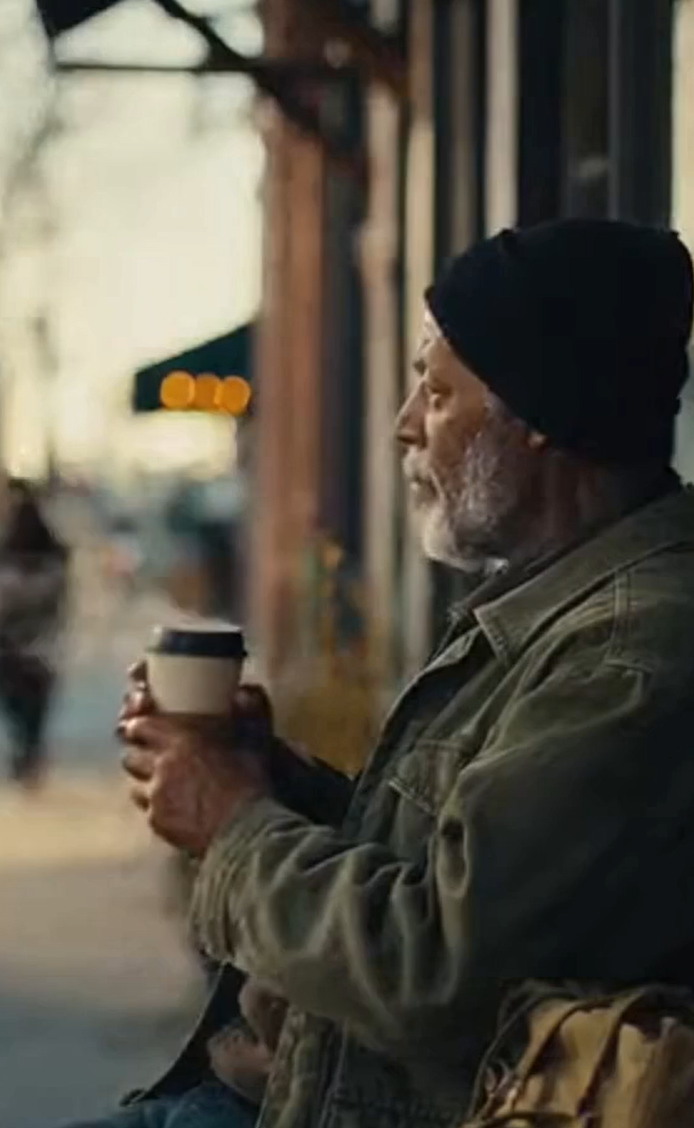
The morning regulars at Bean & Brew knew him simply as “the quiet man.” For three years, Earl Thompson had occupied the same spot on the sidewalk bench just outside the café’s front window, nursing the single black coffee that someone inevitably bought him each day.
At 71, Earl moved slowly. His army jacket was faded but clean, his gray beard neatly trimmed despite his circumstances. He never asked for money. Never held a sign. He just sat there, watching the street with tired eyes that seemed to carry decades of weight.
“He’s scaring away customers,” muttered a woman in a designer coat one Tuesday morning. She said it loud enough for everyone to hear. “Someone should call the city.”
Marcus Chen, the café owner, was wiping down the counter when he heard her. He’d inherited Bean & Brew from his father two years ago, along with an unspoken understanding that Earl was part of the place.
“He’s not bothering anyone,” Marcus said quietly.
The woman scoffed. “He’s bothering me.”
A few customers exchanged uncomfortable glances. Nobody spoke up.
That afternoon, something changed. Earl wasn’t on his bench. Marcus noticed around 2 PM when the usual spot sat empty. By closing time, Earl still hadn’t appeared.
Three days passed. No Earl.
Marcus asked around. The regulars shrugged. The woman in the designer coat seemed pleased.
On the fourth day, Marcus found Earl slumped against the back wall of the alley behind the café. His breathing was shallow, his lips cracked. His worn backpack was clutched against his chest like a lifeline.
“Earl! Earl, can you hear me?”
The old man’s eyes fluttered open. “Don’t… don’t let them take my bag.”
Marcus called 911. While waiting for the ambulance, he sat with Earl, promising to guard the backpack. The paramedics arrived, loaded Earl onto the stretcher, and one of them reached for the bag.
“I’ll take it to him,” Marcus said firmly. “I promised.”
At the hospital, Marcus sat in the waiting room, the backpack on his lap. It was heavier than he expected. After two hours, curiosity and concern won out. Earl had no family listed. No emergency contact. If there was something important inside, maybe it could help.
He unzipped it carefully.
Inside, beneath a neatly folded change of clothes, Marcus found a manila folder thick with papers. He opened it.
The first document was a deed. To the building. His building. Bean & Brew.
Marcus’s hands trembled as he kept reading. There were letters. Dozens of them, addressed to his father, David Chen, spanning twenty years. The handwriting was Earl’s.
“Your father saved my life in Da Nang,” one letter read. “I told him I’d repay him someday. He said the only payment he wanted was for me to watch over his family if anything ever happened to him.”
Marcus flipped through more pages. Bank statements. A trust account. His father’s signature on documents transferring ownership of the building to Earl in 1987 – and Earl’s signature transferring it back to the Chen family trust in 2019, one month before Marcus’s father died.
The final page was a handwritten note dated three years ago:
“David’s son runs the shop now. I’ll keep my promise. I’ll watch over him like I watched over his father. He doesn’t need to know. He just needs to be safe.”
Marcus looked up as a nurse approached.
“Mr. Chen? Mr. Thompson is awake. He’s asking for you.” She paused. “He’s also asking if you found the photograph.”
Marcus looked back in the folder. At the very bottom, tucked into a small envelope, was a faded photograph. Two young soldiers, arms around each other’s shoulders, grinning at the camera.
One was Earl.
The other was his father.
On the back, in his father’s handwriting: “Earl and David. Brothers forever. Saigon, 1971.”
Marcus walked into Earl’s hospital room, the photograph in his hand. Earl’s eyes went to it immediately, then up to Marcus’s face.
“Your father,” Earl whispered, his voice cracking, “made me promise never to tell you. Said he didn’t want you to feel obligated.” His weathered hand reached out. “But I think… I think he’d understand now.”
Marcus sat down beside the bed, tears streaming down his face. “Three years. You sat outside my shop for three years. Protecting me. And I never – “
“You bought me coffee every single day,” Earl said softly. “You looked me in the eye. You said good morning.” He smiled, the first real smile Marcus had ever seen from him. “Your father raised you right.”
Marcus opened his mouth to respond, but the door swung open behind him.
The woman in the designer coat stood in the doorway, a hospital administrator beside her, clipboard in hand.
“That’s him,” she said, pointing at Earl. “That’s the homeless man I filed the complaint about. I’m on the city council, and I want him permanently removed from – “
She stopped mid-sentence.
Because Marcus had stood up, holding the deed to the building, the photograph, and twenty years of letters.
“Ma’am,” he said, his voice steady, “I’d like you to meet Earl Thompson. He owns the building your husband’s law firm rents on Fifth Street. And the one on Market. And the parking structure next to City Hall.”
The administrator’s face went pale as she looked at her clipboard, then back at Earl.
The councilwoman’s mouth opened and closed.
Earl just looked at Marcus, a quiet pride in his eyes.
“I also think,” Marcus continued, “that you should know exactly who you’ve been trying to remove from my property.”
He turned the photograph around so she could see it clearly—two young soldiers, brothers in everything but blood.
“This man saved my father’s life. And for three years, he’s been—”
The administrator interrupted, her voice barely a whisper as she stared at her paperwork.
“Mr. Chen, I don’t think you understand. According to these records, Mr. Thompson isn’t just a property owner.” She looked up at Earl, then back at the documents. “He’s the largest private donor to the Veterans Housing Initiative in this city’s history. The anonymous one. The shelter on Riverside? The job training center? The—”
Earl closed his eyes.
Marcus looked at the man he’d walked past a thousand times, the man who’d sat quietly outside his window through rain and heat and snow, asking for nothing.
The councilwoman’s face had gone from pale to gray.
“The donation last month,” she whispered. “The one that saved the veterans’ housing bill. That was—”
Earl’s hand found Marcus’s.
“Your father made me rich,” he said quietly. “Invested my army pension for me. Taught me everything. But money never meant much to me. Only people.” He squeezed Marcus’s fingers. “Only family.”
The room was silent.
Then the administrator cleared her throat and turned to the councilwoman.
“Ma’am, I think there’s something else you should see.” She held up her clipboard, pointing to a line at the bottom of the page. “Mr. Thompson’s emergency contact. The one he finally agreed to list this morning.”
Marcus leaned forward to read it.
The name written there was his own.
The councilwoman, whose name was Eleanor Vance, looked as if the floor had dissolved beneath her feet. She backed away from the door, stammering something about a misunderstanding before turning and almost running down the hallway.
The administrator gave Marcus a small, apologetic nod. “We’ll make sure Mr. Thompson has the best care. Anything he needs.”
When they were alone again, Marcus sank back into the chair, the weight of the last hour pressing down on him.
“Why, Earl?” he asked, his voice thick with emotion. “All that money. All that power to do good. Why live on the street? Why sit on that bench?”
Earl took a slow breath, the machines beside him beeping a steady rhythm. “The money wasn’t mine to enjoy. It was a tool. Your father and I, we made a plan.”
He explained how David Chen, a financial whiz even in his twenties, had taken Earl’s meager army savings and turned it into a fortune. They bought small properties, fixed them up, and rented them out.
“David handled the numbers. I handled the handiwork,” Earl said with a faint smile. “We were a good team.”
But after the war, something in Earl had broken. He couldn’t shake the things he’d seen. The noise, the loss.
“I tried living in a nice house. I tried fancy dinners. It all felt wrong. Empty.” He looked at his worn hands. “Felt like I was betraying the boys who never came home.”
So he and David came up with a new plan. Earl would live simply, using the fortune to help others from the shadows. He found purpose in being an anonymous force for good.
“And watching over your father’s coffee shop… that was my anchor. It kept me connected to the best man I ever knew.”
When David passed away, Earl’s mission shifted to Marcus.
“Sitting on that bench, I wasn’t just keeping a promise. I was staying grounded. Remembering what’s real.” He looked at Marcus. “Watching you treat people with kindness, just like your dad did. That was my reward.”
Two days later, the doctors cleared Earl to be discharged. They told Marcus he needed rest and regular meals, a place to recover from severe dehydration and exhaustion.
“He’s coming home with me,” Marcus said without a second thought.
The apartment above Bean & Brew, where Marcus lived, had been his father’s. It was small but comfortable.
When Earl stepped inside, he stopped and looked around, his eyes lingering on a framed photo of David on the mantelpiece.
“He loved this place,” Earl said softly.
The next few weeks were an adjustment for both of them. Earl was quiet, but his presence filled the space with a calm strength.
Marcus would make them breakfast, and they’d sit and talk for hours. Earl told him stories about his father that Marcus had never heard. Stories of their youth, their mischief in Saigon, their shared dreams after the war.
He learned his stoic, hardworking father had once been a risk-taker who could talk his way out of any trouble.
He learned Earl was a talented sketch artist who used to draw portraits of the other soldiers to send home to their families.
One evening, Earl pulled his old backpack from the corner of the room. He took out a worn leather-bound sketchbook.
He opened it to a page filled with a detailed pencil drawing of Bean & Brew. Every brick, every window pane, was perfect. And on the bench outside, a younger David Chen was laughing, a cup of coffee in his hand.
“I sat there long before you took over,” Earl confessed. “I’d come by just to see him. We didn’t always talk. We didn’t have to.”
Marcus realized that Earl hadn’t just been a guardian. He had been a friend, grieving in the only way he knew how.
Meanwhile, Councilwoman Vance had gone silent. Her public crusade against the city’s homeless had stopped.
But then, the anonymous attacks began.
A “concerned citizen” tipped off the health department, leading to a surprise inspection at Bean & Brew. They found nothing.
An anonymous op-ed appeared in the local paper, questioning the source of the “mysterious” donations to the veterans’ fund and hinting at money laundering.
Marcus knew it was Vance. She was trying to discredit them, to salvage her reputation by tearing theirs down.
“We have to fight back,” Marcus said, pacing the apartment. “I can call a lawyer. We can expose her.”
Earl just sat by the window, watching the street below. “Fighting anger with more anger never works, son. It just makes the fire bigger.”
“So we do nothing?” Marcus asked, frustrated.
“No,” Earl said, turning to him. “We find out why she’s so angry.”
It didn’t take much digging. Marcus made a few calls, and a friend at city hall filled him in.
Eleanor Vance’s father had also been a Vietnam veteran. Sergeant Robert Vance. He’d come home with severe PTSD and had struggled for years before passing away when Eleanor was a teenager. She blamed the military, and by extension, all veterans, for her family’s pain.
The final piece of the puzzle clicked into place when Earl heard the name.
“Robert Vance,” Earl repeated, his eyes distant. “I knew a Bobby Vance. From the 101st Airborne. A good man. A brave radio operator.”
The next day, Marcus and Earl went to City Hall. They didn’t ask for a meeting. They just waited in the public lobby.
When Councilwoman Vance came out of a meeting, she stopped cold seeing them. Her face hardened.
“If you’re here to threaten me—” she began.
“We’re not,” Earl said, his voice gentle. He held out an old, creased photograph from his wallet. It wasn’t the one with David. It was another one.
Four young soldiers stood in front of a helicopter. One of them was a much younger Earl. Another was a smiling young man with kind eyes.
“Is this your father?” Earl asked.
Eleanor stared at the photo, her composure cracking. She nodded, unable to speak.
“He was my radio operator,” Earl said. “Bobby. He saved my whole platoon more than once. He’d stay on that radio, calling in support, even when we were taking heavy fire. He never once backed down.”
He told her about a specific day, a firefight in the A Shau Valley. How her father had guided in a rescue chopper while under attack, refusing to take cover until every wounded man was aboard.
“He was a hero, Eleanor. He carried the weight of a lot of boys on his shoulders.” Earl’s voice was filled with a deep, quiet respect. “The things we saw… they leave scars. Some on the outside, some on the inside. Your father’s scars were deep because he cared so much.”
Tears were streaming down Eleanor Vance’s face. All her life, she had seen her father’s struggles as a source of shame, a weakness. She had never seen it as the cost of his heroism.
“I… I never knew,” she whispered.
“He probably didn’t want you to,” Earl said. “He wanted to protect you from it. Just like I wanted to protect Marcus.”
The three of them stood in the middle of the bustling City Hall lobby, a small island of profound understanding.
A week later, Councilwoman Vance held a press conference. She didn’t resign. She did something harder.
She told the truth. She spoke of her father’s service, his quiet pain, and her own misplaced anger. She publicly apologized to Earl Thompson and to the city’s entire veteran community.
Then she announced a new initiative, co-sponsored by an anonymous donor, to massively expand mental health services for veterans and their families.
Bean & Brew became a different place after that. The story had spread through the city.
The bench out front was never empty. People would come by just to sit on it, to feel a part of something good.
Marcus and Earl decided to place a small, simple brass plaque on it. It read: “The Watcher’s Bench. In honor of those who protect us, seen and unseen.”
Earl didn’t go back to living on the streets, but he didn’t move into a mansion either. He stayed in the apartment above the shop with Marcus. He had found his home.
He became a fixture inside the coffee shop, not just outside it. He’d sit at a corner table with his sketchbook, drawing the customers. He’d talk to the young veterans who came in, offering a listening ear and a quiet wisdom that no amount of money could buy.
Together, he and Marcus started the “David Chen & Earl Thompson Second Cup Fund.” For every ten coffees they sold, one was paid forward to a veteran in need. It wasn’t about charity; it was about community.
One bright Tuesday morning, Marcus was behind the counter, a year after finding Earl in the alley. The shop was full. Laughter bounced off the walls.
Councilwoman Vance was there, having a quiet coffee with a group of veterans’ advocates.
Earl was at his usual table, showing a young woman who had just left the service how to shade a portrait.
Marcus looked at the man who had been his silent guardian, his father’s best friend, and now, his family. He thought about the deeds, the bank statements, and the fortune that sat in trust.
But he knew the real treasure was never in the backpack. It was the man who carried it.
The world often tells us to look for value in the loud and the flashy, in the designer coats and the important titles. But true worth, the kind that can change a life or a city, is often quiet. It sits patiently on a bench, waiting not for recognition, but for a simple cup of coffee and a kind look in the eye. It reminds us that the greatest promises are kept not with wealth, but with presence.



