The officer’s club was packed that Friday night. Commissioned officers in dress whites filled the room, drinks clinking, voices sharp with the kind of confidence that comes from power.
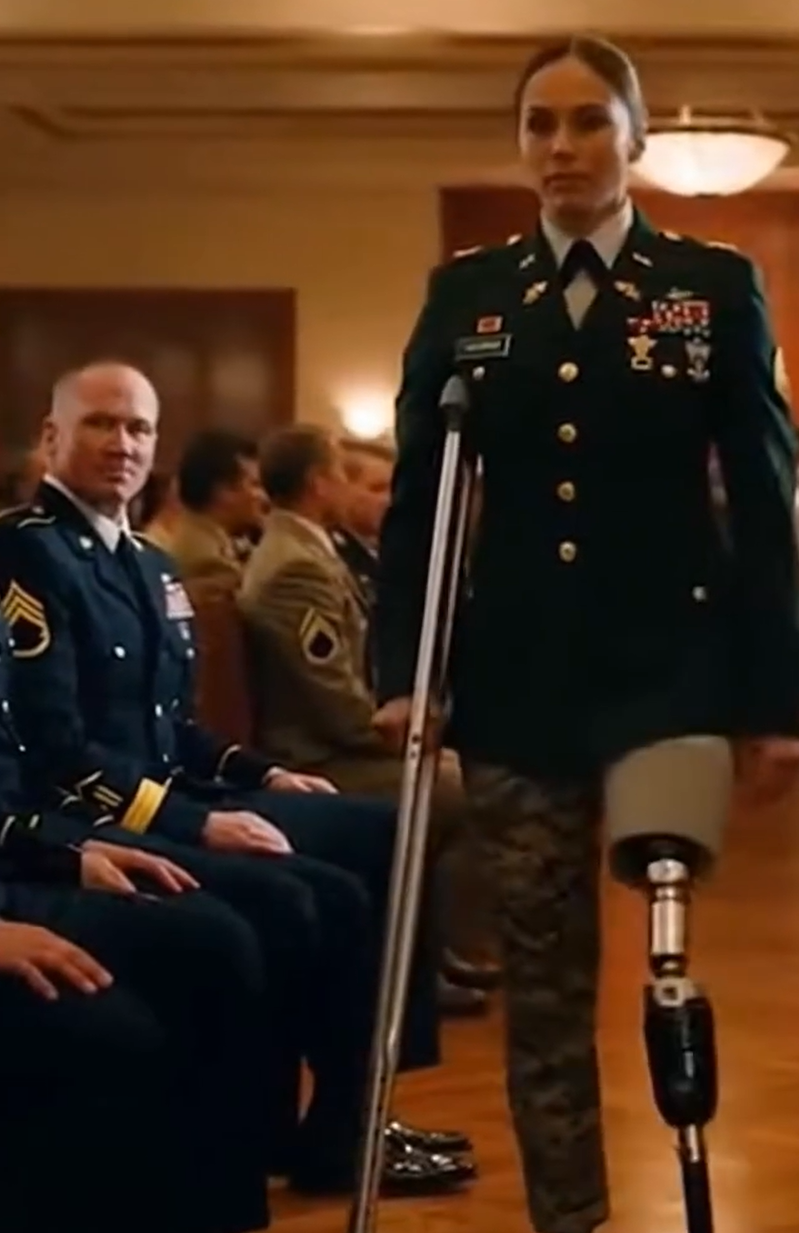
Sarah Chen moved slowly through the crowd, her left leg stiff, each step deliberate. The prosthetic was state-of-the-art, but it never looked quite right in motion.
She wasn’t supposed to be there. Her brother had insisted.
“Come celebrate with us,” he’d said. “You should hear the stories.”
But she’d known better. She’d seen the way people’s eyes tracked her leg.
She’d felt the shift in rooms when she entered.
The table near the window was full of them – young SEALs, maybe mid-thirties, all muscle and swagger. One of them watched her approach the bar, his eyes narrowing.
“Look at that waddle,” he said, loud enough. The others turned.
“Hey, sweetie! The handicap ramp is out back.”
The table erupted. Shoulder slaps, thrown-back heads, the specific cruelty of men who believed they’d earned the right to it.
Sarah froze. Her brother wasn’t with her.
Nobody from her unit was here. Just strangers in dress whites, enjoying the joke.
She turned back to the bar, ordered her drink, kept her hands steady. The laughter continued behind her for another minute before fading into conversation.
She’d learned not to react. Reaction meant engagement.
Engagement meant more.
But she could feel their eyes on her as she walked to the window seat. Slow.
Deliberate. Exactly the waddle they’d described.
Twenty minutes later, the room’s energy shifted. Conversations stopped mid-sentence.
A full Admiral had walked through the door – General Morrison, the Joint Base commander. Imposing.
Silver-haired. Moving with the kind of presence that made junior officers straighten in their chairs.
He scanned the room and locked eyes with Sarah.
His face changed. Recognition.
Then something harder.
He crossed the room directly to her table, ignoring the SEALs who’d stood to attention. When he reached her, he didn’t say hello.
He simply sat down across from her, pulled up the leg of his dress whites, and rolled down his sock.
The prosthetic was identical to hers. Same model.
Same manufacturer. Same precise engineering.
“IED, Kandahar, 2011,” he said quietly, so only she could hear. “You?”
“Explosives disposal, Helmand, 2009,” Sarah whispered.
He nodded once. Then he stood up and turned to face the table of SEALs.
They’d gone completely silent.
“Any of you boys ever lose a leg for your country?”
No one answered.
“Didn’t think so. When you do, you can come back and laugh.”
He looked at Sarah one final time, rolled his pant leg down, and walked toward the dining room. But not before every officer in that room had turned to look at the table of young warriors – and looked back at the woman in the window seat with the careful walk and the iron in her eyes.
The silence that followed was heavier than the earlier laughter. It was thick with shame and judgment.
Sarah took a slow sip of her drink, the ice cubes clinking softly against the glass. The sound felt deafening.
She hadn’t asked for a defender. She certainly hadn’t asked for a spectacle.
But a part of her, a part she kept buried deep, felt a flicker of vindication. It was a small, warm thing in the cold cavern of her chest.
Her brother, Lieutenant Mark Chen, finally appeared, weaving through the silent bodies. He took one look at the atmosphere, at the SEALs staring at their boots, and at Sarah’s rigid posture.
“What did I miss?” he asked, his voice low.
“Nothing important,” Sarah said, not meeting his eyes. “Just a lesson in etiquette.”
Just then, one of the SEALs from the table got up. He was tall, with the sharp jaw and cold eyes of a predator.
He walked over to Sarah’s table, his movements stiff and reluctant. The nameplate on his uniform read ‘REYNOLDS’.
“Ma’am,” he began, the word tasting like ash in his mouth. “On behalf of my men, I’d like to… apologize.”
It wasn’t an apology. It was an order he was following, a box he was checking.
Sarah finally looked up at him. She saw no remorse in his eyes, only the sting of being publicly reprimanded by a superior officer.
“You’re not sorry for what you said, Lieutenant Commander,” she said, her voice even. “You’re sorry you got caught.”
Reynolds’ jaw tightened. He clearly wasn’t used to being spoken to this way.
“You don’t have to accept,” he clipped out.
“I don’t,” she agreed, then turned her gaze back to the window, a clear dismissal.
He stood there for a moment longer, a statue of wounded pride, before turning on his heel and rejoining his table. The moment was over.
Mark sat down, a worried frown on his face. “Sarah, what happened?”
“It doesn’t matter,” she said, and for the rest of the night, it didn’t. They talked about his work, about their parents, about anything other than the prosthetic leg and the men who had mocked it.
But the incident stayed with her. It was a reminder that no matter what she accomplished, some people would only ever see the way she walked.
Months passed. The chill of that night faded into a dull memory.
Sarah threw herself into her work. She wasn’t in the field anymore, disarming bombs with trembling hands and a prayer on her lips.
Now, she sat in a sterile, windowless office at a data analysis center. Her new battlefield was made of code and satellite imagery.
She analyzed blast patterns, dissected bomb-making techniques, and built profiles of the unseen enemies who planted death in the sand. She was good at it.
She saw the patterns others missed, the tiny signatures in the chaos. Her firsthand experience gave her an edge no Ivy League analyst could match.
Yet, she was still an outsider. Her reports were valued, but she was never invited to the high-level briefings.
She was the ghost in the machine, the brain in a jar, her contributions separated from her personhood. It was a safe, quiet existence.
Then, a new file landed on her desk. It was flagged with the highest level of urgency.
A new type of IED had begun appearing in a volatile region overseas. These devices were different.
They were sophisticated, precise, and brutally effective. They didn’t just target vehicles; they targeted individuals.
They were designed with an unnerving intelligence, placed in locations that defied conventional logic, yet always found their mark. The teams on the ground were flying blind, and casualties were mounting.
Sarah felt a familiar cold dread as she pulled up the first images. The circuitry was complex, the trigger mechanism unlike anything she’d seen.
She worked for three days straight, fueled by black coffee and a grim determination. She mapped every detonation, analyzed every fragment of recovered data.
On the fourth day, a summons came. General Morrison wanted to see her.
She walked into his expansive office, her gait as steady and deliberate as ever. He was standing by a large map of the world, dotted with colored pins.
“Chen,” he said, skipping the pleasantries. “The file. What have you found?”
“They’re learning,” she said, her voice hoarse from lack of use. “The bomb-maker is adapting to our countermeasures in real-time. Almost as if he knows our protocols.”
The General nodded grimly. “That’s what we were afraid of.”
He paused, his gaze intense. “The unit being hit the hardest is SEAL Team Five. They’re losing people.”
Sarah’s blood ran cold. She didn’t need to ask.
“Reynolds’ team,” the General confirmed. “They’re lead on this operation. And they’re walking into a minefield they can’t see.”
The irony was not lost on her. The men who had mocked her for a disability earned in the line of duty were now depending on her mind to save their fully-abled bodies.
“I need you to dig deeper,” Morrison said. “Forget the other projects. This is your only priority. Find me a weakness. Find me a pattern. Find me the man behind this.”
Sarah returned to her quiet office, the weight of the General’s command settling on her shoulders. This was no longer just an analytical problem.
It was personal. Not because of Reynolds, but because of the soldiers dying.
She spent the next week living inside the data. She dreamed of circuit boards and pressure plates.
She saw something, a flicker of familiarity in the bomb-maker’s technique. It was in the way he wired his charges, a specific, almost artistic knot he used on the detonator cord.
It was a ghost from her past.
Her hands trembled as she pulled up her own case files from Helmand, 2009. The folders were digital now, but she could still feel the gritty texture of the paper, smell the dust and sweat.
She scrolled through incident reports, photos of cratered earth and twisted metal. And then she found it.
A photo of a dismantled IED from an ambush near a small village. The knot was there. Identical.
The official report listed the bomb-maker as “unidentified, presumed eliminated in subsequent airstrike.” But Sarah knew that wasn’t the whole story.
She remembered that village. She remembered the informant they had used.
His name was Kael. A teenager, barely old enough to grow a beard, with eyes that were far too old for his face.
He had provided the intel that led them to the bomb cache. He’d seemed terrified, eager to help.
Sarah had been the one to interview him. She’d been the one who vouched for him, who told her commanding officer he was trustworthy.
The intel was good, but it was also a trap. As her team worked to disarm the cache, a secondary device, a far more powerful one, was detonated remotely.
That was the day she lost her leg. It was the day she lost two of her closest friends.
Kael had disappeared in the chaos. They’d assumed he was just another casualty, or had fled.
But looking at this knot, at the sadistic intelligence of these new bombs, she knew. He hadn’t fled.
He had learned. And he had perfected his craft.
The boy she had once pitied was now the monster haunting SEAL Team Five. And it was her fault.
She felt a wave of nausea. The guilt she had carried for over a decade came roaring back to life.
She hadn’t just been a victim of that bomb. She had been an unwilling accomplice.
This new mission wasn’t about redemption in the eyes of men like Reynolds. It was about redeeming herself.
She worked with a renewed, feverish intensity. If Kael was the bomb-maker, then he wasn’t just building weapons. He was sending a message.
He was using the same tactics he’d learned from watching them. He knew their patrol patterns, their vehicle formations, their standard operating procedures.
He wasn’t just placing bombs. He was hunting.
She stayed up all night, cross-referencing the recent attacks with the patrol logs of her own unit from 2009. A pattern emerged.
It was chillingly clear. Kael was re-creating the very scenarios that had led to his “betrayal.”
He was targeting patrols in similar geographic locations, at similar times of day, using similar team compositions. He was re-living his victory, over and over again.
Sarah’s heart hammered in her chest. She pulled up the next day’s mission schedule for SEAL Team Five.
Reynolds’ team was slated for a reconnaissance mission. A four-man team, on foot, through a narrow ravine.
It matched a patrol route her own EOD team had taken the day before the ambush. It was the perfect trap.
She knew, with absolute certainty, where the next bomb would be. It would be at the narrowest point of the ravine, concealed under a flat, unassuming rock.
She grabbed her phone and called General Morrison’s direct line. It was 3 a.m.
He answered on the second ring, his voice sharp with sleep. “Morrison.”
“General, it’s Sarah Chen. I know where the next IED is. And I know who is planting it.”
There was a pause on the other end of the line. “Explain.”
She laid it all out. The knot. The informant, Kael. The pattern of attacks mimicking her old patrol routes.
She didn’t hide the part about her own role in the 2009 incident. Her voice was steady, factual, even as she admitted the mistake that had cost her so much.
When she finished, the line was silent for a long moment. “Are you sure, Chen?”
“I’ve never been more sure of anything in my life,” she said. “They are walking into a trap set for them over a decade ago.”
“Reynolds won’t like taking tactical advice from a data analyst,” the General said, a hint of weariness in his voice.
“With all due respect, General,” Sarah replied, “his feelings aren’t the priority right now. His life, and the lives of his men, are.”
There was another pause. “I’ll make the call,” Morrison said finally. “Get some rest, Chen. You’ve earned it.”
But Sarah couldn’t rest. She sat in her dark office, staring at the screen, watching the clock tick.
Hours later, an encrypted email arrived. It was from General Morrison.
The subject line was a single word: “CONFIRMED.”
The body of the email was brief. Reynolds’ team, rerouted based on her intelligence, had approached the ravine from a different angle.
They found the IED exactly where she said it would be. They also found Kael, waiting in an overwatch position with the remote detonator in his hand.
He was captured without a single shot fired. The hunt was over.
Sarah leaned back in her chair, the tension draining out of her body, leaving her feeling hollow and shaky. She finally allowed herself to close her eyes.
Two weeks later, SEAL Team Five returned to base. Sarah was in the mess hall, quietly eating her lunch, when someone stopped at her table.
It was Reynolds. He wasn’t in his dress whites.
He was in his combat fatigues, looking tired and much older than he had that night at the club.
He didn’t say anything at first. He just stood there.
Then, he slowly pulled out the chair across from her and sat down.
“They told me the intel came from you,” he said. His voice was quiet, stripped of all its earlier arrogance.
Sarah just nodded, continuing to eat her salad.
“The device was exactly where you said it would be,” he continued. “Exactly how you described it. Another ten minutes, and my team would have walked right into it.”
He looked down at his hands, then back up at her. For the first time, she saw something other than pride in his eyes.
“I was wrong,” he said. “About you. About everything. What I said that night… there’s no excuse for it.”
He took a deep breath. “You saved our lives. All of us. Thank you.”
This time, the apology was real. It was heavy with the weight of understanding, of respect that had been earned in the most harrowing way possible.
Sarah stopped eating and looked at him. “You’re welcome, Commander.”
A month later, she was called back to General Morrison’s office. He offered her a seat.
“The debrief on Kael is finished,” he said. “He confirmed everything you suspected. He held a grudge against you personally. He wanted you to know he was still out there.”
“He got his wish,” Sarah said quietly.
“He did,” the General agreed. “But you got the last word.”
He slid a folder across the desk. “This is a proposal. We’re creating a new unit. A Predictive Threat Analysis Wing.”
“It’ll be your job to do for everyone what you did for Reynolds’ team. To connect the dots, to see the ghosts in the data. We want you to lead it.”
Sarah stared at the folder, speechless. A promotion.
Her own unit. A chance to do the work she was born to do, without being hidden away in a back room.
“My leg…” she started to say, the old insecurity surfacing.
“Your leg is a part of your story,” the General interrupted gently. “It’s the reason you have the perspective you do. It’s not a weakness, Chen. It’s your greatest strength.”
He leaned forward, his expression serious. “We don’t need you to kick down doors. We need you to see what’s behind them before anyone else has to.”
Sarah Chen walked out of that office with her head held high. Her steps were still slow, still deliberate.
But the waddle that the SEALs had mocked was gone. In its place was the steady, confident gait of a leader.
She realized that the leg they saw was just metal and plastic. Her real strength, the part of her that could never be broken, was the iron will that moved it.
Our deepest wounds often give us our greatest vision. The scars we carry are not signs of what was lost, but maps of where we’ve been and the battles we have survived to become who we are. True strength isn’t the absence of weakness; it’s the wisdom and courage we gain from overcoming it.