
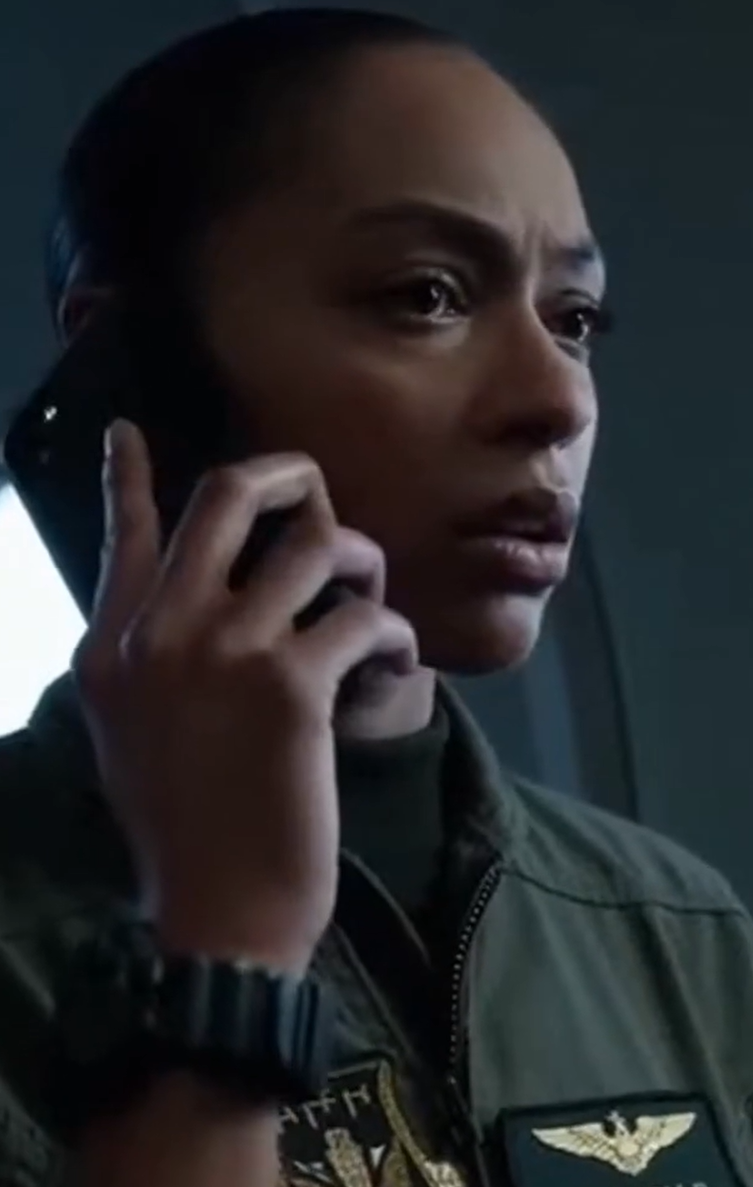
The call hit at 4 a.m. overseas. “Cassie’s grandpa had a massive stroke,” my aunt sobbed into the phone. “Doctors say he might not make it through the night.”
I was stationed in Germany, three thousand miles away, wearing a uniform that my own family had spent two years calling fake.
I caught the first military transport available. Sixteen hours of flying, then a two-hour drive to St. Mary’s Hospital in Ohio. My hands were shaking the entire way – not from fear of what I’d find, but from dread of what would happen when I arrived.
Grandpa Jack had raised me after my mom died when I was eight. He was the one who’d held me while I cried, who’d taught me to fish, who’d sat with me through every nightmare. When I joined the Army at twenty-two, he was the only family member who didn’t laugh.
Everyone else did.
“The military won’t take her,” my uncle Derek had said at my going-away dinner, loud enough for the whole table to hear. “She’ll wash out in a week.”
My cousin Amy scrolled her phone. “It’s cute that she’s pretending to be a soldier.”
My mother’s sister, Aunt Linda – the one who’d just called me – had smiled sympathetically. “Sweetie, maybe you should look at nursing instead?”
Two years of deployment. Two years of sixteen-hour shifts, combat medical training, three field commendations for emergency response. Two years of emails home that nobody asked about.
And they still called it pretend.
I pushed through the hospital doors in my dress uniform, my boots clicking against linoleum. The waiting room was full—Derek, Amy, Linda, my cousin Marcus, their spouses, their children. All of them looked up.
The silence was immediate.
“Cassie?” my aunt Linda stood up, her eyes red. “Oh honey, I’m so glad you’re here. Grandpa’s been asking for you. He—”
“No visitors right now,” Derek said flatly. “Family only.”
I stared at him. “I’m family.”
“You know what we mean,” Amy said. “This isn’t the time for… costumes.”
My cousin Marcus actually snorted.
The nurse station was five feet away. I walked to it.
“Hi,” I said to the nurse on duty, my voice steady. “I’m here for Jack Morrison. Room 412. I’m his power of attorney for medical decisions.”
The nurse checked her system. “You’re listed as Major Cassie Morrison, Army Medical Corps?”
“That’s me.”
Derek stood up. “That’s not—she can’t—”
“The paperwork is signed and notarized,” I said quietly, turning back to the nurse. “Grandpa did that six months ago. He wanted someone he could trust making decisions about his care. Someone with medical training.”
The nurse nodded, clicking through the computer. “Room 412. His cardiologist is in there now. You can go straight in.”
I could feel their eyes on me as I walked past. Not confused eyes. Shocked eyes. The eyes of people realizing something they’d been wrong about.
Grandpa was hooked to three machines, his face gray against white pillows, his breathing labored. But his eyes opened when I took his hand.
“Cassie?” His voice was barely a whisper.
“I’m here, Grandpa. I’m here.”
The cardiologist—Dr. Patel—looked at me with professional respect. “Are you the medical POA?”
“Yes, sir.”
“Good. We need to discuss his options. His stroke was massive, and we’re seeing complications with his cardiac function. The Army taught you about stroke protocol?”
“Field medicine, surgical support, and cardiac complications,” I answered. “I’ve done three rotations in emergency medicine.”
He nodded, not condescending, just treating me like the trained medical professional I was. We spent the next thirty minutes discussing Grandpa’s care—imaging results, medication protocols, recovery chances. I asked questions that made the doctor respect the training in my voice.
When I came back to the waiting room, the room fell silent again. But this time it was different.
Derek’s face had gone pale. Amy was staring at the floor. My aunt Linda had tears streaming down her face.
“That was…” Linda started.
“Dr. Patel just confirmed it,” I said quietly. “Grandpa’s medical POA. He appointed me eighteen months ago. Said he needed someone who understood medicine. Someone he could trust with his life.”
I let that sit.
“He’s sleeping now, but he can have one visitor. Just one. He asked for me first.” I paused. “Then he asked for Derek, to apologize for not telling you he’d appointed me.”
Derek looked like he’d been hit.
I turned to leave, then stopped. “For the record—those two years you all said I wouldn’t make it? I made captain. I’ve treated forty-three soldiers in field conditions. I’ve assisted on emergency surgeries. I’ve saved lives with skills I earned. Not a costume. Not pretend.” I looked at each of them. “A job I love that you never thought was real.”
My aunt’s hand covered her mouth.
I walked to Grandpa’s room and sat beside him, holding his hand through the night. And for the first time since I’d been home, nobody called it pretend.
The sun rose, casting long, pale stripes across the hospital floor. Grandpa slept fitfully, his hand still in mine. I hadn’t moved all night, running on adrenaline and the bitter satisfaction of being right.
Around seven, a nurse came in to check his vitals. She gave me a small, knowing smile. “You’re good for him,” she whispered.
I nodded, my throat too tight to speak.
When I finally stepped back into the waiting room for coffee, the atmosphere had shifted from shocked silence to a simmering, awkward tension. Aunt Linda rushed over, her face a mess of guilt and exhaustion.
“Cassie, honey, I am so, so sorry,” she said, her voice cracking. “We just… we didn’t understand.”
I took a sip of the terrible machine coffee. It tasted like ash. “No, you didn’t.”
Derek was staring out the window, his back to me. His shoulders were rigid. He hadn’t said a word since I’d returned from Grandpa’s room last night.
Amy and Marcus were huddled in a corner, whispering. They wouldn’t meet my eyes.
The day wore on like that. A long, slow grind of medical updates and stilted conversation. Dr. Patel pulled me aside in the afternoon.
“His condition is stabilizing, which is good news,” he began, “but his heart is under immense strain. We found a significant blockage in his left anterior descending artery. It’s what they call a ‘widow-maker.’”
My blood ran cold. I knew the term.
“We need to perform an emergency angioplasty, insert a stent. It’s risky, given his weakened state from the stroke, but if we don’t, his chances are… negligible.”
I processed the information, my training kicking in, pushing the fear down. “What are the odds of success?”
“With a skilled surgeon, I’d say sixty, maybe seventy percent. The risk is that the procedure itself could trigger another cardiac event or a second stroke.”
This was it. The decision Grandpa had trusted me to make. His life was literally in my hands.
“Let’s do it,” I said, my voice firmer than I felt. “It’s his only real shot.”
Dr. Patel nodded. “I agree. I need you to sign the consent forms.”
I walked back to the waiting room, consent forms on a clipboard in my hand. “They’re taking Grandpa into surgery,” I announced to the room.
Derek spun around from the window. “Surgery? For what? You can’t just decide that!”
“I can, actually,” I said, holding up the clipboard. “And I did. It’s an emergency angioplasty. His main artery is almost completely blocked.”
“You’re not a real doctor!” Derek spat, his face turning red. “You’re just a medic playing dress-up! You can’t authorize something that risky!”
“I’m a Captain in the Army Medical Corps, Uncle Derek,” I said, my voice dangerously calm. “I’ve made life-or-death calls in the middle of a firefight with far less information than I have now. I know what I’m doing.”
“You’re going to kill him!” he yelled, taking a step toward me. “My dad trusted you, and you’re going to kill him with your arrogant little games!”
“Derek, stop!” Aunt Linda cried, grabbing his arm.
But his words had struck a nerve, a raw, deep place I thought I’d buried. He wasn’t just questioning my decision. He was questioning everything I was.
And in that moment, something clicked. A memory from years ago. I was about sixteen, helping Grandpa clean out his attic. We’d found an old, dusty footlocker. When I tried to open it, he had gently taken my hand and said, “Some things are best left in the past, Cassie-girl.” His eyes had a sadness I’d never seen before.
Derek’s rage felt older than just his jealousy of me. It was deeper, more personal.
“Why do you hate it so much?” I asked, my voice dropping to a whisper. “Why do you hate the uniform?”
He scoffed. “Because it’s a fantasy! It’s for people who can’t make it in the real world! Dad never wanted any of that military nonsense in this family!”
That was the line. That was the key.
“I need to make a call,” I said, turning away from him.
I walked down the hall, my heart pounding. I pulled out my phone and found the number. A number Grandpa had given me before my first deployment. “If you ever need to talk to someone who gets it,” he’d said, “call Sal. He’ll understand.” I’d never used it.
An old, gravelly voice answered on the second ring. “Yeah?”
“Is this Sal?” I asked.
“Who’s askin’?”
“My name is Cassie Morrison. Jack Morrison is my grandfather.”
The line went silent for a moment. Then the voice softened. “Jack’s girl. He told me about you. Said you were wearing the uniform, too. Making him proud.”
Tears pricked my eyes. “He’s in the hospital, Sal. He had a bad stroke.”
“Oh, kid, I’m so sorry to hear that,” he said, his voice full of genuine sorrow.
“Sal, I need to ask you something,” I said, trying to keep my voice from shaking. “My family… my uncle… he hates that I’m in the Army. He said Grandpa never wanted ‘military nonsense’ in the family. What does that mean?”
Another pause, this one longer, heavier.
“He never told you, did he?” Sal said finally. “Jack was a stubborn old goat. Thought he was protecting everyone by burying it.”
“Burying what?”
“Your grandpa wasn’t just a mechanic who got drafted, kid. He was a combat medic. Vietnam. 173rd Airborne. We called him ‘Doc’. The things he did over there… the lives he saved… mine included. He pulled me out of a hot LZ with three bullets in me. Carried me a mile on his back.”
I sank against the wall, my legs suddenly weak. My grandpa. The gentle man who taught me to fish.
“He came home with a Silver Star, two Bronze Stars, and a Purple Heart,” Sal continued. “And he came home with ghosts. Lots of them. Your grandma, God rest her soul, couldn’t handle it. She made him pack it all away. The uniform, the medals, the memories. She told the kids—your mom and your uncle—that he’d just pushed papers in a supply depot. They thought it was better that way. To forget the war.”
It all crashed down on me. Derek wasn’t sneering at my uniform. He was parroting a lie he’d been told his entire life. He was defending a version of his father that wasn’t even real.
“So he never knew,” I whispered. “Derek never knew his own father was a hero.”
“Jack thought he was sparing his boy the pain,” Sal said sadly. “Looks like all he did was pass it down in a different way.”
I thanked him, my mind reeling, and hung up the phone. The world had tilted on its axis.
I walked back to the waiting room. The consent forms were still on the table. Derek was pacing, looking agitated and cornered.
I didn’t say anything at first. I just looked at him, seeing him for the first time not as a bully, but as a boy who had never been told the truth about his own father.
“They’re prepping him for surgery now,” I said softly.
“I won’t let you,” Derek said, his voice low.
“I wasn’t asking for your permission,” I replied. “But I think you need to see something before he goes in.”
I pulled out my phone and swiped to a web browser. It had taken me thirty seconds to find it. I typed “Sergeant Jack Morrison, 173rd Airborne, Silver Star Citation” into the search bar.
The official Army commendation page loaded. There was a grainy, black-and-white photo of a young, haunted-looking man. My grandpa.
I held the phone out to Derek. “Read it.”
He looked at the phone, then at me, confusion warring with anger in his eyes. He took the phone.
He started to read, his lips moving silently. I saw the exact moment the words registered. His face slackened. The color drained from it. He read about Sergeant Morrison repeatedly exposing himself to enemy fire to render aid to fallen comrades. He read about how he single-handedly defended a wounded platoon leader until reinforcements could arrive.
He read the words “for gallantry in action” and “with complete disregard for his own personal safety.”
He scrolled down and saw the list of medals. The ones Sal told me about.
The phone slipped from his fingers and clattered onto the floor. He stumbled back and sank into a chair, his head in his hands. A dry, ragged sob escaped his lips.
“He… he told me he fixed jeeps,” Derek whispered, his voice broken. “All my life, he told me he just fixed jeeps.”
Aunt Linda picked up the phone, read the screen, and her hand flew to her mouth, her eyes wide with disbelief. Amy and Marcus crowded around, their own faces transforming from scorn to utter astonishment.
“The man you called a coward for hiding in a garage,” I said, my voice shaking with the weight of it all, “was a decorated war hero. The uniform you called a costume is the same one he wore when he saved a dozen men’s lives.”
I looked right at Derek. “You spent my entire career calling me a fake soldier. But you never even knew you were the son of a real one.”
The fight was gone from him. It was like his entire foundation had been turned to dust. All that was left was a hollowed-out man staring at a history he never knew he had.
Just then, a nurse appeared at the door. “We’re taking Mr. Morrison up now.”
We all stood. But this time, we stood together. Derek looked at me, his eyes filled with a lifetime of shame and a dawning, fragile respect.
“Go with him, Cassie,” he said, his voice thick. “Please. Be with him.”
I nodded and walked beside my grandpa’s gurney as they wheeled him toward the operating room. I held his hand until they made me stop at the double doors.
The wait was the longest two hours of my life. But it was different. We weren’t a fractured group of individuals anymore. We were a family, sitting in stunned, humbled silence.
Finally, Dr. Patel came out, his mask down, a tired but relieved smile on his face. “The procedure was a complete success. The stent is in place, and his vitals are strong. He’s a fighter, that one.”
A collective sigh of relief filled the small room. Tears flowed freely, but this time, they weren’t tears of anger or guilt. They were tears of gratitude.
Over the next few days, Grandpa Jack began to recover. It was slow, but it was steady. The family rotated shifts, and for the first time, they asked me questions. They wanted to know about my training, my deployments, the soldiers I served with. They listened.
Derek was the quietest. One afternoon, I found him sitting by Grandpa’s bedside, just watching him breathe.
“I’m so sorry, Cassie,” he said without looking at me. “For everything. I was so wrong.”
“You were taught to be,” I said. “He thought he was protecting you.”
“He was just protecting himself,” Derek said, a sad wisdom in his voice. “And he let me grow up ignorant. Ashamed of something I should have been so proud of.”
When Grandpa was finally lucid enough to talk, we were all there. He looked at Derek, then at me.
“Looks like the cat’s out of the bag,” he whispered, a weak smile on his face.
Derek just shook his head, tears in his eyes. “Why, Dad? Why didn’t you tell me?”
“I didn’t want you to see the things I saw,” Grandpa said, his voice raspy. “But I was wrong. The proudest moment of my life was when Cassie put on that uniform. She wasn’t running from the world. She was running to help it. Just like I did.”
He looked at me. “You’re the best parts of me, kid. You carried the legacy I was too afraid to claim.”
In that moment, all the years of hurt and dismissal melted away. It had never been about me. It was about a hidden history, a family’s attempt to outrun a shadow that stretched all the way from the jungles of Vietnam to a quiet hospital room in Ohio.
My family didn’t just see a soldier in a uniform anymore. They saw their father, their grandfather, and me, all connected by a thread of service and sacrifice they had never known existed. The healing was slow, but it was real. We were finally a family, not because of a shared past we’d agreed on, but because we had finally faced the truth of it.
Sometimes, the battles we fight for respect from our family are the hardest. But often, the war isn’t actually with us. It’s with the ghosts of a past we can’t see, and it only takes one person with the courage to turn on the light to finally lead everyone home.



