
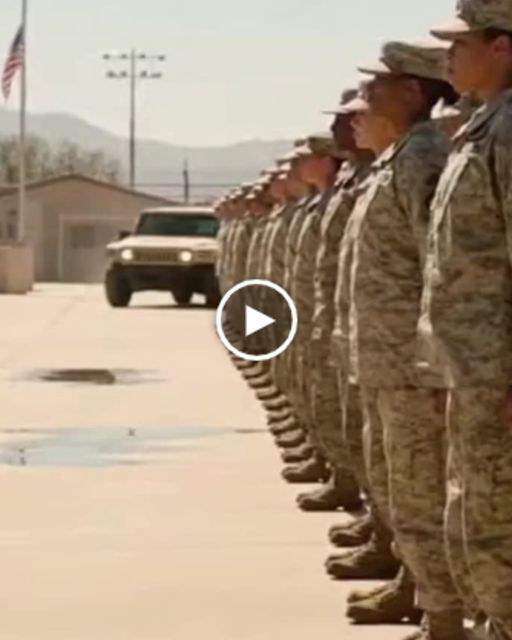
A quiet parade ground, a loud voice
The parade ground was so still you could hear boots scuff the gravel. Rows of soldiers stood in neat formation, shoulders squared, eyes front. It should have been an ordinary morning. But everyone knew the man walking the line was no ordinary officer to serve under. Lieutenant Colonel Miller ruled more with volume than with judgment. He believed fear was faster than respect, and he used it often.
A dusty SUV rolled to a stop by the gate. Miller stepped out with his usual swagger, scanning the yard as if he were searching for a reason to pounce. People lowered their gaze. No one wanted to catch his eye.
A young soldier who did not flinch
Across the square, a young woman in standard fatigues strode toward the center of the ground. She carried her helmet under her arm. Her steps were calm, deliberate, and steady, the way a person walks when they know exactly where they’re going.
She passed right by Miller without a glance. No salute. No pause. Just a quiet, confident walk as if the noise of the place meant nothing to her.
Miller erupted. He lunged after her with his voice already raised. “Hey! Soldier! You too good to salute?” His words cracked across the silent yard, hard and sharp.
He closed the distance quickly, planted himself inches from her face, and demanded, “Have you lost your mind? Do you know who I am?” Spittle flew with every syllable as his anger built on habit and a long-established pattern of getting his way.
The woman stopped. She did not step back. She did not apologize. Her eyes were clear and cool. When she spoke, her tone was even and controlled. “Yes, Miller. I know exactly who you are.”
The sound on that field shifted in an instant. It was as if the whole base inhaled and held its breath at once. Miller’s face reddened. His hand twitched upward as if to summon the military police, the reaction of a man used to instant obedience.
Stars revealed under a simple jacket
Then, with unhurried hands, the woman unzipped the light outer jacket that hid her collar. The cloth fell open, and the morning light caught a small detail with big meaning.
Stars.
Not one meant for a private or a corporal. Not even a field-grade officer. She wore the single star of a brigadier general.
Recognition swept across Miller’s face, draining all the color from it. The transformation was almost painful to watch. A moment ago, he had thundered. Now, he trembled. He snapped into a salute so stiff it looked like it might splinter his shoulder. “General,” he managed, voice suddenly dry and small.
She did not salute back. Not yet. She let the silence settle again, a different kind of quiet this time. Around them, soldiers held still, alert and astonished. To many of them, her name was known only in whispers passed along by those who paid attention. Brigadier General Ava Callahan. Some called her The Ghost, not because she was frightening but because she appeared where the truth was needed—often without announcement—and stayed long enough to see real change.
A new voice takes charge
Her posture was relaxed and sure. Her voice, when she finally spoke, carried further than Miller’s shouting ever did. “At ease, Colonel.” It was not loud, but it had the weight that only true authority brings.
She walked past him and turned to the formation. “My name is General Callahan. As of this moment, I am assuming temporary command of this base.” You could feel the news ripple through the ranks without a single word being spoken.
“There have been reports from this installation—reports of misconduct, mismanagement, and a culture held together by fear. I am here to understand what is happening and to correct it.”
She turned back to Miller, who looked like the ground had shifted beneath his feet. “Colonel, you will escort me to your office. Bring me every personnel file, every incident report, and every complaint filed in the last two years.”
Miller swallowed hard. “Yes, General.” The words came out thin, almost inaudible.
As they left the parade ground, a soft sound spread through the assembled troops. It was not cheering. It was something gentler but just as powerful—the sound of a long-held breath finally released.
Seeing the real base, not the staged one
Inside the command building, Miller tried a different face. He fetched files with trembling hands. He offered coffee, a chair, pleasantries. The bluster was gone, replaced by frantic courtesy. It did not work.
General Callahan settled into the seat behind his broad desk and began to read. She kept the same simple fatigues on for a reason. Rank can obscure the truth. She wanted the unvarnished version of the base, not the polished tour designed for visitors who can be impressed—or misled—by shine and ceremony.
Miller’s public outburst, and his choice of target, had told her more than any memo could have. But paper mattered, too, and she worked through it with steady focus.
Listening before judging
By the next morning, the base had a new rhythm. General Callahan set up a quiet room and invited people in one by one. She did not start at the top. She began at the bottom, with the youngest and most junior, the ones least able to push back when something was wrong.
At first, their answers were careful, as if every word might snap a tripwire. Years of fear can do that to good people. A private named Daniel sat across from her, hands fidgeting, braced for a trap that did not come.
“I’m not here to make things harder,” she told him gently. “I’m here to make things right. But I’ll need your help.”
His story spilled out, slowly at first. The shouted insults. The punishments that had more to do with humiliation than improvement. The day he was ordered to stand in driving rain for hours because his boots did not have a mirror shine. He had nearly quit after that. Not because he hated hard work, but because cruelty without purpose eats away at a person’s hope.
He found the courage to add more. “It’s not just the yelling, ma’am. It’s everything.”
Piece by piece, like careful threads woven into a larger picture, accounts began to surface. There were whispers of base funds diverted for personal comforts. A talented officer, Captain Reyes, had been sidelined after she offered a frank critique during training—professional feedback twisted into personal payback. There were small things that spoke to big problems, and big things that no one should ignore.
The courage of a seasoned leader
That evening, there was a soft knock on General Callahan’s temporary office door. Sergeant Major Davis entered with quiet dignity that comes from decades in uniform and a lifetime of doing the hard things well. He had the kind of presence that made younger soldiers straighten without a word.
He held his cap in his hands and spoke plainly. “Ma’am, they’re scared. They’ve seen what happens when someone speaks up.”
“I know,” she said. “That fear is exactly what we must undo.”
Davis nodded, as if a weight he had carried alone was finally being shared. He placed a worn, leather-bound journal on the desk. It was not an official log. It was his own record. “Two years,” he said. “Every time he bent the rules for himself. Every time he belittled someone who didn’t deserve it. Every time safety took a back seat to his convenience. Dates, times, and witnesses. I believe in the chain of command, ma’am. But sometimes the chain rusts from the top.”
General Callahan opened the journal. The handwriting was neat, crisp, careful. It was a ledger of truth. Not gossip. Not guesses. Facts, laid out with clarity and care. She looked up with deep respect. “Sergeant Major, this is courage.”
Davis offered a small, sad smile. “No, ma’am. This is what’s right.”
Facts replace fear
With the journal as a guide, the General’s questions became more exact. “Private Daniel, on May fourteenth were you ordered to repaint a fence during a mandatory maintenance period?” When a person hears a date, a time, and a detail, courage becomes simpler. Memories find their footing.
Soldiers found their voices when they realized the truth was not going to be ignored. Captain Reyes, steady and composed, explained the unfair reviews that had hobbled her career. A supply sergeant, shaken and tearful, admitted he had been pushed to alter inventory numbers to hide equipment that never should have left the base in the first place. She did not scold him. She thanked him for telling the truth and promised to protect those who had been compelled to enable wrongdoing.
Layer by layer, a fuller picture emerged. This was not simply a matter of harsh language or a bad temper. It was a pattern that put people at risk. A live-fire safety training had been canceled in favor of a golf game. Corners had been cut not for the mission, but for personal ease. The more they learned, the clearer it became that this was not leadership at all. It was control without care.
A desperate call that backfired
Confined to his quarters while the inquiry moved forward, Miller could feel the ground moving beneath him. The guards outside his door stood with a new steadiness. The troops walked with their heads a little higher. He realized he was running out of room to maneuver.
So he reached for one last lifeline. He called an old friend from his academy days—now a powerful senator with a long memory for favors. Miller painted himself as a victim of a so-called overeager general, a person who valued softness over strength. He asked the senator to make a call that would bring the whole process to a halt.
The senator picked up his phone and reached out—straight to the office of the Chairman of the Joint Chiefs of Staff. Polite words, practiced tone. “I’m calling about Brigadier General Callahan,” he began. “She’s disrupting an otherwise fine command. Perhaps it’s best if she’s recalled.”
A long pause followed. When the Chairman spoke, his voice was even, but it carried unmistakable warning. “Senator, do you truly want to interfere with General Callahan’s assignment?”
The senator did not yet see the edge he was stepping over. “I do. Colonel Miller is a good man.”
The Chairman replied, each word placed like a brick. “General Callahan is Ava Callahan, daughter of retired General Marcus Callahan—the same Marcus Callahan who helped you when your career nearly ended a decade ago. You once said you owed him your future.”
Silence filled the senator’s office as fully as a storm cloud fills a sky. He remembered Marcus Callahan well. Integrity, duty, steadiness. And he had heard whispers in recent months: Ava Callahan had been promoted. She had made a name for herself on merit, not because of her father’s reputation, but the connection mattered now—for truth and for consequences.
“Furthermore,” the Chairman continued, “General Callahan is there at my request. Concerns about Miller reached us through trusted channels, and I asked her to go. She works with my full support. I advise you to consider whether you want your name attached to obstructing an investigation like this.”
The senator’s confidence fell away. He had misread the moment, the people, and the principle at stake. “Understood,” he said quietly. “I was misinformed. Please let the General proceed. I may have additional information on Miller my office overlooked. I’ll send it over.”
The call ended. The last, fragile hope Miller had nurtured didn’t simply disappear. It reversed course and sealed his fate. The senator, eager to correct his misstep, forwarded long-buried complaints that aligned with what the General’s team was already uncovering.
Accountability arrives
The following day, Lieutenant Colonel Miller was relieved of command and placed in custody to await court-martial. He walked out of the same gates he once stormed through, not with a roar but with a small, shuffling step. Handcuffs glinted where swagger once had. He kept his eyes on the ground.
People did not cheer. They did not need to. There is a quiet kind of justice that speaks for itself.
Repairing what was broken
A week later, General Callahan stood again on the parade ground, this time in dress uniform. The single star on her shoulder caught the light, a simple symbol with an important message: rank is not about privilege. It is about responsibility.
“What failed here was leadership,” she said clearly. “Leadership is not built on fear. It is built on trust. It is not the loudest voice. It is the voice people choose to follow because it is fair, steady, and true.”
Then she called forward Sergeant Major Davis. In front of everyone, she spoke about his quiet strength, his dedication, and his decision to document what others tried to ignore. She then pinned new rank on his uniform, promoting him to Command Sergeant Major—the highest enlisted rank. The applause that followed was not forced. It was real, full, and grateful.
She looked for Captain Reyes next. “Your record has been reviewed,” General Callahan said warmly. “Your promotion to Major has been approved. It should have happened sooner.” Reyes saluted—sharp and proud—and blinked away tears she did not try to hide.
Finally, General Callahan found Private Daniel in the crowd. “I’ve read your file,” she said kindly. “You have heart and resilience. Your leadership failed you, but you did not fail yourself. I’ve recommended you for officer candidate school. We need people like you.” Daniel’s face lit with a smile that seemed to lift a weight from his shoulders.
By the time the General departed later that day, the base felt different. The air was lighter. Conversations were more open. A new commander was already en route—chosen not just for competence, but for character. The goal was not to erase the past, but to learn from it and build a healthier future.
What everyone took with them
Stories like this travel. They are told quietly in mess halls and on long duty nights, passed along as reminders of what leadership should be and what it must never become. The lesson is not complicated, and it is not new. True authority cannot be demanded. It must be earned, day by day, through fairness, competence, and care for the people entrusted to you.
Older hands on the base recognized this truth easily. Many had seen it in different uniforms and different workplaces across their lives. When a person in charge treats people with decency, standards rise naturally. When a person in charge rules by fear, everyone spends more time looking over their shoulder than looking ahead. Fear chases away initiative. Respect invites it in.
General Callahan did not fix everything in a week. No one could. But she set the tone. She put the right people in the right places. She showed that misconduct has consequences, and that honesty will be protected. She reminded everyone that the best leaders do not need to shout to be heard.
And in homes and barracks around that base, people slept a little easier. They knew they could do their jobs, learn, and grow without bracing for the next blow of needless cruelty. They knew that if they spoke up, someone would listen. That knowledge alone changes a workplace, a unit, and sometimes a life.
The young woman in the simple fatigues, the one who walked calmly across a parade ground and ignored a bully’s demand for a salute, left behind more than a new chain of command. She left a standard. Be the person whose voice does not have to be raised to carry. Be the person who measures strength by the people you lift, not the people you push down. Be the leader who remembers that respect is given most freely to those who offer it first.
On that base, long after the trucks rolled out and the files were boxed and shipped, people remembered the look on Miller’s face when he saw those stars. They remembered the steady tone of the General’s voice. They remembered the pride in Sergeant Major Davis’s eyes and the grateful smile on Major Reyes’s face. And they remembered Private Daniel, who stood a little taller because someone in authority saw not just a uniform, but a person with potential.
In the end, the question that started it all—“Why aren’t you saluting me?”—answered itself. A salute is not just a snap of the hand. It is a sign of respect. The kind that can be ordered is never the kind that lasts. The kind that endures is earned, one steady, decent decision at a time.
That is how fear ends. That is how trust begins. And that is how a place becomes worthy of the people who call it theirs.



