
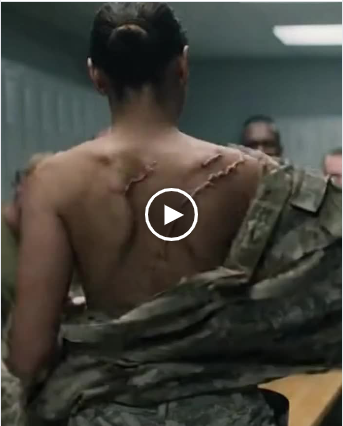
The Quiet Order That Changed the Room
The laughter stopped the moment he stepped through the doorway. The general did not shout. He did not need to. His presence carried its own gravity, and the air in the locker room seemed to settle when he spoke.
Get dressed, he said to the young woman, his voice steady and controlled. Then meet me in the briefing hall. He never looked away from the men who had been laughing moments before. The word Now followed, clear as a bell, and the room obeyed.
Her hands were shaking, but not clumsy. She slid her shirt on and buttoned it with the same careful focus that gets you through a dark night on a rough road. Around her, the soldiers who had smirked and joked a breath earlier suddenly found their boots very interesting. No one could meet her eyes. No one said a word.
The general turned to the room, his tone unchanged. Every single one of you. Briefing hall. Full uniform. Then he left. No finger pointing. No show. Just an order. And somehow, that made it heavier.
Formation, Silence, and a Thin Black Folder
Five minutes later, they stood in formation. Uniforms squared away. Backs straight. The easy banter that fills a hallway before a mission had evaporated. What remained was a silence shaped by confusion and a touch of dread. They knew something had happened. They did not yet know what.
She stood off to the side. Composed. Quiet. Shoulders set, chin level. If she felt exposed in that room earlier—if the scars across her back had seemed like a target—the quiet here seemed different. This was not exposure. This was a stage where truth would finally be heard.
The general walked in carrying a thin black folder. He set it on the lectern, took a breath, and looked straight at them. You see scars, he said. You assume weakness. You assume incompetence. He opened the folder with a calm hand, as if he had done this a thousand times and would do it a thousand more.
The Photograph No One Wanted to Remember
He lifted out a photograph and held it where they all could see. It was grainy, tinted with the ghostly green of night vision. Smoke twisted up like dark ropes. A transport angled wrong. Metal torn. A convoy in the kind of distress that wakes you up years later in a cold sweat.
Some of the men in that room recognized it instantly. A breath caught here. A jaw tightened there. A whisper escaped from one of them. I was there. The general heard him without turning his head. Yes. You were. Then he turned the photograph to face the formation, making sure no one could look away.
And the reason you are standing here today, he said, is because of the soldier you mocked in that locker room.
The silence in the room changed shape. Gone was the blank hush of not knowing. What spread now was the sharp, unforgiving quiet that follows a hard truth. The general placed the first photo down and lifted another document from the folder. This one was a medical report.
Facts, Not Flourish
Burn trauma. Shrapnel wounds. Spinal lacerations. He read the words without emphasis. He did not need to embellish. Facts do their own work when they are heavy enough. Six months ago, he said, your convoy was hit by a secondary device. Flames spread to the rear transport.
Several men in the ranks stiffened. A few looked at their boots, as if the floor might open and swallow the memory whole. They remembered the noise. The heat. The shocking moment when training meets chaos and you must choose your next breath with care.
She was in that transport, the general said. Heads turned toward her then, quick and ashamed. She did not return their gaze. Her eyes were steady and forward. She pulled two of you out before the ammunition ignited. The words landed like stones in a still pond, leaving widening circles of understanding. She went back in for a third. She stayed inside long enough to drag out a man who outweighed her by sixty pounds.
There was a pause before the next line, and it was not for show. The general knew that a beat of quiet sometimes carries more truth than another sentence. When the structure collapsed, he said, she took the brunt of it.
No one dared speak. She lost forty percent of the skin on her back. She refused evacuation until every man in that convoy was accounted for. He closed the folder and looked across the room once more. You call those scars weakness?
Strength Without a Speech
The weight in the room pressed on every chest. Faces that had worn smirks now settled into something more honest. Embarrassment. Shock. Regret. One of the men who had laughed let his eyes fall to the floor. Another stared straight ahead, jaw tight enough to ache.
The general turned to her with a small nod. Would you like to address them? For the first time since this began, she hesitated. Just a fraction of a second. Then she stepped forward. Her voice, when it came, was calm. I did not do it for recognition. No edge. No bitterness. Just truth, plain and respectful. I did it because that is the job.
She looked across the formation at the same men who could not meet her eyes in the locker room. I do not need your praise, she said, her voice low. But I will not accept your contempt. There were no theatrics in it. It was controlled. Clear. Final.
Dismissed, the general said. It should have sent the room moving. But no one moved. They were rooted there by something new—an understanding that has weight and consequence. Shame came first. Respect, surprisingly, was already right behind it.
Dangerous Ground, Honest Answers
Most stories would end there, with a tidy bow and a relieved applause. This one did not. One man stepped forward. Sergeant Keller. He was the one who had reached out and touched a scar that was not his to touch. He looked at the general, not at her.
With respect, sir, we did not know. The general’s eyes were steady. You did not ask. Keller held his ground. We were not told. The air tightened. It was dangerous ground. But the general did not pause. Her file was sealed at her request. Quiet murmurs moved through the formation. She did not want special treatment.
Every head turned her way again. She answered before anyone could shape a question. I did not want to be the girl who survived. The words were simple, and in their simplicity, you could hear the exhaustion of someone who has had to justify her place more times than anyone should.
The Part No One Else Knew
Guilt has a way of creeping in quietly, and you could see it starting to reach Keller’s expression. But guilt does not fix damage. It only points at the work yet to do. Later, when the room emptied out and the echoes faded in the hallway, she stayed behind. The general approached more softly this time.
They will come around, he said. She did not answer right away. He watched her as carefully as a medic watches a pulse. This is not really about them, is it? he asked. Her jaw tightened. No, sir.
He waited without pushing. Finally, she let out a slow breath. There was a fourth man in that transport. The general’s face changed. He had not known. He did not make it, she said. The words were flat, respectful, and terribly controlled. But her hands trembled again. They do not know that part.
The general closed the folder with quiet care. They do not need to. Her eyes rose to meet his. I do. That was the wound that could not be seen. Not the scars. The memory. The moment that would not stop replaying no matter how many miles she ran or how many hours she drilled.
One Witness in the Doorway
Footsteps sounded in the hallway. Someone had not fully left. Keller stood in the doorway, still and pale. He had heard enough, and what he had heard was heavier than anything said in formation. He did not step inside. He did not interrupt. He simply stood as if receiving a message he would carry the rest of his life.
Who was he? Keller asked quietly. She looked at him for the first time that day. Private Ramirez. Keller flinched as if struck. Ramirez had been under his care. His responsibility. The words hit him with a weight he could not set down.
She went back in for him, the general said, his voice calm but unwavering. Keller’s color drained. And she almost died trying. The weight in the room moved again—off her shoulders, where it had rested far too long, and onto his, where some part of it belonged.
The Salute That Meant Something
Keller stepped forward, not to argue, not to posture, but to stand. I remember the fire, he said. His voice had changed. I remember someone dragging me. She nodded once. That was you? Another nod. He swallowed. And Ramirez? I could not reach him, she said. Barely more than a whisper, and yet you could hear every ounce of effort that had gone into that attempt.
Silence stretched. Then Keller did the simplest and hardest thing. He raised his hand and saluted her. Not with a slouch. Not out of habit. With intention. With precision. With a humility that said more than any long speech. I was wrong, he said. No drama. Just truth.
How Respect Spreads
By sundown, the story had traveled across the base. Not because she told it. She did not. Others did. And they told it without fanfare. The tone changed. The looks changed. It was not about admiration or pity. It was respect. The kind you do not clap for. The kind you carry.
That evening, she found a quiet place near the motor pool and sat alone on a bench. The air smelled like oil and a day’s worth of heat left on the pavement. The scars on her back ached the way they sometimes do when the air cools. Not because of what had been said to her. Because of what she still remembered.
The general found her there. You could transfer, he offered, his voice as gentle as a man like him allows. She shook her head. No, sir. Why? She looked back toward the barracks and answered with the kind of clarity that guides people through hard seasons. Because I am not done. Not with them. Not with myself.
A Different Kind of Morning
The next morning, formation felt different. Not softer. If anything, heavier—in the way that takes silliness out of a room and replaces it with purpose. Men stood a little straighter. Eyes forward. When the call to run came, no one misplaced her equipment. No one brushed her shoulder or blocked her path.
Halfway through the run, Keller eased back beside her. He did not try to talk over the cadence of their breath. He did not hurry her or slow her. He simply matched her pace. Step for step. All five miles. They did not speak. They did not need to. Sometimes respect is quiet work.
When they finished, no one laughed. There were no grand announcements or elaborate gestures. The change was in the small things—the check of a strap, the unspoken offer of a canteen, the space made without being asked. Some wounds do not disappear. Some scars do not fade. But properly earned respect does not fade either.
What Strength Looks Like
In the weeks that followed, no one in that locker room mistook strength for volume again. There is a lesson you learn only once if you are wise. The strongest person in a room is not always the loudest. It is often the one who has already walked through fire—and, in her case, carried others out with her.
For some, the lesson came with embarrassment. For Keller, it came with responsibility. He started holding his team a little closer and listening a little faster. He took the extra moment to ask the question he had not asked before. Are you alright? What do you need? He did not ask to pry. He asked to understand. And in time, men stopped thinking of her first as the woman with the scars. They thought of her as the soldier who did the job, no matter what it cost.
As for her, healing did not arrive all at once. It rarely does. But it arrived in steps. A nod where there had once been a stare. A teammate waiting at the end of a drill. The general’s steady presence at the edge of a field exercise. Small things that build a bridge strong enough to carry you.
Quiet Courage, Lasting Change
People often think courage announces itself with a shout. More often, it arrives with a simple, steady voice. I did not do it for recognition. I did it because that is the job. Those words stayed with the unit. They found their way into how the team trained and how they spoke to one another, especially when tempers ran hot or days ran long.
There is a discipline to kindness, especially in a place where toughness is a requirement. Respect is not softness. Respect is precision. It is knowing when to push and when to pause. It is the professionalism that makes sure every person has a fair chance to do the work they have trained so hard to do.
In time, the laughter in the locker room returned, but it sounded different. Not cutting. Not careless. It sounded like a team that understood each other better. And when a new recruit arrived with a scar of his own—a line across his forearm from an old accident—no one asked to see it. They asked him where he wanted his gear stowed and how he liked his coffee.
The Memory That Matters
She still had nights when the past woke her up like an alarm. She still had days when the old burn flared a dull, familiar ache. But the memory that rose most often was not the flash or the noise or even the pain. It was the moment in the briefing hall when the room learned what her scars meant. Not a weakness. A witness. A record of a job done with courage when it mattered most.
Not everyone will know your story. Not everyone needs to. But the right people will see the truth in how you carry yourself each day. Quietly. Steadily. Ready to do the work again. That is how trust is built. That is how a team becomes a unit.
One Final, Simple Truth
The day they laughed at her scars did not define her. The day they learned what those scars meant did not define her either. What defined her was everything in between—and everything after. The morning runs. The careful checks. The choice to stay. The willingness to step into the heat for someone else and keep going, even when no one is watching.
Strength does not always speak first. Sometimes it waits. Sometimes it listens. And sometimes, when the time is right, it steps forward and says only what needs saying. I do not need your praise. I will not accept your contempt. Then it gets back to work.
From that day forward, no one in that unit made the mistake of measuring strength by volume or smooth skin. They measured it by steadiness under pressure. By the hand that reaches back into the smoke. By the soldier who walks through fire—and carries others out.



