
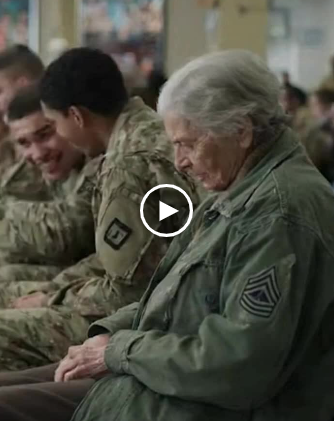
The laughter began as a thin ripple, the kind that slips through a room without asking permission. It wasn’t loud, not at first, and yet it carried a sting. In the visitor center at Fort Breenri, people were coming and going, checking in, sitting with coffee cups, waiting for their names to be called. In the middle of it all sat an older woman in a worn olive jacket, quiet and still, as if the noise of the building flowed around her.
The Waiting Room
She sat with a straight back, small in the chair but steady, hands folded over the frayed edge of a sleeve. The jacket had seen sun, rain, and years. Its collar had lost a button. The elbows were thin from use. A patch on the upper arm clung to the fabric with stubborn stitches, bleached almost to the color of the cloth beneath it.
Two teenage recruits hovered near the door, uniforms crisp, eyes bright with the particular energy of youth that hasn’t yet been introduced to what time can do. One nudged the other, smirking.
“Bet she pulled that thing out of a dumpster,” he said, just loud enough to be heard by everyone who wasn’t supposed to hear it.
The chuckles that followed were sharper this time. Confidence can turn unkind when it’s eager to prove itself. The woman didn’t flinch. She didn’t even lift her gaze. She stayed very still, as though listening to a voice that no one else could hear.
A Patch Seen by the Right Eyes
Bootsteps paused mid-stride across the room. A tall, silver-haired general turned his head, attention drawn not by the laughter but by the patch on the woman’s sleeve. His expression shifted, the weathered look of a man who has given too many orders and written letters no one wants to read. His eyes fixed on that small square of fabric as if it had spoken his name.
He crossed the room the way a man walks through a heavy memory. The waiting area grew quiet one breath at a time, the sound receding until even the air seemed to listen. He came to a stop two paces in front of her, and in a single, precise motion, he raised his hand to his temple and saluted.
Conversation disappeared. Chairs creaked as people turned. The recruits stood frozen, their grins vanished, replaced by a confusion that looked a lot like fear.
The woman lifted her eyes. Her recognition was not for the man, but for the gesture. It was as if that salute carried with it the ghosts of a hundred names and a thousand footsteps. She nodded, almost imperceptibly, and the small movement hit the room like a bell.
The general lowered his hand and spoke without raising his voice. “This woman has earned more respect than most of us can measure.”
The recruit who had joked stared at the floor. His ears had turned a guilty shade of red.
The general faced her again. “Ma’am, would you allow me the honor of escorting you?”
She opened her mouth, then closed it, as though setting a lid on a box of years. She gave him a simple nod.
He offered his arm, careful as a man handles something precious. She rested her hand on it, light and sure. They walked together, not with ceremony or haste, but like two people who understood the same language without needing to speak it.
Down the Quiet Hall
As they moved toward the corridor, the recruits stepped aside. Silence kept pace with them, a companion that did not ask for attention and yet had everyone’s. A sergeant at the end of the hall saw the general approach, snapped to attention, and opened the door to the Command Wing. No questions asked.
They passed framed photographs and plaques fixed to clean walls. Men and women in those frames wore medals and formal smiles, caught in moments when bravery holds still for a camera. There were scenes of desert heat and winter cold, sand and snow. Years, summed up in a few inches of glass and wood.
Neither the general nor the woman said a word. The rhythm of their footsteps, steady and in time, spoke well enough. At a heavy door marked Strategic Archive Division, the general entered a code. A soft hiss sealed the outside world away.
The Record That Wasn’t Lost
Inside, the room was full of quiet. Shelves held rolled maps, labeled boxes, bound folders the color of old leather. The woman slipped her hand from the general’s arm and moved with an ease that didn’t match her years. She seemed to know where to go. Her fingers brushed along spines like a pianist testing keys before a song.
She stopped at a shelf in the far corner, reached behind a dusty box, and pulled out a slim, leather-bound folder. The label was faded but clear enough to read: Operation Blackbird — Unit C, 1969.
The general exhaled, a breath that sounded like the end of a long search. “I thought this was destroyed.”
She opened the folder. Papers yellowed with time rested beside black-and-white photographs. A list of names appeared on the inside cover, some crossed out, some underlined, all of them part of a story that had not been told often enough.
Her voice, when it came, was dry and steady. “I was the communications specialist. We were dropped behind enemy lines. No clear way out. No promise anyone was coming. Just the job we were given.”
The general nodded. The past moved across his face like weather. “Intel always said your unit bought Ridgeway enough time. Two battalions stalled by a handful of people who refused to break. The evac got through because of that stand.”
“No one believed us afterward,” she said. “Said the reports were wrong. We were shadows on paper. Easier to forget than to explain.”
The general studied the photographs and then looked at her, voice low. “My father was with Ridgeway. He told me about a voice on the radio. Calm, even when the sky sounded like it was tearing. He said that voice kept him moving when he was sure he was going to stop.”
She swallowed. Her lips trembled, not from fragility, but from memory heavy enough to bend steel. “They told me I couldn’t go back. Too injured. Too old-fashioned for the new way of doing things. We packed it all away and called it history. But the jacket… the patch… I couldn’t pack that away. I re-stitched it every time it frayed. Some things you hold on to so you don’t lose the people they belong to.”
A Medal Finds Its Place
The general straightened as if the moment had weight he could feel in his shoulders. From his pocket he took a small velvet case and opened it. The metal inside caught the thin light, polished and solemn. The Medal of Valor.
“Ma’am,” he said, voice roughened by more than age. “This should have been yours decades ago. I pulled every thread I could find to prove what happened. When I saw your patch today, I stopped looking. I knew.”
She stared at the medal as if it were a familiar face seen after a long absence. Her hand rose, then paused in midair. “It isn’t just mine,” she whispered. “It belongs to all of them.”
He nodded. There are truths that don’t need arguing. He set the medal inside the folder beside the names and the photographs, not on top of them, but alongside, as if taking its place among old friends. “Then let it rest with them.”
A single tear slid down her cheek. She didn’t brush it away. Tears can be a way of standing at attention too.
Respect, Given and Received
Word can move faster than sound in a place like this. Outside the archive door, recruits had gathered without being told to, the air around them weighted with a kind of waiting that wasn’t sure what it was waiting for.
The general stepped out first, then turned, giving her room to follow. She didn’t look smaller now. She looked complete. Time can take many things, but it can also polish what it leaves behind.
The general cleared his throat. “This is Mrs. Eleanor Hart. Call sign Sparrow. Unit C, Operation Blackbird. ’66 to ’69. She is a hero. From this day forward, remember her name.”
There was a sound like a single breath being drawn by many people at once. One by one, the recruits stood straighter. One by one, their hands rose in salute. The hall was very quiet, except for the small rustle of fabric when arms moved.
Eleanor did not return the salute. Instead, she stood as she had in the waiting room, steady and self-contained. She let her gaze settle on each face. What they saw there was not judgment, and it was not grandness. It was something simpler that matters more.
“I was you once,” she said gently. “I laughed at what I didn’t understand. I said things I thought were clever and weren’t. Then I learned. You will too. I hope your lessons are kinder than ours were.”
The general offered to walk her out. She gave a small smile that reached her eyes. “I came in on my own,” she said. “I can walk out the same way.”
He did not argue. Instead, he stepped aside, the way a person does when respect is the only right response. The recruits parted, making a path in the middle of the hall. Eleanor took it, head up, jacket moving just enough with her steps to seem almost alive.
The Walk to the Gate
Outside, the day had turned breezy. Clouds shifted like slow ships, and the sun cut through them in bright stripes that fell across the pavement. She passed the flagpole, the cloth catching the wind and snapping in clean, strong turns. A few civilians near the parking lot paused and watched. They didn’t know why they were watching. They only knew they should.
At the gate, hurried footsteps came up behind her. “Ma’am!” The young recruit who had joked earlier stood a few paces back, hat in his hands now, all that earlier confidence stripped to something more honest.
She paused without turning. He caught his breath. “I… I’m sorry. For what I said.”
Eleanor turned then and met his eyes. She had the kind of gaze that goes past the surface without being unkind. “You’ll make it right,” she said. “Someday. One day you’ll be the one to set the tone in a room. Make sure the uniform you wear means something when that day comes.”
He nodded, words suddenly hard to find. She gave him a look that held both farewell and a task, then moved on. The guard at the gate opened it without asking her business, hand pressed quietly to his chest as she passed.
After the Lesson
Back inside, the general stood with the recruits, the hallway still subdued. He didn’t ask them what they had learned. Some lessons don’t need to be spoken to be remembered. “Lesson of the day?” he said anyway, to break the spell gently.
They didn’t answer. He nodded. “Good. Some lessons don’t need repeating.” He turned and walked down the corridor, leaving behind a calm that had nothing to do with silence and everything to do with respect.
On the Road Home
In the visitor lot, Eleanor unlocked a weathered sedan and settled behind the wheel. The engine coughed, protested, then decided to cooperate. Before shifting into gear, she reached into her pocket and touched the corner of an old photograph. The paper had softened over time, the edges turned in, the image worn where fingers always found the same place.
She held it up for a moment. Faces smiled from beneath helmets, young and certain in a way that only youth can be. Names rolled across her mind, each one a small flame that didn’t go out when the wind came. She pressed the photo lightly to her heart, then slipped it back where it belonged.
As she pulled onto the road, the wind tugged at the edges of the day, and the clouds moved aside long enough for a wide band of light to cross her windshield. She didn’t look back at the base. She didn’t need to. Some places you leave, and some places you carry with you. This was both.
Behind her, stories began to change shape. A teenager would go home and tell someone about a woman named Eleanor Hart and a patch with a history behind it. A sergeant would look up an old mission he had never heard of. A general would sit alone at his desk for a few minutes longer than usual, hand resting on an empty folder where a medal should have sat for decades, and think about a voice on a radio that once helped his father find his way home.
The jacket she wore still wasn’t new. The patch was still faded. But both had outlived the need to be bright in order to be seen. They had become something sturdier than cloth and thread. They had become a promise kept.
In time, people at Fort Breenri would tell the story the way places pass down what matters. They’d talk about the day laughter shrank and a room stood still. They’d talk about the salute that carried more than rank. They’d remember that the person who seems ordinary can carry a history that changes the air when it’s recognized.
And for those who were there, the lesson would be simple and steady. Respect does not look for a shine. It looks for the truth. Sometimes you find that truth in a folder marked by a year. Sometimes you find it stitched into a sleeve by hands that won’t let go. And sometimes, if you’re very lucky, you find it in the quiet nod of someone who has walked farther than you know and still stands with grace.
Eleanor drove on. The road ahead was unremarkable, lined with familiar trees and signs to towns she had passed through before. But the day had shifted. A memory had been set back into its proper place. A name had been spoken out loud where it could be heard. In a world that moves fast and forgets faster, that is no small thing.
Somewhere behind her, in a long hallway that would feel different for a while, a group of young recruits stood a little taller. Somewhere on a shelf inside a quiet room, a folder held a medal beside a list of names. And somewhere in a worn jacket, a faded patch rested easy, exactly where it had always belonged.



