
A quiet morning turns on a dime
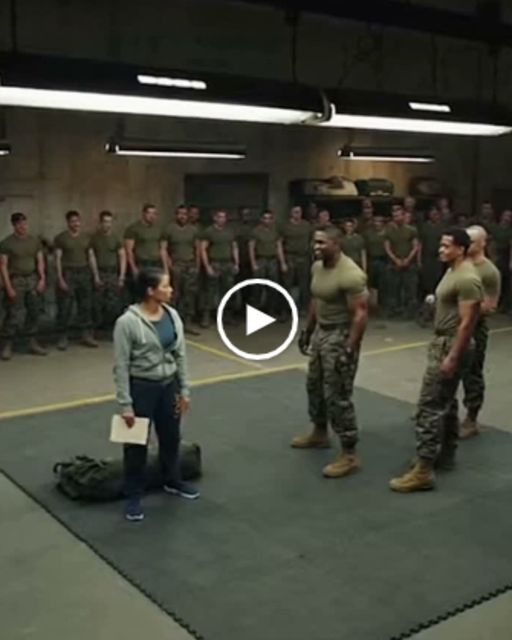
I was halfway through a bitter cup of break-room coffee when a commotion pulled my attention toward the back of the gym. Three of our loudest, most confident hand-to-hand instructors had circled a woman I’d never seen before. She wore faded Navy sweats and carried a sealed manila envelope, nothing more.
We were in Bay 9 at Fort Halberd, a place that didn’t appear on any official orientation tour. It wasn’t a real training area. It was the kind of corner that springs up in every base—a no-frills patch of concrete where people push themselves after hours, sometimes too hard, sometimes with more ego than sense. No medics. No whistles. Just skill, swagger, and sweat.
When the woman stepped in, quiet and calm, it drew every eye. She wasn’t big or imposing. No puffed chest, no flexing. Just an ordinary presence in an ordinary sweatshirt. But the envelope she carried, sealed in red wax, made me pay attention for a different reason.
Price grinned and rolled his shoulders. Torres cracked his neck. Vance, the biggest of the three, folded his arms, soaking in the show that hadn’t even started yet. They’d already decided what this was going to be. They figured they’d have a quick laugh, make a point, and go about their day with a story to brag about.
Price spoke first, the way he always did. “Three of us. One of you,” he said, grinning like it was a game. “Go on then, sweetheart. Fight us.”
The ring formed fast. Marines edged in close, eager for spectacle. I’d seen it before—good men getting too sure of themselves, forgetting the difference between confidence and arrogance. The whole place thrummed with expectation. Everyone figured the outcome was a foregone conclusion.
But the stranger said nothing. No pushback. No sarcasm. She just set the envelope down—carefully, as if it mattered where—and stepped into a ready stance that didn’t look like anything I’d seen on a Marine Corps poster. Her center of gravity dropped. Her hands were open. Her eyes were steady and quiet.
Three moves, three hard lessons
Price went first. He’s a bruiser by trade and by temperament, and he swung a right hand designed to end arguments before they begin. It should have been the hit everyone remembered.
Instead, she slid a half-step, calm as a summer tide, and tapped a palm strike into his jaw so precisely that it sounded like a chair leg snapping on tile. Price hit the concrete and blinked up at the ceiling, suddenly unsure of everything.
Torres charged next. It wasn’t strategy. It was anger. She caught his arm, turned the wrist, and pressed precisely where pain lives. He dropped, breath hissing through his teeth. No theatrics. No windup. Just exactness, applied without cruelty and without hesitation.
The noise in Bay 9 vanished. Eyes widened. Mouths closed. No one was laughing now. The place had shifted from entertainment to education in a matter of seconds.
Standing from my bench so fast it scraped the floor, I leaned forward, watching her hands more than her face. The open stance. The economy of movement. I hadn’t seen that sort of control since a joint-ops assignment a decade back, the kind you don’t talk about over casual beers.
I looked down at the envelope by my boot and saw the red wax seal. Stamped into it was a coiled serpent wrapped around a downward-pointing trident. Not a mark for public display. Not something you’d spot at a base exchange. It belonged to a unit that didn’t give interviews, take credit, or exist on paper where anyone could find it.
Vance stood very still. He’s a wall of a man, and he can fight, but he isn’t a fool. He watched the way she breathed—calm as if on a walk. He watched how she never clenched a fist. Then he slowly raised his hands and took a cautious step back.
It wasn’t surrender. It was recognition.
The Colonel arrives
The doors slammed open hard enough to rattle the cinder blocks. Colonel Davies strode in, two MPs at his flanks. He took in the scene in one sweeping glance: Price and Torres being pulled up, Vance tight and pale, the woman at the center like the eye of a storm.
He opened his mouth, ready to break the paint off the walls with pure volume, when I stepped forward and lifted the envelope. “Sir,” I said, “this is for you.”
He took it. His eyes fell on the address, then on the scarlet seal. The shift in him was immediate. The anger cooled into something so serious it drew the warmth from the room. This was a man who had been under fire in three decades and kept moving. Now he looked, for the first time in a long time, like someone who had just been handed a live device with a loose pin.
“Clear the bay,” he said quietly. “Now. Medical to my office for these two. Everyone else, out.”
In under thirty seconds, the gym was bare. It was just me, the Colonel, the two MPs, the instructors, and the woman who hadn’t broken a sweat.
“You three,” he told the instructors, “my office. Ten minutes.” Then, to the woman, with a level of courtesy that made every hair on my arms stand up: “Ma’am. If you’ll follow me.”
As she passed me, our eyes met once, briefly. She dipped her chin, the smallest acknowledgment that I’d understood what others had missed.
“Gunny Miller,” the Colonel said to me, “you’re with me.”
Names, ranks, and the cost of arrogance
The office that usually echoed with sharp reprimands felt different, like a chapel after the last hymn. Price and Torres sat stiffly, pride bruised harder than bone. Vance stood at parade rest, jaw tight. The woman took up a position by the window, watching the training fields like someone reading a weather report.
The Colonel placed the unopened envelope in front of him and stared at it a moment longer than felt comfortable. When he finally spoke, his voice was level. “Sergeant Price. What happened?”
Price tried to shore up what little pride he had left. “Sir, this woman entered a Marine-only training area. We moved to escort her out. She became hostile.”
Even with my lips pressed together, it was hard not to laugh. It wasn’t courage that made him say it. It was the last, weak thrash of a drowning ego.
The Colonel’s gaze stayed on him a beat too long, then shifted to the seal. “Hostile,” he repeated softly. “Three lead instructors against one unarmed woman, and she became hostile.” He picked up a letter opener, slit the wax, and slid out one sheet of paper and a small black USB drive.
He read. The color left his face.
When he looked up, he didn’t look at his men. He lifted his eyes to the woman by the window. “Lieutenant Commander Rostova.” He exhaled, something between respect and disbelief. “My God.”
“Colonel,” she said. Her voice was calm, precise, and free of ornament.
He tapped the paper with a finger that wasn’t quite steady. “It says you were to arrive, deliver, and observe. That’s all. It does not say anything about a demonstration.”
“Your men initiated the demonstration, sir,” she replied. “I supplied the lesson plan.”
The faintest smile tugged at the corner of my mouth.
The Colonel turned to Price, Torres, and Vance. He didn’t shout. He didn’t need to. “You are the tip of the spear at this facility,” he said. “You train our Marines to be disciplined and lethal, in that order. You teach respect for the uniform and each other. Today you showed me something else entirely.”
He leaned forward, voice dropping. “You saw someone unassuming and thought ‘easy mark.’ You forgot what our code demands. You forgot what service means.”
He sat back, older in that moment by a year. “This document is an evaluation of our training protocols, from very high places. It was largely favorable.” He glanced at Rostova. “I assume you’ll be filing an addendum.”
“A detailed one,” she said.
That settled it. The future had been written in less than five minutes.
“Dismissed,” the Colonel said to the three instructors. “Be in the anteroom at 0600 for your orders.”
They rose, defeat heavy as a rucksack, and shuffled out.
The Colonel faced me. “You recognized the insignia.”
“Yes, sir,” I said. “Kandahar. Task Force Aegis. I saw one of theirs work once. Looked a lot like what we just witnessed.”
He nodded, his jaw set. Then he turned to Rostova. “Commander, my apologies for the reception.”
“No apology needed,” she said. “I often learn more from a base’s unofficial spaces than I do from briefings.” She looked my way. “Gunnery Sergeant Miller. Second MSOB. Operation Vigilant Shield.”
Old dust stirred in my chest. That operation wasn’t supposed to have echoes. “Yes, ma’am.”
“I read your file,” she said, the words simple and without flattery. “You kept your head when others did not. Good instincts.”
“Gunny,” the Colonel said gently, “you’re dismissed.”
I saluted and stepped out, but I didn’t go far. I waited in the hallway because something in me wanted to hear her voice again, to ask one question I couldn’t shake.
What strength really looks like
She emerged a few minutes later, the kind of quiet presence that doesn’t ask for space but somehow creates it. “Commander,” I said.
She turned. “Gunnery Sergeant.”
“For what it’s worth,” I said, “they had it coming.”
She let a small, sad smile appear and disappear. “They’re not bad men. They’re men who confused aggression with strength. It happens more often than you’d think.”
“That technique,” I asked. “The way you moved. The open-hand strikes. Those pressure points. That’s not standard kit.”
“No,” she said. “Most combatives aim to stop a threat quickly—break, drop, end. What I use aims to de-escalate with certainty. End it before it truly begins. Minimum force, absolute control.”
She held my eyes. “True strength is control, Gunny. It’s choosing restraint when you’ve mastered violence. It’s knowing you can shatter a man and deciding, instead, to turn his wrist until he sits down. The loudest person in the room is almost always the one most afraid of being unnoticed.”
Her words landed with the weight of a lesson I should have learned a decade earlier. They fit Price and his crew so exactly that it felt like she’d written their names around them.
She gave me a small nod and moved on, headed for the gate. Her work here was done.
A consequence that wasn’t punishment
By the next morning, rumors flew from the mess hall to the motor pool. Everyone asked the same questions: Who was she? What would happen to the instructors? By 0800, a notice went up on the command board, and the answers weren’t what anyone expected.
There were no stripes torn off. No cells. No headlines.
Reassignment. Effective immediately.
Price, Torres, and Vance were sent to Walter Reed National Military Medical Center, to the prosthetics and rehabilitation wing. Not as guards. Not as instructors. As orderlies.
Their new days would be spent helping wounded warriors, men and women who had paid a price the rest of us pray we’ll never have to. They would guide an eighteen-year-old through the first steps with a prosthetic leg. They would learn how to steady a spoon in a rebuilt hand. They would watch a veteran relearn how to stand so he could place a sergeant’s stripes on his son without wobbling.
It was a masterstroke. It wasn’t humiliation—it was humility. Not punishment, but a path to understanding. On paper, it was the Colonel’s call. In spirit, it had the quiet imprint of a woman in Navy sweats who taught without raising her voice.
What changed after
In the months that followed, Bay 9 grew quieter in the best possible ways. The showboating thinned out. The training sharpened. People still pushed hard, but with purpose instead of noise. It’s amazing how fast a culture can change once it’s reminded what the uniform is supposed to mean.
Then a letter arrived for me. From Vance.
He wrote that his first weeks at Walter Reed were the hardest of his life. Not because of the hours, or the tasks, but because of the honesty they demanded. He told me about a former Marine Captain, a woman who’d lost an arm to an IED, practicing a simple bow knot on a shoelace, over and over, until her fingers caught the pattern. She didn’t complain. She didn’t need an audience. She just worked.
He said Torres broke down quietly one afternoon after listening to a young Corporal talk through the day his convoy vanished into a roar of flame. He said Price—the loudest voice in any room—now read softly to a blinded veteran in the evenings, learning how to keep his own voice steady.
Vance closed with a sentence I’ll never forget. “We thought we were tough because we could win a fight,” he wrote. “We were just bullies. The people here are tough. They fight every day for small victories we took for granted. They’re teaching me what strength really is.”
I folded the letter and slipped it into my pocket, then looked out across the training field. Young Marines ran drills, faces set, voices loud. The old fire was still there, but there was something steadier underneath it now, something better.
My mind drifted back to Lieutenant Commander Rostova. She had walked into the loudest corner of our base and never raised her voice. She had ended a fight before it really began, and in doing so, she didn’t just humble three men. She handed them a chance to become the kind of men the Corps could be proud of again.
The lasting lesson
For anyone who’s spent time in uniform—or even just time in life—you learn that strength isn’t always what it looks like from the cheap seats. It isn’t the person talking the longest or the loudest. It isn’t the body that takes up the most space. Real strength is quieter. It’s specific. It’s the ability to choose the right amount of force rather than the most.
That morning in Bay 9, I watched control at work. Not showmanship. Not spite. Control. The sort that protects dignity while it ends danger. The sort that leaves room for people to become better after they’ve fallen short. I don’t know a single drill manual that puts it that plainly, but every good leader I’ve known has carried that truth in their bones.
If you’ve ever wondered what separates a bully from a professional, it isn’t power. Both can have that. The difference is purpose. A bully uses power to make themselves feel big. A professional uses power to make the situation small. One needs an audience. The other needs an outcome.
And so the memory that lingers for me isn’t the palm strike or the wrist turn. It’s the sealed envelope, the red wax, and a woman who made a choice about how to teach three men a lesson they’d never forget. It wasn’t a public shaming, and it wasn’t a prison sentence. It was a doorway. On the other side were people whose daily courage is too often unseen—people who know that toughness isn’t a pose. It’s patience. It’s getting up again tomorrow and trying the knot once more.
In the end, that’s what I took from Lieutenant Commander Rostova’s visit. The strongest person in the room is rarely the one making the most noise. More often, it’s the one letting the noise burn out, then stepping forward with a steady hand and a better way. True strength lives in restraint, respect, and the kind of quiet courage that does what’s right when nobody’s keeping score.
It was a good day for Fort Halberd. Not because three hard men were humbled, but because they found a path to something greater than pride. And the rest of us, whether we wore chevrons or bars, learned to look twice at what toughness really means.



