
The Challenge No One Expected
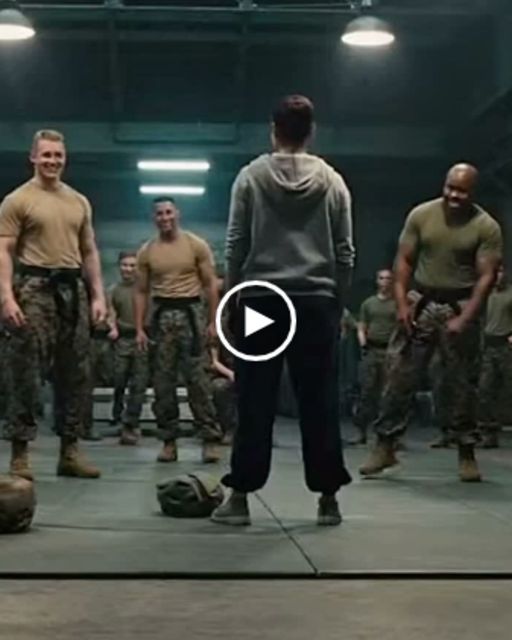
“Go on then, sweetheart. Fight us.” The line was meant as a joke, tossed across the gym by Staff Sergeant Price with his usual growl. He was a big man—more than two hundred pounds of muscle, the kind of presence that filled a room before he even spoke. Most of the recruits thought the matter was settled the moment he cracked his knuckles.
Across from him stood a woman in faded Navy sweats. She was small, quiet, and—most important to men who judge by patches and rank—completely unmarked. No insignia. No fanfare. Just calm eyes and a simple hoodie. I remember thinking she could have been anyone’s aunt stepping into the wrong building by mistake.
Price’s grin widened when Torres and Vance flanked him. “Three of us,” he said, rolling his shoulders. “One of you.” The onlookers chuckled. You could feel the anticipation in the room, a restless energy that sweeps through a crowd when they think they’re about to see something easy and obvious.
We were right about one thing. We were going to see a beating. But we were wrong about who would be on the receiving end.
Six Seconds That Changed a Room
Price led with a heavy right, the kind meant to crush confidence in one move. The woman did not panic. She stepped in, close enough to borrow his balance, her palm striking the hinge of his jaw in a motion so efficient it was almost gentle. There was a sharp sound—a clean, crisp connection—and Price reeled.
Torres lunged to grab her. She turned his wrist with a quiet precision that made his body fold before his mind caught up. He hit the mats with a yelp, his face going pale with shock. Vance tried a tackle; she moved like water around a rock, touched two points on his arms, and he wilted, blinking in disbelief at limbs that wouldn’t answer.
Three trained Marines. Six seconds. Then nothing but silence. You could hear the faint hum of the fluorescent lights above us, the buzzing suddenly very loud in a room where arrogance had been the dominant sound a moment earlier.
Price sat blinking, Torres held his wrist and swore under his breath, and Vance flexed his hands like a man waking from a bad dream. The woman stood where they had left her, breathing evenly, her face as calm as a pond before dawn.
The File No One Recognized
In the corner, our instructor—Gunnery Sergeant Davies—pushed himself up from his chair. A seasoned Marine, thick through the chest, he had the unflappable expression of a man who had seen everything twice. But now, his face had gone pale. He wasn’t staring at the woman. He was staring at a sealed envelope on the bench.
He picked it up. There was a clearance stamp on the front that most of us had never seen. Davies swallowed, eyes flicking to the unconscious lessons sprawled around the floor, then back to the envelope. He opened it quietly and slid out a photo, turning it toward us so we could all see the name typed in black beneath a serious face.
“Mira Valens. Lead Instructor, The ‘Shepherd’ Program.” The words seemed small compared to the way the air shifted around them.
Davies held the file at his side. His voice was barely above a whisper, but it carried to every corner. “The Shepherd Program isn’t something you can look up,” he said. “You won’t find it in the standard manuals. You don’t ask to join it. If you’re lucky, it finds you.”
The recruits glanced at one another. Even the toughest among us looked unsure. We were accustomed to strength being obvious. This was a new kind of storm, one that moved without a sound until it was on top of you.
Davies motioned toward the woman without taking his eyes off her. “Shepherds don’t stand out. They embed. They can be a librarian, a tourist, a barista. You would sit beside them on a train and never guess they are the finest protectors we have. Their job isn’t to win brawls. It’s to ensure certain people get home safely without anyone ever knowing there was danger in the first place.”
Mira finally moved. She stepped to the bench, lifted a water bottle, and took a small sip. Her movements were measured and patient, no rush to fill the silence she had created.
A Quiet Lesson in Real Control
Davies pointed, not at Mira, but at the three Marines on the floor. “What you saw wasn’t a fight,” he said softly. “It was a master class in economy. No wasted motion. No anger. Just understanding how bodies move and where balance lives.”
Price stared at her as if the rules of the world had tilted. He wasn’t angry. He was searching for something that had just slipped out of reach—a version of himself that could not be shaken. The moment had cracked more than a jaw. It had cracked an identity.
Mira set down her bottle and looked to Davies. When she finally spoke, her voice wasn’t loud, but the certainty in it drew every eye. “Your men lack discipline,” she said. “They confuse aggression with strength. They believe volume equals power.”
She turned to Price, and there was no cruelty in her gaze. Only clarity. “The loudest person in the room is usually trying to convince themselves first.” Price’s eyes fell to the mats. Even from across the gym, I could see the heat rising in his neck.
She lifted the sealed order—another document, not the file—and handed it to Davies. “I’m here to evaluate your hand-to-hand program,” she said. “Specifically, how you teach Marines to manage a confrontation.”
Davies drew himself up. “My program is among the best in the Corps,” he replied, pride reflexive as a salute.
“It is among the most aggressive,” she answered, not unkindly. “You’re teaching your people to win fights. I’m interested in whether they can prevent them. Whether they can control a room before a punch is ever thrown.”
Her eyes swept the group. “Your top men chose to escalate with an unknown visitor, announced their intentions, and used telegraphed attacks. In the field, that series of choices puts a protected life at risk. Then it endangers your own.”
The words settled over us like a drop cloth, muffling the old noise. A hard truth has weight. You can deny it for a while, but you still feel it landing.
Why Some Men Yell
Mira did not storm out. She did not puff herself up with the victory we had all witnessed. Instead, she walked to Price, who had propped himself against the wall, thumb gently probing a tender jaw. She knelt so they were eye to eye.
“Why did you challenge me, Sergeant?” she asked. The question was simple, and her voice was warm enough to disarm the room.
Price’s first answer was the one we all expected. “You were in my gym.”
“This is a Marine Corps facility,” she said, almost a whisper. “It belongs to the mission, not to one man. Let me ask another way. Why did you really challenge me?”
He stared at the floor. The set of his shoulders said more than words. She waited. We waited with her. There’s a kind of patience that can hold a room steady without force. She had it.
When he spoke, the words came from somewhere beyond all the bluster. “I have to be the strongest,” he said, voice a low scrape. “If I’m not, people get hurt.”
Something moved in Mira’s expression—understanding, and maybe a small ache at the edge of it. She reached into the front pocket of her hoodie and brought out a folded photograph, worn at the crease. She handed it to him.
He unfolded it and went still. It was a washed-out image of a marketplace in a hot, dusty stretch of the world. Anyone else might have seen only a blur of people and stalls. Price saw ghosts.
“Kandahar. 2018,” Mira said, voice soft but carrying. “Protection detail for an interpreter named Ahmed. An ambush.”
Price looked up, startled, as if she had spoken a secret he’d locked in the back of his skull. “How do you even know that?” It should have been buried in reports none of us would ever read.
“The record says the asset was lost in the firefight,” she said. “It says you did everything by the book.” Then she leaned in, and her words dipped even lower. We could not hear them, but we watched the way Price’s face tightened, the way a man does when truth meets him where he lives.
His answer came with a trembling breath. “There was a boy,” he said, the words catching. “Ahmed’s son. Eight years old, maybe. He ran when it started.”
We barely breathed.
“The shooting kicked off,” he whispered. “I had a choice. Secure the asset. Or go after the boy.”
“You followed protocol,” she said. Not an accusation. Just a fact laid flat between them.
He nodded, jaw clenched. “I did what I was trained to do. I held Ahmed back and got him out.” He shut his eyes. “We never saw the boy again. We heard later he was caught in the crossfire.” The big man swallowed. “Ahmed finished his work. Got his visa. He never spoke to me after that day. But I still see the way he looked at me.”
Now the picture shifted for all of us. The shouting, the swagger, the need to always be the biggest presence—it wasn’t vanity. It was a shield a man had built around a memory that hurt to touch. He had tried to out-muscle grief, and grief had been patient.
What Real Strength Looks Like
“I should have been better,” Price said, the words dragging across the mat. “Faster. Stronger. I should have saved them both.”
“No,” Mira said, firm enough that he met her eyes. “That was an unwinnable moment. Your mistake wasn’t in acting according to orders. The mistake came later, when you decided the only answer to pain was more force.”
She gestured gently toward the room. “You’ve taught yourself—and these recruits—that if you just hit harder, if you shout louder, the world will bend. But some problems do not yield to volume. Some moments require a different kind of strength.”
She rose and glanced toward Davies. “This is the real reason I’m here. Not only to evaluate.”
She looked back to Price. “I’m here to recruit.”
The room stirred, a faint ripple of surprised voices. For a second, I saw a flicker of hope in Davies’s eyes. He had led us well for a long time, and old soldiers rarely stop wanting the next mountain to climb.
But Mira did not look at Davies. She kept her gaze on Price.
“The Shepherd Program doesn’t look for spotless records,” she said. “We look for people who have failed—and know exactly what it costs.”
Price blinked, as if the idea didn’t fit into any drawer he kept for himself. “Why would you want that?”
“Because someone who has never tasted loss is often too casual with risk,” she replied. “You know what it is to lose someone you swore to protect. That pain you carry is not weakness. It’s a warning bell no one else can hear, a fire that burns away carelessness. We can’t teach that kind of awareness. You earn it the hard way.”
She extended a hand. “We can teach you to guide a room without a blow. To see danger forming three steps ahead. To keep someone safe so completely that nothing ever escalates. But you have to let go of the false idea that strength is the noisiest person in the room.”
Her voice softened, and it felt like it reached every one of us. “True strength is the discipline to be quiet.”
Price stared at her hand, then at the photo in his lap. For a long moment, no one moved. Then he reached up and took her hand. She stood him up the way you’d help a friend, not a fighter. Something in the room changed shape. We were not watching a bully being humbled anymore. We were watching a man offered a way forward.
When the Culture Shifts
Mira stayed on base after that day. Officially, she was there to complete her evaluation. Unofficially, she began to teach. And in doing so, she changed more than a schedule. She changed a culture.
Her sessions weren’t about raw strength, though she could demonstrate plenty when needed. They were about attention. About posture. About where your eyes rest when you enter a room and how you adjust when someone else’s attention spikes. We learned to let an opponent tire themselves out by pushing into empty space. We practiced how to interrupt tension before it rose, how to speak low and slow even when adrenaline tried to hurry our words.
We spent entire mornings on observation. She would take us to a crowded cafeteria and have us tell the story of the room from memory—who was restless, who was nervous, who held their utensils a little too tight. Not to judge, but to learn the language of human behavior. It felt strange at first, like we were being trained to be part detective, part good neighbor. Then it began to make a deep kind of sense. If your mission is to protect, you have to see people clearly.
Davies, to his credit, set his pride aside and became her most diligent student. I watched a man with decades of tradition behind him ask questions like a first-year recruit, patient with himself when an old habit got in the way. His instruction changed. He yelled less, listened more. He began to coach situational thinking as seriously as he once demanded pushups.
But the transformation none of us expected was Price’s. The edge in his voice dulled into something steadier. He stopped trying to fill every silence. And when he did speak, he chose his words with care. It was not softness. It was focus. The kind of presence that made the room’s temperature drop a degree, because you knew someone was really paying attention.
I saw him with a new recruit once—a kid who reminded me of myself not long before. Instead of barking, Price knelt to match the recruit’s gaze. They spoke too quietly for me to hear all of it, but I could see his hands guiding the kid’s stance, shifting his weight, easing tension out of his shoulders. When the recruit tried again, the movement flowed. Price nodded once, a small sign that carried more weight than a thousand shouts.
Watching him, I understood what Mira had been trying to show us. Strength held in reserve is not weakness. It is stewardship. It says, “I know what I can do, and I choose the right moment to do it—or not do it at all.”
The Day She Left
On the morning she was scheduled to leave, I was cleaning the mats when she walked in, a small duffel over her shoulder. “Peterson,” she said, catching my eye.
I stood so fast I nearly tripped. “Ma’am.”
She glanced toward the far end of the gym, where Price was leading a session and Davies was watching, chin tucked, nodding with approval. “What did you learn?” she asked.
I thought about what I had believed strength looked like when I first stepped onto those mats. I looked at Price—quieter, steadier, stronger in ways that can’t be charted on a whiteboard. “I learned the toughest person isn’t the one who can hit the hardest,” I said. “It’s the one who can see where someone is hurting and show them how to turn that pain into purpose.”
For the first time since I’d met her, a small smile touched her face. “Good,” she said. “Don’t forget it.”
And then she was moving again, the way water moves around a stone—unassuming, easy to miss if you didn’t know where to look. She would vanish back into crowds and offices, trains and sidewalks. She would be part of the scenery, and yet, somehow, the reason it remained safe.
What We Keep
I think about that day more often than I admit. Not because of the speed of the fight—though I can still see it as if it happened yesterday—but because of the quiet that followed. The quiet held something I had not encountered enough in my life: mercy paired with responsibility. The mercy to meet a man where he was, and the responsibility to call him to something better.
We are all shaped by our failures. The older I get, the more I understand that truth. You can spend years building armor around a single moment you wish you could redo. You can mistake noise for courage and force for wisdom. Or you can choose another path. You can let the failure teach you what to watch for, who to listen to, and when to set your power down.
Mira didn’t erase Price’s past. She didn’t pretend the boy in the marketplace wasn’t lost, or that the pain would ever fully disappear. She gave him something different: a way to hold that loss without letting it hold him. She offered him work equal to the weight he carried, and in doing so, reshaped a man’s life—and, in a quieter way, the lives of everyone around him.
There is a lot of talk about toughness in places like ours. But the lesson that lingers is simpler and harder than the old slogans. Strength is not a shout. It is not a fist. It is the patient choice to take responsibility for what you can control, to prepare for what you cannot, and to move with enough humility that danger never finds a reason to announce itself.
The gym is different now. The drills still leave us sweating. The bags still swing from their chains. But there is a steadiness in the room that wasn’t there before—a sense that the real work happens before the first blow is ever thrown. Price still looks like a man who could lift a truck. The difference is in his eyes. He watches. He listens. He leads.
And sometimes, when the building is quiet and I’m the last one to turn off the lights, I think about a woman in a faded hoodie who finished a fight before it began, who read the story of a man’s life in the set of his shoulders, and who taught a room full of Marines that the strongest thing we could learn was how to be still.
True strength isn’t the absence of weakness. It’s what you build in the space where weakness used to live. It’s the discipline to be calm when your instincts beg for noise. It’s the courage to see your own failures clearly—and then to step forward anyway, not to prove you’re the toughest, but to make sure the people counting on you get home safely.



