
A Wedding Day Turned Upside Down
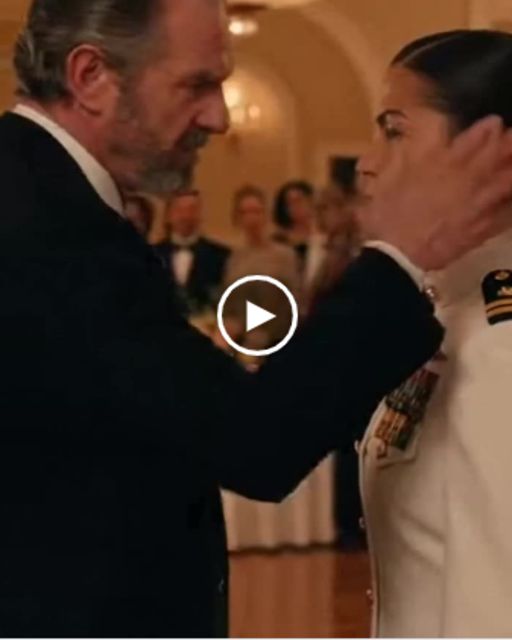
The sound of the slap cut through the reception hall and seemed to stop time. My cheek burned, but the heat in the room came from something deeper than pain. I stood there in my Dress Blues, the uniform I had earned with years of service, and felt the stares of two hundred guests land on me like stones.
“Take that off,” my father shouted, voice shaking with anger. “I paid for this wedding, and I won’t have my daughter dressed like a circus soldier.” His fingers clawed at the Bronze Star on my chest, and for a moment, I felt impossibly small, like a child again.
He jabbed a finger toward the staircase. “Go upstairs and put on the gown, or you’re out of the will.”
Everything went quiet. I tasted blood where I had bitten my lip. The pride I felt wearing that uniform, a symbol of sacrifice and service, collided with the shame of being publicly humiliated by the man who raised me.
Eight Words That Changed Everything
That was the moment Mark stood. My father curled his lip at him. “Sit down, gym teacher. This is family business.”
Mark had always moved easily, a kind man with a casual way about him. But as he walked toward us now, his steps were measured and controlled. He reached out and caught my father’s wrist in mid-air with surprising speed.
“Get your hands off me,” my father spat. “Do you know who I am?”
Mark didn’t raise his voice. He simply looked my father in the eye and spoke eight unforgettable words. “Sir, you just assaulted a federal intelligence officer.” His words carried across the room, picked up clearly by the microphone.
My father froze. “What?”
Mark reached into his jacket, and instead of a ring box, he produced a badge and a document. He lifted his head slightly, and the groomsmen all rose in unison behind him. Only then did I truly see them—not as teachers and friends, but as trained agents.
Mark turned the document for my father to see. It was a warrant, yes—but it was also a photograph. My father’s knees seemed to weaken as he stared at it. I looked too.
In the photo, my father stood smiling beside a familiar face. He had once told me that man had killed my mother in a hit-and-run fourteen years before, and that the man had died in prison. But the man in the photo was very much alive—standing shoulder to shoulder with my father.
My breath caught. Something inside me shifted, like the floor giving way.
When the Truth Steps Out of the Shadows
The agents closed in, calm and professional. They guided my father toward a side exit without shouting or shoving. The onlookers were stunned into silence. I barely noticed the hum of whispering and the glow of cell phone cameras lifting in disbelief.
I stared at the empty space where my father had just stood, my heart pounding. The man who had controlled my life with money, rules, and conditional approval had just been unmasked in front of everyone I knew. I touched my cheek and felt the sting through my uniform, a uniform he called “trash.”
Mark stepped in front of me, and the hard lines in his face softened. He reached for my arm; I flinched away. The look in his eyes hurt almost as much as the slap had.
“Sarah,” he said quietly, “we need to talk. Not here.”
Behind a Closed Door
We slipped into a small office down the hall. The door shut with a heavy click, and the noise from the reception faded into a different world. I stood with my hands at my sides, still wearing the Dress Blues that had just sparked a storm. I looked at the man I thought I was about to marry. For a heartbeat, I didn’t recognize him at all.
“For how long?” My voice barely carried.
“Two years,” he said. “The investigation into your father started two years ago. I was assigned to get close to his only child.”
The words landed like a stone in my stomach. Assigned. I was a mission.
“So it was all a lie?” I asked. “The dates, the late-night talks, the proposal—everything?”
“No,” he said, stepping closer without reaching for me. “The assignment was real. Getting to know you was part of it. But falling in love with you wasn’t planned.”
He watched me carefully, seeing the conflict in my face. “In the beginning, I played a role, the harmless gym teacher your father would look down on. It let me be near you, near him. But it didn’t take long before I saw who you really are. Your courage isn’t just on your chest; it’s in how you have lived every day under a controlling father and still became your own person.”
He took a slow breath. “Do you remember that walk along the water, when you told me about your first tour? You didn’t brag. You talked about your fellow soldiers and the weight of coming home without all of them. That was the night I knew the mission had changed. That was the night I knew I loved you.”
My anger crackled like a downed wire, but his voice steadied it. The pain of the deception was real. So was the sincerity I heard now.
The Life I Thought I Knew
“Tell me what my father did,” I said, my voice uneven.
“Your father’s shipping empire is a front,” he said. “For over a decade, he has trafficked illegal arms to sanctioned countries. He’s wealthy and very dangerous.”
I sat down because my knees would not hold me up any longer. The words sounded like a movie plot, not the reality of a man who had funded every school trip, every birthday, and expected gratitude like interest on a debt.
“And my mother?” The question felt like a shard of glass in my throat.
He paused, choosing his words carefully. “Your mother found out. She was preparing to report him. She had gathered proof. The so-called hit-and-run was staged to stop her. The man in the photo with your father is one of his oldest associates. According to our informant, he was there that night. Your father paid off the right people, created a false culprit, and built the image of a grieving widower.”
There was a knock. One of the agents—who, hours earlier, had stood beside me as my maid of honor—poked her head in. “He’s asking to speak with her,” she said.
“No,” I answered, too quickly, too loudly. Mark nodded to the agent, who withdrew.
He turned back to me. “You don’t ever have to speak to him, Sarah. Not if you don’t want to.”
“What happens now?” I whispered.
“He’s being transported to a federal facility. His assets will be frozen. There will be a long trial.” Mark’s face softened as he knelt and took my hands in his. “And I will be with you through all of it, if you’ll allow it. Not as an agent. As a man who loves you.”
The Long Weeks After
The days that followed slipped into each other like pages stuck together by tears and sleepless nights. There were meetings with investigators, hours with prosecutors, quiet meals where I tried to taste food but mostly tasted shock.
Mark kept his promise. He brewed coffee before dawn when I couldn’t sleep. He sat with me at noon when I didn’t want to talk. He held me in the evenings when memories swelled and I could hardly breathe. He told me his real name—David—and he told me that lying to me had become the hardest part of his job.
Aunt Carol, my mother’s younger sister, flew in from Oregon. For years my father had claimed she kept her distance out of blame and bitterness. The truth was different.
“I suspected,” she admitted one afternoon over tea, her hands wrapped around the warm mug as if it could steady her. “Your mother called me the day before she died. She was scared. She said your father was in something illegal and she was going to do the right thing. Then she was gone.”
She looked at me with eyes full of regret. “He threatened me. He said if I spoke up, I would lose everything, including my children. I was afraid, and I stayed quiet. I’m so sorry.”
I didn’t feel anger toward her, only a deep sadness at the circle of fear and control my father had built around all of us. We had all been trapped by it in different ways.
The Financial Web Untangled
During one meeting with the federal prosecutor, the conversation took a turn I never expected. My father’s fortune, the ships and shell companies and polished offices, had been built on a foundation that technically belonged to my mother’s side of the family. He had laundered and funneled his dirty money through corporate structures originally tied to my mother’s inheritance.
“What does that mean?” I asked.
“It means,” the prosecutor said steadily, “that his empire sits on top of your mother’s legal legacy. If you testify truthfully and he is convicted, you have strong standing to reclaim not only her original assets, but also everything he constructed from them.”
It felt surreal. The fortune that funded my childhood and imprisoned my adulthood was now a chain I had the chance to lift from others.
The letters from jail began soon after—through lawyers, through well-meaning family friends, through any door my father could try. Some were threats. Some were pleas. He spoke of duty, of family, of loyalty. He even invoked my mother’s memory, asking me to protect “our” name.
That was the final break for me. He had already taken her life; he would not take her voice, too.
Facing Him in Court
When the trial date came, I chose a simple black suit instead of my uniform. I did not need a medal to feel strong. I walked into the courtroom with my head high and sat on the witness stand, looking at the man who had tried to shape me like clay, who had slapped me on my wedding day for wearing what I had earned.
I spoke clearly and simply. I described his control and cruelty in our home. I described the slap, the demand to take off my medals, the moment Mark—David—stepped forward and ended the charade. I explained how I had learned the truth about my mother’s death. I did not raise my voice. I did not cry. I told the truth, and the truth was enough.
The verdict came back: guilty on all counts. The sentence was life in prison without the possibility of parole.
After the criminal trial, the civil case went quickly. The structure he had built collapsed in court like a stage set. The assets were transferred to me. When the final numbers landed in my account, I stared at them with no sense of victory. It felt like holding something radioactive. It was wealth born of damage and fear.
A Wedding That Was Really Ours
A year later, David and I stood on a quiet beach. No towering flower arrangements, no orchestra, no table assignments. Only waves, a gentle breeze, a simple ceremony, and words that were finally honest.
I wore a plain sundress. He wore a linen shirt and jeans. We promised each other a life built on truth and kindness, a steady home after a long storm. We slipped rings on each other’s hands with no audience beyond the gulls and the tide.
Turning Pain into Purpose
The money my father left behind could have been a curse, but I refused to let it remain one. We established a foundation in my mother’s name. It supports the families of fallen service members. It funds education programs for children growing up in places scarred by conflict. It helps provide legal aid to women seeking safety from abuse.
Each time a grant goes out, I imagine my mother’s quiet smile. The fortune once used to control and harm is now used to protect and heal. It feels like setting a broken bone and finally letting it knit the right way.
What I Learned About Strength
Sometimes I hear those eight words again in my mind—“Sir, you just assaulted a federal intelligence officer.” They were a turning point, not only for my father’s downfall, but for the life I had believed in until that moment. The story I lived for decades ended in that hall, and a new one began in a quiet office with hard truths and shaking hands.
I used to think strength was all about standing on a battlefield or carrying weight no one else could see. And yes, that is one kind of strength. But there is another kind, softer but no less brave: the strength to look directly at the truth and still choose goodness, to accept what is broken and build again, carefully and honestly.
My father took a great deal from me—time, innocence, a childhood unshadowed by suspicion. But in the end, by revealing who he really was, he unintentionally gave me something he never meant to offer. He gave me the chance to start over, to live without fear or strings, to love openly and to use what was meant for harm to do real good in the world.
Today, I keep my medals not as trophies, but as reminders of choices—of standing firm when it matters, of honoring those who served beside me, and of honoring myself. I do not wear them to win anyone’s approval, least of all his. I wear them because they tell a story of showing up when it would have been easier to walk away.
And now, when I think of the altar, I do not think of the slap or the shame. I think of a line drawn at last. I think of the truth stepping into the light. I think of a beach wedding with no audience and vows that felt like a promise to the future rather than a performance for the past.
Freedom, I’ve learned, can arrive in unexpected ways. Sometimes it comes dressed in a uniform. Sometimes it comes in eight quiet words that change everything. And sometimes, it looks like a life rebuilt—steady, honest, and finally your own.



