
A Quiet Night Turns Heavy
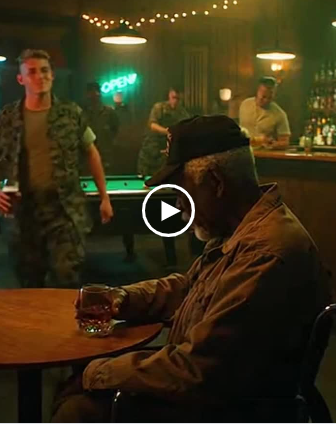
The wind pushed rain against the windows and rattled the old neon sign outside the bar. Inside, the light was warm and worn-in, a comfort to men who had been through too much and spoke more with their eyes than with words. Earlier that evening, a young Marine had let his pride do the talking. He had mocked an older man in a wheelchair, a stranger to him, a veteran he did not recognize. He thought he was being tough. He thought he was being funny. He was neither.
When the door swung open again, cold air washed in, along with a man whose uniform was heavy with earned metal and the weight of years. He didn’t slam the door. He didn’t bark orders. But the room felt different the second he stepped inside. A Marine General, the kind whose presence made even the jukebox seem to turn itself down, looked across the room and found the man in the chair.
“Reaper One,” he said in a voice that sounded like stone pressed into memory.
The man in the wheelchair lifted his eyes, steady and calm, and nodded once. “Sir.”
The General didn’t take off his coat. He didn’t glance at the glassware or the crowd that had been filling the space with weekend chatter. He simply took in the room, then spoke in a tone that was quiet and final. “Everyone out.”
Chairs scraped. Boots shifted. A half-finished drink was set down on a napkin, forgotten. In moments, the bar was nearly empty. Only three remained: the bartender polishing a glass with hands that had suddenly gone careful, the General, and the old vet in the wheelchair—the same man the kid had ridiculed not an hour before.
When Silence Says More Than Words
The General stood with his hands resting on the back of a chair as if he were bracing for a wave only he could see. He didn’t sit. He kept his eyes on the older man, searching for something that might not even be there anymore. Maybe it was guilt. Maybe it was forgiveness. Maybe it was both.
The vet gave him nothing but a level gaze and a steady breath. The bartender, whose name was Eddie and who had seen just about everything a small-town bar could throw at a man, stayed quiet. He had broken up fights and watched marriages end over barstools, but he knew this was different. It felt like church—the kind where you didn’t dare whisper, not even to yourself.
Finally, the General spoke again, softer now. “We classified that operation for a reason.”
The older man’s fingers tightened around his glass, once, a quick flash of pain and memory moving under the surface. “And I kept that reason buried for thirty years. But tonight…” His words trailed off, as if the rest of the sentence had been living in him for too long and had worn itself smooth.
The General nodded once. “I heard. The kid mouthed off.”
“He needed a lesson. Maybe they all did.”
“And what lesson did you teach him?”
“That some stories don’t end with parades and speeches. Some end in sand, in smoke, and in silence.” He shifted, the chair creaking, the moment hanging between them. “They think ‘Reaper One’ was a call sign. It was a sentence I lived to carry.”
The General’s jaw tightened. “You were never meant to carry it alone.”
“But I did. And I still do.”
The room held its breath with them. Outside, the storm pressed on the windows like a long, slow exhale.
Asking for the Truth
Eddie cleared his throat as respectfully as a man could. “With respect, sir,” he said to the General, his voice careful. “We’ve heard bits and pieces here and there. What really happened?”
The General turned toward him, lips set as if he meant to say no. But the vet lifted a hand. “Let him hear it. Let someone finally hear it straight.”
The General thought about it longer than a man like him usually did. Then he pulled out the chair across from the wheelchair and lowered himself into it like a man sitting down to a confession he knew was overdue.
“Operation Nightglass,” he began. “Two-thousand-three. We were sent on a classified recon into a Syrian black site. The intelligence said it was a weapons lab. Bio-chemical threat. High risk. In and out.”
The vet nodded, his eyes steady. “Turned out, it wasn’t just chemicals and formulas. It was people. Our people. POWs from Desert Storm who had been written off as missing. They were still alive, and they had been used, broken, and turned into training tools for elite enemy units. Brainwashing. Experiments. The kind of things that change a man’s face even when you don’t touch the skin.”
Eddie’s hands stopped moving. The glass he was polishing shone in the dim light, forgotten. “My God.”
The General continued. “We were ordered to get one man out. One. It was a test extraction, meant to be quiet. But Reaper One—” he paused, his eyes meeting the vet’s “—refused to leave the others behind.”
The older man let out a breath that wasn’t a sigh exactly, but it carried years with it. “Fifteen men made it out alive. Fifteen. I heard them screaming through a wall. Orders don’t mean much when the men on the other side of that wall could be the ones who would’ve carried you if you couldn’t walk.”
The General lowered his eyes for a moment. “We paid a heavy price. The op blew wide. We lost four covering the escape.” He hesitated, then added, “And you…”
“I caught a blast head-on,” the vet said, finishing it for him. “Woke up three months later without my legs and with half a lung. Learned to breathe through pain and learned to sit still in a world that never stops moving.”
Eddie swallowed hard. “You were the one they airlifted out in the blackout protocol. The one people said didn’t make it.”
The vet shrugged gently. “Close enough. On paper, I was gone.”
The General rubbed his knuckles along the edge of the table, the movement small but restless. “We couldn’t let it out. If we had, the fallout would’ve crushed every alliance we were trying to hold together. Politics would’ve swallowed the story and spit out something twisted. So we buried it. We buried you.”
“And I stayed buried,” the older man said. “For a long time. A name people whispered like a rumor, if they said it at all.”
When the Door Opens Again
Thunder rolled outside like distant artillery. The door opened, not with a bang, but carefully, as if the person on the other side didn’t want to disturb whatever was happening inside. The young Marine stood there in the doorway, cap in his hands, rain dripping from his jacket. He looked smaller now, not because of his size, but because of what he knew he had done. Behind him, a few older vets waited in the hall, faces steady and unreadable.
He took a few steps in, and his voice, when it came, wasn’t cocky. It was quiet and cracked at the edges. “I… I didn’t know.”
The vet angled his head. “Didn’t know what?”
“Didn’t know you were him. Didn’t know Reaper One was real.”
The General stood, slow and firm. “It’s not about who he is. It’s about who you choose to be. That uniform stands for sacrifice you can’t see just by looking at it. When you wear it, you carry every name behind you.”
The young Marine nodded, shame and understanding both settling across his face. “I was playing tough. I forgot what the uniform means.”
The older man in the wheelchair didn’t blink. “You didn’t forget. You never learned. Now you have a chance to change that.”
The words struck him harder than a fist. The kid took a breath and stepped forward. He knelt beside the chair, the floor cool against his knee, and looked up with steady eyes.
“I’m sorry, sir,” he said. “For disrespecting the name. For disrespecting you.”
There was a long pause, the kind that decides what comes next. Then the vet placed a hand on the young Marine’s shoulder. “Don’t apologize to me. Earn it. Every day. In how you act when no one’s watching. In how you treat the people who can’t do anything for you. In how you remember the ones who didn’t come home.”
The General let out a breath he seemed to have been holding for years. “Spoken like the man who saved more lives than any medal could ever cover.”
Toasts Without Speeches
The tension eased, not like a door slamming, but like a knot slowly loosening. Eddie set out three clean glasses. He poured with a steady hand and slid one toward the vet, one toward the General, and one to the young Marine. He hesitated a moment, then gave a small nod.
“On the house,” he said. “For the ones who aren’t here to drink with us.”
The vet raised his glass. “To the ones who didn’t make it home.”
The General lifted his. “To the ones we couldn’t save.”
The young Marine swallowed and lifted his glass, too. “To never forgetting them.”
They drank, not to celebrate, but to honor. The kind of quiet that followed didn’t feel empty. It felt full.
The door opened again, and this time a small stream of Marines eased back into the bar—some older, some younger, some limping, some standing so straight it looked like habit more than choice. No one spoke as they took their seats. No one broke the moment. But here and there, eyes met, and small nods passed across the room like an old language only a few people still spoke.
One by one, more glasses were lifted. No speeches. No grand declarations. Just the shared sound of remembrance and the rustle of history settling across their shoulders.
Stories That Keep People Alive
The young Marine stayed by the older man’s side, not hovering, just present, as if he knew he was sitting near the heart of something he had wanted to wear but had not yet earned. He listened. He asked questions the way you ask them when you are trying to learn, not when you are trying to impress.
The vet talked, not like a man performing for a crowd, but like someone finally ready to open a door that had been stuck for too long. He spoke about brothers who kept each other warm in cold deserts when the wind cut through gear like it wasn’t even there. He spoke about the sound of helicopter blades turning the night air into a promise. He spoke about letters written in dusty tents, meant to be mailed but never sent, because the men who wrote them were gone before the morning came. He spoke about the cost of silence and the cost of truth, and how sometimes you have to pay both.
The kid took it in. He didn’t interrupt. He didn’t try to add his own stories. He didn’t have any yet, not really, not compared to these. What he did have was something new—a sense that the uniform on his shoulders came with a history as long as the road home and as heavy as a folded flag.
The General listened too. He had been there. He had his own memories shut away behind his eyes. He didn’t share them all. Some things a man keeps. But he added the details that gave shape to the vet’s memories, the things that made the picture whole. Codes. Times. Names spoken carefully, as if the room itself should treat them gently.
Eddie poured quietly, then stepped back. He knew enough to let the night do what it needed to do.
Why It Matters
Older veterans in the room shifted in their seats and looked at the young Marine the way a father looks at a son when he hopes the boy has learned something that might keep him from harm. The lesson wasn’t about glory. It wasn’t about medals or stories to trot out at holidays. It was about respect and duty and the burdens you choose to carry because someone carried them for you first. It was about admitting when you’re wrong and understanding that an apology is only the start of the work.
The young Marine had come in full of swagger and quick lines. He would leave with something harder won. Humility isn’t loud. It doesn’t shine. But once it’s in you, it steadies your hands. It changes your voice. It makes you step forward when it would be easier to step back.
For the older folks in the bar who had been around long enough to see good men and women worn down by the years, there was a kind of quiet relief in watching a hard lesson land in the right heart. They didn’t need drama. They didn’t want punishment. They wanted understanding. They wanted the next generation to carry the torch without burning down the house.
A Small Peace
Outside, the storm loosened its hold. The rain thinned. The clouds began to separate just enough to let the moon put a soft edge on the street. Inside, the room felt warmer, not because the temperature had changed, but because the people had. The General reached out and placed his hand on the vet’s shoulder, a gesture that said what words couldn’t cover.
“You did more tonight than any briefing could,” he said.
The older man nodded, the lines around his eyes easing. “They needed to know. Now they do.”
He finished the last swallow in his glass and set it down with simple finality. It wasn’t a victory. It wasn’t closure. But it was something he could live with.
For the first time all night, he allowed himself a small smile. Not because the past had been fixed. Not because he had been forgiven. But because for a moment the noise inside his chest had quieted. For a moment, the names he carried felt closer to peace than to pain.
Across the room, the young Marine stayed a few steps behind the wheelchair as Eddie cleared the bar. He didn’t feel entitled to push it. He didn’t need to be seen helping. He simply stood ready if asked. It was a small thing. It was everything.
What the Young Learn from the Old
Before the night ended, the General spoke to the young Marine one more time. Not like an officer talking to a recruit, but like a man who knows how much a good word, at the right moment, can change the path a life takes.
“You don’t get to choose the history that came before you,” he said. “But you do get to choose how you honor it. You can make the uniform mean a little more every day—or a little less. That’s up to you.”
The young Marine nodded. “Yes, sir.” There was no bravado left in it. Just resolve.
As for the man in the wheelchair, he didn’t want praise. He didn’t ask for it then, and he didn’t want it now. What he wanted was simple: that the people who came after him would look at the road he had walked, or rolled, and understand its cost. That they would act with the steadiness he had tried to carry. That they would take care of each other.
When the night finally wound down, the bar didn’t roar to life. It simply settled. The men and women who had filtered back in finished their drinks slowly, shared a few last glances, and gathered their coats. No one rushed into the rain. There are some doors you don’t close in a hurry.
Walking Out Different
The young Marine would walk out of that bar different from how he had walked in. He would remember the weight of a hand on his shoulder and the quiet order that meant more than any shouted command: Earn it. Every day. He would remember the way the room fell silent for the names of men he had never met but would now carry in a corner of his heart simply because it was right to do so.
And the older man, the one they called Reaper One, would carry on too. Not lighter, exactly, but steadier. He had given the truth room to breathe. He had reminded a young man of the power of humility. He had said what needed saying and felt, in his chest, the quiet that follows a hard job done well.
Outside, the last of the rain slipped down the gutter, and somewhere, far away, the first hints of clear sky waited for morning. Inside, the bar lights clicked off one by one. The night, heavy and sacred, folded itself up and was put away like a flag after a ceremony. Tomorrow would come, as it always does. And for the people who had been in that room, tomorrow would mean a little more than it did the day before.
Some stories don’t get parades. Some stories don’t come with neat endings. But some nights leave you with what you most need. Not answers. Not even forgiveness. Just a quiet, honest understanding of what it costs to keep faith with the people who stood beside you when it mattered most.



