The Mark That Stopped the Room
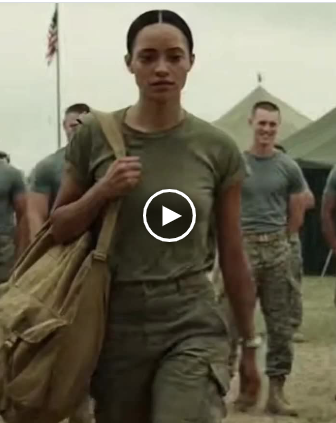
The commanding officer turned pale, the kind of color that drains from a face when memory hits hard and fast. He stepped forward slowly, as if walking into the past instead of across the training mat. His voice came out quiet, almost a whisper that did not fit the room. ‘Where did you get that ink?’
Emily did not answer. She stood still while a dozen young recruits tried to make sense of the symbol on her back. The tattoo was hard to miss, a serpent coiled around a burning sword, old runes trailing along its body like scar lines. It did not look stylish. It looked like a warning from another time.
The commanding officer’s mouth tightened. ‘Answer the question, Private.’
Emily pulled her collar back up, calm and controlled, and stepped toward the edge of the mat. She did not hurry. She did not look afraid.
‘You do not walk away from a superior officer,’ the CO barked, louder now. Beneath the order, there was something else. It was not anger. It sounded like fear he had tried to bury and could no longer hide.
Emily stopped at the edge of the mat and turned around. When she looked at him, her eyes seemed to sharpen in an instant. The tired look was gone. What stared back was focus, cold and clear.
‘I did not come here to make friends,’ she said, voice steady and even. ‘I came here to see if anyone remembered.’
The room broke into whispers. Someone muttered that it was only a tattoo. Someone else wondered what there was to remember. But the commanding officer was already moving, crossing the floor with a kind of urgency that made everyone else hold their breath.
‘My office. Now.’
A Past No One Dared Name
In the small office, the CO drew the blinds with a sharp snap. He did not take his seat. He leaned forward over the desk, hands braced, eyes searching her face like he was trying to confirm something he hoped was not true.
‘Who sent you?’
‘No one,’ Emily said. ‘I volunteered.’
‘That is not how it works. People do not volunteer with that mark. That symbol is classified. I have not seen it since—’
‘Since Beirut,’ she said.
He stopped speaking. The pause felt long enough to cross an ocean.
‘How do you know that?’
She drew a breath, slow and measured. ‘Because I was there.’
‘Impossible. That operation was blacklisted. Everyone tied to it either vanished or died.’
‘I did not.’
He stared at her for a long time, and then he sank into his chair as if the weight finally landed. ‘You would have been a child. Ten years old?’
‘Eleven.’
He rubbed his face, a tired motion of a man who had carried secrets too long. ‘We thought the extraction failed.’
‘It did.’
Silence filled the room. It was the kind that says more than talk ever could. When he finally spoke, his voice held equal parts authority and regret. ‘Why now? Why come here?’
‘I need to know if the system that made us still exists,’ she said. ‘I need to know if the people who did what they did are still out there. I need training, access, and time. I plan to disappear here until I am ready.’
He examined her again, as if reading a coded message in the set of her jaw. ‘You are not here for the army.’
‘I am here for answers.’
Rumors in the Barracks
Word spread down in the barracks the way it always does, faster than any official notice. The afternoon jokes dried up. Curiosity turned uneasy. People said she might be some kind of ghost agent. Others said spy. A few whispered a different word: plant.
By lights-out, no one was laughing at her anymore. They left an empty bed on either side of her cot. They lowered their voices when she walked by. Emily did not complain. She did not correct anyone. She did not explain herself.
She ran drills alone after dark, the quiet kind of work no one notices until the results show up when it counts. She used breaks to practice small, exact skills: fieldcraft, map reading, routines for quick movement. She read every manual, every chart, every posted rule. She learned fast. She moved like someone who had been taught to survive first and ask questions later.
She was stronger than she looked, and sharper than she let on. She did not smile much. She did not seem interested in being understood, only in being ready.
The Night Jason Vanished
Weeks passed. Feet got quicker. Shoulders got straighter. Confidence grew in the unit, as it always does when routine becomes habit.
Then one night, during a navigation exercise, Jason did not return to the rally point. He had cracked jokes at dinner. He headed out in good spirits. And then he was gone.
They found his compass cracked in the dirt and his bootprints veering off the marked path. There were no signs of a struggle. No blood. Nothing that told a straightforward story. Just a torn strip of fabric near the trees and a small symbol carved into the ground. A circle with a serpent, like the ink on Emily’s back.
The base shut down fast. Lights swept across the woods. MPs spread out. Drones skimmed the tree line. Radios crackled for hours. Jason remained missing.
Recruits looked at Emily out of the corners of their eyes. She did not look back. She did not push for news. She did not ask questions that would not be answered anyway.
The commanding officer called her in again.
‘Tell me you had nothing to do with this.’
Emily met his gaze head-on. ‘I did not. But someone is watching us. That mark was a message.’
He nodded once, a small motion with a heavy meaning. ‘Then all of us are in danger.’
Visitors Without Names
Two days later, two black SUVs arrived at Fort Raines near dawn. They had no plates and no markings. Men stepped out dressed in gray suits, each holding a briefcase and moving like they had rehearsed the route. They passed through security without a pause.
The recruits stood near windows and watched. The guesses started up again. CIA. FBI. Maybe some other stripe of agency that never put its name on the door. No one claimed these men, and that said enough.
Emily stood at her window and watched, too. Her jaw tightened. She said nothing at breakfast. She said nothing at drills. She moved as usual, but quieter, if such a thing was possible.
After lights-out, she slipped from her bunk. She moved past sleepers without stirring them. She did not challenge the cameras; she stepped where they did not see. Four minutes. That was her window in the schedule of the security sweep.
She reached the records room and found a steel drawer stamped with a warning and a code: ARCHIVE RED — 14X. Inside, she pulled a folder with her name on it.
There was one word above the file tab: Project Ember.
Project Ember Revealed
Her hands trembled as she opened it, the kind of shake that comes not from fear but from finally touching the truth. The folder held reports with blacked-out lines, biometric readings, and photographs.
There was one photo she could not look away from. An eleven-year-old girl stared back at her. Dirt on her cheeks. Blood on her knees. She stood beside a burned-out mess of metal that used to be something people relied on. A caption typed beneath it read: Subject: Emily R. Status: Non-recovered. Presumed dead. Hazard level: Critical. DO NOT ENGAGE.
The room felt smaller. Not because the walls moved, but because the past had finally caught up with the present and stood shoulder to shoulder with it.
A soft click sounded behind her.
She turned. One of the men from the gray-suited group stood in the doorway. He did not raise a weapon. He held a small device that glowed blue along one edge, steady and patient.
‘You should not be here, Emily,’ he said.
‘You know my name,’ she answered.
‘We know a great deal about you. We wrote your file.’
‘Then you know what you did to my family.’
He sighed in a way that suggested he had said these words many times. ‘That was not personal. It was protocol.’
‘You killed them.’
‘We trained you,’ he said, matter-of-fact. ‘You were not meant to survive. But now that you have—’
He tapped the device. The door eased shut with a final click.
‘—you are a complication.’
The Man with the Blue Device
Emily moved first, quick and direct. He was faster than she expected, like someone who had been taught the same lessons she had. She slipped past one strike, blocked another. Pain spread along her forearm where she caught him, but she did not let it slow her. Training took over. She shifted her weight and drove an elbow into his ribs. He made a sound somewhere between surprise and approval.
‘You have learned,’ he said through a short breath.
‘You have no idea,’ she replied.
They did not waste motion. Strikes, counters, pivots. He aimed to disable. She aimed to finish. When the blue device flashed past her face, she saw it clearly enough to understand it was meant to end the fight. She snatched it mid-arc and buried it in his throat with a sharp, precise motion. It sparked, and his body answered the jolt with a full-body shudder.
He went down. Emily did not stay to see if he would get back up.
She grabbed the folder and ran.
Into the Trees
Sirens took flight across the base like a flock of startled birds. Lights snapped on. Shouts cut through the night. Search beams spread over the training fields, then swept toward the fence line.
Emily moved the way she had trained her body to move since childhood: low, quiet, steady. She took a blade, a flashlight, and the truth that weighed more than both. She knew the gaps and the timing. She slipped through the dark edge of the compound and vanished into the trees.
Back in the barracks, the commanding officer found an empty bunk and a folded note on a pillow.
They are back. I am going to finish what you could not.
He folded the paper again and stood very still. It was the stillness of someone who understood that a choice made long ago had reached its due date.
A Message Written in Fire
Two days later, a screen glowed in the officers’ lounge with a local news headline. The volume stayed low, but the words were clear enough. A small private jet had exploded in the night sky over Northern Virginia. It was unregistered. Anonymous. The kind of aircraft used by people who prefer to pass unnoticed. Agencies refused to comment.
The commanding officer watched the footage in silence. He rewound and paused at a frame where the wreckage burned across a slope buried in winter. On the snow, faint but unmistakable, a symbol had been seared into the ground. The serpent. The message was not subtle. It was made for the people who would understand and pretend not to.
Far away, a very old line lit up on an encrypted network. In a dark room, someone opened a message with no sender name and no traceable path. It was a single photograph of Emily, fully grown, alive, eyes set like flint.
Below it, three words: I remember everything.
What Memory Demands
For most of the recruits, Emily had been a quiet stranger with a hard look and faster feet. For the commanding officer, she had become a living reminder of a chapter no one had dared to read out loud. For the people who came in gray suits, she was a lapse in their plan, a piece that slipped free and could not be put back the same way.
But for herself, Emily was something else entirely. She was proof that a person can step out of a story written for them and write a new one. She had been named a subject in a file. She no longer answered to the name printed there.
She was not the lost girl who vanished under smoke and chaos at eleven. She was a woman who knew what had been done, and who felt the calm certainty that comes when past and present line up like a compass needle finding north.
People older than Emily often talk about what time does to pain. Some say it dulls it. Others say it sharpens it until the right moment comes. For her, time did not erase anything. It refined it. It took fear and distilled it into purpose. It turned confusion into a line of action as straight as a plumb bob.
The Weight of Command
The commanding officer closed his eyes and saw the faces of the people in Beirut, the ones he could not save, the ones he was told not to save. Orders had been given. Files had been sealed. He had followed the rules and carried the quiet. Now the quiet was over.
He knew, in the honest way experienced leaders know, that Emily did not come to the base to wear a uniform for the rest of her life. She came to learn exactly what she needed and then to leave. He also knew he could have stopped her. He could have sounded a louder alarm, posted more guards, set more traps. He did none of those things.
People in command sometimes have to choose not between right and wrong, but between two kinds of wrong. He had chosen the wrong he could live with. He let her go. Perhaps that was his first real act of courage in years.
How a Mark Becomes a Message
On the mat that first day, the mark on Emily’s back had looked like a tattoo. To most eyes, something to talk about at lunch and forget by dinner. To people who knew, it was a message sent from a decade ago straight into the present. It said the old program was not dead. It said someone had survived who was not supposed to. It said the ledger was not balanced.
Symbols do that. They carry history inside them, even when the people looking do not know the language. That coiled serpent around a burning sword was never meant for fashion. It was meant to warn. And when she uncovered it, she did not do it to shock her peers. She did it to see who in that room remembered. The commanding officer remembered. The gray-suited men remembered. That was all she needed to know.
Preparation Meets Purpose
It would be easy to say Emily was naturally gifted. But luck and talent do not explain what happens when a person is forged by hard lessons and then chooses who to be. She learned to move efficiently because there was no room for waste. She learned to read quickly because every second had once meant the difference between safety and loss. She kept to herself because trust had been broken so completely that any new bridge had to be built with care and caution.
And yet, even with all that, she did not become cruel. She became clear. There is a difference. She did not hit first out of spite. She acted because she understood that some doors, once opened, leave you only one path left to walk.
The Road Ahead
After the jet burned and the snow told its quiet story, more people began to pay attention. Not the recruits. Not yet. Not the public either. The attention came from behind doors and across desks where the walls were thicker and the phones did not ring. Files were reopened that had not seen light in many years. A handful of names looked at each other across a table and realized that the past was coming due.
Across oceans and within cities, in apartments with ordinary curtains and in offices without name plates, a ripple went out. The kind of ripple that frightens people who thought they had controlled every variable. It was not the fear of a headline. It was the fear of someone who knows your methods, your tools, and your rules—and does not intend to play by them anymore.
Emily moved with patience. She did not post messages. She did not make speeches. She made plans the same way she had learned to breathe: quietly, consistently, and with purpose.
The Storm They Never Saw Coming
Back at Fort Raines, new recruits filed onto the mat, none of them aware of the way a single mark on a single back could pull an old thread and unravel a larger cloth. The commanding officer watched them and did his duty. He trained them well. But sometimes, late in the quiet between drills and darkness, he would glance toward the tree line and imagine a figure moving with quiet certainty through the world beyond the fence.
Emily was not the lost girl anymore. That title had been the last thing the old program gave her. She returned it. She took something else in its place: direction.
She had found out that the system still existed. She had discovered who had made the choices that cut her childhood short. She had recognized the symbol for what it was—a promise, not only of pain, but of accountability. And she had decided to write the final chapter herself.
Her message had been simple: I remember everything. For people who spend their days burying secrets in deep drawers with red labels, that is the sentence they fear most.
So she moved, step by step, to keep that promise. Not with noise, but with focus. Not with revenge alone, but with a sense of balance returning after too many years tilted the wrong way.
In the end, that is what made her a storm. A storm is not loud for the sake of loud. It builds and gathers and arrives. It clears the air. It leaves a mark not because it sought attention, but because it could not be stopped. Emily had become that kind of force.
Somewhere, in a quiet room where the blinds are always shut, a man once confident behind his protocols finally understands the truth. You can close an archive and stamp it ‘Do Not Engage.’ You can drive up in suits with briefcases and tidy words. You can decide a child should not survive. But if that child does, and grows, and remembers—then one day you will see a mark in the snow and realize that your past has found you.
And on that day, you will understand what the commanding officer knew when he watched the news and did not speak. The storm had arrived. And it was not leaving until the debt was paid.