
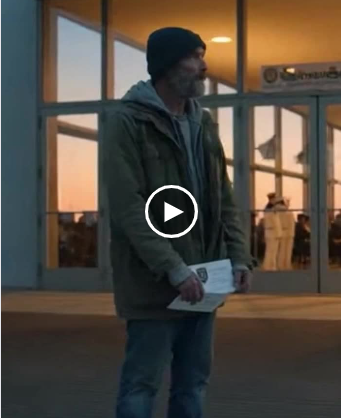
The man in the back row
He had been walking for days, long enough for the soles of his shoes to thin and the salt of old roads to work into the seams of his clothes. County lines slipped past him like mile markers in a memory. He kept going anyway. He had a reason. His son was graduating, and whether anyone invited him or not, he would be there. Even if he stood in the shadows and slipped away before the applause died down, he would not miss this day.
By the time he reached the auditorium, the ceremony had begun. Music echoed against polished floors. Families leaned into each other. Photographs flashed. He chose a quiet spot at the back, shoulders angled small, trying not to draw attention. His coat was torn at the cuff, and beneath the ragged edge of the sleeve, a faded tattoo showed in the light. It was old ink, the kind that told a story even when no one asked.
Most people didn’t notice him. Why would they? All eyes were on the stage, where new officers sat tall and straight, and an admiral held a stack of notes for his speech. But in mid-sentence, the admiral stopped. He didn’t lose his place. He didn’t forget a line. He simply saw something the rest of the crowd had not yet seen. He saw the tattoo. Then he saw the face.
A name only certain people use
The admiral set his notes down slowly, his expression sharpening with recognition. The room quieted, puzzled. Then he spoke, in a voice that cut through the soft murmur of the crowd.
“Master Chief… is that you?”
The words seemed to travel in waves. Heads turned. Shoulders squared. A hush fell across the rows as people tried to follow the admiral’s gaze to the man standing near the back.
Dan Brooks did not move. He hadn’t come for attention, and he certainly hadn’t come for a spotlight. He came to watch his son. He planned to blend in, to leave unnoticed after the last name was called. But the admiral’s question wasn’t a mistake, and it wasn’t something a man like Dan could ignore. You do not mishear a call like that, especially when it comes from a voice that remembers.
The admiral stepped down from the podium with a steady urgency that belonged to someone used to moving as the situation demanded. Officers and staff parted to let him pass. Shoes clicked on the smooth floor, each step echoing in the silence. He approached the man in the torn coat and studied his face, taking in the lines, the weight, the years. Then his voice softened.
“My God,” he said. “I thought you were gone.”
Dan’s answer was plain. “Most days, I was.”
Recognition and reluctance
For a breath or two, no one spoke. The silence felt full, like a held note. The admiral turned to address the audience, not in the practiced tone of a prepared speech, but from the quiet conviction of memory.
“Ladies and gentlemen,” he said, “forgive the interruption. We have an unexpected guest today. One of the finest sailors this Navy has ever known. A man whose courage saved lives you’ll never hear about. Master Chief Daniel Brooks.”
There are moments when a room changes shape. This was one of them. You could feel it. The applause did not start yet; the sound that moved through the hall was softer. It was the sound of people catching up, understanding that something rare was happening right in front of them.
Up on the stage sat Tyler Brooks, straight-backed among the graduates. He narrowed his eyes and focused on the back of the room as if willing the distance to shorten. His brow furrowed. His mouth parted. He knew that face, even altered by time.
Dan shifted under the lights, uncomfortable in clothes that had seen too many nights outdoors and too many miles in the wind. He kept his hands close, one of them clutching a folded piece of paper that had survived the journey like a small, private promise.
“I didn’t come for this,” he said quietly. “I just wanted to see my son graduate.”
The admiral nodded with understanding. “Then let’s make sure you can see him. Properly.” He raised a hand, and two junior officers approached. Dan tensed out of habit, ready to be told to leave. But instead, they guided him forward—gently, respectfully—toward the stage.
Father and son
Murmurs swelled as Dan made his way down the aisle. A few people lifted their phones. Others watched with hands over their hearts. By the time he reached the front, Tyler was already on his feet.
They did not rush each other. They stood close, separated by a few steps and more years than either of them wanted to count. Tyler’s expression flickered—the shock of recognition, the sting of old absence, the pull of something deeper. Dan’s voice came out rough with feeling.
“Hey, kiddo.”
Tyler didn’t move at first. Dan swallowed and tried again, softer this time. “You look like your mother.” It wasn’t said to soften the moment. It was the truth, and it landed gently.
Tyler stepped down from the platform, each pace deliberate, as if navigating a field marked by memories. He stopped inches away and searched his father’s face for answers that no story could fully explain. “You’re really here,” he said.
Dan nodded. “Didn’t think I’d make it. But I had to try.”
What happened next surprised even those who thought they couldn’t be surprised by anything anymore. Tyler reached forward and wrapped his arms around his father. He did it like a man anchoring both of them to something solid. For a heartbeat, Dan went stiff, as old reflexes collided with present reality. Then his arms came up and held tight. The folded paper, carried all those miles, crushed softly between them.
The room erupted. It wasn’t a polite cheer. It was the kind of applause that comes from shared relief, from gratitude, from a hundred hearts releasing a breath at once. Some people cried openly. You could see officers wipe at their eyes, and a few of the toughest men in uniform blinked hard.
“I’m proud of you,” Dan whispered into his son’s ear. “So proud.”
Old wounds, honest words
When they stepped back, Tyler’s eyes shone. He did not avoid the question that lived between them. “Why did you leave?”
Dan took the words as they came. He did not flinch. “I thought I was keeping you safe,” he said. “I told myself that. But the truth is, I was hiding. I didn’t know how to be me and still be your father. I didn’t know how to be whole.”
Tyler listened without folding his arms or hardening his face. “I spent a long time wondering if I wasn’t enough,” he said. “Wondering if I did something wrong.”
Dan’s voice trembled, not with fear but with relief at finally speaking plainly. “You did nothing wrong. It wasn’t you. It was me stumbling through the dark, thinking I had to do it alone. I’m sorry.”
Tyler exhaled, the sound of a young man carrying a heavy pack and deciding to set it down. “Then maybe,” he said gently, “we learn this together. Starting now.”
The admiral’s charge to the room
The admiral, who had stepped back to give them space, returned to the moment with a steady hand. “If you’ll allow me,” he said, looking at father and son, “this is your moment. But it also belongs to everyone here, because it reminds us what service looks like beyond the uniform.”
He faced the audience. “We are celebrating new officers today, and rightly so. But we must also remember the men and women who carried burdens we did not always see. Who returned with more than scars. Master Chief Daniel Brooks is one of those sailors. I served with him. I saw him take missions no one expected us to survive and turn them into chances for all of us to come home. He saved lives, including mine.”
The weight of those words settled warmly over the room. Men and women who had never met Dan looked at him with recognition—the kind that doesn’t need a name tag.
The medal that waited years
The admiral turned to Tyler. “Ensign Brooks,” he said with a small smile, “would you do the honor?”
Tyler blinked. “Sir?”
“Your father never received the commendation he earned during our last deployment together,” the admiral explained. “Records were misplaced. Then the story got buried under paperwork and time. But I kept the file, through three commands. I always hoped the day would come when I could set it right.”
He opened a small leather case. Inside lay a medal, silver and bright, etched with quiet weight. The Navy Cross.
Gasps rolled through the audience. Dan stared, as if the light might make it disappear. “I don’t—” he began, then stopped. Sometimes there are no words that feel like enough.
Tyler accepted the case with both hands. He turned toward his father and pinned the medal to the worn fabric of Dan’s coat. It sat awkwardly against the torn threads, but somehow, it looked perfectly at home. It was not the coat that made the medal worthy, and it was not the medal that gave the man his worth. The two simply met, at last, in the same place.
Dan swallowed, eyes wet. “I don’t deserve this,” he whispered.
“You do,” Tyler said softly, steady as a deck underfoot.
Back to the program, but changed
The ceremony resumed. Speeches continued. Names were read. Caps were adjusted. Yet the room felt different. Warmer, perhaps. Truer. People listened more closely. They looked at one another with a little more care. Between remarks, eyes drifted toward the back row where a man sat straighter than he had in years, his hands quiet now, the medal catching the stage light in a way that did not boast so much as bear witness.
When the final applause faded and families gathered in clusters, Tyler did not leave his father. They walked outside together into the ocean air. The breeze moved the sleeves of Dan’s coat, and the sky held that soft brightness you only get near water, where everything seems a little wider, a little more possible.
After the crowd, a quieter conversation
They found a spot on a low wall. People passed by with flowers and programs in hand. Laughter carried across the courtyard. Tyler looked at his father and shook his head in quiet amazement.
“You walked all the way here?” he asked. It wasn’t disbelief. It was respect, mixed with the need to understand.
Dan nodded. “Took me a while,” he said. “But it’s the first thing I’ve finished in a long time.”
Tyler smiled, the kind of smile that lifts without straining. “You’re not finished, Dad,” he said. “You’re just getting started.”
Dan glanced out toward the horizon. “I don’t have a place to go back to.” The words were simple. There was no self-pity in them. Just a clear statement of where he stood.
Tyler shifted closer. “You do now.”
Dan looked at him, cautious, protective of the hope stepping back into his life. “You sure? I’m… not exactly parade material.”
Tyler’s answer was calm and steady. “I didn’t join the Navy to follow in your footsteps,” he said. “I joined to understand them. And now? I’d like to walk beside you.”
Dan turned away for a second, blinking hard at the sky. “You always were the brave one,” he said, and you could hear the pride in it.
They sat without filling the space with too many words. There’s a kind of quiet that heals, and they let it do its work. Waves rolled in, steady as breath. Gulls lifted on an easy wind. Somewhere close by, a family cheered for a photograph that finally turned out. The world continued, and for the first time in a long time, Dan felt still inside.
The story behind the ink
Tyler nudged his father’s elbow and nodded toward the edge of the sleeve where the tattoo showed. “What’s the story there?”
Dan’s mouth pulled into a small, crooked grin. “Unit mark,” he said. “SEAL Team 9. We were the kind of outfit that moved in the spaces between the lines. We didn’t say much. The ink helped us find each other without words.”
Tyler tilted his head. “And the lightning bolt?”
“That was our promise to each other,” Dan said. “Move fast. Hit hard. Come home.” He paused, then added in a voice that held both humor and humility, “I managed the first two better than the last.”
Tyler met his eyes. “Except you did come home. Maybe not all at once. Maybe not the way people expect. But you’re here.”
Dan looked down at the medal, then at the hands that had pinned it there. “Maybe now I will,” he said quietly.
Turning toward home
Tyler stood and offered his father a hand. “Let’s get you cleaned up,” he said. “You’re coming with me.”
Dan got to his feet, bones complaining the way old friends do when they’ve been apart too long. The medal shifted with his movement and settled back against his chest. He turned to take one last look at the building where everything had changed. Then he faced forward.
For years, he had believed the most loving thing he could do for his son was to disappear. He told himself a story about keeping distance, about protecting the boy from the jagged edges he couldn’t smooth. But the truth had walked him over county lines and through blisters and into a crowded auditorium filled with light and music and names.
The bravest thing he ever did, it turned out, wasn’t surviving what the world threw at him. It was showing up. In torn clothes. With a past he couldn’t edit and a heart he was finally willing to open. He had walked for days to witness his son’s new beginning, and instead found one of his own.
Father and son moved together through the courtyard, one step and then another, simple as that. No grand speeches now. No fanfare. Just the quiet agreement of two men who had decided to try. The ocean wind followed them, cool and steady, and the day seemed to expand a little in front of them, making room for what might come next.
Somewhere far behind them, applause and music settled into memory. Ahead, a front door would open. A hot meal would be set down. A razor and a clean towel. A spare room made ready. Simple things, each one the shape of welcome.
They walked on. The medal glinted. The old tattoo showed at the edge of a sleeve. And the promise in Tyler’s words—walk beside me—felt like a map Dan could finally read.
He was not fixed, not suddenly free of old aches or quiet nights. But he was not alone, either. He was headed home.



