
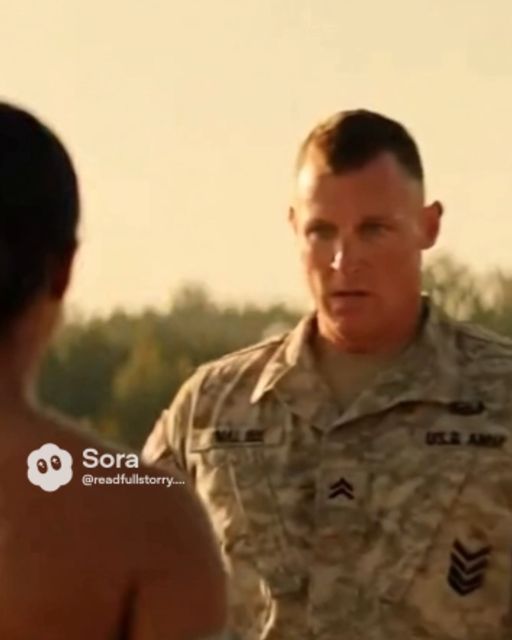
A quiet figure on the training field
The training ground was usually loud with marching commands and the thud of boots, but that afternoon it had fallen still. At the far edge of the field stood a lone woman in a uniform that looked like it had survived a lifetime. The fabric was bleached by the sun, the cuffs threadbare, the Velcro patches empty. There was no name tape, no rank, and no unit insignia—just the ghost of what once had been there.
Sergeant Brenner spotted her first. His voice carried fast and sharp, the kind of bark designed to make new recruits jump. He strolled forward with a smirk that didn’t reach his eyes and called out, asking who she thought she was. A snicker rose from somewhere in the formation, and a recruit muttered something about stolen valor. The accusation dropped into the quiet like a stone.
She didn’t flinch. She stood at perfect parade rest, hands clasped behind her back, heels together, shoulders set. There was nothing nervous or defiant in her posture—only the calm of someone who knew exactly how to stand in a place like this, and why.
Brenner stepped closer, his swagger deliberate. He demanded her name, then threatened to have her taken off the grounds in cuffs if she didn’t comply. Still she said nothing. Instead, she kept her eyes fixed past the horizon, as if she’d learned long ago that looking people in the eye only invited teeth.
He reached for her collar and tugged, ordering her to remove the jacket if she wanted to keep up the charade. She didn’t fight him. She let the heavy material slip from her shoulders and fall to the dirt with a soft thud.
The laughter died at once. No one spoke. No one moved.
Across her back, three deep scars crossed from shoulder to waist, puckered and harsh. They were not the neat lines of surgery or the ridges from a childhood injury. They were the kind that told a story all by themselves—the kind that come from being bound, broken, and left to heal the hard way.
Brenner’s face drained of color. He stepped back, words scrambling at the back of his throat. Before he could find one, a black staff car jolted to a stop on the grass. The door swung open, and the base commander stepped out, his pace urgent and his expression tight.
The general who recognized what others missed
General Arthur Hale didn’t slow as he crossed the field. Brenner snapped to attention and threw his hand into a salute, but the General didn’t look at him. His eyes were locked on the woman—on her scars, on the battered uniform jacket lying at her feet, and then, carefully, on her face.
He stopped a few steps away. It was as if the wind had been knocked from him. He took off his cap with unsteady hands. There in the dirt, in front of two hundred recruits and a suddenly silent sergeant, a two-star general went down on one knee, then the other. When he finally spoke, his voice cracked like a field radio at the edge of range.
“Valerie?” he whispered. “We buried you seven years ago.”
The woman turned slowly. Her eyes were steady and dark, but they carried a weight that made the air feel thin. She reached into the pocket of her worn trousers and pulled out a dog tag bent nearly in half and scorched along one edge. She put it in the General’s hand and, for the first time, looked straight at the sergeant.
“You left me.”
The words weren’t loud. They didn’t need to be. They landed with the force of truth, and the ground under Brenner’s feet seemed to shift. His bravado drained away, and with it the confidence that had held his shoulders high for years. Around him, the recruits stopped being an audience and became witnesses.
General Hale closed his hand around the dog tag as if it might disappear. He stood up slowly, his expression turning from shock to something colder. When he finally faced Brenner, the look said there would be no more guessing, no more assumptions, and no more hiding.
“Sergeant Brenner,” he said, voice low and steady. “My office. Now.”
He turned back to the woman. “Valerie,” he said softly, as if testing the name to make sure it was real. “Can you walk?”
She nodded once. He helped her ease back into the jacket, careful not to touch the scars, and led her toward the staff car. The recruits remained silent as they went, a collective hush settling over the field. It felt like the end of a drill and the start of a story that no one there would ever forget.
Seven years lost, and a truth that refused to die
The walk to the General’s office felt longer than it was, like the hallway itself understood the weight of what had just happened. Brenner followed, his chest tight, each step loud in his ears. He could feel eyes watching, questions being formed, judgments taking shape.
Inside, the office was neat and quiet, the kind of place where every object had a place and every place had an order. Valerie sat in a chair near the desk, small in her oversized, ancient uniform, yet somehow filling the room. The General stood behind his desk with his hands braced on the edge, as if steadying himself against a rolling deck.
His tone, when he began, was controlled and measured. “Seven years ago,” he said, “Operation Nightfall. You were assigned to Captain Ross’s team.” It was not a question. It was a laying down of a line in the sand.
Brenner swallowed. “Yes, sir.” His own voice sounded thin, the echo of a man trying to remember how confidence felt.
“You returned with three others,” the General continued. “You reported that Captain Ross was hit at the start of the ambush. You said you saw her go down. You said her remains couldn’t be recovered under enemy fire.” He didn’t raise his voice. He didn’t need to. Each sentence landed like a paperweight on a file that had sat too long on the wrong shelf.
Memories sprinted through Brenner’s head—the dim light of the debrief room, the damp paper cup of coffee, the way people had looked at him afterward with gratitude and respect. The commendation pinned to his chest. The way it had all felt so unsteady for a while, then solid. He had built a life on it. A reputation. A future.
“Sir, that’s what happened,” he said, forcing his words through a throat that wanted to close. “We all saw it.”
Valerie spoke at last. Her voice was calm and even, the tone of someone who had learned to use her words carefully. “No,” she said. “You didn’t.”
She looked up, and the room seemed to lean in to listen. “The ambush came from the east ridge. A machine-gun team locked us down, and I took a hit to the leg. It was bad, but it wasn’t fatal.” Her gaze shifted to Brenner. “I ordered you to lay down suppressing fire while I dragged Corporal Evans to cover. You looked straight at me. You knew I was alive.”
There it was—Evans. The kid with the ready grin and fast hands. The gunfire had been vicious. The air had been full of dust and fear. Brenner felt the room tilt.
“The enemy was closing,” he said hoarsely. “I had to make a call. It was her or the rest of the team.”
“You didn’t make a call,” Valerie said, still steady. “You made a choice. You ran.”
The General’s pen cracked against the desk as he set it down too hard. The sound startled no one. “You reported her killed in action,” he said, his voice edged with a grief that sounded old and newly sharp all at once. “I signed the paperwork. I went to her parents’ home. I stood by an empty casket and praised a hero we believed we had lost. All of it, because you told us she was gone.”
The heaviness of those words was almost a physical thing. Brenner’s shoulders slumped. The path he had walked for seven years was suddenly lit from a new angle, and it showed things he didn’t want to see.
He tried one more time to find a thread to hold. “Sir, seven years as a prisoner can change a person’s mind. Memories get—”
“My memory is clear,” Valerie said, not unkindly but without any give. “I remember the sound of your boots running. I remember you shouting, ‘She’s gone! Fall back!’ I remember turning toward the ridge and realizing I was alone.”
A knock at the door, and proof no one could argue
The intercom buzzed. The General’s assistant, her voice hesitant, said there was a visitor who asked to be heard—a Mr. Elias Thorne—with information about Captain Ross. The name brought a quick flash of recognition across Valerie’s face, and the General nodded to let him in.
The door opened to a man in civilian clothes, fit and alert in a quiet way, with eyes that seemed to carry both sorrow and relief. He crossed the room and put a gentle hand on Valerie’s shoulder.
“Val,” he said, soft and sure. “You made it back.”
She gave him a small smile that somehow brightened the whole space. The General studied him. “Elias,” he said. “Team medic.”
“Yes, sir,” Elias replied. He turned toward Brenner, and whatever warmth had been in his face cooled. “I’ve carried that day every single one of the past seven years,” he said. “I never believed she was gone. I tried to go back right after, but I was ordered to stand down. Later, I went on my own.”
He pulled a cracked piece of plastic from his satchel and set it on the desk. “I found this a year after the ambush. It’s the shell from Captain Ross’s comm unit. I brought it home and worked with a friend who recovers data. We clawed back thirty seconds. The thirty seconds right after Sergeant Brenner called her down.”
The General’s jaw set. “Play it.”
Elias pressed a button on a small recorder. Static filled the office, then the sharp rattle of gunfire, a shout carried on wind and grit. Then Valerie’s voice came through, pained but unmistakably in command.
“…Brenner, on me! Suppressing fire now! I’ve got Evans! Repeat, provide cover!”
A beat of chaos followed. Then another voice cut in—higher, strained with panic. Brenner’s.
“She’s gone! She’s gone! Fall back! Fall back now!”
The recording picked up one last breath, and then Valerie again, softer, as if speaking into a silence that had just appeared in her ear.
“Brenner? …Don’t do this.”
Elias stopped the playback. Quiet settled like dust after a blast. There was nothing else to say to contradict it, nothing to fold the moment back into the lie that had stood for so long. Brenner stared at the recorder as if it might bite.
The confession and the cost
He sank into the chair opposite Valerie. The fight had gone out of him. He didn’t hide behind words anymore. “It should’ve been my command,” he said, the admission spilling like water from a cracked canteen. “I was told I was next. Then she got it. The firefight was chaos. I was scared. I told myself it was the only way to save the rest.”
The General’s eyes never left his. “You didn’t just panic,” he said, each word steady and sharp. “You saw a path to a promotion, and you let it matter more than your duty. You left your commanding officer to be taken. You left a good man—Corporal Evans—without the cover he needed. He died because you ran.”
The words landed like a sentence even before the real one was given. The General straightened. “Military Police are on their way. You will be charged with dereliction of duty, cowardice in the face of the enemy, and making a false official statement. Your rank, your commendations, all of it—gone. Your lie ends here.”
Brenner didn’t fight. He had nothing left to push against. Two MPs arrived moments later. He stood, let them take his arms, and walked out without turning his head. The door clicked shut behind him with a finality that left the room oddly calm.
General Hale exhaled, the air leaving him in a long, shuddered breath. He came around the desk and stopped in front of Valerie. “Captain Ross,” he said, voice thick with regret. “I failed you. I believed a coward. I didn’t dig when I should have. I am sorry.”
She looked up, and for the first time her voice softened. “You had a report, sir,” she said. “You acted on what you were given.”
He shook his head. “It doesn’t excuse it. But I will set it right. Welcome home, Valerie.”
Rewriting the record, and choosing peace
Word traveled across the base not with gossip’s buzz but with reverence’s hush. Captain Valerie Ross, long believed killed in action, had returned. Her record was corrected. She was awarded the Distinguished Service Cross and acknowledged for seven unthinkable years as a prisoner of war. Her time in captivity was recognized as active duty. In a rare and quiet recognition of her service and sacrifice, she was promoted, not once but twice, to lieutenant colonel.
Valerie accepted what was placed in her hands because it stood for truth, not because she desired an audience. Ceremonies drained her. Crowds pressed. Speeches tired her bones. She wanted something simpler. She wanted to sleep without listening for footsteps in the dark. She wanted to look at a mountain and think only of the weather, not cover and concealment.
She medically retired with full honors. The past didn’t vanish—wounds like hers don’t—but it found a quieter place to live. Elias, who had long since left the service, helped her find a small house tucked near a stand of pines in a town where the stars came out every night, not just when the power failed. It had a porch with two chairs and a view that made conversation optional.
A visit, a verdict, and a different kind of courage
Months later, a sedan turned into her gravel drive. A man stepped out, not in a uniform but in a plain jacket and slacks. Arthur Hale had retired a week after the court-martial ended. Some choices are simpler at a desk; others can’t be borne a day longer than they must.
Valerie was on the porch, watching the day give itself to the evening. He paused at the steps, hat in his hand by habit more than need. “I wasn’t sure if you wanted company,” he said.
“I do,” she replied, motioning to the empty chair. “When they’re friends.”
He sat. They didn’t rush. The colors in the sky did most of the talking. Finally, Arthur spoke in a voice meant for hushes. “He was sentenced to life,” he said. “Military prison.”
Valerie nodded. There was no triumph there. No victory song. Just a sense that a door had finally been shut and latched. Some endings do not need applause to be right.
Arthur watched the light thinning between the trees. “You could have stayed away,” he said at last. “You could have lived quietly and let the story remain what they wrote it to be. Coming back, standing there, facing him—that was a different kind of courage.”
Valerie folded her hands, eyes on the far ridge. “I didn’t do it for revenge,” she said. “I did it for the truth.”
She turned to him. “A lie is a kind of prison,” she added. “Brenner was locked in his for seven years. I was locked in another. I couldn’t free myself without freeing the truth, too.”
What endures when the noise is gone
They sat a while longer. Crickets started their evening chorus, and a thin breeze sighed through the needles above. Somewhere far off, a dog barked twice, then worked out that he’d said enough.
In the days that followed, the base would move on to new training cycles, new recruits, new missions. The story of that afternoon on the field would become a tale passed on in quiet corners—the day a general knelt in the dirt for a soldier everyone thought was gone, the day a lie met the one thing it could not outlast.
People would remember the details they could hold in their hands: the burned dog tag, the scarred back, the thirty seconds of audio pulled from a broken shell. But underneath those details was something larger. It was the reminder that honor isn’t found in the words we say about ourselves or the medals we polish. It lives in the choices we make when no one is watching, and in the courage to go back and tell the truth when we didn’t.
Valerie found her peace, not in forgetting, but in knowing that the story finally stood straight. She tended a small garden. She walked in the mornings when the light was gentle and the world felt brand new. Sometimes Elias stopped by with groceries and a laugh. Sometimes Arthur called to check in and say the same two words he’d said that day in his office: Welcome home.
And somewhere behind bars, a man lived with the one thing he could never outrun, not with rank, not with ceremony, not with time. He lived with the truth. He had chosen himself over his duty and left others to pay the price. Stripped of his ribbons and his story, he was left with the lesson that should have guided him from the start.
Because when the speeches end and the uniforms hang quiet in the closet, what remains is simple. A lie can build a reputation and even a career, but it is a house on sand. It might stand for a season or seven long years, but the tide of truth is patient. It comes in its own time. It does not shout. It doesn’t need to. It just arrives, steady and sure, and everything built on false ground starts to slide.
Honor does not live on a chest. It lives behind the ribs, in the steady part of a person that decides who they are when no one will ever know. In that place, Captain Valerie Ross had always been what the uniform claimed she was. In that place, she had led, held fast, and faced the hardest things with a quiet courage that didn’t need witnesses.
And in that same place, a general remembered that leadership sometimes looks like standing tall—and sometimes, when the truth demands it, like going down on your knees in the dirt to welcome someone home.



