The Day the Laughter Stopped
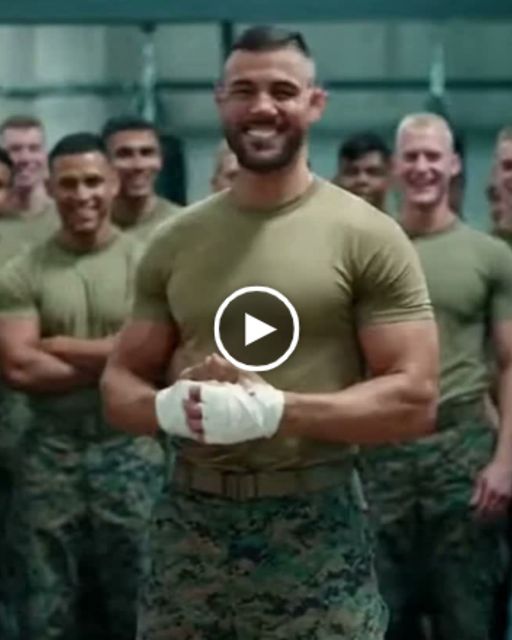
Bay 9 had that familiar tang of rubber mats and old sweat, the kind of scent that tells you more lessons have been learned here than anyone’s willing to admit. The recruits had drifted in on their own, word passing through the barracks quicker than a rumor ever needs help to move. There was going to be a show. Three seasoned Marines were about to remind a visitor of the pecking order.
Staff Sergeant Price cracked his knuckles with a grin he had probably practiced in the mirror a thousand times. Torres and Vance circled with the loose-bodied swagger of men who know how to win. The mood was light. A few of the younger recruits laughed the way people laugh when they think they already know the ending.
She didn’t look like much at first. A faded gray hoodie, Navy sweats, hair tied back. She could have been somebody’s mother headed to a morning walk if not for the way she stood. Calm. Simple. Not trying to impress anyone.
Without a word, she placed a sealed manila envelope at the edge of the mat, smoothing it with a steady palm as though it carried something fragile. Then she stepped into the center and gave the smallest nod, the kind that says, If you must, go ahead.
The First Lesson Arrives Fast
Price moved first, because of course he did. Big right hook, all confidence. In the blink that followed, she was already inside his guard. There was a single clean sound, the kind of crisp impact you feel in your teeth more than you hear with your ears. His legs disappeared from under him and he folded to the floor like someone had yanked a chair away.
Torres made the noise men make when they’ve been waiting to play the hero. He charged. She caught his wrist, pivoted, and set him down hard and flat. The slap of flesh on concrete echoed. Then silence. Torres did not get up.
Vance stopped moving. His mouth opened, then shut again like he wanted to swallow the fear before anyone else noticed it. She looked at him the same way a calm ocean looks at a stone tossed from shore.
“Your turn,” she said, hardly louder than a breath.
He put both hands up and started backing away. “I’m good,” he said, and he meant it.
When the Man in the Back Stands
The Master Gunnery Sergeant rose from the back bench. He doesn’t stand for much; he doesn’t speak unless words are needed. He walked past the two men on the floor without checking for bruises and stopped in front of her. He dipped his head, solemn, like a man at a graveside.
“I told them,” he said softly.
Price coughed and tried to sit up, his pride catching up to his pain. “Who… who is she?”
She picked up the envelope, tossed it into his lap with the same easy care she’d shown setting it down. “Read.”
His hands shook. He slid a finger under the flap, pulled out a single hard-stock sheet. The print was matter-of-fact, the kind of typography that never tries to sell anything because it belongs to the government and says what it says.
His face changed first at the eyes, then all at once, the way a storm becomes real when thunder finally follows lightning.
“This… this can’t be real.”
“It’s real,” Master Guns said, his voice carrying no judgment, only truth.
The Envelope You Don’t Expect
Everyone always thinks it’s a transfer or a reprimand. The sort of paperwork that moves people from one place to another without leaving a mark. This was something else. It was a deployment record from a unit we don’t say out loud. My eyes found the line that mattered and stayed there.
Under Rank, it did not say Chief. It did not say Captain. It did not say anything you can salute in the normal way. Above a faded unit crest stamped RESTRICTED in a thick red, there was a line that read like a whisper.
Asset Designation: Echo.
Below that, the unit: Special Projects Group 7.
If you’ve served long enough, you hear things late at night from people who will never tell you the same story twice. Special Projects Group 7 lives in those stories. Not soldiers in the usual sense. Not even shadows, exactly. Solutions, people say, to problems nations do not put on paper.
Price looked suddenly very young. The pretense and the pose were gone. He stared at the page as if it had opened a door in his chest and let the weather in.
Master Guns spoke without raising his voice. “Miller, Collins, get Torres and Vance to the infirmary.”
We moved fast, because that tone doesn’t leave room for delay. The two groaning Marines did not argue. They let us haul them upright, careful and quiet, both of them glancing back at the woman still on the mat, still standing easy, as if this had been a conversation more than a contest.
“Price,” Master Guns said. “My office. You too.” He looked to her. She gave a single, precise nod.
Behind a Half-Open Door
I found an errand that led me conveniently near Master Guns’ office and a reason to linger with a field-stripped rifle. The door wasn’t closed all the way. Some things in life are meant to be overheard by those who need to hear them.
“You happy with yourself, Staff Sergeant?” Master Guns’ voice had the gravel in it. “You wanted to fight. You found one.”
Silence. The kind of pause that gives a man the space to choose what he will be next.
Her voice came then, steady and even, free of any heat despite what had just happened. “That’s not why I’m here, Master Gunnery Sergeant.”
“I know why you’re here, Anya.”
The first name landed like a new rule. I had never heard him use one.
“Your file landed on my desk last week, Price,” Master Guns said. “Another conduct violation. Disrespect to a superior. Hazing a junior recruit. It’s a pattern.”
“He was weak,” Price muttered, hoarse.
“He was a kid from a farm in Iowa,” Master Guns answered, each word placed like a weight. “Your job is to build him up, not break him for sport. You’ve got all the talent. All the gifts. But arrogance is a sickness when you let it grow.”
Quiet again. I pictured Price staring at the floor, the world tugging hard at the edges of the man he thought he was.
A Promise Older Than Pride
“Do you know who David Price was?” Anya asked.
Something sharp moved in the air. “Don’t you talk about my father,” Price snapped, more fear than fury.
His father’s name lived on base like a standard in the wind. A Sergeant Major who never came home from a mission that never made the news, a man so respected the stories about him were told softly. His son wore that memory like a shield and a burden.
“I’m not just talking about him,” Anya said, and her voice eased a fraction. “I served with him.”
The office went still. Even through the door, I felt it. She continued.
“He was my team leader in Group 7. In a place we weren’t, on a day that doesn’t exist, he pulled me out of a burning vehicle. Carried me two miles with shrapnel in his leg. Never said a word about it after. Never boasted. He did the job and lifted everyone around him while he did it.”
She let the memory breathe. Then, softer, “He was the strongest man I knew, and it wasn’t the way he hit. It was where his strength came from.”
I could not see Price’s face, but I could hear him stop resisting the truth.
“Before his last mission,” Anya said, “we talked about family. He told me about his boy. Headstrong, proud, quick to lead and slow to listen sometimes. He worried about that.”
Her voice dropped to a near-whisper that somehow carried through the hall. “He asked me for a favor. He said, ‘Anya, if something happens to me, check on my boy. Make sure he grows into a good man. Not just a good Marine. A good man.’”
Everything shifted in that instant. She wasn’t there to teach a seminar or to collect a trophy. She was a promise in motion.
“I kept tabs on you,” she said gently. “I was proud when you chose the uniform. Proud when you made Sergeant. But the last year? The reports weren’t good.”
She took a breath you could almost hear. “Master Guns reached out to a mutual friend. He didn’t know I knew your father. He only knew I was someone to call when he needed a problem solved.”
And there it was. Master Guns hadn’t ordered up an instructor. He had asked for a mirror, and the right one had answered.
“You walk through this place like you own it,” Anya said, steel returning to her tone. “You think that honors him? You think pushing down the young makes the old proud?”
A small, aching sound came from Price, and the strongest NCO on base sounded, for once, like a son. Tears do not sound the way you expect. They sound like surrender to a better truth.
“Your father died saving his team,” Anya said. “He used what he had to protect, not to prey. Every time you use his name to excuse small cruelties, you tarnish what he gave you. That ends now.”
Two Weeks That Remade a Man
After that day, the base felt different, like someone had changed the tune and we were all still finding the beat. Anya—Echo, some whispered—didn’t leave. She took a guest room and no official title, but everybody knew her job. She had one student.
Each morning at 0400, long before the first chow, they were on the track. It wasn’t just miles. It was sandbags across shoulders, sleds that seemed to gain weight with every push, tires flipped end over end until the sunrise found steam rising off their backs. She never stood aside. She carried what he carried. She asked nothing she didn’t do herself.
On the mats, the lessons had changed shape. She still took him apart with economy, but now, after a sweep or a hold, she would lean in and speak so quietly only he could hear. She showed him where his balance left him. She showed him his impatience and how to set it down. Piece by piece, she disassembled the brittle shell he had built around his talent and handed him back something durable.
The biggest changes, though, weren’t on the track or the mat. They were in the pauses between. You could see it the first time a skinny recruit named Peterson fumbled his rifle at inspection. The old Price would have made the kid a public example of how not to be. The new Price stepped over, knelt, and adjusted the strap with steady hands.
“Keep your head up. Watch your hands. You’ll get it,” he said. Then he stood and glanced across the yard. Anya watched from a distance. She gave him the smallest nod. It was more than praise. It was permission to be better than yesterday.
At meals, Price left the NCO table where laughter often had an edge to it. He sat with the junior enlisted, learning where they were from, what their parents did, how many brothers and sisters they left behind to be here. He stopped performing toughness and started practicing strength.
One evening, I saw the two of them on a bench that looked out across the training grounds. Twilight softened the hard lines of the day. Anya handed him a small, dented metal box. He opened it, and the light caught on steel.
“Your father wanted you to have these when you’d earned them,” she said. “Not when you pinned on rank. When you earned the right to be called his son.”
Price held the dog tags in his palm for a long time. He didn’t say much. When a thing is true enough, it doesn’t need a lot of words.
The Test That Mattered
The field exercise came at the end of those two weeks like a page turning at just the right pace. A simulated rescue mission. Obstacles arranged with the careful malice of good instructors. Price had the squad leader band around his arm.
Everything went wrong on schedule. A route went dead under red markers for mines. Comms flickered out. Time bled away. The version of Price from a month earlier would have muscled forward because that was the only language he trusted. The new version gathered his people and asked for thoughts. Peterson, the skinny kid with the uncertain hands, pointed at a steep, muddy embankment the planners had written off as impossible.
Price looked once, then nodded. He went first, because that’s what leaders do. He went last too, coming back down to put hands on the wrists of every Marine behind him, hauling them up one after another, until his uniform was more mud than fabric.
They made the objective with seconds to spare. No casualties. The plan had bent but not broken, and neither had the men.
From the observation post, Master Guns and Anya approached. The stopwatch in his palm still ticked a little as he looked down and then up. The edges of his mouth did something we weren’t sure they could do.
“Not bad, Staff Sergeant,” he said, and the compliment landed harder than any reprimand ever had.
Anya stepped in front of Price and looked into his eyes. The steel in her gaze had warmed, like sunlight on metal.
“Your father never threw the first punch,” she said quietly. “He lifted people. Over walls, across lines, out of fear. That’s strength.”
You could see it, clear as a flag caught by a steady wind. His shoulders eased. He stood taller, not with the stiffness of pride but with the freedom that comes from knowing exactly who you are.
“Thank you,” he said, and his voice was steady again.
How Some Stories End
The next morning, she was gone. No ceremony. No announcement. Just an empty guest room and a base that felt like it had shed an old skin. The recruits whispered “Echo” less like a rumor and more like a blessing.
Price didn’t become a different man overnight. He became the man he had been asked to be all along. The swagger returned, but it had changed shape. It wasn’t noise anymore. It was confidence worn quietly, the kind that doesn’t need an audience. He worked harder. He listened more. He led the way his father had led, by earning trust one decision at a time.
There were no headlines for any of it. Just the sound of boots on gravel in the morning, conversations that ran a little deeper at night, and a base where young Marines stood a bit straighter because someone had shown them what strength is supposed to look like.
What Stayed With Me
I think about that envelope more than I expected to. Not because of the secrets it held, but because of what it revealed without saying much at all. Rank can tell people where to stand. Reputation can fill a room. But character walks in quietly and changes everything.
I think about the way she placed that envelope, the gentle care of it. That’s how you handle what matters. With steadiness. With intention. With respect for the weight some things carry.
I think about a father’s request carried across years and miles by someone who understood that promises are not made to be remembered; they are made to be kept. That is the heart of service, whether you wear a uniform or not. You do what you say you will do, especially when no one is watching.
Most of all, I think about the shape of real strength. It is not the loudest voice in the room. It is not the first fist thrown. Real strength is patience in the face of impulse. It is the discipline to absorb an insult and return a lesson instead of a blow. It is the courage to admit wrong and the humility to change direction. That is harder than any sprint, longer than any ruck, and more important than any ribbon on a chest.
Legacy, I learned, is not something you inherit whole like a family heirloom. It is a thing you build one action at a time. You do not deserve it the day your name gets sewn onto a uniform. You earn it when the people around you begin to stand a little taller because of how you carry yourself.
Price figured that out with mud on his boots and sweat in his eyes. He stopped trying to be his father’s shadow and started becoming his father’s echo, the best kind, the kind that carries the original truth forward without needing to copy every sound. In the end, he was not just Sergeant Major Price’s son. He was Staff Sergeant Price, a good man in his own right. That is a legacy a father would recognize and salute.
I have seen plenty of hard lessons handed out in places like Bay 9. Most of them sting and fade. This one stayed. Maybe because it started with laughter and ended with quiet. Maybe because it began with a challenge and ended with a promise kept. Or maybe because, if we are honest, each of us has a little of Price in us—a part that needs to be reminded that strength is for lifting, not pressing down.
So when I hear knuckles crack and proud words thrown like bright pennies on the mat, I remember the woman in the gray hoodie setting down an envelope with care. I remember the way a room can go silent when the truth steps in. And I remember that the measure of a Marine, and of a person, is not found in the force of a single moment, but in the long, steady arc of who they choose to become.