
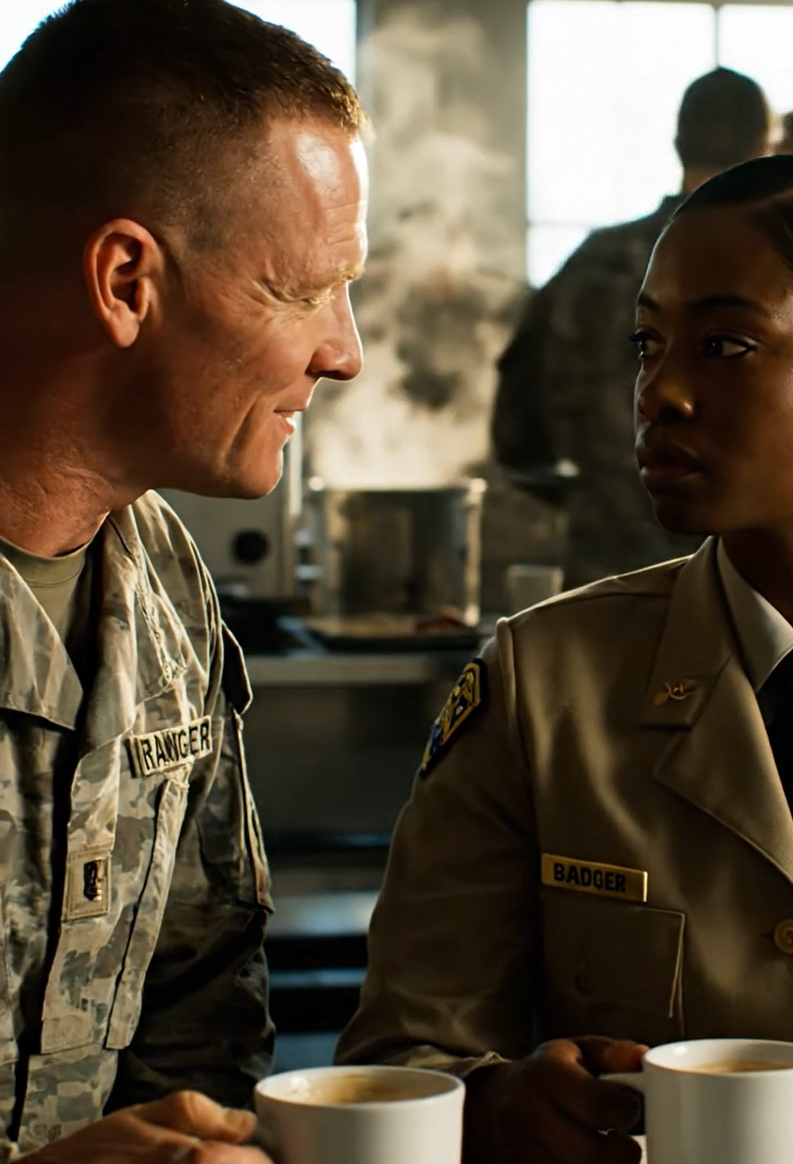
The morning sun hadn’t yet burned away the dew when Captain Lana Ashford stepped into the mess hall at Fort Bragg. She moved with quiet precision – the kind of movement learned by people who understand that being noticed can sometimes get you killed.
Her ACU uniform was textbook perfect. To anyone watching, she was just another logistics officer grabbing breakfast before another long day of spreadsheets and supply chain reports.
But Staff Sergeant Caleb Drummond was watching.
He sat three tables over with his crew – mechanics, truck drivers, the guys who fixed things when command broke them. His eyes locked on her sleeve. Specifically, on the small embroidered patch just below her rank: a badger, rearing up.
Caleb’s jaw tightened. He leaned over to Martinez, the diesel specialist next to him. Whispered something. Martinez looked. Both men laughed.
Lana didn’t hear it, but she felt it. That electric prickling on the back of your neck that means you’re prey.
She grabbed a tray. Kept moving. Sat in her usual spot near the window, alone.
“Yo, Cap!” Caleb’s voice cut across the hall. Not loud enough for officers to intervene. Loud enough for everyone else to hear. “Nice patch. You hiking a lot? Girl Scouts end at what, fifth grade?”
The mess hall shifted. Heads turned. Someone suppressed a smile.
Lana’s fork didn’t pause. She cut into her eggs. Ate. Chewed. Swallowed.
“Or is that what they give you for… what do you do, exactly? Manage the pencil supplies?” Martinez. Louder this time. Other men joined in – low, mean laughter rippling across the room like a wave.
Three other officers sat near her. None of them said anything. They looked at their plates like they’d become suddenly very interesting.
Lana set her fork down slowly. Very slowly. She turned her head just enough to look at Caleb. Her eyes were gray. Not angry. Worse than angry. Professional.
“Problem?” she said.
“No problem, Captain,” Caleb said, and the way he said “Captain” made it clear he didn’t mean it as a title. “Just thinking maybe you got the patch for… administrative excellence? Prettiest spreadsheet in the battalion?”
The laughter swelled. Four more enlisted men joined Caleb’s table, drawn by the scent of blood in the water. Lana was alone. Lana was logistics. Lana didn’t belong here.
She stood up. Tray in hand. Walked toward the exit.
“Running away?” Caleb called after her. “That’s more Girl Scout behavior!”
The room erupted. Even some of the younger officers couldn’t hide their smirks.
Lana didn’t look back. She pushed through the doors and disappeared into the Kansas morning.
The next morning, General Patricia Morrison arrived at Fort Bragg unannounced.
Not unusual. Generals did that sometimes. But this wasn’t a routine inspection. Morrison was the Deputy Commander of United States Special Operations Command. She moved through the base like a woman who owned it, because technically, she did.
She spent two hours in classified briefings. Then she did something no one expected: she asked for the entire fort to assemble in the primary gym.
Five hundred soldiers filed in, confused and alert. Officers lined the back. Enlisted men filled the bleachers. The air tasted like sweat and uncertainty.
General Morrison walked to center court. Alone. No aides, no fanfare.
“I’m here about a situation that happened yesterday in the mess hall,” she said. Her voice was quiet, which meant everyone shut up immediately.
Caleb’s face went pale.
“A Staff Sergeant and his crew decided to mock one of our officers. They decided her credentials, her service, her presence didn’t matter. They laughed at her patch.”
Morrison paused. Her eyes scanned the crowd.
“That patch is from the 75th Ranger Regiment. It’s earned, not issued. You get it for combat operations in denied areas. You get it for being the type of soldier who operates where command can’t officially follow.”
Caleb was now the color of old snow.
“Captain Lana Ashford,” Morrison continued, “spent six years with the Rangers before she transferred to logistics command. She spent those six years in places I cannot name, doing things I cannot discuss, with a deployment rate that makes most of you look like you’re on permanent vacation.”
Morrison’s eyes found Caleb’s across the gymnasium.
“The badger on her patch isn’t about Girl Scouts, Staff Sergeant. It’s the symbol of the Afghan mountain region where Captain Ashford conducted four operations that kept American soldiers alive. Operations that saved the lives of people in this room. Possibly yours.”
The gymnasium had become a tomb.
“Captain Ashford doesn’t talk about her service because she was never authorized to. She wears that patch quietly because that’s how operators operate. They don’t brag. They don’t boast. They do the work and they move forward.”
Morrison turned to face the officers’ section where Lana stood, still in her fresh uniform, her face absolutely still.
“Stand with me,” Morrison said.
Lana walked to center court.
When General Patricia Morrison—decorated, silver-haired, commanding the respect of thousands—put her hand on Lana’s shoulder and faced the crowd, something shifted in the gymnasium. Not just the air. Something deeper.
“This,” Morrison said quietly, “is what real looks like.”
She turned to Lana and extended her hand for a handshake that lasted four seconds—an eternity in military protocol.
Then she turned back to the crowd.
“Anyone who has a problem with this officer leaves my command today,” Morrison said. “I’m serious. Walk out now, or you stay quiet for the rest of your service.”
No one moved.
“Dismissed,” Morrison said.
The shuffle back to the exit was silent except for the sound of boots on hardwood and the weight of five hundred soldiers understanding, all at once, that they’d been in a room with someone they’d never really seen before.
Caleb stayed seated long after everyone else left.
When Lana passed his table on the way out, she didn’t look down at him.
She didn’t need to.
He already understood.
The days that followed were worse than the public shaming. They were quiet.
Caleb walked through the motor pool like a ghost. The usual banter and friendly insults died whenever he approached. His own men—Martinez, Henderson, Price—looked at him differently. They looked at him like he was a fool.
He deserved it. He knew that.
He tried to lose himself in the grease and steel of a Humvee’s engine block. But his thoughts kept drifting back to the General’s words. “Possibly yours.”
He had served two tours in Afghanistan. He’d been in firefights where, for no reason he could explain, the enemy had just melted away. He’d been on convoys that were rerouted at the last minute, only to hear later that the original path had been lined with IEDs.
He had always chalked it up to luck. To good intel from on-high.
He had never once considered that the “on-high” was a quiet Captain with gray eyes who ate her eggs alone.
Lana, for her part, hated the new attention.
Before, she had been invisible. Now, she was a legend. Young lieutenants would stop and stare. Colonels would offer to buy her coffee. She was no longer just a logistics officer.
She was the “Badger Captain.”
She felt exposed, like a sniper whose ghillie suit had been ripped away. Anonymity had been her armor, and General Morrison, with the best of intentions, had stripped it from her.
She just wanted to manage her supply chains. To ensure the beans and the bullets got where they needed to go. That was her new mission, and she was good at it.
The past was the past for a reason.
Two weeks after the assembly, the sky over Kansas turned a bruised purple. The weather reports went from “severe thunderstorm watch” to “tornado warning” in less than an hour.
The first funnel cloud touched down ten miles north of the base, tearing through the small town of Oak Creek.
It was a direct hit. The town was flattened. Roads were gone. The bridge over the river, the only way in or out, was a mangled mess of concrete and rebar.
Fort Bragg immediately shifted into disaster relief mode.
The base commander put Colonel Hayes in charge of the response. Hayes was a good man, but a traditional one. He called a meeting with his top people.
“We need to get heavy equipment, medical supplies, and search-and-rescue teams into Oak Creek,” Hayes said, pointing at a map. “But the bridge is out. The river is flooded. We’re cut off.”
Ideas were thrown around. Airdrops were too risky with the high winds. Engineers said building a temporary pontoon bridge would take at least forty-eight hours. People in Oak Creek didn’t have forty-eight hours.
The room was filled with grim-faced officers.
Lana stood in the back, listening. She looked at the topographical maps, the supply inventories, the equipment manifests. Her mind wasn’t seeing obstacles. It was seeing a complex logistics problem.
“Sir,” she said, her voice cutting through the silence.
Colonel Hayes looked up, surprised. “Captain Ashford.”
“The old logging trail,” Lana said, pointing to a faint line on the map. “It runs north of the river. It’s washed out and hasn’t been used in twenty years, but the bedrock is solid. It bypasses the bridge entirely.”
An engineering officer scoffed. “That trail is impassable. It’s a mud pit. Our heavy transport vehicles will get bogged down in minutes.”
“Not our standard transports,” Lana agreed. “But we have six M-ATV chassis in long-term storage. We can modify them. We’ll need to fabricate new suspension struts and equip them with high-torque winches.”
“Fabricate?” the engineer said. “That would take a week in a proper facility.”
Lana shook her head. “It will take six hours in our motor pool. If we have the right people.”
Colonel Hayes looked from the engineer’s doubtful face to Lana’s steady gaze. He remembered General Morrison’s words.
“Who do you need, Captain?” he asked.
Lana took a breath. “I need Staff Sergeant Drummond and his crew.”
A heavy silence fell over the room. Colonel Hayes stared at her. “Are you sure about that, Captain?”
“He’s the best mechanic on this base,” Lana said simply. “His team knows fabrication. We don’t have time for anything less than the best.”
It wasn’t forgiveness. It was a tactical decision.
Caleb was elbow-deep in the engine of a transport truck when the call came. He was told to report to the main briefing room. Immediately.
He walked in to find Captain Ashford standing over a set of vehicle schematics. Colonel Hayes was there, along with half the command staff.
He braced himself for the formal reprimand he knew was coming. Maybe even a demotion.
“Sergeant,” Lana said, not looking up from the blueprints. “We need to get six of these M-ATVs running and modified for severe off-road conditions. We’re salvaging parts from the HEMTTs in Yard Four. I need custom-welded winch plates and reinforced A-arms. Can you do it?”
Caleb was stunned into silence. He looked at the schematics. He saw the problem. He also saw the solution. His mind, which had been a fog of shame, suddenly cleared. This was what he understood. This was metal and torque and horsepower.
“Yes, ma’am,” he said, his voice raspy.
“You have six hours,” she replied, finally meeting his eyes. There was no animosity in them. Just expectation. “Your crew is waiting for you at the motor pool.”
For the next six hours, the motor pool was a whirlwind of focused chaos.
Lana was the nerve center. She directed the flow of parts with an almost supernatural foresight, knowing what Caleb’s team would need ten minutes before they did. She had forklifts moving pallets of equipment into place like a master chess player.
Caleb was the heart of the operation. He and his men worked with a furious intensity. Sparks flew from welding torches. The clang of hammers on steel echoed through the massive garage. He wasn’t just a boss; he was a craftsman, his hands moving with a certainty that had been absent for weeks.
He and Lana barely spoke. They communicated with hand signals and single words. “Torque wrench.” “Plasma cutter.” “Check the fluid levels.”
There was no time for apologies or awkwardness. There was only the mission.
Around the fourth hour, as Martinez struggled to align a heavy steel plate, Caleb saw a faster way. He grabbed a small hydraulic jack.
“Captain,” he called out. “I need you to hold this light steady. Right there.”
Lana knelt in the grease and grime beside him, holding the work light exactly where he pointed. For a full minute, they were side-by-side, their worlds shrunk down to a single stubborn bolt.
He finally wrenched it tight. He looked up, his face inches from hers.
“Captain,” he said, his voice low. “About what happened in the mess hall…”
“Focus on the work, Sergeant,” she cut him off, but her voice was not harsh. “We can talk when people aren’t trapped.”
He nodded. He understood. The work came first.
At dawn, six monstrous vehicles rolled out of the motor pool. They looked like something from a post-apocalyptic movie. They were ugly. They were loud. They were beautiful.
The convoy, led by Lana in the command vehicle and with Caleb’s team providing mechanical support, reached the old logging trail.
It was worse than they had imagined. It was a river of mud and fallen trees. But the modified vehicles clawed their way through. They winched each other up steep inclines. They forded streams that would have swallowed lesser trucks.
Twelve hours after the tornado hit, the first vehicle from Fort Bragg rolled into the devastated town of Oak Creek. They had brought doctors, water, and hope.
The rescue operation lasted for three days.
When it was over, the base returned to its normal rhythm. But something had changed.
The story of the “Oak Creek Six” M-ATVs and the midnight fabrication job spread through the ranks. People talked about the quiet logistics Captain and the master mechanic who had made it happen.
One afternoon, General Morrison’s aide found Caleb in the motor pool. He handed him a thin manila folder.
“The General thought you might want to see this,” the aide said, and left.
Caleb opened it. It was an after-action report, heavily redacted with thick black lines. The operation code name was “Badger’s Claw.” The date was from his second tour in Afghanistan.
He read about a small team that had infiltrated a mountain pass to gather intelligence. The report described how that intelligence pinpointed the location of a command-wire IED meant to ambush a supply convoy. His convoy.
The report didn’t have names. It didn’t need to. He knew exactly who had been in those mountains. He knew whose skill had saved him and the twenty other soldiers in his unit that day.
He closed the folder. The weight of it felt immense. He had not just mocked an officer. He had mocked his own savior.
He found Lana later that day. She wasn’t in her office. She was at the base’s long-distance rifle range, a place few people used.
She lay prone, perfectly still, staring through the scope of a sniper rifle. He stood back, waiting.
Crack. The rifle shot was sharp and clean. A puff of dust appeared on a target 800 yards away. A perfect bullseye.
She ejected the shell casing, her movements fluid and economical. She knew he was there.
He walked up slowly. “Captain,” he began.
She sat up, turning to face him. Her expression was neutral.
“I saw the report,” he said, his voice thick with emotion. “Badger’s Claw. That was my convoy.”
Lana simply nodded. She picked up the spent shell casing, still warm, and rolled it between her fingers.
“Thank you,” Caleb said. The two words felt entirely inadequate. “For what you did over there. And for… everything.”
She looked at the small piece of brass in her hand, then looked back at him. “We all have a job to do, Sergeant. You keep the trucks running. I make sure they have a safe road to drive on. It’s the same mission.”
She stood up and offered him the shell casing. “A souvenir.”
He took it. It was a small thing, but it felt like a medal.
The next morning, Lana Ashford walked into the mess hall. She got her tray and sat at her usual table by the window.
A moment later, Staff Sergeant Caleb Drummond and his entire crew walked in. They got their trays. Instead of sitting at their usual table, they walked over to hers.
“Morning, ma’am,” Caleb said. “Mind if we join you?”
Lana looked up at the men who had once laughed at her. She saw no mockery in their eyes. Only a deep, quiet, hard-earned respect.
She gave a small, almost imperceptible smile. “Pull up a chair, Sergeant.”
True strength isn’t measured by the noise you make or the medals on your chest. It’s measured by your actions when no one is looking, by the quiet competence that holds the world together. And respect isn’t about rank or patches; it’s the simple, powerful understanding that everyone has a vital part to play.



