
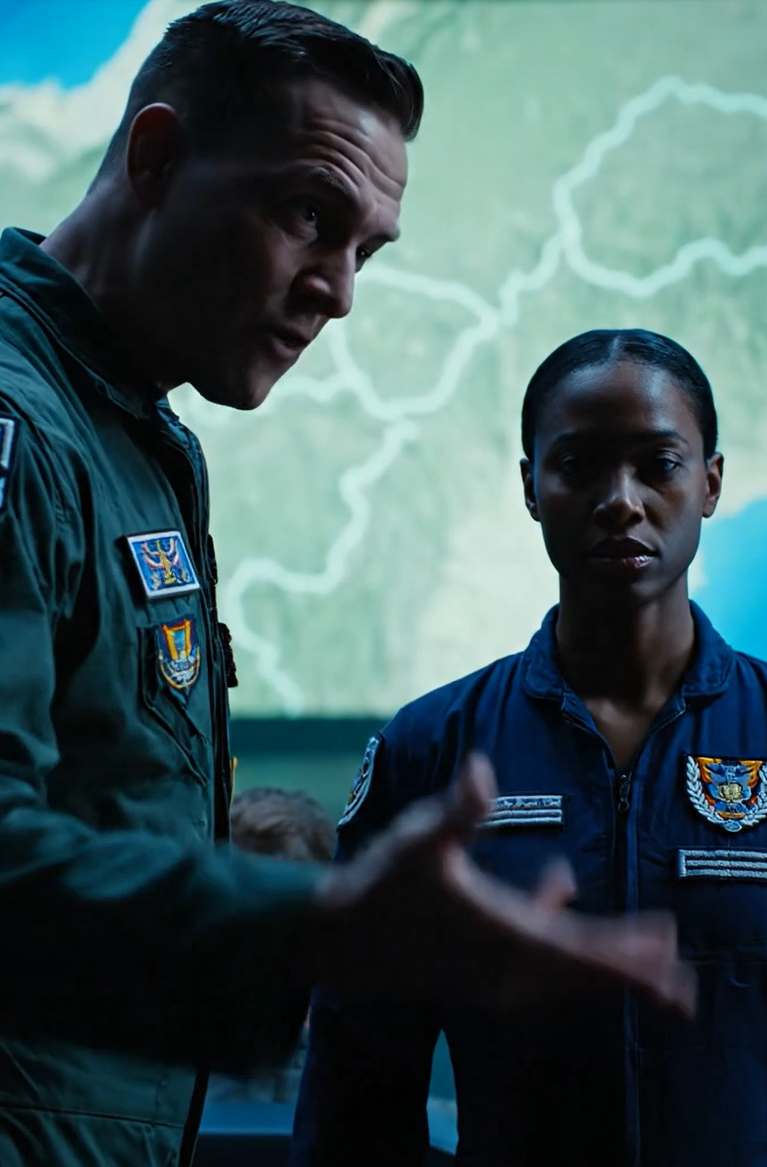
The first morning of Red Flag felt like stepping into a testosterone storm. One hundred of America’s top fighter pilots packed into the briefing theater, loudly trading dogfight stories.
I stood quietly near the back in a plain, unmarked flight suit. No name tag. No rank. No patches.
To them, I was invisible. Admin. A secretary who got lost.
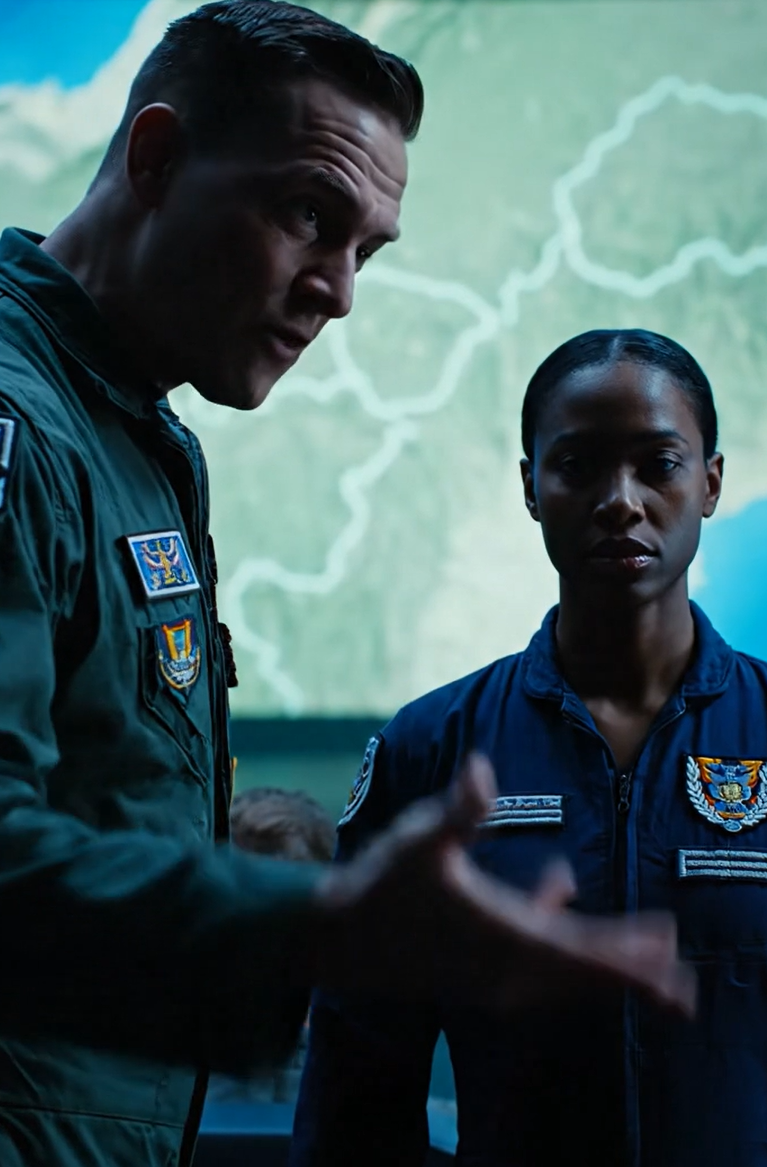
Then the double doors slammed open. Lieutenant Mark Wyatt swaggered in. Our father’s golden boy – the one who supposedly “inherited the flying genes.” We shared a father, nothing else.
Mark’s eyes scanned the room, landed on me, and he burst out laughing. Not a small laugh. The kind that made heads turn.
“Dude, what are you doing here?” He said it loud enough for everyone to hear. “Did you take a wrong turn from the cafeteria?”
A ripple of snickers. Someone turned to look at me, then looked away. I didn’t react. Couldn’t afford to.
“Seriously, you need to – ” Mark started walking toward me, still grinning.
“Take your seat, Lieutenant.” The voice came from the doorway. Quiet. Absolute.
General Sarah Chen stood there in dress blues, her face neutral. The room went completely silent.
Mark froze mid-stride. “Ma’am, I was just – “
“Your seat. Now.”
He sat. Fast.
General Chen walked to the front, her eyes finding mine for exactly one second. Then she turned to address the room.
“Gentlemen—and Captain,” she paused, letting that word hang in theair, “—welcome to Red Flag. I’m going to be direct. The pilot in the back of this room has the highest aerial combat rating in the Pacific Fleet. She holds three tactical innovation patents. She’s also the reason we don’t lose pilots to the same mistakes anymore.”
I felt my throat tighten.
“The culture that made some of you laugh thirty seconds ago is the same culture that costs lives. Not today. Not in this exercise.”
Mark’s face had gone white. His jaw was clenching so hard I could see the muscles working.
General Chen continued, “Captain Wyatt will be running the tactical analysis for the week. You will listen to her briefings. You will implement her recommendations. And you will thank her when you walk out of here alive.”
She said my name. My rank. My title.
The room shifted. Phones were already coming out—someone was recording. I could see it in the corner of my vision. This moment. This reversal. Spreading.
Mark stared straight ahead, not moving, not looking anywhere. His hands gripped the edge of his desk.
General Chen turned back to me. “Captain, the floor is yours.”
I walked forward. Every step felt like stepping on air. One hundred pairs of eyes tracked my movement. Some curious now. Some angry. Some ashamed.
I reached the podium and looked directly at my half-brother.
“Let’s talk about why yesterday’s engagement protocols failed,” I said, my voice steady.
And that’s when Mark’s phone buzzed. Then another pilot’s. Then another.
The video was already circulating. The laugh. The dismissal. The general’s response.
By the time I finished that briefing, every single person in that room knew exactly who I was.
More importantly, they knew who Mark was.
The briefing ended and the pilots filed out, the usual boisterous energy replaced by a heavy, awkward quiet.
They gave me a wide berth. A few offered a respectful nod.
Mark was the last to leave his seat. He moved like a man wading through concrete.
He caught up to me in the hallway, grabbing my arm. His grip was tight.
“You set me up,” he hissed, his voice low and venomous.
I pulled my arm away. “I did nothing, Mark. I just stood there.”
“You knew Chen was going to do that. You planned this whole thing to humiliate me.” His face was flushed, a stark contrast to the pallor it had held in the briefing room.
“You humiliated yourself,” I said, my voice barely above a whisper. “You did that all on your own.”
He looked like he wanted to say more, to lash out, but his phone buzzed again. He glanced at it, and a new wave of fury washed over his features.
“This is everywhere,” he seethed. “Everywhere.”
He stalked off down the corridor, leaving me standing there. The silence he left behind was louder than his anger.
My work started immediately. I was given a small, windowless office filled with monitors. This was my cockpit now.
Data from the day’s first simulated sorties poured in. I watched callsigns dance across a digital map of the Nevada desert.
I saw patterns they couldn’t. I saw vulnerabilities they missed while pulling 7 Gs.
My first analysis was on Mark’s squadron. They flew with textbook aggression, exactly like our father taught them.
And that was the problem. It was predictable.
In the afternoon debrief, I put my findings on the main screen. A red arrow showed the precise moment an enemy simulator could have slipped in behind them.
“Lieutenant Wyatt’s squadron is fast,” I began, keeping my tone clinical. “But your entry vector is compromised. You’re broadcasting your attack run a full ninety seconds before you engage.”
Mark stood up from his seat in the front row. “With all due respect, Captain, that’s a theoretical risk. In a real-world scenario, speed is security.”
A few of his squadron members nodded in agreement.
“Speed is a tool, not a strategy,” I countered. “The aggressor squadron is adapting to your ‘textbook’ approach. They know what you’re going to do before you do.”
I pointed to another part of the screen. “A simple rolling scissors maneuver here would mask your approach and give you the element of surprise.”
Mark scoffed. “That’s academy stuff. Too slow. It bleeds energy.”
“It keeps you alive,” I said flatly.
An older pilot in the third row, a guy they called ‘Pops,’ spoke up. “The Captain has a point, Mark. We got bounced by aggressors using that exact blind spot last year.”
Mark shot him a dark look. “We’ll stick to what works, Pops.”
He sat down, his message clear. He was still the leader in the sky. I was just the voice on the ground.
The next two days were a battle of wills fought with data and pride.
I would present my analysis, pointing out flaws and offering solutions. Mark would find a way to publicly question it, subtly dismiss it, or claim it was overly cautious.
He never disrespected my rank again, not openly. But his resistance was a quiet poison, seeping into the other squadrons.
Pilots started talking. Was I too conservative? Too reliant on data instead of gut instinct?
Was I trying to make my hotshot brother look bad?
I kept my head down and did the work. I ate alone in the mess hall. I spent my evenings running predictive models.
One night, while I was staring at a screen of code, a shadow fell over my desk.
It was General Chen. She held two cups of coffee.
“Burning the midnight oil, Captain?” she asked, placing a cup beside my keyboard.
“Just running some numbers, ma’am.”
She leaned against the doorframe. “I know this isn’t easy. I know who your father was. I flew with him.”
I stopped what I was doing. “You did?”
“He was the best stick-and-rudder man I ever saw,” she said. “But he always said his greatest weakness was tunnel vision. He saw the target, and nothing else.”
She took a sip of her coffee. “He used to talk about you. Said Mark got his hands, but you got his head. The part that could see the whole chessboard.”
I didn’t know what to say. My father had never said anything like that to me.
“Mark is his father’s son,” Chen continued. “He thinks the only way forward is to push the throttle. Your job is to show him there’s more than one way to win a fight.”
She gave me a small, rare smile. “Don’t back down, Captain.”
Then she was gone. Her words stayed with me, a shield against the doubt that had started to creep in.
The final major exercise was scheduled for day five. A massive, complex scenario involving dozens of aircraft.
My analysis predicted a specific, high-risk ambush. The aggressor squadron had been using a new type of electronic warfare, and I found a ghost in their machine. A faint signal that gave away their position, but only if you knew exactly what to look for.
I built my entire morning briefing around it. “They will feign a frontal assault to draw you in,” I explained, highlighting a valley on the map. “The real threat is a secondary force hiding in a canyon, using signal repeaters to mask their heat signatures.”
My recommendation was clear. “Ignore the primary assault. Swing wide and eliminate the hidden threat first. It’s a pincer movement in reverse.”
Mark listened, his expression unreadable. When I finished, there was a long silence.
“That’s a hell of a gamble, Captain,” another squadron leader said. “Ignoring a direct threat?”
“The direct threat isn’t real,” I insisted. “It’s a distraction.”
Mark finally spoke. “My squadron will take point. We’ll assess the situation and proceed as we see fit.”
He didn’t argue. He didn’t dismiss it. He just… sidestepped it. It was worse.
I watched the simulation from the command center, my stomach in knots. The room was dark, lit only by the glow of the massive screens showing the battlespace.
The exercise began. Green icons representing Mark’s squadron flew toward the valley.
“Red Dragon flight, what’s your status?” the controller asked.
“Engaging primary targets,” Mark’s voice crackled over the speakers. Cool. Confident.
The red icons of the ‘primary’ aggressors appeared on screen. Exactly where I said they would.
“It’s a feint, Mark,” I whispered at the screen. “Turn around.”
But he didn’t. He pushed forward, leading his flight directly into the valley. He was going to prove me wrong by brute force.
Then, it happened.
From a side canyon, a dozen new red icons blinked into existence. The ambush.
“Ambush, ambush! Break right, break right!” someone screamed over the comms.
It was too late. The virtual sky filled with simulated missile fire.
One by one, the green icons of Mark’s squadron turned red on the screen. Wingman one. Wingman two.
Then his.
A simulated voice announced coldly, “Red Dragon lead is down.”
A wave of groans swept through the command center. The entire exercise had collapsed in less than five minutes.
The debriefing was a morgue.
I didn’t have to say a word. I just put the flight data on the screen.
First, I showed my predictive model from the morning briefing. Then, I overlaid the actual flight paths from the simulation. They were nearly identical.
The facts were brutal and undeniable. Mark had flown his entire team into a perfectly executed trap that I had laid out for him, hour by hour.
He didn’t look at the screen. He just stared at the table in front of him. His reign as the golden boy, the untouchable ace, had ended. And everyone in the room knew it.
When it was over, he got up and walked out without a word. No excuses. No anger. Just a hollow emptiness.
I didn’t see him for the rest of the day. He wasn’t at the mess for dinner. He wasn’t at the officer’s club, where the other pilots were dissecting the day’s failure in hushed tones.
Later that night, I found him. He was standing on the edge of the flight line, watching the ground crews perform maintenance under the harsh floodlights.
The desert air was cold.
I stood beside him for a long time before speaking. “Are you okay?”
He didn’t look at me. “I lost my whole squadron. Even in a sim, that’s… unforgivable.”
“It was just a simulation, Mark.”
“Don’t,” he said, his voice cracking. “Don’t patronize me. Not you.”
He finally turned to face me, and in the stark light, I saw it wasn’t anger in his eyes. It was fear. Pure, undiluted fear.
“I didn’t see them,” he said, his voice barely a whisper. “On the final approach, I had a… a moment. The instrument panel blurred.”
I froze.
“It’s been happening for a few months,” he confessed, the words spilling out of him now. “Just for a second or two. A little dizziness. I thought it was just fatigue. Dehydration.”
My mind raced. Vertigo. A career-ending diagnosis for a pilot.
“I kept pushing harder,” he said, his gaze dropping to the tarmac. “Flying more aggressively. Taking more risks. I thought if I was good enough, if I was the best, it wouldn’t matter. I could compensate for it.”
The whole week suddenly made sense. The arrogance wasn’t just pride. It was a shield. A desperate attempt to hide a terrifying secret.
He was terrified of not being the golden boy their father always wanted. Terrified of losing the only thing that gave him his identity.
“Why didn’t you tell anyone?” I asked softly.
“And say what?” He laughed, a bitter, broken sound. “That our father’s legacy, the great Mark Wyatt, can’t handle a little G-force? They’d ground me in a second. I’d be a disgrace.”
He was putting himself and everyone who flew with him in mortal danger, all because of pride and fear. But for the first time, I didn’t see my arrogant brother. I saw a scared man trapped in an impossible situation.
I had a choice. I could report him, as was my duty. His career would be over. Or I could help him.
“You’re right,” I said. “They would ground you.”
He flinched, expecting the blow.
“But you’re not just a pilot, Mark,” I continued. “You’re one of the most experienced flight leaders in the Navy. That knowledge doesn’t just go away because you can’t be in the cockpit.”
He looked at me, confused.
“Come with me,” I said. “We’re going to see General Chen. Together.”
The next morning, we stood in General Chen’s office. Mark, pale but resolute, told her everything. He didn’t make excuses. He just stated the facts of his medical condition and his reckless attempts to hide it.
When he was finished, Chen was silent for a long time. She looked from him to me, then back again.
“Lieutenant,” she said finally, her tone unyielding. “You have compromised the safety of this command. You have endangered the lives of your fellow pilots. By the book, I should have you court-martialed.”
Mark squared his shoulders, ready to accept his fate.
“However,” she continued, “the book doesn’t always account for everything. It takes a different kind of courage to walk in here and admit what you just did.”
She looked at me. “And it takes a leader to guide him here instead of just writing a report.”
She stood up and walked to the window overlooking the airfield.
“Your flying days are over, Mark. That’s non-negotiable. But your career isn’t.”
She turned back to us. “Captain Wyatt’s tactical innovation program is expanding. She’s proven its value this week. The program needs an experienced flight leader to help translate her data into practical training for the pilots. Someone they respect. Someone who knows what it’s like up there.”
Mark’s eyes widened. He was being offered not a punishment, but a new purpose.
“You’ll work for your sister,” Chen stated. “You’ll take her analysis and you’ll make damn sure every pilot in this fleet understands it. You’ll save lives from the ground instead of the air.”
Six months later, our office was no longer a tiny, windowless room. It was a proper command center, the nerve center for tactical development.
Mark stood beside me, pointing at a monitor. “If you adjust the simulation here,” he said, “you can show the pilots how the pressure change affects their blackout threshold. They’ll feel it in the centrifuge before they ever have to face it in the air.”
His swagger was gone, replaced by a quiet confidence. He was no longer the golden boy pilot. He was a teacher. An invaluable one.
He wasn’t fighting his weakness anymore; he was using his experience to make others stronger.
We weren’t just half-siblings who shared a last name. We were a team.
I learned that strength isn’t about never showing weakness. It’s about having the courage to face it. True victory isn’t always about proving you’re right, but about helping others find their right path. Our father may have given one of us his hands and the other his head, but we were finally learning to use them together.



