
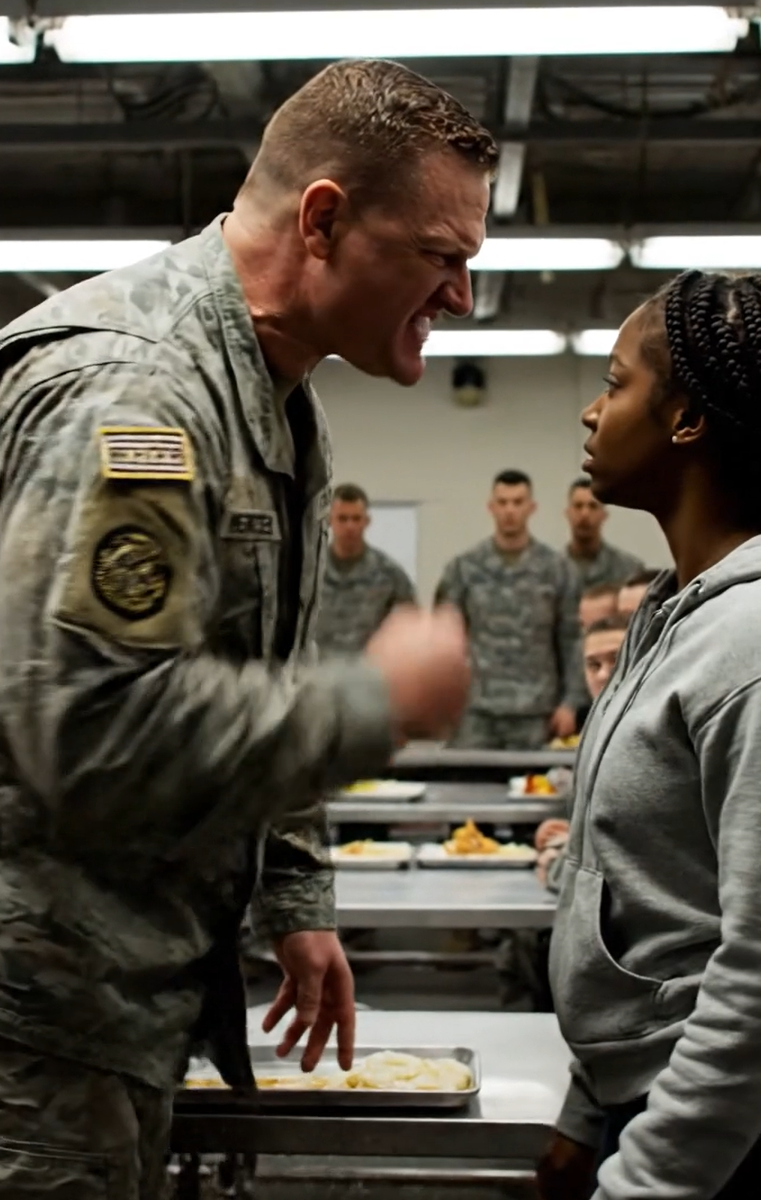
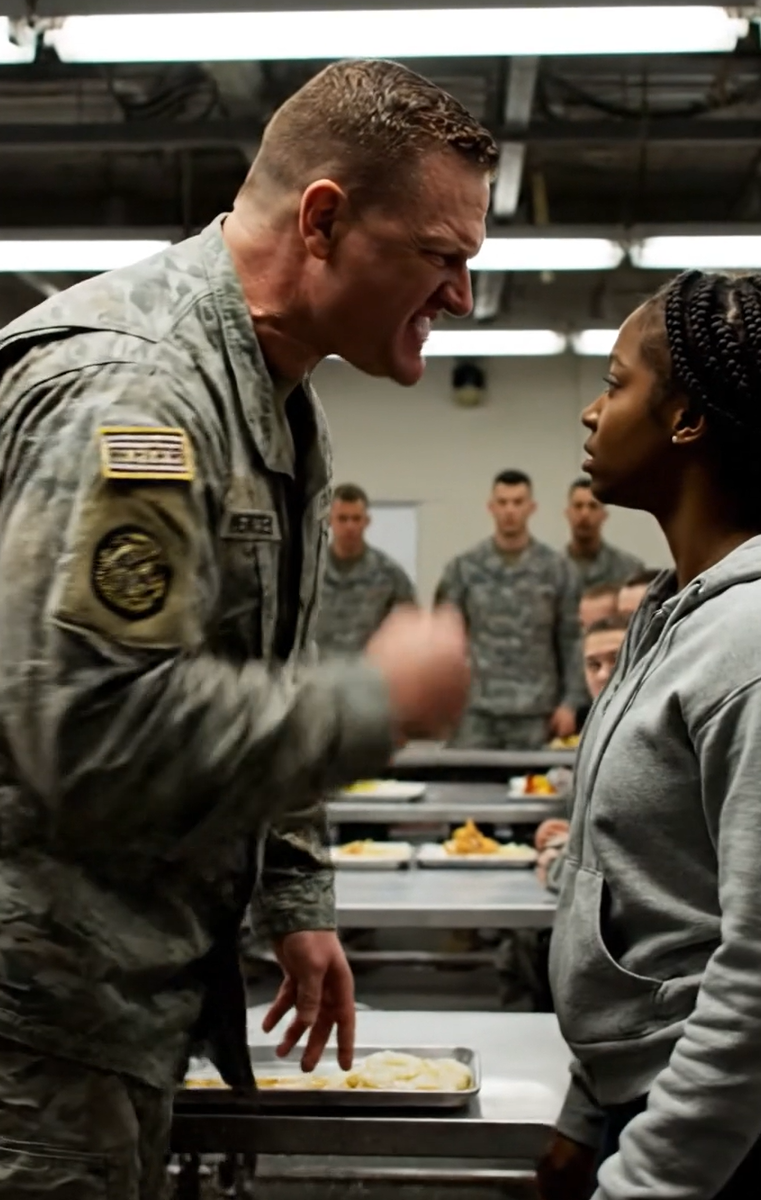
The lunch rush at Camp Redstone always sounded the same – trays clattering, boots on linoleum, the hiss of the industrial dishwasher. Until Staff Sergeant Wayne Mercer walked in.
Mercer was the base’s golden boy. Six commendations. Two Purple Hearts. The kind of soldier whose name made junior enlisted stand straighter. But unofficially, people whispered about how authority followed him into closed rooms and left with someone else looking shaken.
Across the mess hall sat a woman nobody recognized. Jeans. Faded gray hoodie. Hair tied back. She was maybe forty, with tired eyes and hands wrapped around a coffee cup like it was the only warm thing in the world. A guest pass hung from her neck on a frayed lanyard.
Mercer grabbed his tray and scanned the room. His eyes landed on the woman sitting alone at a table near the wall.
“Hey.” His voice cut through the noise. “Civilians sit in the overflow section.”
She looked up slowly. “I was told I could sit anywhere.”
“Well, you were told wrong.” He stepped closer. “Move.”
The conversations around them started dying out. Forks paused mid-air. People glanced over, then quickly looked away.
“I’m waiting for someone,” she said quietly. “I’ll be gone in a few minutes.”
Mercer’s jaw tightened. “I don’t care if you’re waiting for Jesus Christ himself. Move. Now.”
She didn’t move.
He reached down and grabbed the back of her chair, jerking it backward. Her coffee sloshed onto the table. She gripped the edge to steady herself.
“What the hell is your problem?” His voice rose. “You think because you’re some contractor’s girlfriend you can ignore regulations?”
Her face stayed calm. Too calm. “I’m not anyone’s girlfriend.”
“Then what are you doing here?”
“Having coffee.”
The mess hall had gone completely silent now. Two hundred soldiers watching. Some looked uncomfortable. Most looked at their trays.
Mercer leaned down, his face inches from hers. “Listen to me very carefully. I run this place. My word is law. And if you don’t get your civilian ass out of this chair right now, I will have MPs drag you out and ban you from this base permanently.”
She met his eyes. “Are you finished?”
Something flickered across his face. Rage, maybe. Or confusion that someone wasn’t backing down.
He grabbed her arm and yanked her to her feet. The chair toppled backward with a crash.
“Sir – ” A private from the next table started to stand.
“Sit down, Davies.”
Davies sat.
Mercer shoved her toward the exit. She stumbled, caught herself against the wall. Her coffee cup shattered on the floor.
“Get. Out.”
She straightened slowly. Brushed off her jeans. Looked at him one more time.
“Sergeant Mercer,” she said quietly. “I’m going to remember this.”
“Good. Remember it on your way off my base.”
She turned and walked toward the exit. The room stayed frozen. The only sound was her footsteps and the buzz of the overhead lights.
Then the door to the commander’s office opened.
Colonel Briggs stepped out, scanning the mess hall. His eyes found the woman near the exit.
“Ma’am.” His voice carried across the room. “I apologize. I got held up in a meeting. Have you been waiting long?”
Mercer’s face went white.
The woman turned back around. The exhaustion in her eyes had been replaced by something else. Something cold and sharp.
“No, Colonel. I’ve been getting a very educational tour of your facility.”
Briggs’s expression darkened. His eyes swept across the silent room and landed on Mercer.
“Sergeant. My office. Now.”
But Mercer wasn’t looking at the Colonel. He was staring at the woman, at the way she was reaching into her hoodie pocket. She pulled out a thin black wallet and flipped it open.
The badge caught the fluorescent light.
“Major General Patricia Holbrook,” she said quietly. “Inspector General’s Office. I’ve been conducting an informal assessment of command climate and regulatory compliance at Camp Redstone for the past seventy-two hours.”
She stepped forward. Every soldier in the room was on their feet now.
“And Sergeant Mercer, based on what I just experienced – and what I’ve heard from approximately fifteen enlisted personnel over the past three days—you and I are going to have a very long conversation about…”
Her voice trailed off, but her eyes finished the sentence. The promise in them was absolute.
“…the definition of leadership.”
Colonel Briggs cleared his throat, the sound unnaturally loud in the dead-silent room. “General, let’s take this to my office.”
She gave a single, sharp nod. “Sergeant Mercer will be joining us.”
The walk to the Colonel’s office was the longest ten yards of Wayne Mercer’s life. The stares of the junior enlisted felt like physical blows. He could feel the carefully constructed armor of his reputation cracking with every step.
Inside the office, the door clicked shut, sealing them in. Colonel Briggs looked like he’d swallowed a bad piece of fish.
“General, I cannot apologize enough. Staff Sergeant Mercer is one of our most decorated NCOs. This is… an aberration.”
Holbrook ignored him. Her focus was entirely on Mercer, who stood stiffly at attention, his face a mask of disbelief.
“Sergeant, I’m going to ask you a question,” she began, her voice low and even. “In your opinion, what is the purpose of your rank?”
Mercer swallowed hard. “To lead soldiers, ma’am. To enforce discipline and maintain standards.”
“And how does physically assaulting a civilian in the mess hall accomplish that?”
“Ma’am, I-I mistook you. I thought you were a civilian trespassing in an authorized area. I was upholding regulations.” It was a weak defense, and he knew it.
“Which regulation, Sergeant?” she pressed. “Show me the article that permits you to put your hands on another person, much less a guest on this base, for a seating infraction.”
Silence. The hum of the computer on the Colonel’s desk was the only sound.
“You see, that’s the interesting part,” Holbrook continued, walking slowly around the desk to face him. “For three days, I’ve been ‘Pamela,’ a temp clerk for the motor pool office. I’ve listened in the break rooms. I’ve stood in line at the PX.”
“I’ve heard your name a lot, Sergeant. Not in connection with your Purple Hearts. But in connection with ‘lost’ leave forms for soldiers who question you.”
Mercer’s eyes flickered toward the Colonel, a silent plea for help. Briggs just stood there, his face grim.
“I’ve heard about extra duties assigned for ‘bad attitudes.’ I heard about a young specialist who was publicly humiliated by you for a scuff on his boot until he requested a transfer.”
Each sentence was a hammer blow.
“What I saw today wasn’t an aberration,” she said, her voice dropping to just above a whisper. “It was the system you’ve built. A system of fear.”
“Ma’am, with all due respect, that’s not true,” Mercer stammered. “My record—”
“Your record is what allowed this to fester,” Holbrook cut him off. “It made you untouchable. It made men like Colonel Briggs here turn a blind eye, assuming a good soldier on paper must be a good leader in practice.”
Briggs flinched as if he’d been struck. “General, that’s unfair.”
“Is it, Colonel?” she shot back. “How many anonymous complaints about this NCO have crossed your desk, only to be dismissed because his file was too shiny?”
The Colonel had no answer.
Holbrook turned her attention back to Mercer. “Your behavior wasn’t about regulations. It was a performance. You needed to make an example out of the ‘civilian’ who didn’t immediately bow. You needed to remind the two hundred other soldiers in that room who was in charge.”
“You needed to remind them to keep their mouths shut.”
That last line hung in the air. It was more than an accusation. It was a key turning a lock.
“I wasn’t just here to assess command climate, Sergeant,” she said softly. “The IG’s office received a series of well-documented, anonymous tips about inventory discrepancies at the main supply depot. Your depot.”
Mercer’s blood ran cold. This was no longer about his career.
“The tips spoke of intimidation. Of junior personnel being forced to sign off on incomplete manifests. Of high-value equipment vanishing between the loading dock and the storage cage.”
She paused, letting the weight of her words settle. “It’s amazing what you can learn when you just listen. One of the names that kept coming up as the enforcer of this ‘system’ was yours.”
“I… I don’t know anything about that,” Mercer said, but the confidence was gone. His voice was thin, reedy.
“Don’t you?” Holbrook smiled, but it was a chilling, humorless expression. “Then you won’t mind if my team, which has been quietly arriving on this base all morning, begins a full forensic audit of your depot. Effective immediately.”
She turned to Colonel Briggs. “Colonel, you will place Staff Sergeant Mercer on administrative hold. He is to be confined to his quarters, with no contact with any personnel from the supply depot. Is that understood?”
“Yes, General,” Briggs said, his voice tight.
“Good. Now, there is one more thing.” She looked past both men, toward the door. “I’d like to speak with Private Davies. Alone.”
An hour later, Private Mark Davies stood nervously in the same office. Sergeant Mercer and the Colonel were gone. It was just him and the two-star general who still wore a faded hoodie.
“At ease, Private,” she said kindly, gesturing to a chair.
He sat on the edge of it, his back ramrod straight. “Ma’am.”
“Davies, I have one question for you. Why did you start to stand up back there in the mess hall?”
Mark took a deep breath. He thought of the other young soldiers in his unit. He thought of the constant, low-grade fear they all lived with.
“Because it was wrong, ma’am,” he said simply. “What he was doing to you. It was just plain wrong. Nobody deserves to be treated like that.”
“Even if it meant getting on Sergeant Mercer’s bad side?” she asked.
“Yes, ma’am. Someone had to.”
Holbrook studied him for a long moment. She’d seen men with more stripes and less spine crumble in this very room.
“You knew who I was, didn’t you, Private?”
Mark hesitated. This was the moment of truth. He could lie, play dumb. But looking into her eyes, he knew that wasn’t an option.
“No, ma’am. Not specifically. But we had a good idea someone from IG was on base.”
This was the twist Mercer never saw coming.
“We?” she prompted gently.
“A few of us, ma’am,” he admitted, his voice barely a whisper. “The ones who work in the depot. We saw things. Things that weren’t right.”
He explained how Mercer would pull them aside, one by one. How he’d use their personal problems—a sick mother, a car payment, a small mistake on their record—as leverage. He’d “help” them out, and in return, all they had to do was look the other way when a crate of night-vision goggles or GPS units wasn’t logged correctly.
“He made us complicit,” Mark said, his voice thick with shame. “If any of us spoke up, he’d make sure we all went down for it. He called it ‘team building’.”
The fear of a court-martial kept them silent. Until one of them, a tech specialist named Anna, came up with a plan.
“She said one complaint would be ignored. But if five of us, from different sections, submitted separate, anonymous complaints to the IG about different things—intimidation, supply issues, favoritism—it would create a pattern. A pattern they couldn’t ignore.”
It was a brilliant, desperate gamble.
“We didn’t know if it worked,” Mark continued. “Then you showed up, working as a temp. We weren’t sure it was you, but we hoped. We just… waited.”
“And when Sergeant Mercer went after you in the mess hall,” Holbrook finished for him, a look of profound understanding on her face, “you stood up. Not just for a stranger, but to protect your plan. To confirm for anyone watching that what he was doing was unacceptable.”
Mark just nodded, unable to speak.
“You took an incredible risk, Private.”
“It felt like a bigger risk to do nothing, ma’am,” he said.
By the end of the week, Camp Redstone was a different place. Major General Holbrook’s audit team had uncovered a sophisticated theft ring orchestrated by Sergeant Mercer. He wasn’t just a bully; he was a criminal, using his decorated status as a shield.
He had coerced over a dozen junior soldiers into his scheme, threatening their careers if they didn’t comply. Faced with irrefutable evidence and the testimony of soldiers who no longer feared him, Mercer confessed to everything.
His fall was as swift as it was brutal. He was stripped of his rank, his commendations, his honor. The last anyone saw of him, he was being escorted in handcuffs, no longer the “golden boy,” but just a man who had betrayed every ideal he claimed to represent.
Two weeks later, the entire battalion was assembled on the parade ground. Colonel Briggs stood at the podium, his voice clear and steady. He spoke of accountability, of a failure in his own leadership to see past a soldier’s file to the man himself. He promised a new climate, one where integrity mattered more than image.
Then, he called a name. “Private Mark Davies.”
Mark walked forward, his heart pounding.
Major General Patricia Holbrook, now in her full dress uniform, stepped up beside the Colonel. She held a small, velvet box.
“Courage is not the absence of fear,” she said, her voice carrying across the field. “It is the decision that something else is more important than fear. Private Davies and a handful of his peers made that decision. They chose to protect the integrity of this institution over their own personal safety.”
She opened the box. Inside was the Army Commendation Medal.
“For integrity, moral courage, and upholding the highest traditions of the service, at great personal risk,” she said, pinning the medal to his chest. “You did not stand up to a sergeant. You stood up for what was right. That is the only command that truly matters.”
As she stepped back, the entire battalion broke into applause. It wasn’t just for Mark. It was for Anna, the tech specialist. It was for the quiet supply clerk. It was for all the young soldiers who had found their voice.
The real lesson wasn’t about the downfall of a bully. It was about the quiet power that resides in those who are overlooked. It was a reminder that true strength isn’t found in a loud voice or a chest full of medals, but in the simple, terrifying, and ultimately world-changing decision to stand up and say, “This is not right.” One person’s courage, when joined by others, can move mountains and expose the darkest rot, ensuring that the light of integrity shines through once more.



