
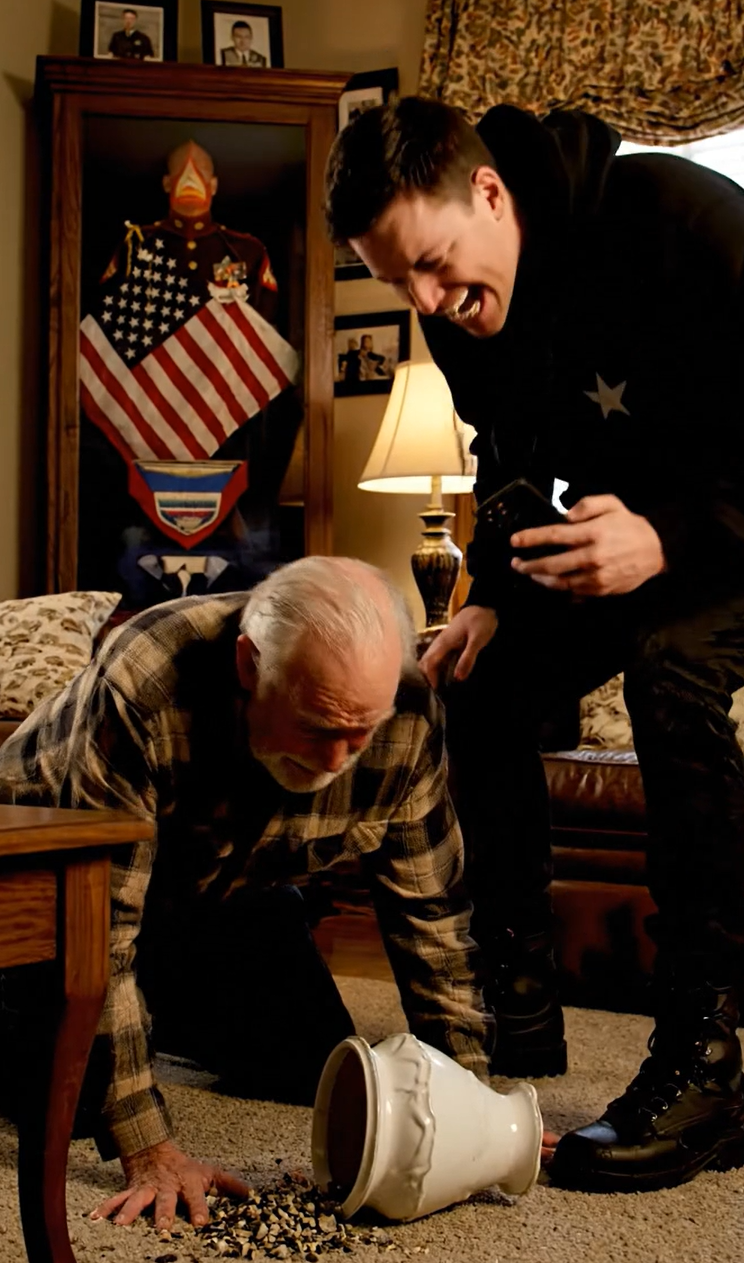
For three long seconds… nobody moved.
The intruders were still laughing.
The phone was still recording.
And Walter Bennett, a retired Marine from Colorado Springs, was still on his knees on the hardwood floor, trying to gather what remained of his wife’s ashes with shaking hands.
It had started twenty minutes earlier. Walter had been sitting in the living room, the urn on the mantelpiece, when the doorbell rang. He moved slowly these days – his left hip bothered him, and his breath came harder – but he made it to the door. Through the peephole, he saw three young men in hoodies, their faces shadowed.
“We’re not interested,” he called out, not opening it.
“Open up, old man,” one of them said, his voice young and cruel. “We know you got cash. Your neighbors see you leave at the same time every Tuesday. ATM. Cash. Old people always keep it at home.”
Walter’s jaw tightened. He didn’t open the door. He moved to the kitchen and called the police. The dispatcher said someone would be there in eight minutes. But the pounding started immediately. Then the window smashing. Then they were inside, and Walter realized that eight minutes was an eternity.
He backed away slowly, his hands up. “Take what you want. Please. Just take it.”
They didn’t want the TV. They didn’t want the jewelry box they found in the bedroom. They wanted to humiliate him. One of them shoved him down. Another laughed and knocked the urn from the mantelpiece. It shattered across the hardwood floor in a cloud of gray powder.
“No,” Walter whispered. “Please. That’s my wife. That’s… that’s all I have.”
His knees gave out. He dropped down, his arthritic fingers trying desperately to gather the ashes back into the broken pieces of ceramic. His shoulders shook. He couldn’t help it. He was crying.
One of the intruders pointed his phone at him, laughing. “This is going viral, old man. Look at you. Pathetic.”
The laughter echoed through the house.
Then the front door opened.
The woman standing in the doorway was tall, muscular, wearing a black tactical vest over a gray shirt. Her hair was pulled back tight. Her eyes swept across the three intruders, then landed on Walter.
“Get away from him,” she said quietly.
One of the intruders laughed. “Lady, you’re about to get hurt. Walk away.”
The woman stepped inside. “I said, get away from him.”
“Or what, grandma?” the one with the phone sneered. “You gonna – “
She moved so fast Walter barely saw it. The phone hit the wall. The intruder followed, his arm twisted behind him. The other two tried to rush her. She didn’t look like she was fighting them. It looked like they were hitting a wall and the wall was hitting back.
Thirty seconds later, all three were on the ground, gasping for breath.
The woman knelt beside Walter. Her expression softened completely.
“Hey, old man,” she said gently. “You okay?”
Walter looked up at her through his tears. He recognized something in her eyes now. Something familiar. A scar on her left temple he remembered from thirty years ago.
“I know you,” he whispered.
She smiled sadly. “Yeah. You do.”
“Sarah?”
“Hey, Dad,” she said. “Looks like you still need someone to watch your back.”
The name hung in the air, heavier than the dust motes dancing in the afternoon light. Sarah. His daughter. The one who had walked out of this very house thirty years ago and never once looked back.
Sirens wailed in the distance, growing closer.
Sarah didn’t seem to notice. Her focus was entirely on him, on the gray dust of his wife, her mother, scattered across the floorboards.
“Mom,” she breathed, her voice cracking for the first time.
Walter just nodded, a fresh wave of grief and confusion washing over him. He felt like he was dreaming.
The police arrived moments later, two officers bursting in with their weapons drawn, only to stop dead in their tracks. They saw the three young men groaning on the floor, the formidable woman kneeling beside the old man, and the shattered pieces of the house’s peace.
Sarah stood up, her movements calm and professional. She pulled an ID from a pocket on her vest. “Agent Miller, FBI. These three are yours.”
One of the officers, a young man with wide eyes, just stared. “Ma’am?”
“They broke in. Assaulted a senior citizen. I subdued them,” she said, her voice flat, all business now. The gentle tone she’d used with her father was gone.
Walter watched it all from the floor, feeling completely disconnected from his own life. FBI? His Sarah? The girl who used to paint watercolors and cry when a bird hit the window was an FBI agent?
The paramedics arrived next. They wanted to check on Walter, but he waved them off. “I’m fine. I just… I need to clean this up.”
He gestured with a trembling hand toward the ashes.
Sarah knelt again, this time with a dustpan and a small brush she found in the kitchen. She didn’t speak. She just started to carefully, reverently, sweep Eleanor’s remains into the pan.
Walter watched her. Her hands were steady. They were strong hands, calloused. Not the hands of the teenager he remembered.
Thirty years. Not a call. Not a letter. Not a single word. He had imagined her a thousand different ways over the decades. A teacher somewhere. A mother with her own family. A struggling artist in a big city.
Never this. Never a warrior.
After the police had taken the intruders away and the paramedics had left, a deep silence fell upon the house. It was broken only by the sound of Sarah gently sweeping.
She placed the dustpan, now holding the precious gray powder, on the coffee table. She wouldn’t look at him.
“Why are you here, Sarah?” Walter finally managed to ask. His voice was raspy.
“I was in the area,” she said, her back still to him. “On a case. I heard… I heard Mom had passed.”
“That was six months ago,” he said, the words tasting like ash.
“I know,” she whispered. “It took me a while to… work up the courage to come.”
The last time he had seen her, she was seventeen. She had screamed at him, her face red with tears, that he was trying to turn her into a soldier she never wanted to be. He had yelled back that she was weak, that the world would eat her alive.
She had packed a bag that night and was gone by morning.
“You look…” he started, but couldn’t find the words.
She finally turned to face him. The years had been kind in some ways, but hard in others. There were lines around her eyes that spoke of things she’d seen.
“I joined the Army, Dad,” she said quietly, answering the question he hadn’t asked. “Right after I left. Did my time. Then I went federal.”
Walter felt the air leave his lungs. He had pushed and pushed for her to be strong, to be a fighter, and his pushing had shoved her right out the door. And yet, she had become exactly what he always said she should be.
The irony was a physical blow.
“All this time,” he said, shaking his head. “All this time, you were… like me.”
“No,” she said, and her voice was firm. “I’m not like you. I did it my way. On my terms.”
The distance between them felt wider than the thirty years. It felt like a canyon.
A few days passed in a strange, tense truce. Sarah stayed, sleeping on the couch. She helped him clean up the house, board the broken window, and spoke to insurance agents. She moved with an efficiency that was both impressive and heartbreaking. She was a stranger who knew where the good mugs were kept.
She bought a new urn. A simple, elegant wooden box. Together, in silence, they transferred Eleanor’s ashes. It was the most they had connected in days.
One evening, a detective from the local police department came by. His name was Peterson.
“Mr. Bennett,” he said, sitting at the kitchen table. “We’ve been interrogating the young men who broke in here. Two of them are just local troublemakers. But the ringleader… a kid named Daniel Thorne. He’s different.”
Sarah, who had been listening from the doorway, stepped in. “Different how?”
“He’s not talking about cash,” Peterson said, looking from Sarah to Walter. “He keeps saying your father ruined his family. He mentioned a name. Sergeant Michael Thorne.”
Walter’s blood ran cold. Michael Thorne. He hadn’t heard that name in almost forty years. But he saw the face as clearly as if it were yesterday. A young man, scared, in a jungle halfway across the world.
“I knew him,” Walter said, his voice barely a whisper. “We served together.”
“Daniel is his grandson,” the detective explained. “He claims his grandfather came back from the war a broken man because of something you did, Mr. Bennett. Something on a mission that went wrong. He said you were a coward who left his grandfather for dead.”
Walter flinched as if he’d been struck. The old shame, the one he had buried for decades, rose up like a ghost.
“That’s not what happened,” he said weakly. But even to his own ears, it sounded like a lie. The official record had been messy. The reports were conflicting. Walter had been given a commendation, but there were always whispers.
After the detective left, the silence in the house was suffocating.
Sarah finally spoke. “Dad. What happened over there?”
Walter sank into a chair. He looked at his hands, the liver spots, the wrinkled skin. They didn’t look like the hands that had held a rifle.
“It was a rescue mission,” he began, his voice distant. “We were supposed to extract a pilot. We got pinned down. Thorne… he froze. Completely locked up.”
He took a shaky breath. “The call was made to pull back. To leave the pilot. I refused the order. I told my men to provide cover. I went forward alone.”
“And Thorne?” Sarah asked, her voice neutral.
“I told him to stay put. He was a liability,” Walter admitted. “I got the pilot. But on the way back, we took heavy fire. I was hit. My hip.” He patted his left leg. “It’s been a reminder every day since.”
He looked at his daughter, his eyes pleading for her to understand. “The official report said I disobeyed a direct order. It also said I saved the pilot. They gave me a medal to keep it quiet, but Thorne… he told everyone I abandoned him, that I was a glory hound who almost got the whole squad killed.”
“And you never fought it?” Sarah asked, a hint of the old frustration in her voice. “You just let him tell that story?”
“What was the point?” Walter sighed. “He was a broken man, Sarah. The war broke him. What good would it have done to break him even more by calling him a coward?”
Sarah was quiet for a long time. She just stood there, watching him. For the first time, she wasn’t seeing the hard, unyielding father who had pushed her away. She was seeing a man who had carried a quiet burden for forty years.
“I need to make some calls,” she said finally, and left the room.
For the next two days, Sarah was a whirlwind of quiet activity. She was on her phone constantly, speaking in low tones, using language Walter didn’t understand. She spent hours on her laptop, her brow furrowed in concentration.
Walter left her to it. He felt a fragile hope blooming in his chest, something he hadn’t felt in a very long time.
On the third day, she walked into the living room and placed a thin file on the coffee table.
“I found him,” she said. “Corporal David Chen. He was in your unit. He’s retired now, lives in Arizona.”
Walter stared at the file. David Chen. A good man. Quiet, but steady.
“I spoke to him for two hours last night,” Sarah continued. “He remembers that day perfectly. He said everyone in the squad knew Thorne froze. They also knew you were the only reason any of them, Thorne included, made it back.”
She opened the file. Inside was a scanned copy of a letter.
“This is a letter Thorne wrote to Chen five years after the war. He was apologizing. He admitted he was ashamed of freezing, and that he made up the story about you abandoning him because he couldn’t live with his own failure.”
Walter picked up the paper with a trembling hand. He read the words, the crabbed handwriting of a man confessing his deepest shame. Bennett was the bravest man I ever knew. He saved my life, and I repaid him by trying to ruin his.
Tears welled in Walter’s eyes, blurring the words. Forty years of carrying that weight, and in two days, his daughter had lifted it.
“His grandson, Daniel, never knew,” Sarah said gently. “He just grew up hearing the lies, watching his grandfather drink himself into an early grave, and he blamed you for all of it.”
The next day, they went to the police station. With Peterson present, they sat down with Daniel Thorne. The boy was sullen, angry, his eyes full of hate.
Walter didn’t speak. He just slid the copy of the letter across the table.
Daniel read it. Then he read it again. The anger in his face slowly crumbled, replaced by a wave of confusion, and then dawning, horrified understanding. The entire foundation of his anger, the story that had defined his family’s tragedy, was a lie.
“He… he lied?” Daniel whispered, looking up at Walter. His voice was that of a lost child.
“Your grandfather was a good soldier who had one bad day,” Walter said, his voice full of a compassion that surprised even himself. “The war did that to a lot of men. I’m sorry for the pain it caused you. But it wasn’t my fault.”
Daniel Thorne broke down, sobbing at the table. It wasn’t a victory. It was just a tragedy finally finding its truth.
Walking out of the station into the bright Colorado sunshine, Walter felt lighter than he had in decades. He looked at the woman beside him. His daughter.
“Why ‘Titan’?” he asked, the question that had been nagging at him since that first day.
Sarah gave a small, rare smile. “You remember those books on Greek mythology you used to read to me? Before you got so… hard?”
Walter remembered. They were his wife’s books. He used to read them to Sarah before bed. It was their special time.
“You always told me the Titans were the old gods,” she said. “The strong ones who came first. The ones who held up the world.” She paused. “When I needed a call sign, it was the only thing I could think of. Something strong. From you.”
In that moment, the thirty-year canyon between them didn’t seem so wide. It seemed like maybe, just maybe, there was a bridge.
They drove home in comfortable silence. Back at the house, Sarah walked over to the mantelpiece where the new wooden urn sat.
“She would have been proud of you,” Walter said quietly. “Your mother. She always knew how strong you were.”
“She would have been sad we wasted so much time,” Sarah replied, her back to him.
Walter walked over and stood beside her. He reached out, his old, trembling hand resting on her shoulder. She didn’t pull away.
“We can’t get that time back,” he said, his voice thick with emotion. “But we can start now.”
Sarah finally turned to him, and her eyes were shining with tears. She leaned in and hugged him, burying her face in his shoulder. Walter held his daughter for the first time in thirty years, the warrior and the old soldier, finally home.
The path to healing is never easy. It’s often paved with misunderstood truths and words left unsaid for far too long. But strength isn’t just about fighting battles on a field; sometimes, the greatest strength is found in the courage to forgive, to listen, and to finally, after all the years, come home.



