
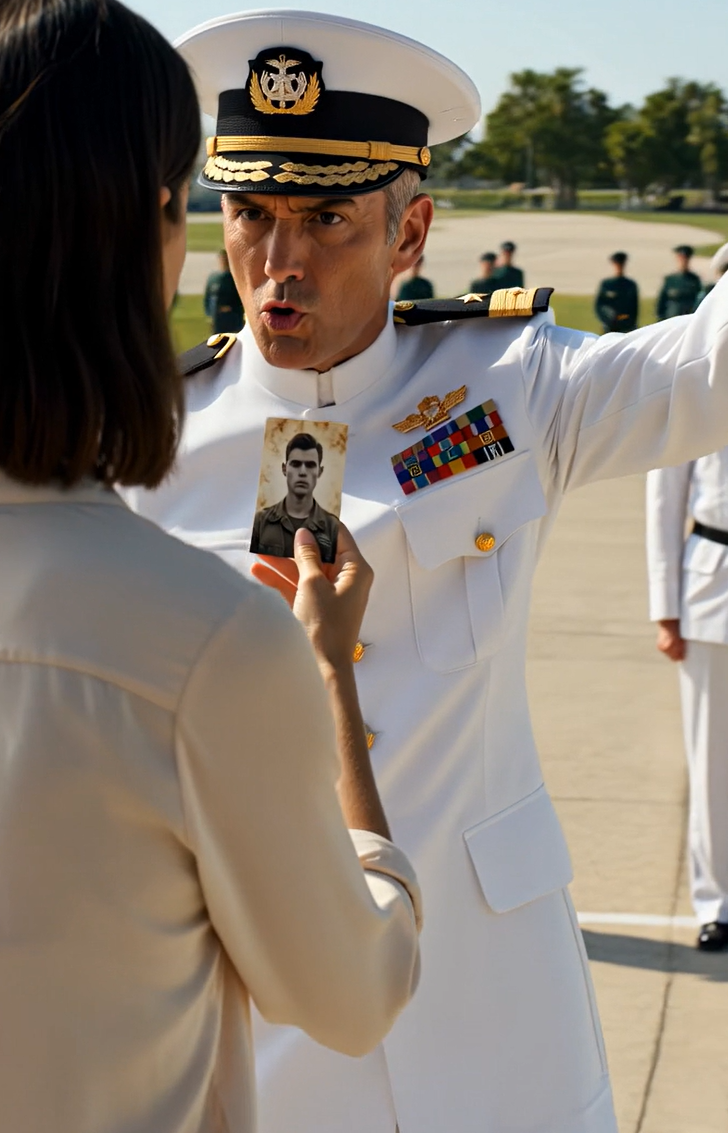
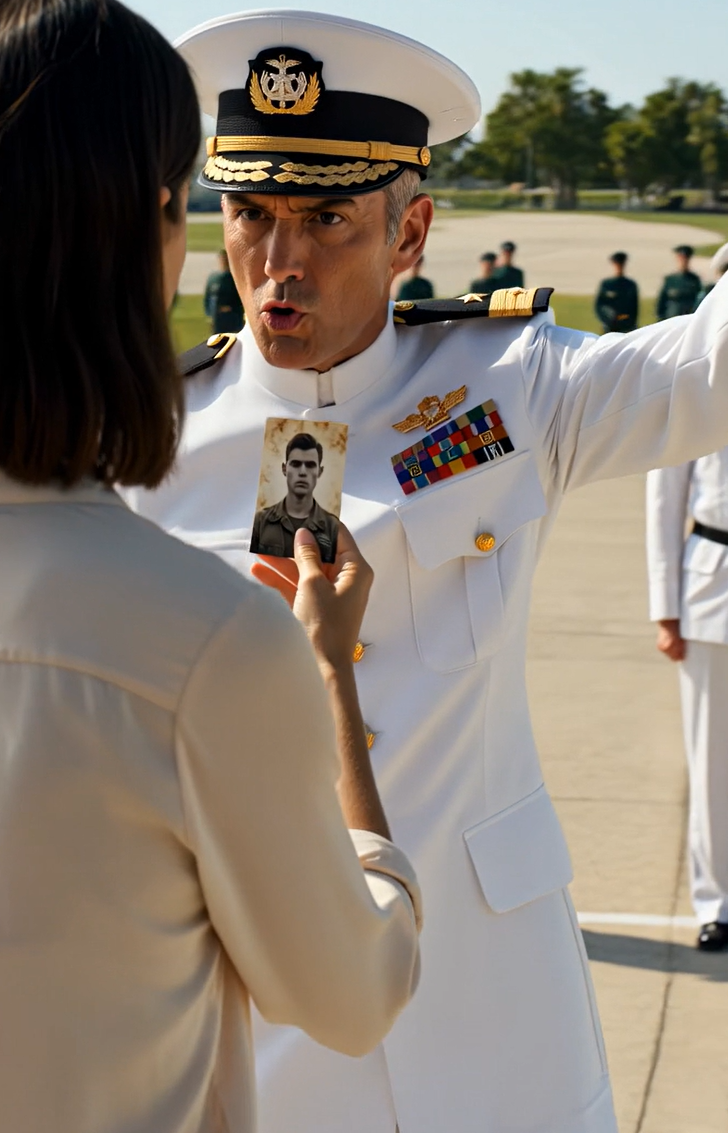
The slap echoed like a gunshot across the parade deck. Two thousand Marines stood frozen in perfectly straight lines.
Admiral Harlan Brooks lowered his hand, his face purple with rage. Standing in front of him was a young woman in faded camo pants and a plain t-shirt, her cheek already turning red.
“I told you to leave my ceremony!” Brooks roared, his voice booming over the silence. “You are a disgrace! Get off my base!”
The woman didn’t move. She was maybe twenty-five, with dark circles under her eyes and dirt under her fingernails. In her left hand, she clutched a photograph. Her right hand trembled.
“Sir, I just need one minute,” she said, her voice barely carrying across the deck. “Please.”
Brooks stepped closer, his chest puffed out. “Security! Remove this civilian immediately!”
Two MPs started forward, but the woman held up the photograph. “It’s about Captain Marcus Hayes,” she said.
The admiral’s eyes narrowed. “Captain Hayes was killed in action six months ago. Whatever scheme you’re running ends now.”
Murmurs rippled through the formation. Some Marines shifted uncomfortably. A few pulled out their phones despite regulations.
“I’m not running anything,” the woman said. Her voice broke. “I’m trying to deliver something he asked me to – “
“Enough!” Brooks grabbed her arm, squeezing hard enough to leave marks. “Marines die with honor. They don’t send disrespectful civilians to interrupt memorials.”
She tried to pull away. “I’m not disrespectful, I’m – “
“You’re nothing.” Brooks yanked the photograph from her hand. “Security, escort this woman off base. If she resists, arrest her for trespassing.”
The MPs reached her, one on each side. She didn’t fight. Tears streamed down her face as they started walking her toward the gate.
Brooks glanced at the photograph he’d taken. It showed a Marine in dress blues standing next to this same woman. Both were smiling. Behind them was a chapel.
The Marine’s face was unmistakable. Captain Marcus Hayes.
Written on the back in Hayes’s handwriting: “Sarah – if anything happens to me, give this to Admiral Brooks. Tell him the truth about Kandahar. The civilian casualties weren’t insurgents. He needs to know before the ceremony. —M”
Brooks’s hand started to shake. He looked up at the woman—Sarah—being led away.
His eyes dropped to her left hand. The one that had been holding the photo.
She was wearing a simple gold band.
“Wait,” Brooks said, his voice suddenly uncertain.
The MPs stopped.
Brooks looked at the photograph again. At Hayes’s arm around Sarah’s waist. At the chapel in the background. At the way they looked at each other.
He turned the photo over again and reread the message about Kandahar.
Six months ago, Captain Hayes had died on a mission Brooks personally authorized. The after-action report said Hayes eliminated twelve enemy combatants before being killed.
Twelve enemy combatants.
Brooks’s throat tightened.
“Bring her back,” he said quietly.
The MPs hesitated.
“BRING HER BACK!” His voice cracked.
Sarah walked back slowly, flanked by the MPs. Her face was streaked with tears and dirt. The red mark from his slap stood out against her pale skin.
Two thousand Marines watched in complete silence.
Brooks stared at the photograph. At Hayes’s smile. At the woman who’d traveled however many miles to reach this ceremony. The woman he’d just assaulted in front of his entire command.
His hands wouldn’t stop shaking.
“Are you…” He couldn’t finish the sentence.
Sarah lifted her chin. “Captain Hayes was my husband. We were married three weeks before his deployment. He sent me that photo two days before he died. Along with a letter.” She pulled a folded envelope from her back pocket. “He told me exactly what happened in Kandahar. He told me what you covered up.”
The envelope had the official Marine Corps seal.
Brooks’s blood ran cold.
“Those weren’t combatants,” Sarah said, her voice steady now despite the tears. “They were families. Children. Hayes tried to stop it. He tried to report it. You told him to keep quiet.”
Phones were definitely out now. Someone was recording.
Brooks looked at the formation of Marines. At the junior officers in the front row. At the press corps standing at the edge of the deck.
At the two-star general standing off to the side, his face unreadable.
Sarah held out the envelope. “He wanted you to have this. Before they gave him the medal. Before you stood up there and lied about how he died.”
The envelope had Brooks’s name written on it in Hayes’s handwriting.
Behind Sarah, a black sedan pulled up to the parade deck. The door opened and a man in a dark suit stepped out. He wore an FBI badge on his belt.
Another car pulled up. Then another.
Brooks stared at the envelope in Sarah’s hand. At the photograph of Hayes smiling. At the woman whose face he’d struck in front of two thousand witnesses and a dozen cameras.
The FBI agent walked toward them, his credentials held high.
Sarah’s voice was barely a whisper. “He loved the Corps. He loved you. He thought you’d do the right thing if you knew the truth.”
Brooks reached for the envelope.
His fingers touched the paper when the lead FBI agent finally spoke. His voice was calm, but it cut through the air like a knife.
“Admiral Harlan Brooks.”
It wasn’t a question. It was a statement of fact, an indictment.
“This ceremony is concluded.” The agent addressed no one in particular, but his authority was absolute.
The two-star general, a man named Peterson, finally moved. He strode over, his face a mask of controlled fury.
“Agent, what is the meaning of this?” Peterson demanded. “This is a military installation.”
The agent didn’t even look at him. His eyes were locked on Brooks.
“We have jurisdiction, General,” he said simply. “Obstruction of justice is a federal crime.”
Brooks felt the world tilt on its axis. The envelope in his hand suddenly felt like it weighed a hundred pounds.
He looked at Sarah. Her expression was not one of triumph, but of profound, bone-deep sorrow.
This wasn’t what she wanted. This circus, this public humiliation. She had just wanted to fulfill her husband’s last wish.
He had turned her grief into a spectacle.
“Ma’am, I’m Special Agent Miller,” the man said, his tone softening as he addressed Sarah. “We spoke on the phone.”
Sarah nodded, a single tear tracing a clean path through the grime on her cheek. “You said to wait for your signal.”
“Your arrival was the signal,” Miller replied gently. “We needed him to acknowledge the evidence in a public setting.”
Brooks’s mind reeled. This was a setup. They had coordinated this.
He had walked right into it, led by his own arrogance. His own temper.
“The letter,” Brooks rasped, looking down at the envelope.
“Read it, Admiral,” Sarah said. Her voice was quiet, but it carried the weight of a command. “Read it so they all know who Marcus really was.”
General Peterson tried to intervene again. “This is not the time or the place.”
“It is exactly the time and place,” Agent Miller countered, finally turning to face the general. “Captain Hayes died trying to get this information to the right people. His voice will be heard today.”
Brooks’s fingers fumbled with the seal. It was cheap, standard-issue paper. It felt fragile, like the career he had built over thirty years.
He pulled out two folded sheets of paper, covered in Marcus’s familiar, neat script.
His eyes scanned the first few lines. He remembered the call. He remembered the argument.
“Sir,” Marcus had said over the crackling sat-phone line. “The intel is bad. I’m on the ground. These are farmhouses, not a training camp.”
“Your orders are clear, Captain,” Brooks had barked back from his air-conditioned command center half a world away. “The target is confirmed. Execute the mission.”
“There are children here, sir! I repeat, I have visual confirmation of non-combatants.”
“They are being used as human shields,” Brooks had insisted, his eye on the promotion packet sitting on his desk. “It’s a classic insurgent tactic. Do not lose your nerve, Captain.”
There had been a long silence on the other end. Then, a resigned sigh.
“Yes, sir,” Marcus had said.
Brooks’s hands trembled so violently he could barely hold the paper. He began to read aloud, his voice a hoarse, broken thing.
“‘Admiral Brooks, if you’re reading this, it means I didn’t make it home to Sarah. It also means my last report from Kandahar was buried.’”
A wave of shock rippled through the ranks of Marines. They stood ramrod straight, but their eyes were wide.
“‘The objective was a compound designated Target Delta. Intel suggested it housed a dozen high-level enemy combatants. I argued against the drone strike. I was on the ground. I could see the truth.’”
Brooks had to pause, taking a ragged breath. The words on the page blurred.
“‘It wasn’t a compound. It was a village. Three families lived there. Farmers. They had nothing to do with the war. I saw a little girl flying a kite not an hour before the strike.’”
He could hear a few soft gasps from the crowd. The reporters were scribbling furiously.
“‘I radioed my concerns. I told command the intel was wrong. I begged them to abort. The order came back from you, sir. Proceed. You told me they were human shields.’”
His voice cracked on the last word. He looked up, his eyes finding Sarah’s. She just stared back, her gaze unwavering.
“‘I couldn’t disobey a direct order. But I couldn’t be a part of it, either. I evacuated my team from the designated blast radius, under the pretense of seeking better cover.’”
“‘Then I ran back. I don’t know what I thought I could do. Yell? Drag them out? The drone was already in the air. I was trying to get the children out of one of the houses when the missile hit.’”
The secret of how Marcus Hayes really died hung in the air. Not fighting twelve combatants.
Trying to save a child.
“‘The after-action report you filed is a lie. The twelve ‘enemy combatants’ were three men, four women, and five children. Their names were Ahmadi, Basira, Farhad…’”
Brooks continued reading the names, each one a hammer blow to his soul. He had seen those names on the classified report. He had dismissed them as collateral damage.
“‘I wasn’t killed by enemy fire, sir. I was killed by our own. I died because I hesitated to follow an order I knew was wrong, and because I tried to fix a mistake that should never have happened.’”
The letter ended with a final, devastating plea.
“‘Honor isn’t in the medals, sir. It’s in the truth. Please, tell them the truth. Don’t let my last act be a lie. For the good of the Corps. For them. For Sarah.’”
Silence.
A heavy, suffocating silence fell over the entire base. The only sound was the distant cry of a gull and the frantic clicking of cameras.
Brooks let the letter fall from his fingers. The two sheets of paper drifted to the deck like fallen leaves.
He looked at the two thousand Marines in front of him. Their faces were a mixture of horror, confusion, and profound disillusionment.
These were the young men and women he had sworn to lead, to protect. He had fed them a lie about one of their own best.
“It was for a promotion,” Brooks said, the confession tumbling out of him, unbidden. “A fourth star. The report would have compromised my selection. It was a mistake. A terrible mistake.”
Agent Miller stepped forward. “Admiral Harlan Brooks, you are under arrest for violation of the Uniform Code of Military Justice, Article 107, false official statements, and for obstruction of a federal investigation.”
He pulled out a pair of handcuffs.
But as he moved to cuff the Admiral, General Peterson put a hand on his arm.
“Wait,” the general said, his voice low and firm.
Miller stopped, surprised.
Peterson turned to Brooks. His face was no longer unreadable. It was filled with a cold, hard disappointment.
“There’s more to this,” Peterson said, his eyes on Brooks. “Isn’t there, Harlan?”
This was the twist Brooks had never seen coming. He thought the letter was the end.
“I don’t know what you’re talking about,” Brooks stammered.
Agent Miller looked confused, glancing between the two senior officers.
“Agent,” Peterson said, turning to Miller. “You’re here because of an anonymous tip you received three months ago, correct? A tip that gave you the unredacted Kandahar casualty report and Captain Hayes’s internal communications?”
Miller’s eyes widened slightly. “That’s classified information.”
“It is,” Peterson agreed. “The tip came from me.”
The crowd gasped. Brooks felt the last bit of ground crumble beneath his feet.
Peterson had been his friend for twenty years. His rival, but his friend.
“Why?” Brooks asked, the word catching in his throat.
“Because Marcus Hayes came to me a week before he deployed,” Peterson explained, his voice ringing with clarity. “He was worried, Harlan. He was worried about you. About your ambition.”
Peterson looked out at the silent formation of Marines.
“Marcus said you’d been cutting corners for months. Fudging reports. Pushing units too hard to inflate success metrics. He feared something bad was going to happen. He asked me to keep an eye on things.”
He turned back to Brooks, his gaze like steel.
“When Marcus died, and I read your glowing, fictional account of his heroism, I knew. I started digging. It took me three months to get past the firewalls you put up, but I found the original satellite imagery. The audio from your call with him.”
“I sent it all to the FBI,” Peterson concluded. “I was just waiting for the right moment. Sarah Hayes provided that for us today.”
It wasn’t just a cover-up of one tragic mistake. It was a pattern. A sickness of ambition that had cost a good man his life and stained the honor of the Corps he claimed to love.
Brooks sagged, the fight completely gone from him. He had been outmaneuvered from the start.
He looked at Sarah, who was watching Peterson with a look of dawning understanding. This was the justice her husband had deserved.
“Cuff him,” Peterson said to Miller.
The click of the handcuffs was the loudest sound Brooks had ever heard.
As the agents led him away, he stopped for a moment. He looked at the sea of faces, young and old, who had once looked up to him.
“I am sorry,” he said, his voice clear and steady for the first time that day. “I failed you. I failed the Corps. And I failed Captain Marcus Hayes. He was a hero. Not for the reasons I said, but because he was a man of honor when his commander was not.”
He let them lead him toward the black sedan. He did not look back.
General Peterson stepped up to the podium. The ceremony was in tatters, the mood funereal.
“Marines,” he began, his voice resonating with authority. “Today, you have witnessed a failure of leadership. But you have also witnessed an act of incredible courage.”
He looked directly at Sarah Hayes, who stood alone on the deck, clutching the photograph of her husband.
“The courage of Captain Marcus Hayes, who tried to do the right thing in the face of an unlawful order. And the courage of his wife, Sarah, who walked through fire to make sure his truth was heard.”
He paused, letting the words sink in.
“Honor is not a given. It is not a rank or a medal. It is a choice. It is a daily commitment to the truth. Captain Hayes understood that. Admiral Brooks, in his ambition, forgot.”
He stepped away from the podium and walked over to Sarah. He took the letter from the ground and folded it neatly.
“On behalf of the United States Marine Corps,” he said softly, so only she could hear. “I want to offer our most profound apology. We will not be awarding Marcus a medal based on a lie. We will be launching a full review to honor him for what he truly did: try to save innocent lives.”
He then saluted her. Not a casual gesture, but a full, formal salute. The kind reserved for a head of state, or a Medal of Honor recipient.
One by one, the two thousand Marines in formation followed his lead. A forest of hands rose in a silent, powerful tribute.
They weren’t saluting an admiral or a general. They were saluting a young woman in camo pants who had reminded them all what their uniform was supposed to stand for.
Sarah stood there, tears flowing freely now, as the respect of the entire base washed over her. It was a wave of healing, a promise that her husband’s sacrifice would not be defined by a lie.
The real ceremony had just begun.
A life lesson echoes long after the noise of a scandal fades: True honor is not found in the pristine lines of a parade or the shine of a medal, but in the quiet, difficult choice to stand for the truth, no matter the cost. It’s a reminder that a single voice, armed with integrity, can be more powerful than an entire army.



