A Morning That Changed Everything
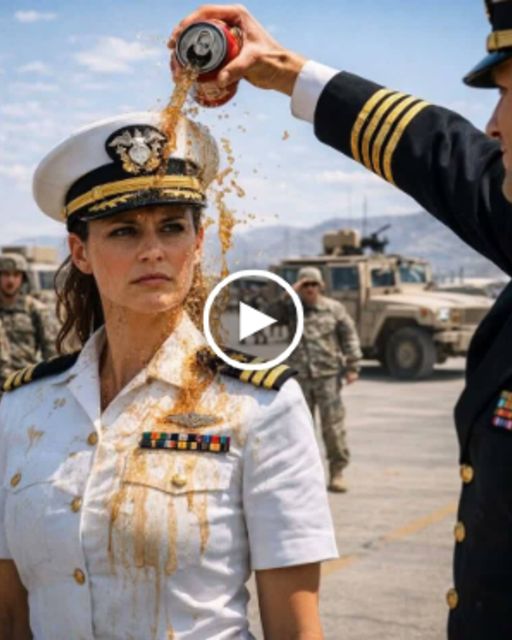
The can made a sharp hiss as it opened, and before I could take a breath, cold soda poured over my head. It ran down my hair, into my collar, and through the sleeves of my uniform. The motorpool went quiet in an instant, thirty pairs of eyes frozen on me, tools paused in midair. The only sound was the steady hum of the generators and the soft drip of cola hitting concrete. The man holding the can was Captain Drake, a visiting officer with a reputation that preceded him. He grinned like he had just performed some harmless prank. To him, it was a show. To me—and to my soldiers—it was a line you do not cross.
“You look like you need a shower, sweetheart,” he said with a laugh that didn’t reach his eyes. It was 0700 at our Forward Operating Base and already hot enough to bake the dust into the ground. I was a logistics officer on my first deployment, still earning trust the only way I knew how: by working hard, treating people fairly, and keeping my cool.
I will not pretend I didn’t feel a flash of anger. My hands trembled. My face burned. But I also knew that the second I yelled or made a scene, he would win twice—once by humiliating me and again by making me look unprofessional in front of my team. So I blinked soda out of my eyes, lifted my clipboard, and walked straight past him without a word. The bay stayed quiet as I crossed it. You could feel the weight of what had just happened settle onto everyone’s shoulders.
Choosing Composure Over Conflict
In my office, I sat down in a chair that instantly stuck to my damp uniform and took a slow, even breath. Then I did the most powerful thing I could do in that moment. I wrote an incident report. No emotion, no name-calling, and no dramatics—just time stamps, witness names, exact words, and the specific regulations and standards he’d violated in front of my soldiers. I typed it like I was assembling an engine: one clear piece at a time, everything in its place, nothing left to guesswork.
When I handed the report to my battalion commander, Colonel Todd, he read it carefully. His jaw set, and the muscle in his cheek tightened. He looked up at me and asked a single question. “Did you keep your composure?”
“Yes, sir,” I said. And I meant it. Anger is fuel, but restraint is direction. Without restraint, you’re just a spark in the wind.
What I didn’t realize at that moment was how much that report mattered. Captain Drake already had a quiet trail of complaints behind him—nothing formal enough to force a change, but plenty of smoke. What he also didn’t know was that our base was expecting a visitor later that morning, a senior leader with a long memory and very little patience for officers who treated people like props.
When the Helicopter Landed
Just after mid-morning, the sirens announced the arrival of a Blackhawk. We formed up on the tarmac as the rotor wash kicked up dust and grit. Captain Drake stood tall with his hands exactly where they were supposed to be, wearing that familiar smirk. But the helicopter door opened, and the General didn’t head for the command staff first. He walked straight past them, purposeful as a man who already knew his destination. He stopped inches from Drake and held up a printed copy of my report.
“Captain Drake,” the General said in a low, steady voice that cut cleanly through the fading thump of the blades, “I’ve read some fiction in my time, but this is not it. This is the most factual, damning account of poor leadership I’ve seen in a decade.”
I watched the color drain from Drake’s face. The bravado vanished. He swallowed and tried to speak. “Sir, I can explain—”
“Can you explain pouring a beverage on a fellow officer’s head in front of her troops?” the General asked, not raising his voice even a fraction.
“It was a joke, sir,” Drake answered, quieter now, and suddenly much smaller than his rank suggested.
“A joke?” the General replied. “Leadership is not a joke. Respect is not a joke.” He turned his head and spoke clearly enough for the crowd to hear. “This officer chose to humiliate one of her own. She”—he emphasized the word in a way that left no doubt—“responded with professionalism and dignity.”
He faced Drake again. “She acted like an officer. You acted like a child with a misplaced sense of entitlement.”
Then the General lifted the paper once more. “This report is a masterclass in documenting a failure in the chain of command. Lieutenant Jenkins did her job.” He looked to Colonel Todd. “Relieve Captain Drake of his command, effective immediately. Put him on the next transport back to the States. He will await nonjudicial punishment. As far as I’m concerned, his time in my Army is finished.”
A quiet gasp moved through the formation. This wasn’t a warning or a private reprimand. It was decisive, public accountability. Drake opened his mouth as if to object, then closed it again. The General’s final words were simple. “You are a disgrace to that uniform. You are dismissed.” And with that, he turned away.
A Conversation I Will Never Forget
An hour later, with a clean uniform and the last tacky hint of soda finally washed from my skin, I was called to the temporary command center. The door creaked when I pushed it open. “Enter,” came the voice from inside.
The General sat behind a metal desk with my report in front of him, and Colonel Todd stood nearby. This time, the General’s presence felt different—less iron, more gravity. He nodded toward a chair. “Lieutenant, have a seat.”
I sat up straight, every part of me alert. “Sir.”
He slid the report across the desk. “This was perfectly executed. You didn’t give him the satisfaction of a reaction, and you documented it with facts. Clean. Precise.”
“I was following procedure, sir,” I said, because that’s what it felt like. If there is a right way to handle something, you choose the right way. Simple as that.
He studied me for a moment. “You did more than follow procedure. You showed restraint and maturity that many officers take years to learn. You understood that real power is not in shouting back, but in building a case no one can ignore.”
He paused then, the set of his shoulders softening. “I don’t share this often. Do you know why I flew out here as soon as I read your report?”
“Because of the breach of conduct, sir?” I offered.
“Partly,” he said. “But it’s also personal.” He drew in a slow breath. “My daughter is a Captain—an engineer. Tough as nails and twice as bright. On her first tour, she had a superior a lot like Drake. He never did something as obvious as pouring soda on her, but he chipped away at her. Little comments, ‘jokes’ that weren’t jokes, quiet cuts made in public. He went after her confidence. She tried to power through it alone. She didn’t report it. And it nearly cost the Army a fine officer.”
He looked at me—really looked—and I recognized a father’s worry tucked inside a General’s steady gaze. “Months after she came home, she told me everything. It remains one of my deepest regrets that I commanded an organization where my own daughter felt she couldn’t speak up without being labeled weak or a troublemaker.”
He tapped the report with two fingers. “Your report was different. Measured. Complete. It wasn’t a plea; it was a statement of fact. You trusted the system to work and gave us the tool to make it work.” He stood and moved to the window, staring out at the brown horizon. “People like Drake are a cancer. They poison morale and push good people out. We cannot afford to lose a single good soldier because a bully is allowed to thrive.”
He turned back and met my eyes. “So thank you. You didn’t just stand up for yourself. You stood up for my daughter, and for every soldier who has ever been made to feel small by someone wearing rank they didn’t earn in spirit.”
I felt a lump rise in my throat. For a brief moment, he wasn’t a two-star general. He was a dad.
Then his expression eased into something like a smile. “And another thing. Colonel Todd tells me your logistics reports are the best he’s seen. He says you increased your unit’s readiness by twelve percent.”
“Just doing my job, sir,” I said, but I felt the warmth of that recognition settle in my chest.
“Keep doing it,” he replied. “This Army needs leaders like you. Not noise-makers like Drake.”
Ripples Across the Base
In the weeks that followed, the story of that morning spread fast, as stories in small places always do. But this wasn’t empty gossip. The mood changed. You could see it in how people carried themselves, in the way conversations stopped sounding guarded and started sounding honest.
One afternoon, while I was reviewing a vehicle inspection, a young private from my motorpool approached me. “Ma’am,” he said quietly, “what you did—that was something.”
“I just filed a report, Peterson,” I answered, because that’s all I believed I had done.
“No, ma’am,” he insisted, looking me square in the eye. “At my last unit, we had a sergeant a lot like Captain Drake. We all kept our heads down. Nobody wanted to be next. Seeing someone actually report it—and seeing command act on it—means more than you know.”
His words were worth more than any medal. I realized then that what had happened wasn’t only about a single act of humiliation or a single act of accountability. It showed people that the system, imperfect and slow as it can be, sometimes does what it’s supposed to do—when you give it what it needs.
The Weight of Leadership, Shared
Later, Colonel Todd called me to his office. A mug of coffee sat waiting for me on the small table, hot and generous. He didn’t waste time.
“Lieutenant, I owe you an apology,” he said.
“For what, sir?” I asked, genuinely surprised.
“For not dealing with Drake sooner,” he answered. “That file I had on him was full of whispers and sideways stories. Nothing to hang a decision on. Soldiers were scared to go on the record. I knew he was a problem, but I needed something undeniable. Your report was it. You gave me the ammunition to go to the General and say, ‘We must act now.’”
It was a revelation. I’d felt alone walking back to my office, dripping with soda and biting back anger. I wasn’t alone. Leaders above me had been fighting a quiet fight, waiting for something concrete—waiting for the piece that made action possible and lasting.
New Rank, New Purpose
Six months later, our deployment wound down. The days shortened, and we began the careful business of handing things over. In a small ceremony in front of my team, with dusty boots and a breeze that carried the smell of oil and earth, I was promoted to Captain. As Colonel Todd pinned the new rank to my collar, he leaned in and said, “Well deserved, Captain Jenkins. Well deserved.”
Not long after, an email from the General landed in my inbox. He congratulated me on the promotion and told me he was building a task force to streamline leadership training and strengthen accountability. He wanted me on it. I read the message twice, then a third time, not because I doubted it but because it felt like the natural next step after everything we had learned together as a unit.
At the bottom of that email was a short postscript. The words were plain, but the meaning was clear. Drake had faced an Article 15, the Army’s term for nonjudicial punishment. He was given a choice: resign his commission or face a court-martial. He resigned. The last anyone heard, he was a shift manager at a big-box store back home. The General’s closing line was dry and unadorned: it seemed Drake was finally learning how to handle stock.
I won’t pretend I didn’t smile. It wasn’t about revenge. It was about balance. He had treated me like I was nothing more than a prop for his amusement. Now, stripped of the power he misused, he was living with the results of his own choices. Actions have weight. Respect does, too.
What Quiet Strength Looks Like
When I think back to that morning, it would be easy to focus on the humiliation. But that isn’t the story I carry with me. The story is about what happened next—the quiet walk to my office, the steady click of the keyboard, the decision to put facts on paper and let them stand on their own.
There is a lesson tucked inside those moments that has nothing to do with rank and everything to do with character. You do not win by shouting louder, by matching insult for insult, or by putting on a bigger show. You win by refusing to leave your standards behind. You win by doing the work, by documenting what is true, and by trusting that integrity—yours and the system’s—still has the power to move mountains when you give it a fair push.
I have seen a lot of leadership in a short time—some fine, some not so fine. The best leaders are not the loudest. They do not puff themselves up or rely on fear to make people move. They build trust. They protect their teams. They hold the line quietly and firmly. And when wrongdoing shows itself in the open, they act swiftly, not to make a spectacle, but to set things right.
If you are ever faced with a moment like mine, remember this. Calm is not weakness. Silence is not surrender. Composure is a choice, and sometimes it is the strongest one you have. Write it down. Name the problem. Give your leaders the facts they need to do the right thing. Then stand tall and let the truth do the heavy lifting.
The Lasting Change
In the end, the real reward wasn’t the promotion, the email, or the ripple of a tough man finally facing consequences. The real reward was the change I saw in the people beside me. Young soldiers lifted their chins when they spoke. Mechanics in the bay swapped jokes without glancing nervously over their shoulders. NCOs corrected mistakes with firmness but without sneers. Our work did not get easier, but it felt cleaner. It felt fair.
That is the thing about dignity. It doesn’t shout. It doesn’t elbow for space. It settles in quietly and changes the air. And once it is there—once people have seen what steady, unflinching professionalism can do—it is very hard to shake loose again.
The morning started with a sticky cascade meant to cut me down. It ended with the highest-ranking officer on the ground reminding everyone what leadership looks like. Between those moments was something simple and steady: the decision to keep my head, to use my voice in the right way, and to trust that facts still matter.
True strength is not the noise you make. It is the integrity you hold onto when provoked. It is the patience to build a case rather than a scene. It is the will to stand, soaked and silent, and choose the path that leads to justice rather than the path that only leads to more noise.
That morning taught me how to win. Not with volume, not with anger, but with quiet dignity that does not budge. And in the end, that is what changed everything.