
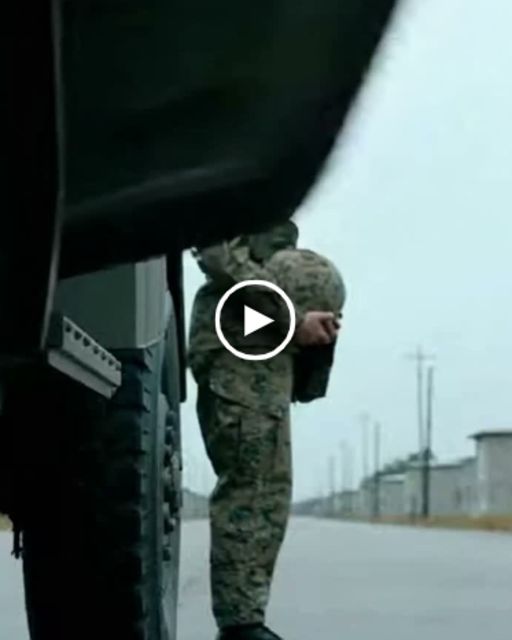
The morning that changed Fort Redstone
At 07:00, the parade ground felt like the air before a storm. Three platoons stood shoulder to shoulder, uniforms crisp, eyes fixed forward. Boots were polished to mirrors, and even the wind seemed to hold its breath. We all knew what kept us so tense: the presence of Lieutenant Colonel Victor Harlan.
He was the kind of commander who confused fear with respect. Careers ended over small mistakes. He believed humiliation was the best form of correction, and he delivered it in front of as many witnesses as possible. If someone wobbled in formation, he would pounce. If someone asked why, he would make them regret the question. For two years, that had been our normal.
He was already tearing into a private that morning, voice sharp and cutting, when a young woman in combat uniform crossed the far end of the formation. She carried a thick green folder. She kept walking. And she did not salute.
Harlan spun as if yanked by a wire. He roared across the gravel, his words hitting the formation like blows. He called her out. He demanded she stop. You could feel hundreds of eyes follow his gaze. We feared for her; we had all seen this movie before.
The woman stopped twenty yards away. She seemed composed, almost serene, as if she had already measured everything that would happen next. Harlan stormed toward her, booming about respect and insubordination. Then came the moment none of us expected. When he demanded to know why she had not saluted, she met his eyes and said, calm and steady, that at this moment, she was not required to.
A salute withheld, and a line no one expected
You could hear the silence. No one spoke to Harlan like that. He closed the distance until he was inches from her face, promising a court-martial, a ruined future, and public disgrace. It was the kind of threat we had all endured in one way or another. But this time, his target did not shrink.
She squared her shoulders and opened the green folder with practiced ease. Her voice carried clearly across the yard without ever rising. She explained that she was acting under direct orders from the Inspector General’s office. Then she said the sentence that changed our base forever: she did not salute men who were the subject of an active investigation for fraud and abuse of command authority.
The ripple that moved through the formation was part shock and part hope. Harlan’s face lost its color. The sound of his boots grinding the gravel faded into nothing, as if someone had turned down the volume on the world. The woman’s nameplate read SHARMA. Only then did we notice the captain’s bars on her collar.
She stepped forward and addressed him by name, her words sharp and exact. She relieved him of command, effective immediately. She held out a document for him to take. He did not move. He looked emptied out, like a man who had just realized the ground beneath him was not ground at all.
Two Military Police officers approached from headquarters. They moved the way professionals do when there is no argument to be had. They stood at his sides. One of them spoke softly and asked him to come along. The show of force, the swagger, the menace that had defined Harlan’s presence—all of it drained away. He seemed suddenly smaller inside his own uniform.
They escorted him across the yard. The sound of his boots no longer carried authority. It was just the quiet scuff of someone leaving a place where power had slipped through his fingers.
The Inspector General steps in
Captain Sharma closed the folder, turned to our company commander, and gave a simple order to dismiss the formation. We were told to stand down, yet we barely moved. We watched until the three figures disappeared into the building. Only then did the base find its voice again. Whispers began at the edges and worked their way toward the center like a tide.
That morning felt like a door had opened in a wall we thought would never crack. For years, discipline had been twisted into cruelty. Harlan had kept people in the rain as punishment for asking for clarity. He had buried people in busywork for daring to care about their families. The salutes were always sharp, but they were motivated by fear, not respect. Now there was a name for what so many of us had lived through: abuse of command authority.
By midday, the rumors had shape. It was not only about how he treated us. It was about money—government money dedicated to our safety and readiness. There were whispers of a civilian contractor submitting fake invoices, of parts that never arrived and repairs that were never done, of funds siphoned away and signed off by the man who barked at our muddy boots while our vehicles limped along. The idea felt sickening and, tragically, it explained so much. The broken Humvees. The long waits for basic parts. The maintenance backlogs we told ourselves were just part of military life.
For anyone who has never served, the Inspector General’s office exists to keep the system honest. It gives soldiers, regardless of rank, a way to report wrongdoing, whether it is a bad policy, a dishonest practice, or a leader who has lost his way. It is there to protect the mission and the people who carry it out. That morning, we watched that system do exactly what it was meant to do.
Whispers become proof
In the days that followed, the base felt different. Relief is a quiet thing, but you could hear it. Jokes returned. Conversations sounded lighter. You could feel it even in the way people walked—less hurried, less tense, less ready to be punished for a stumble.
Then I ran into Private Miller, the quiet kid from Ohio who had been the target of Harlan’s fury that morning. He was a supply clerk, soft-spoken and careful, the kind of soldier who did his job well and kept to himself. We sat on opposite bunks in the barracks, and he told me what he had been carrying.
He handled invoices for vehicle parts, so the paper trail passed through his hands. He noticed bills that did not line up with reality. Engine blocks we never received. Tires that never reached the motor pool. The same contractor’s name again and again. Every single invoice approved with Harlan’s signature. He tried to raise the issue discreetly, but an NCO shut him down. The message was clear: keep quiet. The system worked a certain way. Do not interfere.
Most people imagine courage as something that roars. But for Miller, it started with a stack of printed invoices tucked into the bottom of a locker. He did not have a plan. He had a feeling that something was wrong and a fear that speaking up would crush him. Then he saw a poster for the Inspector General’s hotline. Anonymous reporting. He waited a week, gathering his nerve. Then he mailed the copies and did the hardest part of all: he waited.
When Harlan chewed him out on the parade ground, it was about a paperwork error. But under that anger was something deeper. Miller told me Harlan leaned in and warned that whisperers had short, miserable careers. The threat was not subtle. He knew someone had talked. He just did not know who. From what we later learned, that public threat became the final piece Captain Sharma needed to complete the abuse of authority charge. The timing made sense. The long, careful work had been done quietly. The last proof arrived loudly, for everyone to hear.
Why the salute mattered less than the truth
For many of us, the image of that moment stayed clear: a young captain not saluting a senior officer in front of the entire battalion. In the strictest sense, a salute is a sign of respect for the rank, not necessarily the person. But what we saw that morning was bigger than custom. The salute was withheld because something sacred had been violated. The rank had been used as a shield for wrongdoing. The quiet refusal to salute was not rebellion; it was an affirmation that respect must be earned and protected by integrity. Uniforms and insignia matter, but they mean nothing without the values behind them.
Later, we learned how carefully measured Captain Sharma had been. She had not arrived for a spectacle. She had come to deliver a decision backed by months of evidence. Her voice never rose because it did not need to. The facts did the speaking.
A base begins to heal
Within a few days, a temporary commander stepped in. The difference was immediate. Soldiers straightened their backs because they were proud again, not because they were scared. Questions were answered without someone paying a price for asking them. Accountability returned, the honest kind that helps people grow instead of shrinking them down.
In time, the formal process finished. Harlan faced a court-martial. The facts held up. He was found guilty on all charges. He lost his rank and his career and faced prison time for what he had done. The staff sergeant who had silenced Miller was punished, too—demoted and reassigned. No one celebrated another person’s fall, but there was a sense that the ledger had been balanced. The message was plain: the rules apply to everyone. Integrity is not optional.
Eventually, Lieutenant Colonel Peterson took permanent command. He was firm yet fair, the kind of leader who demands excellence and returns respect. He knew names. He asked about families. If you made a mistake, he corrected it without tearing you apart. The standard stayed high, but the fear faded. People met it with pride instead of dread.
An unexpected visit and a promise kept
Some weeks later, I was on gate duty when a car rolled up and Captain Sharma stepped out. She was there to close out paperwork, but she paused long enough to look around. She told me the base felt better. I agreed. Then she said something I have never forgotten. She said the credit did not belong to her. It belonged to someone with courage.
She shared a bit about her own past. As a young lieutenant, she had watched a good officer pushed out by someone who abused power and twisted the truth. That memory stayed with her. It shaped her mission. She promised herself she would fight for soldiers who did not have a voice, and in coming to Fort Redstone, she kept that promise. Before walking away, she asked me to pass along a message to the quiet private who had helped set everything in motion: the Army was fortunate to have him.
Six months later: a simple ceremony, a lasting lesson
Half a year passed. We gathered on the same parade ground where fear had once overwhelmed everything. This time, the occasion was simple and joyful. Our new commander stood before us, steady and confident. He called Private Miller forward and pinned on a new rank. The handshake was firm. The words were quiet, meant only for the young man who had earned them. But the smile on Miller’s face told the story. He had grown into himself. The constant worry in his eyes was gone.
Looking down the rows, I saw faces that looked lighter, older in a good way, as if a long, heavy season had finally lifted. Work at a base is never easy, and standards will always be high. But there is a world of difference between pressure that refines and pressure that crushes. That morning, it was clear which kind we now lived under.
What I carried forward
I have thought often about what true strength looks like. It is not the loudest voice or the harshest punishment. It does not swagger or bully. Real strength is steady. It does not need to shout. It is the quiet decision to do what is right, even when no one is watching, even when the risk feels bigger than you are. In our case, one young soldier, armed with nothing more than the truth and a few photocopies, helped restore honor to an entire battalion.
For those who have spent time in uniform, you know the rituals and the ranks guide our days. But beneath those symbols, the heart of any unit is trust. We trust that our leaders care more about the mission and the people than about their own comfort. We trust that when we raise a concern, it will be heard. We trust that when someone does wrong, the system will correct it, not hide it. When that trust breaks, it is painful. When it is rebuilt, it is powerful.
The morning a captain did not salute a lieutenant colonel was never really about a salute. It was about a promise—that the values stitched into our uniforms mean something. It was about a base remembering what respect is supposed to feel like. It was about making sure that the quiet, careful work that keeps soldiers safe is honored, not exploited.
In the end, the lesson was not complicated. Integrity matters, and it matters most when it costs something. Courage does not always look like a dramatic charge. Sometimes it looks like a young clerk noticing that numbers do not add up, taking a deep breath, and dropping an envelope in the mail. Sometimes it looks like a leader standing calm and clear in a sea of salutes, insisting that rank and responsibility serve the truth, not the other way around.
We all walked away from that chapter changed. The fear that had shadowed our steps loosened its grip. Laughter returned. The motor pool got the parts it needed. Respect sounded different in the morning air—quieter, yes, but deeper. And when we saluted, it felt right again.
That is how a base heals. Not all at once, and not without scars, but with steady steps taken by people who choose what is right over what is easy. And sometimes, all it takes to start that process is one voice saying, with calm certainty, that the ground has shifted and the truth is finally standing in the light.



