
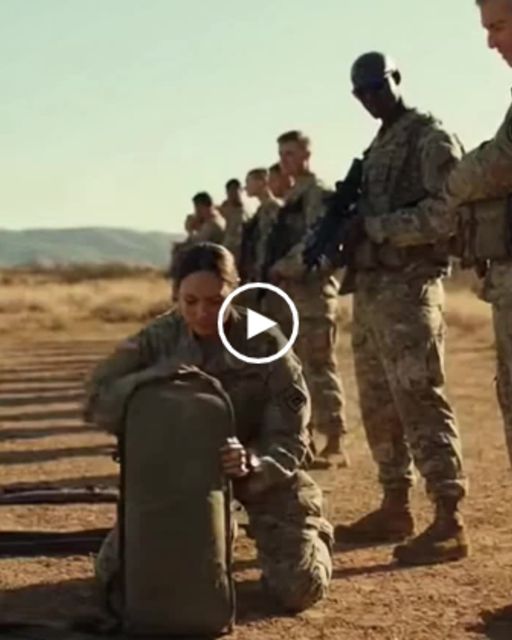
The Firing Line Where Doubt Began
She took her place on the range like she’d done a thousand times, blending into a sea of starched uniforms and new gear. The old rifle case she carried had scuffs that told stories, the kind you don’t brag about. When Sergeant Brenda Kowalski unzipped it, the chatter along the line slowed, then turned into snickers she had heard before.
“That scope’s older than me,” one of the younger shooters muttered, hugging a rifle topped with a glowing, digital wonder full of charts, numbers, and predictions. Others glanced at her plain matte-black scope, its dials worn smooth by years of sand, sweat, and hard use. No display. No app. Just glass and patience.
Someone joked that the long targets—nearly a thousand meters out—were too much for a relic. Brenda didn’t bother replying. She settled behind the rifle, let her cheek find the familiar rest, and felt the wind brush her skin. Heat shimmered above the earth, a mirage that told her more than any blinking screen. She waited for her breath to ease. She pressed the trigger the way you close a door you don’t want to wake a sleeping baby.
At six hundred meters, her shots tapped the center like they had a magnet in them. At eight hundred, same story. No fuss. No drama. Just quiet control. Down the line, digital gadgets chirped, rebooted, and offered warnings while their owners fiddled and frowned. Her rifle never complained. Neither did she.
The mood changed. Snickers became curious stares. A few tried to whisper their surprise, but awe has a way of stealing volume from a room. They were seeing the difference between guiding hands and guided menus.
A Question That Stopped the Room
Hours later, the day’s results stacked like proof no one could argue with, the room fell silent. A general with a face that looked as if it had been chiseled from campaigns and sleepless nights flipped open a file bearing Brenda’s name.
“Sergeant Kowalski,” he said, voice low and even, “what’s the longest shot you’ve ever taken?”
Her hands, steady all day, rested on the edge of the table. It was the first time she paused. When she answered, her words were simple and careful, as if each had a weight of its own.
“Four thousand two hundred meters, sir. Afghanistan. One round. Headwind. Dust storm. And it wasn’t a target.” She drew a quiet breath, the kind you hold onto when memories still have heat in them. “It was a lifeline.”
The Day the Dust Stood Still
The general didn’t blink. “Explain,” he said. Not suspicious, just focused.
Brenda’s eyes drifted for a moment, not to anywhere in that room, but to a place the color of copper and sand. “We had a pilot down. Captain Evans. His chopper fell into a valley full of hostile fighters. He crashed hard and took cover behind rock, but they had him pinned. They were coordinating from a command post across the way on a higher ridge. Too far and too hot for anyone to reach him in time.”
She could still see it, as clear as the markings in her old scope. “Their communications ran through a small satellite dish on a tripod, barely two feet wide. It sat next to their leader. If that dish went quiet, they would lose their rhythm, maybe even panic. It was our only chance to buy the pilot a few minutes he didn’t have.”
One of the younger snipers—the same one who had laughed the loudest—shifted his weight. “Two and a half miles,” he murmured, barely finding his voice. “The drop alone…”
Brenda kept her eyes on the general. “Yes, sir. Two and a half miles. The wind was pushing dust until the air looked thick enough to chew. My spotter said it couldn’t be done. Command said it couldn’t be done. But every now and then, the gusts paused. The light blinked off that dish. A fraction of a second here, another there. A path through the noise.”
She had asked for permission. Someone had given it. Then everything came down to fundamentals most people never see: wind pulling one way at the muzzle and another along the ridge, the bullet drifting from its spin, the subtle nudge of the earth rotating under its flight. Simple ideas, but at that distance, they aren’t small. They’re everything.
“I held so high it felt like I was pointing at a horizon I couldn’t even see,” she said softly. “I told myself to trust the years, the math, the tiny signals the land was giving me. Then I pressed.”
Ten seconds can feel like a lifetime when the only thing in the world is a speck of copper and lead crossing an ocean of air. She didn’t see the impact. The wind swirled dust into a curtain. But a minute later, the voices on the enemy frequency turned into a clean, perfect silence.
“That was the opening,” the general said, finishing her memory with his own. “The team went in while confusion held. They pulled Captain Evans out.”
The room breathed again, just barely. Most had heard rumors about a shot like that, but gossip loses its shine against a steady voice and a verified outcome. Here it was, not a tall tale but a quiet truth.
Old Glass, New Respect
The corporal stared at her, eyes wide and searching. “But… your scope. How?”
Brenda let a small, almost apologetic smile reach her face. “You trust your computers to tell you what’s happening right now. They’re great tools. But they freeze a moment as if time stands still. Out there, nothing is still. Heat bends light. Wind stacks in layers. Air grows thicker and thinner as the day shifts. My scope doesn’t give me an answer. It gives me a picture. The rest has to be built inside me.”
She patted the worn housing. “This isn’t magic. It’s miles of practice and years of attention. Anybody can buy equipment. It takes time to become the person who knows what to do with it.”
The general closed her file with a soft, deliberate tap. He dismissed the room, then asked Brenda to stay. As the others filed out, shoulders lower and minds fuller, the corporal paused at the door.
“Sergeant,” he said, voice thick with humility, “I’m sorry.”
She nodded once. “Go learn your rifle. Really learn it.”
The Voice on the Other End
When the door shut, the general stepped from behind the desk. He was a tall man, but what showed more than his height was a kind of deep, earned tiredness that still carried warmth. “I was the theater commander for that operation,” he said. “I’m the one who gave the green light for your one-in-a-million shot.”
Brenda’s professional calm rippled for the first time. She had never known who sat at the far end of the radio, weighing risk and mercy at the same time.
“I heard everything,” he continued. “Your spotter counting the seconds. The sudden silence when their comms went dead. And then the rescue pilot’s voice, steadier than his heartbeat, calling out, ‘Package is secure.’” He held her gaze gently. “You saved more than one person that day. You saved the men who would have tried to get to him if we’d lost him. You saved families who never even knew your name.”
He hesitated. “There was no medal. The range was too unbelievable. The mission too classified. The questions would never have ended.”
“I didn’t do it for a medal,” she said simply.
He smiled, a tired, grateful smile. “I know. That’s why I kept something for you until the right time.” He took out a card and slid it across the desk. “Captain Evans has been trying to find the person behind that call sign for years. He’s a civilian now. He asked me to pass this to you if I ever could. He just wants to say thank you.”
The card was plain and steady like good paper always is: Daniel Evans, Founder. The Phoenix Initiative. An address not far from her base sat at the bottom like an invitation that didn’t demand, just waited.
A Door She Hadn’t Expected
One week later, Brenda stood outside a building made of glass and steel that somehow felt warm. It had the hum of a place where minds are busy and hope is more than a word.
A man in a wheelchair rolled toward the reception desk. His face was open and kind; his arms moved with strength and intention. “Can I help you?” he asked, his voice friendly but careful, as if he didn’t want to startle a moment he’d been waiting for.
Brenda held up the card, feeling something she hadn’t felt on a firing line in years. “I’m here to see Daniel Evans.”
He smiled in a way that reached all the way to his eyes. “You found me,” he said softly. “Or the general found you. I’m Daniel.”
She had seen his name printed in ink. She had heard his call sign under stress. Now she saw the life she had helped keep going sitting right in front of her. She didn’t have words right then. She didn’t need them.
“Come on,” he said. “Let me show you what ten seconds can become.”
Where Broken Becomes Building
He guided her down bright hallways into a space that lived somewhere between a workshop, a lab, and a community center. Veterans—men and women with losses the eye could see and others it couldn’t—were designing, machining, calibrating, and fitting advanced prosthetics that looked more like fine instruments than equipment.
Daniel explained how life after the injury had started with feeling lost. The standard prosthetics had felt heavy and blunt, more like obstacles than answers. “So I put my engineering training to use,” he said. “I used what savings I had and called in every favor from people I trusted. We built this. We hire wounded veterans. We teach them. And we give custom prosthetics to those who need them. No bills. No red tape. Just solutions.”
They paused to watch a young woman using a mind-controlled prosthetic hand to pick up a tiny screw with the ease of a pianist finding a familiar chord. Down the hall, a former infantryman ran steadily on two prosthetic legs while a screen analyzed his stride and offered small adjustments. In another room, a veteran with a highly articulated hand painted a miniature figurine with remarkable precision, tongue caught between teeth the way all patient artists do.
There was no pity anywhere. Only purpose. Only the quiet music of focus and shared effort.
“All of this,” Daniel said, voice catching, “happened because you gave me time I didn’t have. You gave me ten seconds, and I vowed to spend the rest of my life earning them.”
He turned to her with tears that didn’t ask permission, and Brenda felt an answering burn in her own eyes. For years, her work had been measured in distances and decisions. She knew what it meant to end a threat, but she had never stood in the middle of what it meant to create a second chance.
“You did this,” she whispered.
“We did this,” he said gently. “Your one shot started a ripple. We’re just making sure it keeps going.”
A New Mission Takes Shape
In Daniel’s office, blueprints and prototypes covered the walls with the handsome clutter of ideas in motion. A framed satellite image showed a rocky Afghan valley—an old scar and a quiet badge of honor at the same time.
“You’re nearing retirement,” he said, not as a guess but as something he’d been told with care. “What comes next for you?”
“Twenty years is enough,” she replied. “I might try something quiet. Maybe a library.”
He smiled at that, a smile that said he understood the appeal of quiet. Then he gestured toward a set of drawings and a workbench where magnifiers and micrometers sat like a watchmaker’s tools. “We’re developing the next generation of neural-interface sockets. They’re the point where the human body and the prosthetic truly meet. A hair’s breadth matters. Temperature matters. The tiniest vibration matters. We need someone to lead the calibration team. Someone who understands patience like an instinct. Someone who knows how to work with forces you can’t always see, only feel.”
He paused, then spoke with care. “I’m not offering you a job. I’m inviting you to a new mission. You’ve spent your life solving problems from far away. Here, you can help build solutions up close.”
Brenda looked through the glass at the workshop. She saw people focused on building, restoring, and steadying each other. She thought of the old rifle in its case. For so long, it had been a partner whose purpose was singular and final. Here, the purpose was to begin again.
In that reflection, something eased inside her. For years, she had lived by a simple rule: perfect the one shot in front of you. She realized now that the real aim of that rule wasn’t about endings at all. It was about responsibility—about what you choose to do with the chance you’re given and the skill you carry.
What Endures When the Wind Changes
Tools change. Screens get brighter. Buttons multiply. But some truths hold steady no matter how the years pile up. You can’t rush wisdom. You have to feel the wind with your own skin. You have to learn how heat bends light and how patience bends time. You have to earn trust—from your hands, your mind, your surroundings.
Brenda had spent a career turning those truths into quiet results. Now, she could feel a different kind of result reaching out to meet her. The line from that Afghan ridge to this bright, humming workspace wasn’t a straight one. It bent and curved the way a bullet does in real air. But it arrived just the same.
She looked back at Daniel. He didn’t press. He just waited, the way you wait for a friend to decide how to step over a stream. Her answer didn’t need to be spoken aloud to be heard.
Later, walking through the facility once more, she paused at a window that caught the afternoon light just right. She thought of her scope—the old glass, the old metal—and how it had served her by refusing to speak, by insisting she pay attention. The best tools don’t just inform; they invite you to become someone worthy of using them well.
On a distant range, people had laughed at what they thought was outdated. They didn’t see what time can teach you if you let it. In the right hands, even a tool born for destruction can be turned toward salvation. In the right heart, a single act can ripple through years and strangers’ lives until it becomes something far larger than the moment that began it.
Her story didn’t end with one impossible shot. It began there. It began with ten long seconds that opened a door no one saw coming. Now there were rooms beyond that door filled with bright minds and steady hands, with dignity and second chances, with plans drawn in pencil because they were always improving.
And sometimes, the quietest person in the room is carrying the lesson everyone needs. You don’t have to be the loudest to make the biggest difference. You don’t have to chase the newest thing to do the most lasting good. You just have to keep learning, keep feeling, and keep choosing the next right shot—whether it’s through a scope or beneath a magnifier or across a table where someone is waiting for a simple, life-changing yes.
Brenda Kowalski had spent a lifetime aiming for certainty at great distance. Standing there, among people building hope you could hold in your hands, she understood something deep and kind. The truest mark of skill isn’t just precision in the moment. It’s what your precision makes possible for others long after the sound fades. That day in the desert, a single round traveled through dust and doubt. Years later, its echo sounded like laughter in a workshop, the soft click of a prosthetic hand mastering a delicate task, and the steady breath of someone who decided to keep going.
It turned out an old scope could see surprisingly far—not only across miles of mountain air, but across time, all the way into a future where courage becomes care and experience becomes a home for second chances. That was the view that mattered most.



