
On the Firing Line
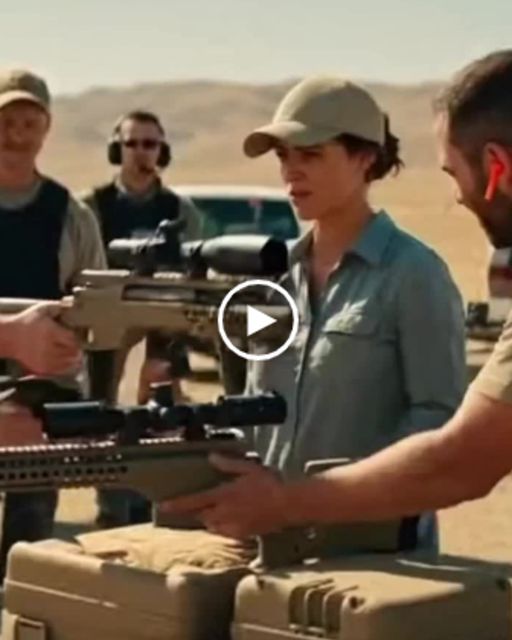
“Just hold it,” Travis said with a grin, placing a long, heavy sniper rifle in my hands as if he were passing me a broom. “Careful, sweetheart. That thing’s worth more than your life.”
Laughter rolled across the firing line. To the squad, I was the office girl—a civilian consultant who sifted through ballistics data and typed neat reports, not someone who crawled in the dirt and squeezed a trigger. I was in a blouse and slacks, not camouflage. They saw a spreadsheet, not a soldier.
The target lay nearly three kilometers away, swallowed by heat shimmer and distance. To the naked eye it was nothing. To me, it was a quiet challenge, waiting.
Someone whispered that I’d probably dislocate my shoulder. It was meant as a joke. It wasn’t funny.
My heartbeat settled as soon as I touched the ground. The smell of dust and oil felt familiar. I slid prone, let the stock fit into my shoulder, and let the world shrink to wind, light, and timing. I didn’t ask for a spotter. I didn’t need one. I read the air like a map I’d memorized long ago.
I drew in a breath and let it go. The trigger broke like glass.
The shot cracked across the valley. Silence fell, heavy as a curtain closing.
Then the sound came back to us, a long second later: a bright, ringing clang.
A perfect hit.
Clipboard on the ground. Smirks gone. A few mouths open. I stood, brushed the dirt from my slacks, and met Travis’s stare without blinking. “You’re pulling left,” I said softly. “Fix your breathing on the exhale.”
The Name They Whispered
Up in the tower, the General had been watching. He came down the steps faster than a man his age should, took one good look at me, and his face went pale. He turned to his stunned men, voice barely above a whisper. “Do you have any idea who you just mocked?”
He pulled up a file on his tablet and turned it toward them. My photo stared back, but it didn’t say “Consultant.” The header was just a single word.
Kestrel.
I saw the moment they recognized it—the flicker of stories they’d heard while cleaning rifles at 2 a.m., the half-true legends traded by rookies and veterans alike. The ghost who could make impossible shots. The operator who worked alone and then vanished. A cautionary tale and a quiet prayer rolled into one.
“She’s dead,” someone muttered. “Kestrel was lost in Kandahar.”
The General, whose name I knew all too well—Miller—put a hand around my arm and spoke in that gravelly tone of his. “The official record says what we decided it should say,” he told them. Then, to me, a simple, urgent command. “My office. Now.”
The Ask I Didn’t Want to Hear
His office was scrubbed clean of personality—framed certificates, a safe, a spotless desk. That was Miller. He gestured at a chair; I stayed on my feet.
“That was some show, Sarah,” he said, the formality slipping. We had history. It ran deep. It ran cold.
“You set me up,” I answered. My voice was steady in that way that worried people who knew me well. “You knew they’d test me. You wanted to see if I still had it.”
He didn’t deny it. He just sighed and sat, looking a little older than he had an hour ago. “I need Kestrel,” he said simply. “Not Sarah Evans the civilian consultant. I need the one they whisper about.”
Every muscle in my body tightened. “No,” I said. “We made a deal. I give you my mind. I keep my life. That part of me is done.”
“With our kind,” he said gently, “it’s never done. We just learn to pretend.”
He tapped a few keys and brought up a satellite image. Rugged slopes. Bare stone. A place the wind never stops talking. I knew it before he even spoke.
“The Vulture is back,” he said.
I felt my breath hitch. The Vulture wasn’t a man, but a machine of men—a syndicate that supplied chaos and bought silence. We bled to stop them five years ago. That was the day the official record said Kestrel died.
“They’ve built a high-altitude drone system,” Miller continued. “Fast. Quiet. Hard to see, hard to stop. They plan to sell it to anyone with money and no conscience.”
“Send a team,” I said. “That’s what you’ve got all these young guns for.”
“We did,” he said quietly. “Twice. No one came home. Their nest sits where our drones can’t peek and our boots can’t go without getting burned. There’s one way in—one shot from farther than anyone else can touch. Their command antenna is a narrow steel line in the wind. Hit it, the whole drone web goes dark.”
I looked away. He was asking me to pull a ghost out of a grave I’d buried myself in. “I can’t,” I said. “You know why.”
He nodded, voice going softer. “I know what you lost. I know you lost Daniel.”
The name landed like a metal door closing. Sergeant Major Daniel Cobb. My spotter. My partner. My compass when the world spun too fast. The one who could read a breeze across a ridge I couldn’t see. The one who told me, every time, “Breathe.”
He died in my arms, in dust the color of old bones. Part of me went with him. The part that answered to Kestrel.
“This is the same crew,” Miller said. “The same thread. This is a chance to cut it for good, so what happened to Daniel doesn’t happen to anyone else.”
The Son I Didn’t See Coming
“Who’s the spotter?” I asked. Because if he didn’t have someone I could count on with my life, there would be no next paragraph to this conversation.
Miller hesitated. “He’s the best young talent I’ve seen in years. Sharp. Hungry. He needs guidance, but he can learn.”
There was a knock, and then the door was already swinging. Travis stepped inside. His face had lost the swagger and kept the pallor. He looked like someone who had realized the map he’d trusted since childhood was wrong.
“Sir,” he started, flicking nervous glances my way. “I need to understand.”
“Back to your unit,” Miller told him. “That’s an order.”
“Please, sir,” Travis said, stepping forward. Then to me, his voice tight, stripped of bravado. “The woman from Kandahar—the legend—were you there? Five years ago?”
“That’s classified,” I said. My throat felt dry.
He swallowed. “My father was there five years ago. He didn’t come home. His name was Sergeant Major Daniel Cobb.”
The room tilted. I saw him then—not the hotheaded kid on the range, but the echo of the man I’d trusted with my life. The same eyes. The same stubborn set to the jaw.
Daniel’s son.
All his rough edges snapped into place: the chip on his shoulder, the eye-roll at a “desk person,” the need to be better than the story. He’d grown up with a framed flag and a handful of redacted pages. Somewhere in those blank spaces, he’d drawn me as a villain.
“Out,” I said to Miller. My voice wavered with a grief I’d kept balled tight for half a decade.
“Sarah—” he began.
“Out.”
He saw the flash in my eyes and left us to it, shutting the door behind him.
It was just the two of us now. The son of the man I couldn’t save, and the woman he’d learned to blame.
“It was you,” Travis said, barely more than a breath. “You were Kestrel. You were with him.”
“Yes,” I said. There was no way to soften it.
His face folded in on itself. “They all said you were the best. A ghost. That he died protecting you. But the reports… they’re blacked out. I kept thinking—if you were that good, why didn’t you save him?”
That question had been my companion at night. A stone in my chest I’d learned to breathe around.
“Your father was the best man I’ve ever known,” I said. “Not just as a soldier. As a human being.”
“Then why did he die and you didn’t?” His voice cracked, but he held my gaze. He deserved more than the official line. He deserved the whole, burning truth.
“We walked into an ambush,” I told him. “Pinned down, outnumbered. Daniel saw something no one else saw. He saw the trap—the explosives laid out like bread crumbs for the rest of the unit on the way in.”
I took a breath to steady myself. “There wasn’t time to warn them over the radio. Not enough seconds. He handed me his rifle. ‘Make ’em count, Kestrel,’ he said. And then he ran.”
My words went rough. “He ran straight at danger. Drew every eye and every barrel. He bought the team the seconds they needed to spot the trap and pull back. He saved seventeen men that day.”
I looked him full in the face. “He saved me. He put the whole unit first, even when his orders said I was his first responsibility. He made a choice only a hero makes.”
Travis’s anger didn’t vanish; it deepened, changed shape, turned into the sorrow of a son who had finally learned the shape of his father’s courage.
He sat, head in his hands, and I let him grieve. We stayed that way a long time, two people sharing a quiet room with ghosts in it.
The Deal We Made
When Travis finally looked up, his voice was steadier. “This Vulture mission,” he said. “Is it the same people?”
“Yes,” I said.
He stood. The resemblance to Daniel took my breath. “You’re going to need a spotter.”
“You’re not ready,” I answered out of instinct, even as a part of me wanted to say yes.
“Then get me ready,” he said. “My dad taught me the basics before he left. I can read wind. I understand the math. I need to do this. For him.”
I studied him. Determination. Pain. A hard, bright kernel of purpose. Maybe we both needed this walk back into the mountains. Maybe this was how I paid a debt no one could write off on paper—by bringing his son home.
“All right,” I said. “You follow my word like it’s the ground beneath your feet. No freelancing. No pride. Your life depends on it.”
“Understood, ma’am,” he said, and the “ma’am” wasn’t sarcasm. It was respect, newly earned and carefully held.
Weeks on the Range
We lived at the range for two weeks. Dawn to dark. We tore down old habits and built new ones, piece by patient piece. I pushed him farther than he’d ever been pushed. When he got something right, I told him. When he didn’t, I told him faster.
He learned to see the world in tiny movements—the shimmer of a mirage telling you the air is boiling upward, the faint sway of a plant that betrays a crosswind, the way air thins with heat and elevation, stealing a bullet’s strength. He learned to do math in his head with his heart rate in check. He learned that silence is not empty; it’s full of information.
Between drills, he told me about Daniel the father. The dumb jokes he wrote in letters. The way he folded paper airplanes better than anyone. The way he burned pancakes on Sundays and laughed anyway. I told him about Daniel the spotter, who could feel a gust coming five seconds before it arrived, who never let me forget to breathe, who called me “kid” even when I outranked him in skill.
We shifted, in those days, from Kestrel and the hothead to Sarah and Travis—two people learning to carry the same loss.
Back to the Mountains
When the mission came, we went at night. The air was thin and honest. Every sound carried. We moved slowly, like the ground might complain if we rushed.
For two days we crawled and watched. We ate cold food and drank warm water and waited, eyes on the compound tucked into rock and shadow. Just like Miller said: a fortress. The command antenna was a narrow, unforgiving target—no more than the width of a few fingers—more than 3,200 meters away. The kind of shot you do not take unless every star in your sky is exactly where it should be.
Travis was solid as bedrock. Calm voice in my ear. “Wind seven miles an hour, shift at two o’clock. Mirage rising straight up. Add two clicks of elevation.” He sounded like Daniel and not like him, a new note I had never heard before—his own.
I settled into my breath, letting time spread out. Then I saw a spark that didn’t belong. Across the way, on a western ridge, sunlight briefly winked off glass.
A counter-sniper. Patient. Watching for the ghost everyone had promised would come.
“We’ve been made,” I whispered. “Western ridge. He’s waiting for our flash.”
Travis didn’t flinch. “I see him. He’s keyed to the antenna. If you fire, he’ll have our line.”
We were boxed in by our own skill. Hit the antenna and we’d be traced in the next breath. Hit the counter-sniper and we’d lose the tiny window for the antenna. It felt like a checkmate with one move left on the board—if we could invent it.
I thought of the scenario Daniel and I had sketched on a napkin years back, shaking our heads even as we wrote it down. He’d called it “The Echo.” Risky. Precise. A trick for when no trick should work.
“I’ve got an idea,” I said. “You need to trust me.”
“Always,” he said, and I believed him.
“Find me something metal halfway between us and the counter-sniper. Big enough to sing when it’s hit. Right on our line.”
He scanned, slow and careful. Seconds lengthened. “Rusted fuel tank,” he said at last. “About fifteen hundred meters out. It’s right there on the path.”
“Good,” I said. “Give me two complete solutions. First for the tank. Second for the antenna. I’ll fire both as fast as I can cycle.”
He was quiet for a beat, doing the math of two worlds at once. “You want the first hit to pull his eyes,” he murmured, “so the second can do its work before he finds our true line.”
“Exactly. We’ll have seconds to move after the first sound. The echo will point in our direction, not at us.”
He read me numbers with that calm, steady voice. It was the hardest math of my life—two distances, two winds, two breaths welded together.
I set the dials. Breathed in. Breathed out. The first trigger broke.
The rifle kicked, and I was already working the bolt, already shifting that hair’s breadth of aim. The second shot went the instant the chamber closed. It felt like playing a song I’d learned long ago and hadn’t had the courage to play since.
“Move,” I said, grabbing my pack.
We slid from our nest just as the first impact rang out—a bright, undeniable PING that leaped across the canyon. A heartbeat later came the second sound, higher-pitched and true, the long, singing CLANG of steel where steel should never have been touched.
Half a breath after that, a round smashed into the rock where my head had rested a second before.
We didn’t stop to admire the shot. We ran low, ran quiet, ran smart. We made our extraction ahead of schedule, lungs burning, ghosts at our heels and the wind at our backs.
Ghosts Laid to Rest
When we stood in front of Miller, the world felt different, cleaner. He shook his head, looking at us like we had pulled a rabbit from a hat and saved a life in the same gesture. “I’ve never seen anything like it,” he said. “You two did the impossible.”
I looked at Travis. The anger he’d worn like armor was gone. In its place was something steadier. He had found a shape for his father’s legacy that fit his own shoulders.
“We did it, Dad,” he whispered, just for me to hear.
I didn’t go back to being just Sarah Evans the analyst. But I didn’t slip the old mask of Kestrel back on either. I became something different. Something built from both truths.
I stayed on as a lead instructor for special operations marksmanship. My job wasn’t shooting; it was teaching. I passed along what Daniel passed to me—patience; the discipline to wait longer than comfort wants you to; the courage to choose the hard thing when it is the right thing; the quiet trust between two people on a line only they can see.
Travis became my best student and, later, my best partner in the classroom. He honored his father by building on what came before rather than living in its shadow. He taught from his own scars and his own victories, and the men and women under his guidance learned faster because of it.
The Lesson That Lasts
People are quick to label what they don’t understand. They saw me on the range and thought office girl. They saw Travis and thought arrogant kid. They saw Miller and thought cold brass. In truth, each of us was carrying a story nobody else could see—a quiet weight of loss, love, promises made, promises kept, and promises broken.
Respect doesn’t live in a title or a story whispered after lights out. It lives in the dirt you’re willing to lay in for someone else, in the breath you steady when someone needs you, in the courage to face what haunts you and do the right thing anyway.
That day on the range began with laughter at the wrong target and ended with truth. We did not win because I was a legend or because a young soldier was hungry to prove himself. We won because two people learned to listen—to the wind, to each other, and to the hard, clear voice of what needed to be done.
In the years since, I have watched new recruits take their first careful breaths behind a scope and learned their names in the quiet between shots. Some of them ask about Kestrel. I tell them legends make for good campfire stories, but real life belongs to those who show up, prepared and humble, willing to do the work no one sees.
When the afternoon light leans long across the range and the mirage starts to dance, I sometimes catch a glint on the edge of a lens a field away and think of Daniel. I hear him still—easy, patient, always with that half-smile in his voice. Breathe.
And when Travis steps to a student’s side and murmurs the same word, I know we carried the right things forward. Not the myth. The lesson. Not the ghost. The grace.
We all want the same ending, really. To do our jobs well. To bring our people home. To be seen for who we truly are under the dust and noise. That day on the range taught a lot of young eyes to look again—and taught me, once more, that the respect that matters most is the kind you earn, quietly, when no one is applauding and the wind is your only witness.



