
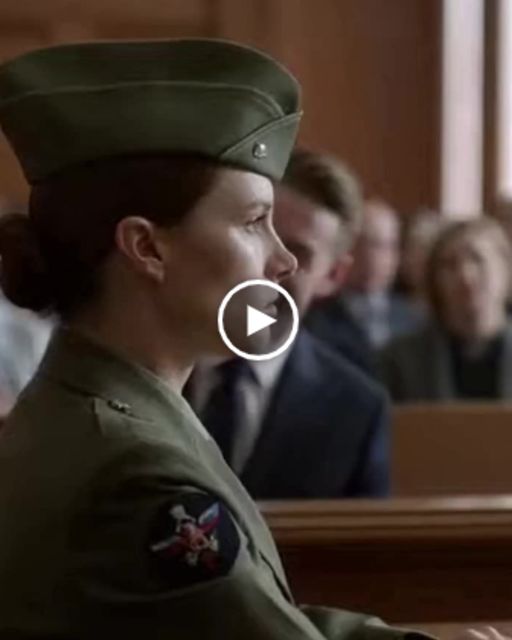
The day my family learned who I really was
My brother tilted his chin toward the gallery, savoring the moment. He called me a pretender in uniform, a desk jockey with a cushy clearance, someone whose greatest threat was a paper cut. Laughter rippled from the back row. My parents were there, too, wearing that familiar look that said I had disappointed them yet again.
I sat very still. Hands folded. Eyes forward. Saying nothing was not weakness. In my world, silence is a shield and a promise at the same time.
My attorney, Mr. Vance, rose without a word. He did not object. He did not make a speech. He carried a single sealed manila envelope to the bench and placed it in front of the judge like a fragile piece of glass.
The judge broke the wax seal with the boredom of someone who has seen everything. He expected a character reference. A letter from a supervisor. Some polite defense of an ordinary woman with an ordinary job.
He pulled out one sheet of paper.
At first, there was nothing. Just the sound of the heating system and the flutter of a coat in the gallery. Then came the change. The judge went pale. The tremor in his hand rattled the paper against the wood. He lifted his gaze, not to the lawyers and not to me, but to the two armed bailiffs by the exit.
Seal the courtroom, he said. The order was quiet but urgent. The heavy doors slid shut and the locks engaged with a click that sounded far too loud.
My brother’s grin collapsed. He tried to reclaim it, stretching his mouth into something like confidence. But he could feel what we all felt. The air had shifted.
The judge rose slowly and turned the document so my brother could see the black stamp at the top. His voice, when it finally came, was steady and grave. Your sister is not a clerk. She is not a veteran in the way you imagine that word. She is still active.
Then the sentence that froze the room. Based on what is in this directive, you have just committed a felony.
There was a stunned, stumbling protest. A denial. Confusion. He demanded to know how mocking a job title could be a crime.
The judge explained, carefully and without anger. In raising a public challenge to a covert identity, in open court and on the record, a line had been crossed. He spoke of federal law. He spoke of classified information. He spoke of harm done when the wrong questions are asked in the wrong rooms.
The bailiffs didn’t move toward my brother. They formed a quiet perimeter and watched the gallery instead. This was no longer just a family case. It was now a matter that sat above everyone in that room.
What happened behind the judge’s door
We requested a short recess. The judge, relieved to have a next step, guided us into his chambers. The quiet back there felt heavier than the silence in the courtroom. He paced, the way a man paces when the ground beneath him is shifting and he is trying to feel for solid footing.
I need to make a call, he said. This is above my pay grade.
Mr. Vance was calm, even kind, as if he had been expecting this moment all along. He was not only my attorney; he was a handler assigned to me by the place where I worked, which went by many names and none that would be printed on a business card.
The situation is contained, he assured the judge. We planned for this possibility.
Planned for it, the judge repeated, surprised. You let him push this far?
We needed the extent of his actions on the record, Vance said gently. Not because of the will alone, but because of everything tangled around it.
In that moment, the truth landed in me like a cold stone. This fight over my grandfather’s estate was not just a family argument. It was an operation whose edges I had only begun to see.
The quiet wisdom I grew up with
When I think about strength, I still see my grandfather on his porch, a man who carried decades of history in the set of his shoulders and said very little about it. He spent his days with books and birds and the kind of stillness that heals people who have seen too much.
My family called him old-fashioned, a relic. I never did. We did not talk openly about our work, he and I. We shared something quieter than explanations. At times he would drop a single sentence that seemed to echo for years.
The loudest man in the room is the weakest, he once told me, pushing his glasses up with a familiar gesture I can still picture. Remember that.
He knew my parents preferred my brother’s shine. He knew I was most comfortable in the second row, the shadows where you can see the whole room. He knew the difference between noise and strength.
When the courtroom changed shape
Two men in plain suits had appeared by the time we returned. They spoke in low voices to the bailiffs and then took positions where they could watch everything without seeming to stare.
The judge settled back into his chair, older by ten minutes and wiser by a mile. He dismissed the case my brother had filed, the challenge to the will my grandfather left. Dismissed with prejudice, he said. Final. Done.
My brother shifted toward a protest, but his attorney laid a steadying hand on his arm and gave a tiny shake of the head. Even he could read the room now.
The judge continued, his voice even, almost gentle. He said certain irregularities in my brother’s business dealings had come to the court’s attention. Someone in a suit handed him a thick file. He turned a few pages, then closed it with a quiet tap.
The words money laundering and shell corporations are dry on paper. In a courtroom, spoken aloud, they land like stones. My brother went pale, all that easy charm falling away to show the fear underneath.
Two men from the aisle stepped forward. They did not look at me. They addressed my brother, calm and efficient. They placed handcuffs on his wrists and read him his rights. My mother’s cry was raw, a sound I had never heard from her before. My father seemed to age in front of me, the weight of it all pulling at his face.
As they led my brother away, he searched my face for an answer that would not come. Why, he mouthed. Why.
I could not give him the comfort he wanted. There are truths that sit far above family dynamics. There are consequences that arrive because long before a hearing, someone made a choice and then another and then another.
What the will really meant
When the courtroom opened again, the whispers spilled out with the crowd. My parents passed me without a word. There are silences that blame and silences that beg. This one did neither. They were simply emptied out.
Mr. Vance and I left without ceremony. In the hallway he said, softly, Now you go claim your inheritance.
My grandfather’s home was never a showplace. It was a modest two-bedroom cabin tucked into ten acres of woods where the air felt different the moment you turned down the gravel drive. It was the only place where I could take a long breath and feel it settle all the way to my feet.
The will was clean. No split percentages, no contingencies. Just my name. My brother took that as a slap. I understood it as a shield. My grandfather had protected me one last time, in the same careful way he chose words that mattered and left the rest unsaid.
Inside, the house was exactly as he had left it. Books in small, hopeful stacks. The gentle ghost of pipe smoke that had long since faded into the walls. A half-finished game of solitaire waiting on the kitchen table as if he might come back from the porch and flip the next card.
Before Mr. Vance left me there, he paused at the door. There is something your grandfather wanted you to have, he said. Check the fireplace.
I knew the stone. He had shown me once, years ago, during a game of hide-and-seek when we were both pretending the world was simpler than it was. Behind it, a metal box waited. No key. Just a smooth pad that warmed under my thumb and then clicked open like it had been holding its breath.
Inside lay a letter in his steady, looping hand, and beneath it, a neat stack of weathered journals bound in leather worn by time and use.
The letter I will never forget
My dearest Sarah, the letter began, and the world narrowed to the curl of each letter and the space between the lines. He apologized for the way the world has of forcing our hands. He wrote that he hoped I might live in a quiet shade he never could. He said he knew my brother’s hunger for flash and my parents’ hunger for proof the world could admire. He wrote that I should not be fooled into believing those were the only kinds of value that count.
He wrote that he was proud of me. Not proud in the way people say on holidays or after graduations but proud the way one craftsman recognizes another. He wrote that my fire was not loud or showy but steady, the kind that does not go out when the weather turns.
He told me the journals were his true legacy. Not land. Not money. Not the house itself. Inside them lived the work he had done and the promises he had made, the networks that held and the enemies that never forgot. He warned me that some of those enemies may still exist, convinced that his secrets died with him. They would be wrong.
And then he passed the torch without drama. The inheritance was not a reward, he wrote. It was a responsibility. A continuation. He told me my quiet service mattered, even if it drew no applause. Especially if it drew no applause. He asked me to be careful, to trust my instincts, and to remember that he loved me in a way deeper than anything he could have said out loud.
I sat on that floor with the letter in my hands and wept for all the years of being underestimated, for the distance that money and status had put between me and the people who were supposed to know me best, and for the strange tenderness of being seen so clearly by one person who rarely spoke.
The truth behind the case
Over the next several days, I read his journals in the slow, respectful way you read a map that will decide whether you make it safely home. They were a history of events most people will never hear about, written by someone who had been there when it mattered. Cold War operations. Payphones and safe houses. Quiet deals made so bigger disasters never had to be reported on the evening news.
In those pages I understood my own past with new clarity. My job as a so-called librarian had been a cover for years. I was a signals analyst, trained to hear meaning in the static, to catch the whisper inside the noise and decide which whisper mattered. My grandfather, by contrast, had been the one out where the whispers began, where a wrong turn cost more than a career.
My brother’s sudden legal trouble was not an accident. The people I worked for had not just anticipated his lawsuit; they had been building a separate case for months. The real estate empire he bragged about at family dinners was, to the eyes that know how to look, a complex laundering machine tied to an international arms network my grandfather had tracked in pieces for a decade.
He had not stumbled into a family squabble. He had wandered, loudly and confidently, into the final chapter of our grandfather’s last mission. The lawsuit gave the right people the opening they needed to act in public view. His greed turned the key.
There was a cold precision to it, I won’t pretend otherwise. But there was also justice, stripped of sentiment and focused on harm prevented rather than headlines won.
What came after
A week later, my phone flashed a missed call and a voicemail. My mother’s voice, usually crisp as a pressed blouse, was broken. We are so sorry, she said. We did not know. My father took the line to add facts the way he always did, as if accuracy might fix regret. No bail. Frozen assets. Everything gone. We were wrong, he said at last, and for a long moment he did not say anything else at all.
I did not call them back right away. Forgiveness is not a light switch. Neither is trust. Some wounds need quiet before they can decide how to close.
Work did not get easier. Quite the opposite. Once certain circles knew who I was, my assignment changed. I moved deeper into the part of the world that has no public door, where the hours are long and the consequences are real. I went to places with no signposts, the kind of work that is satisfying for exactly the reason you cannot talk about it.
Still, something in me settled. I was no longer the invisible one. I was my grandfather’s granddaughter in full, not because of a title but because I had chosen the same kind of life and understood why.
I kept the house. In a world of coded messages and secured lines, that porch became a small, honest anchor. I read his journals as the light changed through the trees. I listened to the birds he loved and tried to hear what he would have told me about patience and timing and the usefulness of silence.
The lesson I carry forward
My grandfather taught me that service is not about medals or uniforms, though those have their place and deserve respect. True service is a promise you make quietly to protect people who will never know your name. It is the decision to do the work that prevents tragedy rather than the work that collects applause after it.
Strength, I have learned, is not volume. It is steadiness. It is the choice to remain calm while other people perform their anger or their certainty or their charm. It is the willingness to act without being seen and to accept that you might be misunderstood for as long as you wear that responsibility.
My family spent years measuring worth by square footage and guest lists. They are not alone in that. It is tempting to reach for whatever glitters in the moment. But easy light fades fast. The steadier light comes from a different source entirely.
There is a great deal of noise in the world. It will tell you that louder is better and that recognition is the only way to prove you matter. The work that kept me safe as a child and keeps strangers safe now does not look like that. It is careful. It is quiet. It happens in rooms you will never enter and on days you will never read about. It happens because people decide that the absence of disaster is a victory they are willing to claim in private.
That is the legacy my grandfather left me. Not the land or the roof and not the money that pays the bills. He left me a way to live, a way to count the right things, a way to keep faith when no one is watching. And if I am very lucky, years from now, someone I love will sit in the soft light of a late afternoon and feel that same steady fire, knowing they are part of a quiet line that holds when it must.
So when I think back to the courtroom, to the way the room hushed and the doors locked and the truth rose between us, I do not think of rage or victory. I think of relief. Not because my brother was led away, though he chose a path that earned that ending, but because a hidden promise was kept. The right people stood up at the right moment. The work did what it was meant to do.
And I remember what my grandfather told me on a quiet afternoon with nothing to prove. The loudest man in the room is the weakest. He was right, of course. But here is the rest of it. The quietest work can be the strongest. It stands whether anyone claps or not.



