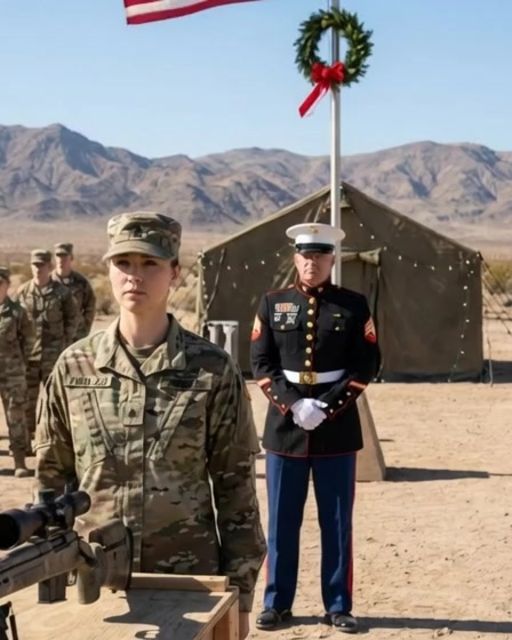
A Glimmer in the Heat
The target sat four thousand meters away, a speck of metal shimmering in the harsh Arizona sun. The desert air bent and danced with heat waves, and the wind made a low, restless sound. Thirteen of the finest snipers had tried to make that shot. Thirteen had missed. Every bullet had been pulled off course by air currents no one could quite solve.
General Vance, his collar damp with sweat, shook his head. He had seen enough. To him, the day had turned into nothing more than wasted ammunition and fraying tempers. He gave a brusque command to pack it up, eager to get his people out of the punishing heat and back into the shade.
Then a voice, quiet and steady, drifted over the dust. She did not shout. She simply asked to try.
It was Monica, the supply officer. The person who kept the coffee topped off, the paperwork in line, and the shelves standing tall. The kind of soldier who made sure the right batteries ended up in the right radios, and who never gave anyone trouble. A ripple of laughter ran through the group. A few of the snipers smirked, offering warnings she did not need and comments she did not deserve.
She ignored all of it. She picked up the heavy rifle, lay prone in the sand, and set a small, worn black notebook beside her left hand. No fancy electronic tools. No spotter whispering corrections. Just the rifle, the wind, the glinting plate of steel far beyond the horizon line, and the old notebook.
She breathed—once, twice—allowing time to stretch. She watched the mirage-like waves in the air. She waited until everything in her mind went quiet.
The shot broke the air like a whip. The sound reached them and then, for a few suspended heartbeats, there was only silence. Everyone stared at the target, holding their breath. Then, as thin and clean as a bell from miles away, they heard it—the unmistakable ring of lead meeting steel.
General Vance’s cigar dropped into the dust. On the monitor, the impact point glowed dead center. No one laughed now.
The Notebook with a Name
The General’s boots crunched on the hard ground as he strode over, his face drawn tight. He knew what that distance meant. He knew what kind of reading it took—the way the wind layered at different heights, the bullet drop over a vast stretch, the delicate timing that carried a shot across the desert without mercy or forgiveness. There were perhaps a handful of people in the world who could do it in those conditions.
“Who taught you that?” he asked, his voice roughened by old memories.
Monica rose, brushed pale sand from her sleeves, and held out the black notebook. “The man who wrote this,” she said. “He told me you were the only other person who could make that shot.”
General Vance opened to the first page and froze. The penmanship was precise, measured, and familiar—so familiar it ached. He had not seen those letters in twenty years, yet here they were, alive on paper.
“This is Sergeant Elias Thorne’s notebook,” he said, almost to himself. His throat tightened. “He was my spotter. My friend.”
He looked at Monica, struggling to connect her presence to the past that surged back without warning. “He was killed in action in 2003. I was there. I saw it.”
Monica’s voice was gentle but unflinching. “He wasn’t killed, sir. He was thrown clear in the blast. He survived, but his memory did not.”
Vance sank down onto an ammo crate. The notebook sat heavy in his hands, an anchor dropped into old waters. He lifted his eyes to hers, searching for a fact sturdy enough to stand on. “Who are you?”
“I’m his daughter,” she said, calm and clear.
Silence settled like a blanket. Vance flipped through page after page of careful lines and quiet brilliance—bullet-drop notes, wind charts, meticulous pattern sketches, fragments of ideas that once whispered between two soldiers in a dozen different winds.
Monica spoke, her voice carrying the steady cadence of a story told many times. Her father had been found by villagers; the man had no name, no tags, and no past. He returned to the United States with help from a relief agency and made a small, quiet life as a carpenter. Yet the skills in his hands—the ones he could not explain—rang in his muscles like a bell that would not stop. He wrote them down, one by one, taming the noise that visited him at night.
“He taught me patience,” Monica said softly. “He taught me to watch the way the world moves. To notice what most people don’t, especially the things you cannot see, like the wind.”
Vance swallowed. He could hear Elias’s voice again, a memory from another lifetime. Shooting isn’t about power. It’s about listening to the world. He had said that often, usually with a quiet smile.
“Before he died last year,” Monica continued, her words catching only once, “one name finally returned to him. Vance. He told me to find you and give you this notebook. He said you would understand.”
Old Missions, New Shadows
Vance stared at the sunlit horizon. He had lived with the weight of that day—Operation Desert Serpent—for two decades. He had believed he was mourning a fallen friend while carrying on the work they both had sworn to do. Now the ground under that story shifted beneath his feet.
“The report said he was confirmed KIA,” Vance said, his voice turning clipped and official. “I identified remains.” He let the sentence hang, then forced himself to add, “They showed me a body.”
Monica met his gaze. “It wasn’t him. He remembered flashes over the years—odd details that made no sense on their own. There was an argument before the mission. And there was a last-minute change in the plan.”
Vance stood with sudden purpose and dismissed the gathered troops with a firm gesture. When the wind and the sand were the only witnesses left, he told Monica to follow him.
They moved to his office, cold with recycled air and quiet with thick walls. On the desk, the black notebook looked small, but it had gravity. They spoke for hours. Monica shared what her father had recalled in fragments and dreams: the sense of being watched, the puzzle pieces that would not stay put, the fear that did not have a name.
Vance, thinking aloud, began to set the scene from long ago. They had gone after a high-value insurgent leader. The intelligence had looked convincing—too convincing, Elias had warned. Another officer had been loudest in his certainty. He had urged speed, pressed them to move before the window closed. That officer had been Captain Robert Jennings.
Monica opened to a page near the back of the notebook. In one corner, a small drawing snagged Vance’s attention: a hand holding a silver cigarette lighter, engraved with a unique design. It was tiny and simple, but it felt like a flash of lightning in a dark room.
Vance knew that lighter. Everyone did. It belonged to Jennings—now a powerful general in Washington. The lighter had been his trademark, always flicked, always lit with a flourish.
Pieces began to slide into place. Vance remembered waiting for air support that never came, and a rendezvous point that had been moved at the last second. He remembered Elias’s unease. And now he could feel the shape of a darker pattern beneath it all.
Patterns You Have to Listen For
Monica turned to the inside of the notebook’s back cover. In shaky script, there were strings of letters and numbers. Her father had thought they were the jagged edges of a broken mind—a kind of dream language that helped him sleep.
Vance studied the lines, his eyes narrowing. “This isn’t nonsense,” he said at last. “This is a key. A decryption key.”
He logged into a secure system and started the slow grind of pulling up old, sealed files on Operation Desert Serpent. It took time, and patience, and more coffee than either of them wanted to admit. For two long days and nights, they worked side by side. Vance provided context, acronyms, and history. Monica, guided by the logic her father had left her, did what he had always done best—she followed the pattern.
The truth emerged piece by hard-won piece. Jennings was not just ambitious. He was corrupt. He had been moving military-grade weapons into the black market, and the so-called insurgent target had been one of his clients. Elias, without realizing it, had cracked the perimeter of that secret. The mission had not failed; it had succeeded for the person who had planned it. Its real goal had been simple and brutal: eliminate Elias Thorne—and if Captain Vance vanished with him, so much the better.
Vance’s hand closed into a fist on the desk. “He’s a traitor,” he said, the words sharp and plain. “He left us to die and built a career on the rubble.”
They both knew what it meant to take on a man like Jennings. He was well-connected, protected by rank and time. But the notebook existed. The key existed. And the truth had a road to travel.
The Bait
Vance placed a cautious call to a trusted contact in the military’s legal branch. He asked for the Desert Serpent file to be opened for formal review, just enough to start a process. He knew that request would not stop at friendly desks. It would rise, as such things do, straight to the man with the most to lose.
Three days passed, heavy and slow. Then the phone rang. Jennings sounded polished and warm, like always, but there was a hard edge underneath. He warned Vance, in careful words, to let old ghosts stay buried. It was not advice. It was a message.
Vance chose a meeting place: a retired training ground far out in the desert, with old targets and worn structures. It felt, in a strange way, like stepping back into time. Monica listened to the plan with steady eyes. She said what needed to be said—it was dangerous, and Jennings would not come alone. Vance agreed on both counts and handed her a rifle case.
“Your father taught you to listen,” he told her. “Tonight, we need the world to speak.”
As the sun went down and the sky turned purple, Vance stood in the open, wired for sound and backed by a small, loyal team of military police waiting unseen, miles away. Monica had already vanished into the high rocks, almost two thousand meters from where Vance would make his stand. She had her father’s rifle and his notebook. Nothing more.
A Ghost in the Wind
Three black SUVs slid to a stop in the twilight. Jennings stepped out, surrounded by tough, silent men who moved like they knew how to do harm. His friendly mask was gone.
Vance faced him squarely. There was no point in pretense. He named the betrayal in a plain voice. Jennings did not deny it. If anything, he wore it like armor. He even lit a cigarette with that same silver lighter, the flame catching in the dusk, confidence flickering with it.
Jennings made a small signal. Guns came up. The air tightened. Vance kept his feet planted and his heartbeat steady. He trusted Elias’s math. He trusted Elias’s daughter.
Across the valley, a sound snapped the quiet. It came thin and sharp, delayed by the long, invisible journey of a bullet slicing through layered air. In the same breath, the lighter in Jennings’s hand burst apart, a flash of sparks and mangled metal. He stumbled back, shocked and hurting, and everything froze.
Vance spoke into his mic. “Now.”
Sirens rolled in from the dark. Military police vehicles cut through the night, lights washing the scene in urgent color. The mercenaries never had a chance to regain control. Within moments, Jennings and his men were surrounded, disarmed, and taken into custody.
As they led him away, Jennings twisted to glare at Vance. “Who made that shot?” he demanded. The answer drifted to the ridge, to the shadowed silhouette watching over them.
“A ghost,” Vance said.
Setting the Record Right
Back at the base, Monica sat with the rifle broken down for cleaning, every movement calm and exact. The old notebook lay open, its pages catching soft light. Vance told her the words she had worked so long to hear: Jennings was finished, and the network behind him was falling apart, one frightened confession at a time.
She nodded, relief showing in the easy way her shoulders finally dropped. “I only delivered a message,” she said. The words were simple and true. The message had been written long ago by a man who listened to wind and numbers and the quiet truth beneath both.
The weeks that followed were loud with headlines and hearings. Operation Desert Serpent, once a line in a file, became a national reckoning. The facts held up. The codes unraveled further. Testimonies landed. General Jennings faced a court-martial, his honors stripped, his power gone. The sentence matched the damage he had caused.
Most important to Monica, and to Vance, the record bearing Sergeant Elias Thorne’s name was corrected. It no longer told a story of a soldier who fell and vanished. It told the story of a soldier who saw more than he should have, who tried to warn, who survived in body and kept searching in spirit, and whose notes and daughter finished the work he began. He received the Medal of Honor, posthumously, for the courage that had carried him through danger and for uncovering a treason that might have stayed hidden for good.
A Quiet Goodbye
On Monica’s last day at the base, cardboard boxes sat open on a desk, half-filled with the quiet details of a life in uniform. She had asked for a transfer to a calmer post in logistics, far from deserts and rifle ranges. Vance stepped in without ceremony and held out a velvet box. Inside, the medal gleamed against deep blue.
“He was the finest soldier I ever knew,” Vance said, and he did not try to push past the catch in his voice. “And the best man.”
Monica took the medal and traced the letters of her father’s name. She had not set out to seek rank or applause. She had not even chased revenge. She simply wanted to give her father back the truth of who he was. She placed the medal beside the tattered notebook. Together, they felt complete—the skill and the courage, side by side.
What Remains
In the end, it was never just about a single, perfect shot through heat and distance. It was about what that shot stood for: patience, clarity, and the strength to follow the pattern where it leads, even when the trail disappears into sand. It was about a daughter listening as carefully as her father had taught her, and a friend finding the resolve to face what he had tried, for years, not to look at.
The lesson Elias Thorne left behind was not complicated, and it did not belong only to soldiers. The world, he believed, offers hints if we slow down enough to hear them. The wind is always speaking, even when you cannot see it. The numbers line up when the mind is quiet. Skill matters, but patience guides it. And truth—though it can be delayed, ignored, or buried—has a way of traveling, one step at a time, until it stands in daylight.
Monica did not need to be the best sniper in the world. She only needed to be the daughter who listened, who carried forward what was wise and set down what was cruel. She showed that real strength is often found in the steady places: a carpenter’s shop after nightfall, a quiet page in a small black notebook, a breath at the edge of a long shot, a decision to step forward when others laugh.
For General Vance, the desert did not feel as hot after that. The same wind that once seemed to swallow bullets now sounded like something else entirely—like the world, speaking softly, asking for attention and honesty. He had lost a friend long ago. He found, at last, the chance to honor him properly and to protect what his friend had tried to save.
The notebook remained, its corners rounded with use, its pages stubbornly alive. In it lived careful notes, patient drawings, and a code that unlocked more than files. It unlocked a way to see. A father passed that way of seeing to a daughter. A daughter used it to give a good man back his name. That is a rare kind of victory, and it lasts.
And if you stood, at daybreak, on the same ridge where Monica had listened to the wind, you would hear nothing dramatic—only a quiet air moving across rock. The target would be empty, the steel silent. But if you waited long enough, with the sun lifting over the land and the world settling into itself, you might understand what Elias taught them both: that patience, truth, and a steady heart can carry farther than any bullet. And when they arrive, they ring as clear as steel in the desert, telling everyone who listens that the world is, after all, still worth aiming for.