A Quiet Consultant at a Loud Firing Range
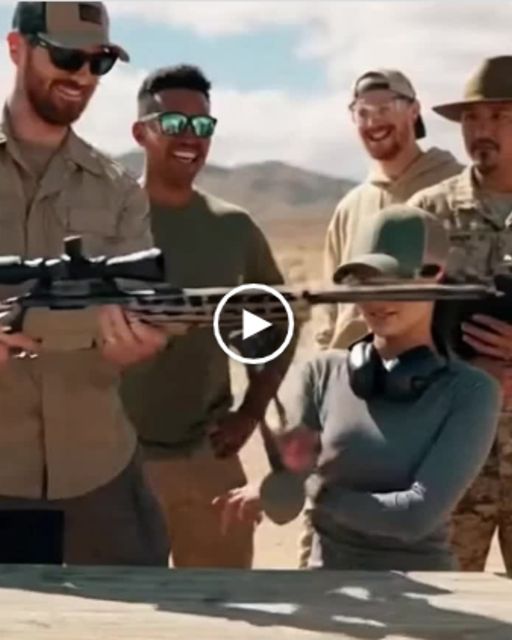
“Careful, sweetheart, don’t break a nail,” Colton joked as he pushed the long, heavy rifle into my hands. “It kicks like a mule.”
The other men at the shooting range chuckled. To them, I was the civilian who kept their inventory tidy and their budgets balanced. The pencil pusher. I wore jeans and a plain T-shirt. My job title said logistics. Nothing about me said marksman.
They were passing around bets on a shot nobody thought was possible. The target was a small white plate 2,500 meters away, a speck in the heat haze. For anyone who prefers miles to meters, that’s over a mile and a half. Even the wind sounded doubtful as it slipped across the open desert.
“It’s impossible with this wind,” Rodney, the spotter, muttered. “Nobody hits that.”
“Let me try,” I said, almost casually.
Colton rolled his eyes and smirked. “Sure. If you hit it, I’ll give you my truck.”
I didn’t ask which dial did what. I didn’t fiddle with the scope. I laid down in the dust and went prone like I’d done a thousand times before. The rifle settled into my shoulder as if it had always belonged there. My hands stopped trembling. My pulse slowed until it felt like one steady drum in the quiet between gusts.
The background disappeared. All that remained was the line from me to the target and the numbers my brain had learned to trust. Windage to account for the breeze pushing the bullet sideways. Elevation to arc the shot across that long stretch of sand and air. Even the Earth’s spin—the Coriolis effect—whispered into the calculation at that distance. None of it felt dramatic. It felt familiar.
I let out half a breath and broke the trigger cleanly.
Crack.
The rifle’s report rolled down the canyon. Four long seconds went by. In that space, I could feel everyone behind me holding their breath.
Then the sound reached us.
CLANG.
It wasn’t loud. It was definite. The kind of sound that says, “You were right,” whether people like it or not.
The laughter faded into stunned quiet. I rolled to my side and set the rifle carefully on the ground. When I looked up, Colton’s mouth was open. He looked like he might be sick.
Rodney didn’t stare at the target. He looked at me. More specifically, he stared at the small pale scar across my trigger finger where the glove rubs thin. His binoculars lowered slowly, his face draining of color. His voice, when it came, was barely a whisper.
“Colton, shut up,” he said, still watching me as if I’d sprouted horns. “That wasn’t a lucky shot.”
The Name I Thought I’d Buried
“What are you talking about?” Colton stammered. “Who is she?”
Rodney looked me straight in the eye, his fear turning into something weightier—recognition and, I realized, guilt. “She’s not a consultant,” he said. “I know that stance. That’s the Ghost of Kandahar.”
His gaze flicked to my gear bag, which I’d set down without thinking. A worn patch showed when the flap fell back. He swallowed hard. “Task Force Nomad,” he said softly. “They were wiped out five years ago.”
The world seemed to shrink until it was just the two of us, me and a man who remembered that name the same way I did—like a bruise that never healed.
Colton and the rest of the team were still and silent. I stood, brushed dust from my knees, and said nothing. Sometimes words make things too real too fast.
“We need to talk,” Rodney said, voice low and tight. “Not out here.”
I nodded. We walked away from the line, past the trucks, to a small storage shed full of old targets and the smell of oil and wood. The door creaked closed behind us, and the light inside turned everything a soft brown.
Operation Nightingale
“How are you alive?” Rodney asked, keeping his back against the door as if the outside world might try to push its way in.
“I keep my head down,” I said. It wasn’t dramatic. It was the truth.
He swallowed and steadied himself. “I was there,” he said. “Operation Nightingale. I was the RTO. Radio operator.”
For a moment, I wasn’t in that shed. I was back in the dust and the noise and the sudden wrongness of that day. I remembered a young radioman, barely more than a kid, eyes too wide, trying to make his voice carry through the chaos. I remembered how fast everything turned and how it never turned back.
“You were just a kid,” I said, the memory settling in with a weight I knew too well.
Rodney’s eyes shone. “They said you went rogue. That you fired on civilians. That you got everyone killed.” He stopped, looking at me as if the past had been shoved between us again.
“And you believed them?” My voice came out quiet and dangerous all at once.
He shook his head hard. “No. I saw the target. I heard the comms before they died. It was a setup.”
A weight I hadn’t admitted to carrying eased, just a little. For five years, the official story felt like a wall I couldn’t climb. Hearing him say it aloud didn’t erase the pain, but it gave me back one small, steady piece of ground.
“Then why are you scared of me?” I asked.
“Because the man we were hunting that day, the one who set us up?” Rodney’s voice thinned, like it might break. “He’s here. In the States.”
One name landed in my chest like a dropped stone.
Kaelen.
An arms dealer with a talent for vanishing and a heart like ice water. He had laughed while he took my mentor, Marcus, from this world. I’d been close enough to see the truth of him once. It was more than enough.
“He’s dead,” I said. “Confirmed.”
“He faked it,” Rodney answered. “He bought a new name and a new life. I know because I’ve been tracking him for two years.”
He told me about the guilt that wouldn’t let him sleep after his discharge. How he took the private security job because it offered databases, contacts, a way to sift through shadows in hopes of finding one honest thing to do. He showed me the lines he’d drawn, the names he’d followed, and how every path led to the same man living under a polished identity.
“Why tell me now?” I asked.
“Because he’s planning something big—here,” he said. “A deal on our soil. And when I saw you on that line today, I realized you might be the only person who can stop him.”
The Monster With a New Name
The past wasn’t knocking politely anymore. It had walked in, taken a chair, and stared me down.
Rodney laid out what he knew. Kaelen was now calling himself Alistair Finch. Philanthropist. Generous donor. Charming smile to go with his new suits. He owned a sprawling mountain estate about a hundred miles out, and he was hosting a charity gala in two days. The gala, according to Rodney, was a cover for a massive arms deal with a rogue state.
I didn’t want his death. That would be clean and quick and, in a way, far too easy for a man like him. I wanted something else. I wanted the proof. I wanted the files and recordings that would clear the names of the soldiers from Task Force Nomad who never came home. I wanted their families to hear the truth on the evening news, not in whispers.
Writing a Plan in Plain English
We shut ourselves in a briefing room for two long days. The men who had laughed at me over coffee were quiet now, listening to each word as if the next one might matter most. Colton’s team—four capable, steady former military operators—leaned in. Rodney spread out his notes, maps, and printouts.
“He’ll have a central server room,” I said, sketching a simple outline. “If he’s as careful as we think, it holds the records of his deals and the names that keep him safe. We get that secure drive, we shine a light he can’t shut off.”
We kept the plan simple enough to remember and careful enough to matter. We would use the gala as cover. Colton and his men would blend in as extra security—nothing flashy, just more boots and earpieces on a busy night. Rodney would stay outside the grounds in a van, watching cameras and radios and keeping us a step ahead. My job was to take an overwatch position, a fancy way of saying I’d settle somewhere high and hidden with a view of the estate and a straight line to one weak point.
“When I give the signal, I’ll disable the communications tower with a single round,” I said. “That should cut the estate’s wireless traffic for about five minutes. In that window, you go in, grab the drive, and leave.”
Colton nodded. “Five minutes. Tight, but doable.” His voice had lost the teasing edge from the range. In its place was that calm, serious tone you only hear when someone knows what the stakes are.
The Night the Mountain Held Its Breath
The evening of the gala arrived clear and cold. The stars felt close enough to touch, and the air was thin in that way mountain air always is. From my rocky perch nearly 3,000 meters out, the estate looked like a glass jewel case under warm light. Music drifted and blended with laughter. If you didn’t know better, you’d think it was a celebration.
“All teams in position,” Rodney said in my ear, professional and steady. “Colton is in.”
“Copy,” I said. My breathing found that slow rhythm again. The rifle felt like an extension of my hands. I watched, and I waited.
Time passed. Guests slipped away in pairs. Staff moved like a quiet tide across the grounds. The flow of the party began to thin to its late-evening core.
“He’s moving,” Colton said, low but tight. “Kaelen’s headed to his office. The deal starts now.”
“Perimeter?” I asked.
“Overconfident,” Rodney answered. “He thinks he’s untouchable.”
“Going dark in five,” I said. My crosshairs found the base of the communications mast. Wind tugged at the barrel. I adjusted. Small moves. Careful breath.
A new voice slipped into our headsets. It sounded like a smile you didn’t want to see. Tinny and distorted, but full of amusement.
“Did you really think it would be that easy, Ghost?”
Kaelen.
The word froze everything inside me for a beat. Then training took over. It was a trap.
“He’s on our channel,” Rodney shouted. “Abort! Abort!”
Too late. Floodlights erupted, turning night into noon. Armed men flowed over the grounds like a dark tide.
“Colton, out! Move!” I said, sharper than I intended.
“Pinned!” he barked back, the percussion of gunfire snapping hard through his mic.
Kaelen’s voice slid back in, smooth as glass. “A touching reunion. I have your friends. And your radioman. He’s as unreliable now as he was then.”
“Rodney,” I said. “Talk to me.”
For a long second there was nothing. Then a broken whisper. “I’m sorry. He found me. Weeks ago.”
I closed my eyes. Not in disbelief. In acceptance. If Kaelen knew I was alive, he would set the board and force us to play.
“He knew you were out there,” Rodney said, his voice cracking. “He knew I was searching records about Nomad. He threatened my family. He used me to lead you here.”
It was a script, and we had followed our lines. The realization didn’t slow me. It focused me.
“Listen to me,” I said, not letting panic into my voice. “You are not a traitor. You’re a soldier. And you’re going to buy them a way out.”
“How?” Rodney’s breath shuddered in my ear.
“Make a diversion. Big enough to pull eyes and guns away.”
Silence. Then an engine turned over. I pictured him straightening his shoulders, the way soldiers do when they make up their minds.
“For Nomad,” he said, and his voice was suddenly calm.
“Rodney, wait—”
Headlights burst from a stand of trees and roared down the service road. The van’s horn blared without stopping. Men turned. So did their rifles.
“Stop him,” Kaelen snapped.
But momentum is a powerful thing. The van smashed through the main gate in a firestorm of sparks and shattered steel. The shock wave hit the grounds and rolled across the lawns. When the roar faded, the comms went still.
The cost of those five minutes of distraction landed hard and final. Rodney had made his choice. He had bought the time. Colton and his team used it without wasting a heartbeat, breaking from cover and sprinting for the perimeter wall, slipping into the dark beyond the lights.
Choosing the Harder Shot
My cheeks were wet, but my hands didn’t shake. Rage rose and tried to take the wheel. I let it pass like a wave instead of letting it carry me out to sea.
I shifted my aim, the tower forgotten. My scope framed the warm square of a window where I knew Kaelen would be, watching with that clinical calm he wore like a second skin. A silhouette moved. A phone lifted to a cheek. It would have been so easy to narrow my world back down to the crosshairs and a trigger press. One breath. One pound of pressure. One end to an old wound.
I lowered the rifle.
Justice sometimes looks like a headline instead of a shot. I remembered what Marcus had taught me when I was still learning to read wind and time. Real strength isn’t pulling the trigger. It’s knowing when not to.
I packed my gear and left the mountain the way I had arrived—quiet and unseen. I wasn’t running. I was choosing my battlefield.
Sunlight Finds Its Way In
In the days that followed, the world filled with a different kind of noise. Not gunfire. Not shouts in the dark. It was the soft rhythm of notifications and the buzz of newsroom phones. An anonymous package of files arrived in inboxes and on desks across the country. Encrypted folders opened into ledgers, emails, and recordings. It was a map of Kaelen’s world drawn in numbers and names.
In the middle of it all lay a report with no redactions, no polite black bars hiding the worst truths. Operation Nightingale. It showed how false intelligence had fed our team into an ambush. It showed the men of Task Force Nomad doing what they were trained to do, fighting to shield civilians, buying time the only way we could. It showed that what finished us wasn’t a mistake on the ground. It was betrayal above us.
News anchors read the story aloud. Commentators argued over pieces that didn’t matter as much as they thought. But the families heard the part that counted. Their sons, their husbands, their brothers were brave. They were not the villains the official line had made them out to be.
Kaelen—Alistair Finch to the circles that had invited him to speak at banquets—was arrested at a private airfield as he tried to leave the country. The polished suit didn’t change the man wearing it. Concrete walls and locked doors have a way of making sure a person finally looks like who they are.
Task Force Nomad was exonerated. The word sounded clinical, but what it meant was simple. The lies were gone. The record was clean. There were medals and folded flags delivered with the right words this time. Grief doesn’t end because of paperwork, but it rests easier with the truth.
A Key, A Truck, and a New Beginning
I watched it all on a small television in a modest motel room. The volume was low. The room was quiet. When the knock came, I almost didn’t answer it.
Colton stood in the hallway, posture uncertain in a way I’d never seen on him before. He didn’t grandstand or apologize with big gestures. He held out a set of keys.
“A deal’s a deal,” he said with a small, honest smile.
“I didn’t hit the target,” I told him.
“You hit the one that mattered,” he said, and I believed he meant it.
Then he surprised me again. “I was wrong about you. About a lot of things. I don’t want you behind a desk anymore. I want you to build something with me. Head up a new security division. Real work. Protect people on our terms.”
I didn’t ask for office space or a title. I said yes. Not because I owed him or because I wanted a steady paycheck, but because it felt like the right way to carry what I’d learned. We don’t always get to choose the battles we face. But sometimes, if we’re lucky, we get to choose the kind of guardian we become afterward.
What I Learned About Strength
My past isn’t a thing I can put on a shelf. It lives in a pale scar across my finger and in the names of friends I say quietly when the house is dark. But it no longer decides who I am when morning comes.
People like to think strength is loud. That it’s the hardest punch or the longest shot. Sometimes that’s true. More often, strength looks quieter. It looks like staying calm when the world tips. It looks like asking for help even when pride argues against it. It looks like choosing the hard path of truth over the quick satisfaction of revenge.
At the range that day, they laughed because they thought they knew me. To be fair, I had let them believe it. After everything that happened, I wanted to be small and safe and useful in ways that didn’t set my heart racing. But life has a way of sending us back to the places we’re needed most. The trick, I think, is returning on your own terms.
Rodney will never be a footnote to me. He made a terrible choice under terrible pressure, and then he made a brave one to set it right. That kind of courage doesn’t make headlines for long, but it matters where it counts. It matters to the people who got to go home because of it. It matters to the memory of the men we both failed to save once upon a time.
Colton taught me something too, though he may never think of it that way. Most of us are capable of changing our minds when we learn better. He laughed once. Then he listened. In between those two things lives the possibility for everything good that comes next.
As for me, I still see the math when the wind picks up. I still feel the weight of a rifle as a familiar balance, not a threat. But I carry those skills differently now. They aren’t about proving anything to anyone. They’re tools I use in service of something I can stand behind without flinching—protecting people who need it, telling the truth when lies are easier, and knowing that the sharpest aim I have is the one that points me away from old ghosts and toward what’s right.
The Ghost of Kandahar can rest. The woman who learned when not to pull the trigger has work to do, and this time, it’s the kind that builds instead of breaks.