
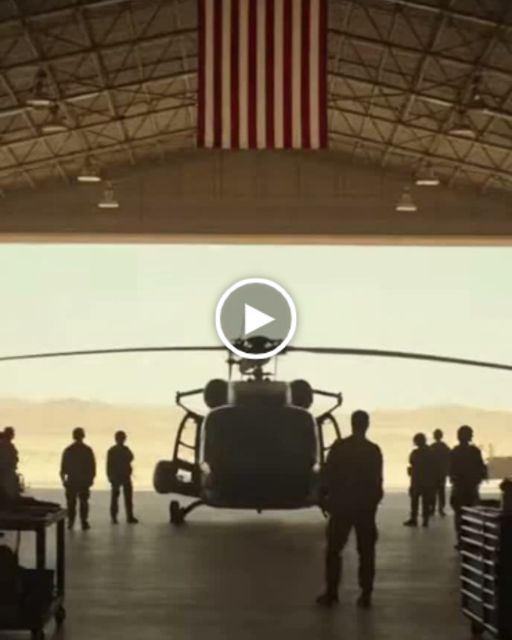
A Sudden Call Across the Hangar
The hangar went quiet in an instant when a frantic voice cracked over the loudspeaker, asking if there was any helicopter pilot on base. Radios were alive with panic. Someone said forty-three troops were cut off on the far side of the perimeter, and the last flyable helicopter sat waiting on the tarmac. Every certified pilot was already out on missions. It felt like the longest pause I had ever lived through.
I stepped forward, still in grease-stained coveralls, and heard myself say the words before I had time to doubt them. I said I could fly it. I am not a pilot on paper. I am a mechanic by trade, the kind who keeps aircraft alive when others are done flying them. But for years, after hours when the hangar lights dimmed and the chatter faded, I sat alone in the forgotten simulators. I practiced start-ups, emergency procedures, landings in crosswinds, and navigation in the dark. I did not do it for glory. I did it because I loved these machines and because, if the worst day ever arrived, I wanted to be useful.
Colonel Travis stared at me. Sweat trembled at his hairline and his face looked too pale for the loud room we were standing in. He told me to do it. No time for ceremony. No time for second thoughts.
I climbed into the cockpit with hands that shook at first, then steadied as muscle memory took charge. Switches, gauges, fuel, rotor, the familiar rhythms of a checklist I had practiced a hundred times with no one watching. The engine caught and built to a steady roar. I eased the collective, felt the skids lighten, and then we were in the air—me and the bird. It was both thrilling and terrifying.
Airborne and All In
I cleared the hangar and rose into bright, open sky. I was ready to do what I believed I had to do—risk a great deal to help those who needed it. For a few minutes, the world narrowed to airspeed, heading, altitude, and the quiet resolve that comes when a hard choice is already behind you.
And then I looked at the rescue coordinates.
They were preloaded into the navigation. It should have been simple—fly to the waypoint, assess, and pull our people out if I could. But the numbers did not line up with any grid I knew from our operational maps. They lined up with something far more familiar. The moment I recognized them, a cold dread settled over me. Those numbers pointed to a small, ordinary address just beyond the base gates.
My address.
The Wrong Waypoint
I pressed my mic to ask command to confirm. Before I could speak, I realized the frequency was already open. I heard Colonel Travis’s voice, low and urgent, as if he had leaned too close to the transmitter by accident. He said I had taken the bait and that someone had twenty minutes to clear it out.
I banked hard. I did not follow the programmed line anymore. I aimed straight for home.
The streets of my neighborhood slid into view beneath the skids. My backyard came into focus, trees shivering in the rotor wash as I steadied into a hover. There were no stranded troops. There was, however, my husband in the yard, lifting something heavy into the back of a truck.
It was my father’s old footlocker, the battered green metal box that held his medals, letters, and the folded flag that had been handed to us when he was laid to rest. It held the best of him—the history of a man who had taught me to stand straight and tell the truth, whether anyone wanted to hear it or not.
A Shocking Betrayal
I switched the camera to zoom, and the view closed tight on the back of the truck. I watched my husband, Mark, shove the locker into place and slam the tailgate. I keyed my mic and called his name.
Silence. Then the frequency crackled alive again—but not with my husband. It was Colonel Travis ordering me to return to the flight path. His voice was sharp and cold, an edge meant to cut off argument. I answered more calmly than I felt and told him my flight path now looked a lot like my backyard, where my husband was making off with the last pieces of my father’s life.
Mark broke in then. His voice sounded smaller than usual. He told me to go, said I was making it harder than it had to be. I asked him as evenly as I could what he was doing. He said he was taking what was his, that he was done with this life and done with me. Ten years of marriage shrank to a single bitter line, and I felt something in my chest go tight and hollow at the same time.
I asked him what was in the truck. He said, flatly, that it was what my father had left—assets my dad had hidden away. The man I loved was not stealing keepsakes, he said. He was collecting money. He told me my father had mentioned a nest egg, tucked away for me, and that it was inside that old locker. It did not sound like my dad. He was a career Master Sergeant, careful and modest. A saver, yes. A hoarder of secret wealth, no.
More Than Money
I looked at the open comms panel and knew Colonel Travis was listening to every word. Whatever this was, he was in it up to his collar. But why would a man in his position gamble his career on a mechanic’s supposed inheritance? The answer, I realized, likely was not money at all.
My years with the simulators had taught me more than how to lift a helicopter off the ground. They taught me every odd little system tucked where only mechanics usually look. I flipped a small, almost hidden switch by my knee and activated the cockpit’s internal recording to a removable drive. If this was going to be a showdown, I needed a record that could not vanish by sunrise.
I kept them talking. I told the colonel that my husband was stealing from me and asked what he intended to do about it. His tone softened almost to fatherly, urging me to return to base and let the local authorities handle a domestic matter. But I could hear something else under the surface—anxiety. He wanted me back on his ground, where he could shape the facts and the future.
Mark climbed into the driver’s seat. The engine of the truck rumbled to life. I did not have minutes to negotiate. I had moments.
Holding a Line in Midair
Landing in the street would have been reckless, and I knew the consequences would echo louder than the rotors. But there was another way—one only a mechanic who had watched downdrafts flatten stubborn obstacles might think to try. I dipped to about fifty feet over the road and positioned the helicopter ahead of the truck’s hood. The wash tore at loose branches, rattled shutters, and sent a parade of tin trash cans wobbling down the curb. The message was plain: he was not going to leave.
Over the headset, Mark shouted, asking if I had lost my mind. I told him clearly that he was not going anywhere. The colonel jumped back on the line, furious, promising the brig and every charge he could throw if I did not obey his order to clear out and return. His voice might have scared me on any other day. Not today.
I told him plainly that he had created this mess. He had sent me off under a false emergency while my husband tried to strip my father’s memory from our home. I asked him, out loud and on the record, why he would do that. He did not answer. Silence, except for blades, air, and a hum of electronics. Sometimes silence tells the truth before any confession does.
As I hovered, it struck me that my dad had once served in a unit with a younger Major Travis. They were not close. My father had called Travis a man who cut corners. I thought of the way he used to tap the side of that locker and say the most valuable things inside were not the ones that shined. I had always assumed he meant the letters and his flag. Maybe he meant proof. Maybe he meant the kind of truth that can end a career in a single meeting.
I spoke again, steady now. I said a man of the colonel’s rank would not risk everything for a pile of cash. I said whatever he wanted out of that footlocker had nothing to do with money. I said it had to be something my father had on him. The airwaves went still. I knew he heard me. I knew he understood that I understood.
Forcing a Choice
I told him he had ten seconds to order Mark to pull over and step away from the truck, or I would broadcast our entire conversation—including the false rescue call—on an emergency frequency that would reach both civilian and military ears. I did not puff myself up or try to sound tough. I simply told him what I would do. It was not a bluff. I knew exactly how to patch it through.
He told me I would not dare. I answered that I was just a mechanic, which meant I had less to lose than he did. Five long seconds passed. Then Travis came back with a voice that no longer had iron in it. He told Mark to stop and get out. Mark protested. The colonel barked the order again. The taillights flashed red, the brakes engaged, and the door swung open. Mark climbed out and shook a fist skyward, looking so much smaller than the man I married.
A Call to an Honest Ally
I did not intend to return to base to hand over my recording and my freedom. Not with Travis still holding any power. I needed someone who did not play games. I turned away from my street and flew low and steady toward a small municipal field nearby. On a secondary panel, I dialed the one person I believed I could trust—Sergeant Adams, head of the Military Police on base and a man my father had mentored years ago. If my father had ever believed someone would protect the truth, it would have been Adams.
He answered with a clipped hello, and I told him my name. I asked him to listen without interruption for a few minutes. Then I laid it out in simple, spare words: the alarm that sent me airborne, the wrong coordinates, the conversation I had overheard, the way I had stopped the truck, and the recording that proved every piece of it. He was quiet for a beat that felt longer than it was. Then he asked me where I was headed. I told him Northwood’s civilian airfield. He said to stay put, that he was on his way, and he added something I had not realized I needed to hear—he told me I had done the right thing.
I settled the helicopter onto the empty ramp, shut the systems down, and pulled the small data drive from its slot, sliding it into my pocket and pressing my fingers around it for a long second. The rotors slowed, then stilled. Suddenly, it was all very quiet.
Lights off, two MP vehicles rolled onto the field about twenty minutes later. Sergeant Adams stepped out of the lead car himself and walked to the cockpit. His expression was plain and honest.
He asked if I was all right. I told him I thought I was. He let out a careful breath and said his team had Mark in custody already, and that Mark was babbling about hidden money. He shook his head. He called my husband a fool, not angrily, just sadly.
What My Father Really Left Behind
We drove back to my house together. The truck sat where Mark had left it, and the footlocker looked strangely ordinary in the fading light, as if it were just another box and not the center of so much trouble. We lifted it together and carried it inside. Adams ran a palm over the cool metal, then stepped back so I could kneel and open it.
I undid the two clasps and turned the combination lock my father had added years ago. My birthday still opened it. The lid came up on a world I knew well: the dress uniform, sharply folded, letters tied with a ribbon, medals sleeping in small cases. It looked like memory, not money. For a moment, I wondered if my own instinct had been wrong. Then my father’s old words returned again, steady and patient, about what truly had value.
I lifted the uniform tray and found more letters, photographs, and a handful of his service journals. The top one was from his last tour, back when a younger Major Travis figured in the daily rhythms of their unit. I paged through neat block handwriting—routines, supply notes, small stories of ordinary days in difficult circumstances. Near the end, the writing changed. It rushed, as if the hand that held the pen was ready to be interrupted at any second.
Those pages described a quiet theft that had nothing to do with wallets and everything to do with our country’s trust. Fuel, parts, electronics—siphoned, traded, gone. Names, dates, shipment numbers. My father had not made a wild accusation. He had made a careful record. Tucked into the last page was a sealed evidence bag with a tiny data chip inside.
I told Adams that this was what the colonel had been after. He nodded, jaw set. It took no leap at all to see how the rest had fallen into place. After my father died, Travis must have hoped the proof had been lost or destroyed. When Mark, chasing a fantasy about a hoard of cash, went to Travis for help, the colonel saw a way to arrange a distraction, outrun the truth, and snatch the footlocker in the chaos. He had underestimated what my father left and what his daughter would do to protect it.
Truth in the Light of Day
The next day moved like a film I barely believed I was in. Sergeant Adams walked the journal and the chip up the chain with precision. The recording from the helicopter joined the evidence. By afternoon, Colonel Travis was relieved of command and taken into federal custody. Mark faced charges for theft and conspiracy. His search for imaginary money had led him to very real consequences.
As for me, I sat across from a general I had only ever seen in framed photographs. He listened without rushing me. He asked a few clear questions. He studied the flight data and the audio, and when he finished, he gave me a small, steady smile. He told me my file said I was a mechanic, but my flight data said I was also a pilot—and a good one. Then he said something I could never have imagined hearing the day before. They would not bring charges for the unauthorized flight. Instead, if I wanted it, there was a place for me in Officer Candidate School and a fast track into official flight training.
A New Heading
I walked outside after that meeting, into ordinary sunshine that felt new, the way air feels after a storm clears. In twenty-four hours, everything I recognized had shifted. I had lost a husband and the shape of the life I thought I would live. I had gained something I could not have named the day before—an understanding of my own steadiness under pressure and the strength that had been built quietly through years of work no one had watched.
Back home, the footlocker rested in my living room. Its contents were no longer a mystery. The real treasure was not hidden cash. It was a record of truth, patient and exact, left by a man who understood the cost of silence. My father had taught me how to be careful with the things that matter and brave with the things that must be faced. Protecting his memory meant more than guarding a set of medals. It meant carrying forward his insistence on integrity, even when the ground tilted and the future wobbled.
What Matters Most
I think often about how emergencies really arrive. Sometimes there is a siren. Sometimes there is a loudspeaker. And sometimes there is only a quiet betrayal that makes you decide, right then, who you are. That day, I took the controls because there was no one else to take them. I kept them because the truth demanded it. In the end, it was not the loudest voice that guided me. It was the simplest. It was my father’s steady reminder that the most valuable things are not always the ones that shine.
If there is a lesson in all of this, it is not just about courage in a crisis. It is about preparation in the quiet. It is about doing the work when no one is watching, trusting the training you have given yourself, and, when the moment comes, setting your course, holding steady, and flying your own path—no matter how uncertain the sky looks ahead.



