
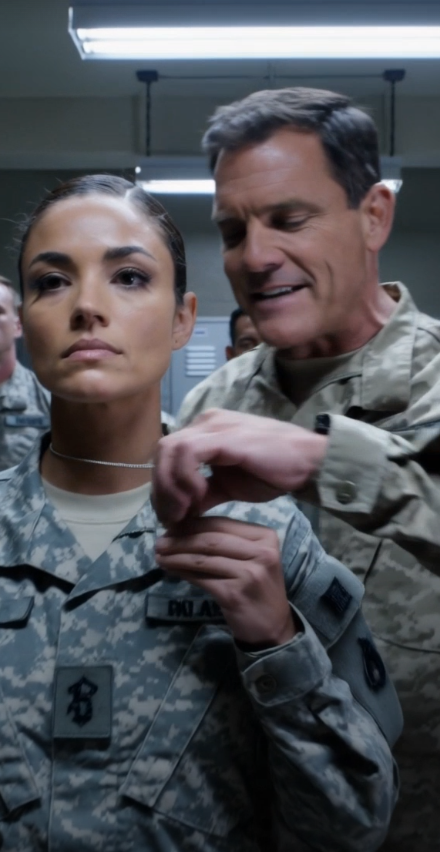
“Take it off.”
Staff Sergeant Carter didn’t yell. He never had to. The locker room went dead silent – thirty soldiers, mid-laugh, mid-breath, frozen.
Private Brooks didn’t move.
She just stood there. Boots planted. Eyes forward. Not scared. Not angry. Just… still.
“You didn’t earn that name,” Carter said, stepping closer. His finger tapped the tag resting on her collarbone. “Let’s see what you are without it.”
Nobody stepped in. Nobody ever did when Carter picked a target. Last month it was Hodges. Before that, Ramirez. We all just looked at our boots and waited for it to be over.
But Brooks?
She didn’t flinch. Didn’t even blink hard.
That’s what made my stomach turn. Because people who don’t flinch usually have a reason.
Slowly, she reached up. Unclasped the chain herself. Dropped the tag into Carter’s open palm like she was handing back a borrowed pen.
Thirty soldiers watched her surrender her own name.
Carter smiled. He’d won. Again.
Then she spoke. Two words. Quiet enough that I almost missed them from two lockers down.
“Read it.”
Carter rolled his eyes. He glanced down, ready to mock whatever was stamped on it. Name. Serial. Blood type. The usual.
But then his thumb stopped moving.
I watched his jaw lock. Watched the color leave his face the way water leaves a cracked glass – slow, then all at once.
The engraving on the back wasn’t regulation. The font was wrong. The depth was wrong. And the three letters underneath her serial number weren’t something a private was ever supposed to have on a tag.
“…No,” he whispered.
Not to her. To himself.
His hand started shaking. Actually shaking. I’ve seen Carter chew out a colonel without breaking a sweat, and now he couldn’t hold a piece of metal steady.
Brooks finally looked at him. Really looked at him. And when she spoke again, her voice was different. Lower. Older than she had any right to sound.
“You weren’t supposed to touch that, Sergeant.”
Behind us, the locker room door clicked shut. I hadn’t seen anyone close it.
And then I heard the boots in the hallway – at least four sets, moving fast – and I finally understood why she’d let him take the tag in the first place.
But it wasn’t until I saw what was stitched on the inside of the jacket the lead man was carrying that I realized who Private Brooks actually was.
The door swung open, not with a bang, but with a quiet, deliberate weight. Four men stood there. Two were MPs, big as refrigerators. One was a man in his fifties with the silver eagles of a Colonel on his collar.
The fourth man held a folded service jacket.
None of them looked at Carter. Their eyes were all on Brooks.
The Colonel nodded. “Major. Is this the individual?”
My brain short-circuited. Major? He was talking to Private Brooks.
Brooks, who hadn’t taken her eyes off Carter’s pale face, just gave a slight nod back. “This is him, sir.”
The Colonel stepped aside. The man with the jacket came forward and held it out to her. It was a formal, respectful gesture.
She took the jacket. Unfolded it. Slipped it on over her plain olive-drab t-shirt. The transformation was instant.
The girl who’d been doing push-ups with the rest of us thirty minutes ago was gone. In her place was an officer. On her shoulders were the gold oak leaves of a Major.
And on the lapel, the crossed pistols of the Criminal Investigation Command. CID.
A wave of understanding, and a new kind of fear, washed over the locker room. This wasn’t a standard training exercise. This wasn’t a drill.
This was an investigation. And we had all been witnesses.
Carter was still staring at the dog tag in his trembling hand. He hadn’t even looked up at the men who entered. He was trapped in the past, staring at a small piece of metal.
One of the MPs stepped forward. “Staff Sergeant Carter, you’re to come with us.”
Carter didn’t respond. He just kept whispering that one word. “No… no…”
The Colonel finally looked at him, his expression not angry, but filled with a kind of weary disappointment. “Give it back to her, Carter.”
Carter’s head snapped up. He looked at Brooks, this woman who he had terrorized, who he thought was just another scared recruit. He saw the Major’s oak leaves on her shoulders, the CID insignia.
He looked back down at the dog tag.
“The name…” Carter stammered, his voice cracking. “Brooks… I thought…”
“You thought what, Sergeant?” she asked, her voice calm and even. It was the calmness that was so terrifying.
“I knew a Brooks,” he finally choked out. “A real soldier. Not… not some kid playing dress-up.”
I saw a flicker of something in Major Brooks’s eyes. It wasn’t anger. It was pain. Deep and old.
“Tell me about him,” she said softly.
The whole situation felt surreal. A CID Major, two MPs, and a Colonel were in the middle of a formal action, and she was asking him to tell a story.
Carter shook his head, looking cornered. “He was my friend. Sergeant Michael Brooks. He was a hero.”
My blood ran cold. Michael Brooks. Of course.
Major Brooks extended her hand, not for the tag, but as if to offer a truce.
“He was my brother,” she said.
The locker room, which had been silent before, now felt like it was in a vacuum. Air couldn’t move. Sound couldn’t exist.
Staff Sergeant Carter stared at her. His whole body went rigid. The bully, the tyrant, the man who broke recruits for fun, suddenly looked small and broken.
“Anna?” he whispered, using a name none of us had ever heard.
“Hello, Will,” she replied, and for the first time, her voice trembled just a little.
They knew each other. Before this. Before any of us.
The Colonel cleared his throat, bringing the moment to an end. “We have a room ready, Major. Staff Sergeant Carter, you will be debriefed.”
The MPs moved to flank Carter. He didn’t resist. He shuffled forward like a man twice his age, his eyes still locked on Anna Brooks. As he passed her, he held out his hand.
The dog tag lay flat on his palm.
She took it from him, her fingers brushing his. It was like watching a bomb being defused.
“The back,” he murmured, his voice hoarse. “Michael… he had one just like it.”
“I know,” she said.
The MPs led him out. The Colonel followed, leaving Major Brooks alone with thirty stunned soldiers in a locker room that now felt like a crime scene.
She stood there for a long moment, the jacket making her seem impossibly authoritative. She looked at us, her gaze sweeping over our faces. We’d all been complicit in our silence. We had let Carter’s cruelty happen, day after day.
I expected a lecture. A dressing-down. I expected to be the next target.
Instead, she just sighed. A heavy, tired sound.
“Listen up,” she said, her voice back to being an officer’s. “What happened here was part of an official investigation into a pattern of misconduct. None of you are in any trouble.”
A collective, silent exhale.
“But I want you all to remember this,” she continued, her eyes finding mine for a second. “You wear a uniform. That makes you a team. When one of you is singled out, tormented… you are all diminished. Looking at your boots is not a strategy. It’s a surrender.”
She turned to leave, and that should have been the end of it. Case closed. Bad guy gets caught, investigator gets her man.
But my mind was stuck on what Carter had said. “The back… he had one just like it.”
I had to know.
“Ma’am?” I said, my voice barely a squeak. Everyone looked at me like I was insane.
She stopped at the door and turned back, one eyebrow raised.
“What did it say?” I asked. “On the back of the tag.”
She looked down at the dog tag still clutched in her hand. She thought for a moment, then walked back toward the center of the room. She held it up so the light caught the engraving.
It wasn’t just three letters. It was a date. And underneath the date, hand-etched and barely legible, were three tiny words.
I’ll carry you.
“It was the motto of their unit,” she said, her voice soft again. “An informal one. A promise they made to each other. That no one gets left behind. Not on the battlefield, and not after.”
She paused, letting the weight of that sink in.
“My brother, Sergeant Michael Brooks, and then-Sergeant William Carter served together in a special forward recon unit. On their last deployment, their position was overrun. Michael was hit.”
She took a deep breath. Thirty soldiers hung on every word.
“Will—Staff Sergeant Carter—refused to leave him. He carried my brother for two miles under heavy fire to get to the evac point. He saved three other men that day.”
My head was spinning. Carter? The man who made Hodges do burpees until he puked because his boots weren’t shiny enough? He was a hero?
“Michael didn’t make it,” she said quietly. “He died just as the helicopter landed. His last words were to Will. He made him promise to go home. To live.”
She closed her hand around the tag.
“For his actions, Will was awarded the Silver Star. But he never wore the ribbon. He refused the ceremony. He came home, but he left the man who earned that medal back in the desert with my brother.”
Suddenly, it all made a horrible kind of sense. Carter wasn’t just a bully. He was a man drowning in guilt. He hated himself for living when Michael had died.
He probably looked at us, a bunch of green recruits, and saw kids who weren’t worthy of the uniform his friend had died in. He saw our small mistakes as personal insults to Michael’s memory.
And when he saw the name ‘Brooks’ on a roster… on a new private who looked nothing like the hero he remembered… it broke something inside him.
“He thought I was just some girl disrespecting the family name,” she said, reading my mind. “He said I didn’t ‘earn’ it. He was right. I haven’t been through what he has. What Michael went through.”
“So… this was all a setup?” Hodges asked from across the room.
“The Army noticed a pattern,” she explained. “A decorated soldier, a fantastic NCO, suddenly becoming a liability. Reports of abuse, psychological torment. They were going to discharge him. I asked for one last chance to find out why.”
She had enrolled in basic training under her own name, a Major going undercover as a Private, a plan so ridiculously bold it actually worked. She put herself in his path, knowing his history, knowing he would target the name ‘Brooks’.
She gave him the opportunity to be the monster he had become. And he took it. But not for the reasons we thought.
“I had to know if the man my brother saved was still in there,” she said, her voice thick with emotion. “I couldn’t let the Army throw him away without knowing the full story.”
That was the real twist. She wasn’t there to punish him.
She was there to save him.
The locker room door opened again. It was the Colonel.
“It’s time, Major,” he said gently.
She nodded, turning to go. She paused at the door one last time and looked back at us.
“The lesson here isn’t just about standing up to a bully,” she said. “It’s about understanding that the heaviest things a soldier carries aren’t in their pack.”
And then she was gone.
We found out later what happened. Staff Sergeant Carter wasn’t court-martialed. He wasn’t dishonorably discharged.
Major Brooks had presented her findings. She talked about his service record, the medal he refused, and the survivor’s guilt that had eaten him alive. She argued that the man who tormented us wasn’t William Carter, but a ghost created by trauma.
He was stripped of his Staff Sergeant rank. He was officially reprimanded for his treatment of the recruits. He had to face us, all thirty of us, and apologize. Not a fake, forced apology, but a real one. His voice shook the whole time.
Then, at Major Brooks’s personal recommendation, he was reassigned. Not to a desk, but to a program that helped soldiers returning from combat deal with their PTSD. He was going to use his pain to help others heal.
Six months later, a letter showed up at our barracks, addressed to “The Platoon.” It was from Will Carter. He didn’t make excuses. He just said thank you for being the wake-up call he needed. At the bottom, he wrote that he was finally going to his sister’s house to have dinner with her and her husband. He was finally going to live.
The postscript was what stuck with me.
“P.S. – Major Brooks says hi. And she told me to tell you that she never did complete her basic training push-up requirement, so you all have one up on a CID Major.”
We never looked at each other, or our superiors, the same way again. We learned that day that strength isn’t about how loud you can yell or how much weight you can carry.
True strength is about what’s engraved on your soul. It’s about the promises you keep, especially the ones you make to the fallen. It’s about having the courage to carry someone when they can no longer carry themselves.



