The laughter started before anyone realized how fast things were about to break.
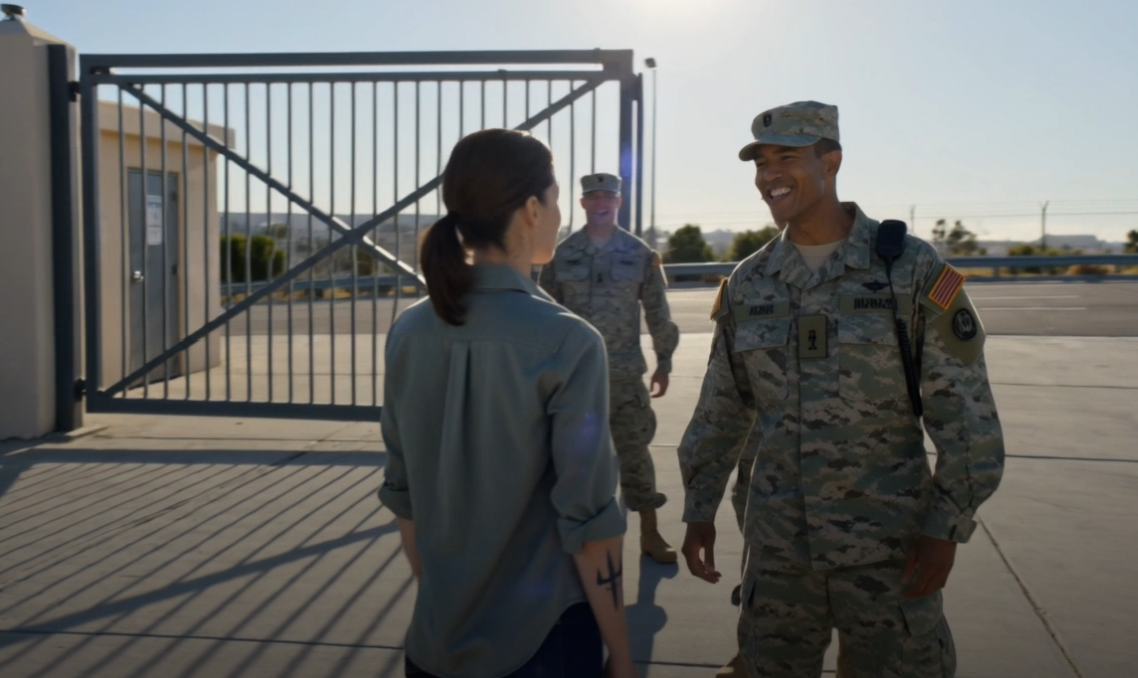
It wasn’t loud at first. Just low chuckles between young sentries who thought they had everything under control. The morning sun hit the steel gate at just the right angle, throwing long shadows across the checkpoint. Everything felt slow. Routine.
That illusion didn’t last.
Because standing there, calm and unmoving, was a woman who didn’t belong to their version of normal.
Sarah Mitchell didn’t raise her voice. She didn’t argue. She just stood there, hands relaxed at her sides, eyes steady, letting them talk.
The petty officer in front of her shifted his weight, trying to wear an authority that didn’t quite fit him yet.
“Ma’am, I’m going to need you to step aside,” he said, forcing firmness into his tone.
It sounded rehearsed. It sounded fragile.
Another sentry leaned in, smirking as he glanced at her arm. “That tattoo’s a bold choice,” he muttered, loud enough for everyone to hear.
The others laughed. A little more confident now. Feeding off each other.
Because once mockery starts, it grows fast when nobody stops it.
The tattoo wasn’t large. But it was precise. Inked clean. Unmistakable to anyone who actually understood what they were looking at.
A trident.
Not decorative. Not casual. Earned.
But to them? It was just something to joke about.
“Where’d you get that?” the petty officer asked, narrowing his eyes. “Internet special?”
Sarah’s gaze didn’t shift. “It belonged to my husband,” she said quietly.
The answer didn’t help her. It made things worse.
“Yeah?” the second sentry scoffed. “Let me guess – SEAL Team Six, right?”
The sarcasm hit hard. Another round of laughter. Someone behind them pulled out a phone, already recording.
Because humiliation always finds an audience.
“Sir,” one of the junior guards said hesitantly, “maybe we should just call this in – “
“No,” the petty officer cut him off. “We handle it here.”
Then back to Sarah, sharper now. “Stolen valor isn’t a joke, ma’am. You can’t just walk onto a base claiming something like that.”
“I didn’t claim anything,” she replied.
That calmness unsettled him. He covered it with irritation. “Then explain it.”
Before she could answer, the radio clipped to his shoulder crackled.
“Gate East, status?”
He grabbed it immediately. “Routine hold, Master Chief. Possible stolen valor situation.”
A pause.
“What name?” the voice asked.
He glanced at her, annoyed. “Sarah Mitchell.”
Another pause. Longer this time.
Too long.
“What is it, Master Chief? Did the inspection team arrive early?” a second voice murmured faintly in the background.
“No, sir,” the first voice replied, quieter now. Almost careful. “It’s Sarah Mitchell.”
Inside Naval Special Warfare Command, Commander Wayne Sterling straightened in his chair so fast his pen rolled off the desk.
The name hit him like something physical. Sharp. Immediate. Undeniable.
For a second, he didn’t speak.
“Brooks, I’m busy,” he finally said, though his voice had already changed. “Let security handle it.”
“Sir,” Brooks replied, firm now, “you’re going to want to come down here.”
That tone was enough. Brooks didn’t exaggerate. Ever.
Sterling stood. “What’s happening?”
“The sentries are giving her a hard time,” Brooks said. “They’re about to call MPs. They think it’s stolen valor.”
The words landed wrong. Completely wrong.
“Stolen valor… Sarah Mitchell?” Sterling repeated slowly.
“You heard me, sir,” Brooks said. “They’re mocking the trident.”
Something cold moved through Sterling’s chest. Then anger – sharp, controlled, dangerous.
He muted the line and turned to his aide.
“Lieutenant,” he snapped, “pull the service record for Master Chief Petty Officer Sarah Mitchell. EOD. Retired. Now.”
The young officer froze for half a second, then moved. Fingers flew across the keyboard. Screens shifted. Files opened.
“Sir…” the lieutenant whispered, his eyes widening.
Sterling didn’t look at him yet. “Confirm it.”
“I… I can’t find a full record,” the lieutenant said. “It’s restricted. Level – ” he swallowed, “—level black clearance.”
Sterling’s jaw tightened.
Because there were only a handful of people who ever got buried that deep.
And none of them were ordinary.
Back at the gate, the petty officer was losing patience.
“Ma’am, last chance,” he said, stepping closer. “Either you step aside, or we escalate this.”
Sarah didn’t move.
Didn’t blink.
Didn’t react.
That was the moment the air changed. Not loudly. Not obviously. But enough that the youngest guard took a step back without realizing it.
Because something about her silence didn’t feel defensive anymore.
It felt certain.
The radio crackled again. Louder this time.
“Do not detain her,” Brooks’ voice came through, sharper than before.
The petty officer frowned. “Say again?”
Footsteps echoed from inside the base. Fast. Controlled. Closing distance.
The gate guards turned.
Commander Sterling was already walking toward them. And he wasn’t slowing down.
He stopped three feet from the petty officer, ignored him completely, and looked straight at Sarah.
Then he did something none of them had ever seen a commander do at a checkpoint.
He saluted her first.
And what he said next made every single guard at that gate go pale.
“Master Chief,” Commander Sterling said, his voice clear and sharp as a rifle crack. “It’s an honor. Welcome back to the command.”
The silence that followed was absolute.
It was heavier than any sound they had ever heard. The smirks on the faces of the sentries didn’t just fade; they were wiped clean, replaced by a dawning, sickly horror.
The petty officer, whose name was Harrison, felt the blood drain from his face. His mouth went dry. He could feel the weight of the Commander’s gaze without him even looking.
Master Chief.
The title hung in the air, a word of profound respect. A rank achieved through decades of grit and leadership. A rank Harrison dreamed of one day reaching.
And this woman, who he had just accused of theft and lies, held it.
Sterling lowered his salute, his eyes still locked on Sarah’s. A flicker of something passed between them—a history, a shared understanding that went far deeper than rank.
“I apologize for the reception, Sarah,” he said, his tone softening just for her.
“They’re young, Wayne,” she replied, her voice still quiet, but now it held a different quality. It was the quiet of a deep, still ocean.
Sterling finally turned his gaze to Petty Officer Harrison. The anger was gone, replaced by something far more chilling: disappointment.
“Petty Officer,” he began, his voice dangerously low. “You stand at the gateway to a command that prides itself on acuity. On seeing what others miss.”
Harrison could only manage a choked, “Sir.”
“You saw a tattoo on a woman’s arm and you saw a joke,” Sterling continued, his voice cutting through the morning air. “I see Operation Nightfall. I see two of my men alive today because of the woman wearing it.”
He took a step closer to the young sailor. “You see stolen valor. I see the valor we could only hope to live up to. You saw a target for your ego. I see a hero.”
Each word was a physical blow. The other guards couldn’t look. The one who had been filming shoved his phone deep into his pocket, his hands trembling.
“You are dismissed,” Sterling said, not to Harrison but to the other two guards. “Report to Master Chief Brooks. He will be handling your remedial training in command etiquette.”
They practically ran.
Sterling turned back to Harrison, who stood frozen, like a statue of regret.
“You,” Sterling said, “will remain at your post. And you will think. You will think about what the uniform you wear actually represents. It is not a shield for arrogance. It is a symbol of service. A service she has given more to than you can possibly comprehend.”
He didn’t wait for a reply. He turned back to Sarah.
“Let’s go,” he said gently. “We have things to discuss.”
He personally escorted Sarah through the gate. As they walked, a hush fell over the parts of the base they passed. Sailors and officers stopped what they were doing. They saw their commanding officer walking stride for stride with an unassuming woman in a simple jacket, treating her not as a visitor, but as an equal.
The entire base went silent watching them pass.
In the sterile quiet of his office, the tension finally eased. Sterling closed the door and let out a long breath.
“I am truly sorry, Sarah,” he said again, pouring two cups of coffee from a pot that was always ready.
“It’s alright, Wayne,” she said, accepting a mug. “They’re just kids. They think strength is loud.”
She paused, looking at the black coffee. “They learn eventually that the strongest things are often the quietest.”
He nodded, leaning against his desk. “It’s been what, ten years?”
“Eleven,” she corrected softly. “Eleven years since that valley.”
Operation Nightfall. The name Sterling had mentioned at the gate. A name that didn’t exist in any official records available to the public. It was a ghost.
A ghost they had both survived.
“You said the tattoo belonged to your husband,” Sterling said, watching her carefully. “You never used to deflect like that.”
Sarah took a sip of her coffee, her gaze distant. “Daniel was a Marine Corporal. Not a SEAL. He was on perimeter security that night.”
She looked down at her arm, at the trident inked into her skin.
“When they asked me,” she said, her voice dropping, “I knew what they were thinking. So I gave them an answer they could understand, or so I thought. In a way, it does belong to him. Everything I did after he was gone… it was for him. To make his sacrifice mean something.”
Here was the first twist, unfolding quietly in the Commander’s office. The tattoo was not her husband’s. It was hers.
“I was EOD,” she stated, as if it was a simple fact. “Attached to your team. A special integration program they were testing.”
Sterling remembered it well. An EOD technician who could not only disarm any explosive but could also keep up with a SEAL team on infil, under fire, for days on end. There had only been a handful. Sarah was the best.
“That bomb in the culvert,” Sterling said, his voice now a low murmur. “It was rigged in three stages. Nobody had ever seen anything like it. We would have walked right into it.”
“Daniel’s squad spotted the trigger wire,” Sarah recounted. “He was the one who called it in. He gave us the warning.”
The memory was still sharp in both their minds. A moonless night in a hostile valley. The chilling quiet before the storm. Sarah on her stomach in the dirt, working by a pinprick of red light, her fingers disabling a device complex enough to wipe out an entire platoon.
Then the ambush began.
“He died giving us cover,” Sarah said. There was no tremor in her voice. Just a profound, enduring sadness. “He and two of his men held them back long enough for me to finish the job. Long enough for your team to get its bearings and fight back.”
The trident wasn’t just a mark of her own skill. It was a memorial. It represented the SEALs she saved, and the Marine she lost.
Sterling was silent for a long time. “I never knew how to thank you for that,” he finally admitted. “Or how to say I’m sorry about your husband.”
“You don’t have to,” she said. “We were all just doing our jobs. Surviving.”
She looked up at him, her eyes clear. “But that isn’t why you called me here, Wayne.”
This was the second twist. She hadn’t come unannounced. She had been summoned.
Commander Sterling nodded, his expression turning serious. He walked over to a filing cabinet, unlocked it, and pulled out a single folder.
“There’s a kid here,” he began, handing the file to her. “Specialist Adam Carter. He’s in the final phase of his training. Top of his class in every physical metric. But he’s failing.”
Sarah opened the folder. Inside was a picture of a young man with intense, angry eyes. Eyes that looked haunted.
“He’s falling apart,” Sterling explained. “Insubordination, fighting, shutting everyone out. His instructors think he’s a wash-out. A risk to any team he joins.”
Sarah looked up, her brow furrowed. “Why are you showing me this?”
Sterling pointed to a name on the next page of the file. Next of Kin. Father’s Name: Sergeant Frank Carter, United States Marine Corps.
Sarah’s breath caught in her throat.
“Frank Carter was one of the two men who died with Daniel,” she whispered, her fingers tracing the name.
“He was Adam’s father,” Sterling confirmed. “The boy grew up on stories of his heroic dad. He thinks the only way to honor him is to become the best of the best. To be a SEAL. But he’s choking on the pressure. He’s breaking under the weight of his father’s ghost.”
He looked at Sarah, his expression pleading. “I’ve tried. My best counselors have tried. We can’t get through to him. He just sees us as officers trying to manage him. But you… you were there. You knew his father.”
Sarah closed the file. She understood now. Her presence here wasn’t about her own past. It was about shaping someone else’s future.
“Where is he?” she asked.
Adam Carter was hitting a punching bag in the base gym, each blow landing with a furious thud. He was ignoring the instructor telling him his form was getting sloppy. He was just hitting, trying to exorcise the rage and grief that lived inside him.
“Carter!” the instructor yelled. “Take a break!”
“I’m fine!” Adam snarled back, not stopping.
Then he saw her. A woman he’d never seen before, standing near the door with Commander Sterling. He let the bag swing, breathing heavily, sweat dripping into his eyes.
Sterling gave a slight nod to Sarah and then walked away, leaving them alone.
Sarah approached slowly. She didn’t look intimidated by his anger.
“You’re Adam Carter,” she said. It wasn’t a question.
“Who’s asking?” he shot back, wiping his face with his shirt.
“My name is Sarah Mitchell,” she said calmly. “I knew your father. I served with him.”
Adam froze. His entire demeanor shifted. The anger was still there, but now it was mixed with a raw, vulnerable curiosity.
“You knew my dad?” he asked, his voice softer.
“I did,” she said. “We were in a godforsaken valley together on a very bad night.”
They sat on a bench, the sounds of the gym fading into the background. Sarah didn’t lecture him. She didn’t talk about his performance or his attitude.
She just told him about his dad. Not the hero from the citations, but the man. The man who told bad jokes when everyone was tense. The man who shared pictures of his little boy, Adam, with anyone who would look.
“He was so proud of you,” Sarah said. “He told me he just wanted you to grow up to be a good man. Happy.”
Adam stared at the floor, his fists clenched. “They told me he died saving a SEAL team.”
“He did,” Sarah said. “But that’s not the whole story.”
She rolled up her sleeve, revealing the trident. Adam’s eyes widened. He had spent his life dreaming of earning one.
“This is mine,” she said softly. “I was the mission. I was an EOD tech attached to that SEAL team. Your dad’s squad was protecting me while I worked on a bomb.”
She told him everything. How his father’s alertness saved them all from walking into a trap. How, when the firefight started, Frank Carter had deliberately drawn fire to himself to protect her position.
“He wasn’t just saving a SEAL team, Adam,” she said, her voice thick with emotion. “He was saving me. He gave his life so that I could finish my job. He saved every man on that team.”
Tears were now streaming down Adam’s face, mixing with the sweat. He had carried the weight of being a hero’s son for so long, he never once considered the real, human cost of it.
“I thought… I thought I had to be better than him,” he choked out. “Stronger. To prove it wasn’t for nothing.”
“Your father’s life was never for nothing,” Sarah said, placing a gentle hand on his shoulder. “Strength isn’t about being invincible, Adam. It’s about what you do for the person next to you. Your dad knew that. He taught me that.”
A profound change was happening in that young man’s soul. The anger was dissolving, replaced by a deep, heartbreaking, and ultimately healing understanding.
Later that day, Petty Officer Harrison was informed he was being transferred. But before he left, Commander Sterling had one final order for him.
He was to report to a small briefing room. When he entered, Sarah was there, waiting alone.
Harrison stood rigidly, unable to look her in the eye. “Ma’am,” he stammered. “I… I am so sorry for my conduct. There is no excuse.”
Sarah gestured to the chair opposite her. “Sit down, Petty Officer.”
He did, hesitantly.
“You know,” she began, her tone gentle, “my husband, Daniel… he was about your age when I met him. Full of fire. Cocky. Thought he knew everything. He wore his uniform like armor, too.”
Harrison finally looked at her, shocked.
“He learned,” she continued. “He learned that the uniform isn’t armor. It’s a responsibility. It’s about the people who can’t protect themselves. It’s about the teammates who trust you with their lives. It’s about humility.”
She didn’t raise her voice. She didn’t shame him. She was giving him a gift. A lesson paid for in blood and sacrifice, offered with grace.
“You made a mistake,” Sarah said. “Don’t let it define you. Let it teach you. Become the kind of leader who listens before he speaks. Who sees the person, not just the appearance. Be the man Daniel was becoming.”
When Harrison left that room, he was a different man. The arrogant boy who had guarded the gate that morning was gone. In his place was a humbled sailor who had been given a second chance.
Sarah left the base that afternoon. Sterling walked her to the gate, past a new set of guards who stood ramrod straight, their eyes filled with silent respect.
Petty Officer Harrison was there, finishing his last shift. As Sarah passed, he met her gaze and gave a slow, deliberate nod. A promise.
Weeks turned into months. Specialist Adam Carter didn’t just graduate; he was named Honor Man of his class. He stood tall, the anger in his eyes replaced with a quiet, confident purpose. He wasn’t living in his father’s shadow anymore. He was standing in his light.
On a different base, hundreds of miles away, an NCO watched as a young Petty Officer Harrison patiently and kindly gave directions to a lost-looking elderly couple, taking the time to make sure they knew exactly where to go.
True strength is not found in the noise we make, but in the quiet impact we have on others. It’s in the humility to learn, the grace to forgive, and the courage to carry the memories of those we’ve lost not as a burden, but as a guide to becoming better ourselves. Heroes are all around us, often hidden in plain sight, waiting not for recognition, but for a chance to help someone else find their way.