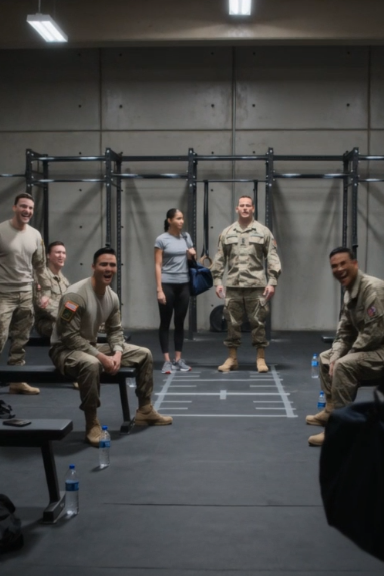
“Do you know who this woman is?”
Hale swallowed hard. “No, sir.”
Colonel Mercer’s eyes did not leave Olivia. The silence stretched until even the ventilation system seemed to hold its breath.
“That,” Mercer said quietly, “is a problem.”
He turned to face the room. Forty soldiers stood frozen in place, sweat cooling on their backs, every one of them suddenly aware of how loud their laughter had been thirty seconds ago.
“Sergeant Hale,” Mercer continued, “you’ve been running this readiness floor for how long?”
“Eighteen months, sir.”
“Eighteen months.” Mercer nodded slowly. “And in eighteen months, no one has shown you the photograph hanging in the Pentagon corridor outside General Whitaker’s office?”
Hale’s throat moved. “Sir?”
A private near the back made the mistake of shifting his weight. The squeak of his boot on the rubber mat sounded like a gunshot.
Olivia still had not moved.
She bent down, unzipped the duffel bag at her feet, and pulled out a single folded item. Not a uniform. Not a weapon.
A manila folder.
She held it out to Hale.
“You asked me to explain myself, Sergeant,” she said. Her voice was even. Almost gentle. “Go ahead. Open it.”
Hale’s hand trembled as he took it.
The young private who had made the yoga joke whispered, “Oh God.”
Hale opened the folder.
His face went white. Then gray. Then something worse than gray.
He looked up at Olivia, then at Colonel Mercer, then back down at the folder. His mouth opened. No sound came out.
“Read it aloud, Sergeant,” Mercer ordered. “Every man in this room is going to hear it.”
Hale’s lips moved. The first word cracked.
“This… this is an order from the Department of Defense. Effective immediately…”
He stopped. His hands were shaking too hard to hold the page steady.
Olivia took one step forward, took the folder back from him, and turned to face the soldiers who had laughed.
“My name is Olivia Kane,” she said. “And starting today, every single one of you reports to me.”
The silence broke into something else entirely when she added the next sentence.
“I am the civilian director of Project Nightingale. A program designed and initiated by my late husband, Captain Daniel Kane.”
The second she said his name, Sergeant Hale dropped to one knee right there on the training floor.
A choked sob escaped his throat.
Captain Daniel Kane wasn’t just a name. He was a legend in their circles.
A hero who had posthumously received the Medal of Honor for an action that saved his entire platoon, at the cost of his own life.
Sergeant Hale had served under him. Daniel Kane had been his mentor, his friend, the man he aspired to be.
The laughter of a few minutes ago now echoed in Hale’s ears as the sound of pure sacrilege. They had not just mocked a woman in civilian clothes.
They had mocked the widow of a man they all revered.
The young private, a kid named Miller, looked like he might pass out. He stared at Olivia, his mouth hanging open.
Colonel Mercer’s voice cut through the thick, soupy shame that filled the room. “Mrs. Kane is not just a name on a file.”
He let that sink in.
“She is one of the most brilliant strategic minds at DARPA. She co-authored every tactical doctrine your beloved Captain Kane ever put to paper.”
Mercer walked slowly around the frozen soldiers. “This project, Nightingale, was his life’s work. It was his vision for the future of special operations.”
He stopped in front of Hale, who was still on one knee, head bowed. “And now, it is his legacy. A legacy you just spit on.”
Hale flinched as if struck. “Sir…”
Olivia raised a hand. “That’s enough, Colonel.”
Her voice was quiet, but it carried the authority of the sun rising. It was not a request.
Mercer fell silent.
She looked at the men, her gaze sweeping over each face, lingering for a moment on Private Miller, whose face was now slick with tears.
“Stand up, Sergeant,” she said to Hale.
He rose slowly, his movements stiff, his face a mask of misery. He could not meet her eyes.
“The work starts tomorrow at 0500,” Olivia stated. “My husband believed this unit was capable of changing the world.”
She paused, letting the weight of her husband’s belief settle on their shoulders.
“Tomorrow, you will all begin the process of proving him right. Or proving me wrong.”
She turned without another word, picked up her duffel bag, and walked towards the exit.
Colonel Mercer gave them one last look, a mixture of disgust and disappointment, and followed her out.
The door clicked shut, leaving forty men in a silence more crushing than any reprimand.
The next morning, the air at 0445 was cold and sharp. The readiness floor was immaculate. Silent.
The soldiers stood in perfect formation, not a whisper among them. They had spent a sleepless night replaying their foolishness.
At precisely 0500, the door opened.
Olivia Kane walked in. She wore simple tactical pants and a plain black shirt. Her hair was pulled back.
She carried no clipboard, no folder. She just walked to the center of the room and looked at them.
“Project Nightingale is not about strength,” she began. “It’s not about how fast you can run or how accurately you can shoot.”
“Your files tell me you are the best at those things. My husband handpicked each of you for that reason.”
A few men shifted, a flicker of pride warring with their shame.
“But he chose you for something more. He believed you had the capacity for a different kind of strength.”
She began to pace slowly in front of them.
“Over the next eight weeks, we are going to find it. We are going to strip away everything you think makes you a soldier and find what makes you a guardian.”
Her training was unlike anything they had ever experienced.
There were no twenty-mile rucks. No live-fire drills. No screaming instructors.
Instead, she presented them with impossible ethical dilemmas.
She put them in simulated villages where the ‘enemy’ was an idea, not a person. They had to win hearts and minds, not firefights.
They spent hours learning languages, studying cultural customs, and practicing de-escalation with trained actors who pushed them to their breaking points.
Sergeant Hale struggled the most. His entire career was built on direct action, on being the hammer.
Olivia was asking him to be a surgeon’s scalpel, and his hands felt clumsy and useless.
He drove himself relentlessly, staying up late, studying the materials, trying to rewire his own brain. He was desperate to earn a forgiveness he knew he didn’t deserve.
One afternoon, Private Miller approached Olivia as she was packing up. His hands were clenched at his sides.
“Ma’am?” he said, his voice barely a whisper.
Olivia turned. “Yes, Private?”
“I… I just wanted to say… I’m sorry. For what I said. The yoga joke. It was stupid and disrespectful. There’s no excuse.”
Olivia looked at him for a long moment. Her expression was unreadable.
“Your apology is noted, Private Miller,” she said calmly. “But apologies don’t complete the mission.”
She continued, her voice softening just a fraction. “My husband didn’t choose you because you were perfect. He chose you because he believed you could learn.”
“Focus on learning,” she said. “That’s the only apology that matters now.”
Miller just nodded, his throat too tight to speak, and walked away with a new kind of purpose.
Weeks turned into a month. The unit was transforming.
They argued, they debated, they failed Olivia’s scenarios spectacularly at first. But slowly, they started to think differently.
They learned to listen more than they talked. They learned that the most powerful weapon they had was understanding.
One evening, Olivia found Hale alone on the training floor, staring at a projected map of a small, nondescript town.
“You look tired, Sergeant,” she said from the doorway.
He started, not having heard her approach. “Ma’am. Just reviewing the parameters for tomorrow.”
She walked over and stood beside him, looking at the map. “This one is difficult.”
“They’re all difficult,” he admitted.
There was a long silence.
“He talked about you, you know,” Olivia said softly.
Hale looked at her, confused. “Ma’am?”
“My husband. Daniel. He kept a journal. He wrote about the men he served with.”
She looked at Hale. “He said you were the most fiercely loyal soldier he’d ever known. He said you had the heart of a lion.”
Hale’s composure finally cracked. His eyes welled up. He had to look away.
“He also wrote,” she went on, “that your loyalty was sometimes a blind spot. That you protected your own so fiercely, you sometimes couldn’t see the bigger picture.”
Hale swallowed, the words hitting him with the force of truth. That was exactly what had happened. He had been protecting his men’s ‘fun,’ and in doing so, had led them all into disgrace.
“He believed you could learn to see it,” Olivia finished. “That’s why you’re here.”
Finally, Hale found his voice. “I will not let him down again, ma’am. Or you.”
It was a vow.
The final test came in the seventh week. It was a full-scale simulation that lasted for thirty-six hours.
The unit was inserted into a sprawling, complex role-play environment designed to replicate a town on the brink of civil war due to a water shortage.
Their mission was not to secure the well. It was to broker a lasting peace between the two rival factions.
Hale was the team lead. For hours, things went badly. Old habits died hard. His attempts at negotiation were seen as threats.
The situation was deteriorating. The actors playing the faction leaders were expertly trained, pushing every button.
The exercise controllers, watching on monitors, were ready to call it a failure.
Hale was in the simulated command post, head in his hands. His team was frustrated. They were soldiers, not diplomats.
Then, Private Miller spoke up. “Sergeant, maybe we’re looking at this wrong.”
Hale looked up.
“Mrs. Kane said it’s not about strength,” Miller said, remembering her words. “We’re trying to force a solution. What if we just… listened?”
Something clicked in Hale’s mind. He remembered Olivia’s words about his loyalty being a blind spot.
He had been focused on his mission, on the objective. He wasn’t seeing the people.
He took a deep breath. “You’re right, Miller.”
Hale went back out, unarmed, without his team. He approached the lead elder of the most hostile faction.
He didn’t make demands. He didn’t offer solutions. He just sat down and asked him to tell him his story.
For the next two hours, Hale just listened. He learned about the elder’s family, his history, the injustices his people had faced. He didn’t argue. He just nodded and acknowledged their pain.
It changed everything.
By showing respect and vulnerability, Hale had disarmed the situation more effectively than any weapon could. He wasn’t a conqueror; he was a guest.
Slowly, painstakingly, leveraging what he had learned from every member of his team who had been doing the same with other villagers, he built a bridge of trust.
By the end of the simulation, the two factions had agreed to a water-sharing schedule. Not because they were ordered to, but because they had been heard.
When the exercise ended, the training room was silent.
Olivia Kane stood before them. For the first time, a small, genuine smile touched her lips.
“Welcome to Project Nightingale,” she said.
That’s when the first twist, the one no one saw coming, came to light, shared not by Olivia, but by one of their own.
A quiet specialist named Dawson, a man who rarely spoke, stepped forward.
His voice was thick with emotion. “Ma’am… there’s something you should know.”
All eyes turned to him.
“Six years ago, in Helmand Province, my fireteam was pinned down. We were out of ammo, comms were down. We were gone.”
He paused, collecting himself. “Then, out of nowhere, a single soldier broke through the enemy line to reach us. He laid down covering fire, dragged our wounded to safety, and coordinated an evac.”
Dawson looked directly at Olivia. “That soldier was Captain Kane. He saved my life that day. I never got to thank him properly.”
He pulled something from his pocket. A worn, faded photograph. It showed a younger Dawson with his arm around a smiling Captain Kane.
“He talked about you the whole time we were waiting for the bird,” Dawson said, his voice cracking. “He called you his North Star. The one who made it all make sense.”
Dawson looked at Hale, then at the rest of the unit. “We didn’t just disrespect our commanding officer. We disrespected the woman who was the reason our hero was a hero in the first place.”
The weight of that revelation settled over them, heavier than anything before it. Daniel Kane wasn’t just Olivia’s husband. He was Dawson’s savior. He was part of their own story in a way they never imagined.
The project was finally deployed. It wasn’t to a warzone.
It was to a region in Southeast Asia devastated by a super typhoon. Infrastructure was gone. Aid groups couldn’t get in. Local factions, armed and desperate, were hoarding resources.
Nightingale wasn’t sent to fight them. They were sent to help them.
Using every skill Olivia had taught them, they made contact. They didn’t come in with guns drawn; they came in with water purifiers, medical supplies, and engineers.
Hale, the man who once saw every problem as a nail for his hammer, spent three days negotiating passage for a medical convoy through a check-point run by a suspicious local militia leader. He succeeded not with threats, but by sharing his own rations and a photo of his family.
Miller, the kid who made the dumb joke, used his new language skills to organize local volunteers, creating a distribution network that was more efficient than anything the overwhelmed NGOs could manage.
Dawson, fueled by the memory of the man who saved him, worked tirelessly to clear debris and rescue people trapped in the rubble, his actions inspiring hope in the terrified survivors.
They saved hundreds, maybe thousands of lives, not by taking any, but by proving that true strength was compassion, backed by capability.
On their last day, as they were preparing to leave, the village elder Hale had befriended came to see him.
He didn’t speak English, but he handed Hale a small, carved wooden nightingale. He placed his hand over his heart and bowed.
No medal or commendation could have meant more.
Back at the base, the unit gathered one last time on the readiness floor. The air was different now. It was easy, familial.
Olivia stood before them, a simple folder in her hand.
“The official report from the Department of Defense,” she said, tapping the folder. “Project Nightingale has been deemed an overwhelming success. It will be expanded. You are all being promoted and will serve as the instructors for the next generation.”
A quiet cheer went through the room.
“But that’s not what matters,” she said, putting the folder down.
She looked at them, her men. “My husband believed that the best of us could be more than just warriors. He believed we could be guardians. He wanted to leave the world better than he found it.”
Her eyes found Hale. “You did it. You honored his legacy.”
Later, as the men were celebrating, Hale found Olivia standing alone by the window, looking out at the setting sun.
“Ma’am,” he said softly.
She turned.
“I know it’s late,” he said, his voice full of a humility he hadn’t known months ago. “But I never properly… I am sorry. For my arrogance. For my judgment. For my failure on that first day.”
Olivia gave him a soft, sad smile. “You were right about one thing that day, Sergeant.”
He looked at her, confused.
“You said I didn’t look like I belonged here,” she said. “And I didn’t. I was just a grieving wife trying to hold onto the last piece of my husband. I was terrified.”
The confession hung in the air between them, a moment of profound, shared humanity.
“You and your men,” she continued, “you reminded me of him. In your strength, your loyalty… even in your flaws. You helped me finish his work. But in the process, you also helped me heal.”
She looked back out the window. “True strength isn’t about never falling. It’s about what we do after we’ve been knocked to our knees. It’s about having the grace to forgive, both others and ourselves.”
Hale stood there, realizing the journey wasn’t just about his redemption. It was about hers, too. They had, in their own broken ways, saved each other.
The lesson wasn’t just about judging a book by its cover. It was about understanding that everyone carries a silent story of love, grief, and purpose. And sometimes, the greatest honor you can give someone is to simply help them finish their chapter.