
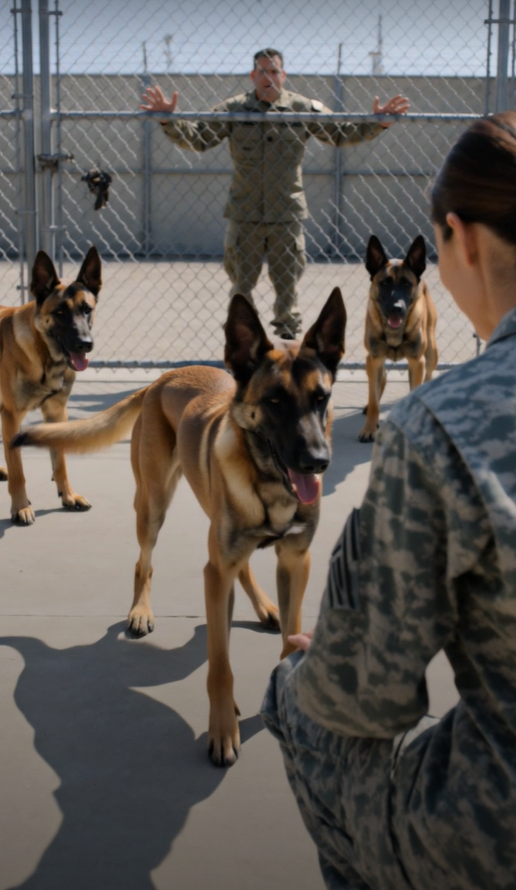
The gate slammed behind me with the kind of metallic finality that makes your spine understand something before your brain does.
Concrete pen. Chain-link fence. Four military working dogs spread across the far side like a tightening net. Ninety pounds each, all tendon and scar and bad patience. The late afternoon sun hit the steel hard enough to turn it white. I could smell hot metal, old bleach, and dog sweat baked into the concrete. Somewhere outside the enclosure a man laughed too softly, like he already knew how this ended.
I kept my hands loose at my sides.
Lieutenant Colonel Dominic Kesler stood at the fence with his jaw set so hard it looked painful. He had one palm flat against the chain link, wedding-band tan line still visible even though there was no ring on his finger. That detail stuck with me. Men like him always told on themselves in small ways first.
“Let her prove it,” he said.
The lead dog lunged.
I didn’t move.
I’d been on a flight sixteen hours earlier. I’d been pulled off a classified detail in Coronado and rerouted to this dust-bowl base in the middle of nowhere with no briefing, no contact, no reason. Just orders signed by a man I’d never heard of, demanding I report to Kesler for “evaluation.”
This was the evaluation.
Four dogs. One pen. A woman they didn’t think belonged in the uniform she was wearing.
The lead dog skidded to a stop six feet from me, hackles up, a low rumble building in his chest. His handler was nowhere in sight. That was the first thing wrong. The second was the muzzle hanging on the fence post – unused. The third was the look on Kesler’s face. Not concern. Not even cruelty.
Recognition.
He was staring at me like he’d seen a ghost.
The dog lunged again. I dropped to one knee, palm down, and made a sound low in my throat – three short clicks my father’s old training journal had taught me to make before I was old enough to read the words around them.
All four dogs froze.
The lead dog’s ears flicked forward. He took one step. Then another. Then he lay down at my feet and rolled, exposing his throat like he’d known me his whole life.
The pen went silent.
Kesler’s hand slid off the fence. His face had gone the color of wet paper.
“Where,” he said, and his voice cracked on the word, “did you learn that command?”
I stood up slowly. My heart was hammering so loud I was sure the dogs could hear it. Thirty-three years of questions. Thirty-three years of a mother who wouldn’t say his name. Thirty-three years of a single photograph and a journal written in a code I’d taught myself to read by candlelight when I was nine.
“From a dead man,” I said.
Kesler took a step back from the fence. His mouth opened. Closed. Opened again.
“Kira,” he whispered – and I had never told him my first name – “what was your father’s name?”
I said it. “Marcus Thorne.”
And that’s when Kesler reached into his jacket, pulled out a folded photograph that had clearly lived against his chest for decades, and handed it through the chain link with a hand that would not stop shaking.
I unfolded it.
And my knees almost gave out, because the man in the photo wasn’t just my father. He was young, impossibly so, with my eyes and my smile, a shadow of the man in the single photo I owned. But it was the second, smaller photo tucked behind the first that made the world tilt on its axis.
It was my father and Kesler. They were younger still, arms slung around each other’s shoulders in front of an old barracks, grinning like fools. They looked like brothers. On the back, in faded ink, it said, “Marc & Dom. Brothers in Arms. Brothers for Life.”
This wasn’t an evaluation. It was a summons.
“Get her out of there,” Kesler said, his voice raw. A handler I hadn’t seen before scrambled to unlatch the gate.
I walked out, my legs feeling like they belonged to someone else. The dog that had submitted to me, a big Belgian Malinois with a scar over his left eye, whined softly as I left.
Kesler didn’t look at me. He just started walking, and I followed him. We walked past hangars and silent training fields, the setting sun painting everything in shades of orange and purple. We didn’t speak until we were inside a small, sterile office with one window that looked out onto nothing but desert.
He shut the door, and the click of the lock seemed as final as the one on the dog pen.
“I’m sorry about that,” he said, finally meeting my eyes. “I had to be sure.”
“Sure of what?” I asked, my voice holding a tremor I couldn’t control.
“That you were his.” He gestured for me to sit. “That you had his gift.”
I stayed standing. “His gift was training dogs and getting killed in a routine exercise.”
The words came out sharper than I intended, a lifetime of bitterness packed into one sentence.
Kesler winced. “That’s the official story. It’s not the truth.”
I felt the air leave my lungs. All my life, the story of my father was a short, tragic book with most of the pages torn out. My mother would only say he was a good man who died serving his country. The details were a locked room I was never allowed to enter.
“The clicks you made,” he said, leaning against his desk. “Marcus developed that sequence. He called it the ‘trust signature.’ It wasn’t in any manual. He taught it to me, and only to me.”
“He put it in his journal,” I said quietly. “I found it when I was a kid.”
Kesler nodded slowly. “He was documenting everything. Smart. Always was.”
He looked out the window for a long moment. “Your father and I joined up together. We went through BUD/S together. He was the best K9 handler the Navy ever had. Not just a handler. He understood them. He connected with them on a level no one else could.”
“They called him ‘The Dog Whisperer,’” Kesler continued with a sad smile. “But it wasn’t a joke. It was awe.”
My own path to the SEALs, and my uncanny ability with military dogs, suddenly felt less like a choice and more like an echo.
“Why am I here, Colonel?” I asked, needing to cut through the fog of the past. “What happened to my father?”
Kesler’s face hardened. “He wasn’t killed in a training accident, Kira. He was murdered.”
The word hung in the air, heavy and ugly. My heart, which had been racing, seemed to stop altogether.
“He found something,” Kesler said, his voice dropping to a near whisper. “Something rotten right in the core of the program he helped build.”
He explained that Marcus had discovered a shadow operation. A high-ranking officer was using the most elite, specially trained dogs for illicit purposes. Not for smuggling drugs or weapons. It was far more sinister.
“They were smuggling intelligence,” Kesler stated. “Using the dogs to carry encrypted data drives past the highest levels of security. No one ever checked the dogs. They were invisible couriers.”
My father had figured it out. He’d noticed anomalies in the dogs’ transport logs and behaviors. He trusted his instincts, the same instincts that lived in me.
“He was going to expose the whole thing,” Kesler said. “He told me he had proof, a final piece he was securing. He was supposed to meet me the next day.”
“But he never showed up.” The words were a statement, not a question.
“No. The next morning, they told us there’d been an accident. A live-fire exercise gone wrong. Case closed.” Kesler slammed his hand on the desk, a burst of rage from a man who had clearly kept it bottled up for decades. “It was clean. Too clean.”
The man behind it all was General Wallace. Back then, he was a Major. He was ambitious, ruthless, and in charge of the K9 unit’s special deployments.
“Wallace submitted the accident report himself,” Kesler added. “And he got a promotion a month later.”
My world was cracking open, revealing a dark, hidden landscape. My father wasn’t the victim of a random accident. He was a hero who had been silenced.
“Why now?” I asked. “It’s been thirty-three years.”
“Because Wallace is about to retire,” Kesler said, his eyes locking onto mine with fierce intensity. “When he does, he’ll be a civilian. The military justice system won’t be able to touch him. And all the evidence I’ve been gathering will be useless.”
He had spent years trying to find the proof Marcus had mentioned, but Wallace was careful. There was nothing concrete, only whispers and suspicions.
“I’ve hit a wall, Kira. I’m too close to it, and everyone who might have helped is either loyal to Wallace or too scared to talk.” He took a breath. “Then, a few months ago, I was reviewing old files and I came across your father’s service records. It listed next of kin. A daughter.”
He’d followed my career from a distance. Watched as I, against all odds, became a SEAL. Heard the whispers about my own unusual talent with the K9s.
“I knew it had to be you. But I had to be sure. I couldn’t risk bringing the wrong person in. That’s why I staged the ‘evaluation.’ If you were just a good soldier, the dogs would have treated you with aggression. But if you were Marcus Thorne’s daughter…”
“I would have his signature,” I finished for him.
“And you did.”
We stood in silence, the weight of his revelation settling over me. This wasn’t just his fight anymore. It was mine. It was the answer to a lifetime of questions.
“What did my father write in his journal?” Kesler asked gently.
I thought back to the coded pages. To the years I’d spent deciphering them, thinking they were just advanced training techniques. I had memorized every line.
“It was mostly about conditioning and scent patterns,” I started, “but there was one section that never made sense. It wasn’t about dogs. It was coordinates, a date, and a name.”
Kesler leaned forward, his entire body rigid with anticipation. “‘Cerberus,’” I said.
A flicker of recognition crossed his face. “Cerberus. That was the name of my father’s prize dog. The one he was with when he died.”
“The date is two days from now,” I continued. “And the coordinates… they’re here. On this base.”
Kesler went to a map on the wall and I read the numbers aloud. His finger landed on a remote, decommissioned storage bunker on the far edge of the base.
“Bunker 7,” he breathed. “It’s been sealed for years.”
My father’s last message wasn’t just a clue. It was a breadcrumb trail left for someone who could read the map. He hadn’t just been documenting Wallace’s crimes; he had hidden the proof.
“Wallace must be planning to retrieve whatever is in there before he retires,” Kesler reasoned. “Clean up the last loose end. The date in the journal must be the day he plans to do it.”
“So we stop him,” I said. It was that simple.
The next two days were a blur of quiet planning. Kesler used his authority to get us access to surveillance schematics of the base. We couldn’t go in with a full team; Wallace had eyes and ears everywhere. It had to be just the two of us.
The night of the operation was cold and clear, the desert sky littered with stars. We moved like ghosts along the perimeter fence, the silence broken only by the crunch of gravel under our boots.
Bunker 7 was exactly as Kesler described it: a concrete monolith half-buried in the sand, its steel door rusted and imposing. A single new, high-tech lock gleamed under the moonlight. Wallace had been here recently.
“He’ll have to disable the perimeter sensors,” Kesler whispered. “That’s our window.”
We waited. Minutes felt like hours. Then, a small light on our borrowed sensor detector blinked off. He was here.
A dark SUV rolled to a stop fifty yards away, its headlights off. General Wallace got out, accompanied by two men in tactical gear. They moved with a chilling efficiency toward the bunker door.
As one of his men worked on the lock, Wallace spoke. “Final sweep. Make sure we leave nothing behind. Corporate is getting antsy.”
Corporate. So this was bigger than just military intelligence. He was selling secrets to a private entity.
The massive bunker door groaned open. Wallace and one of the men went inside, while the other stood guard outside.
“Now,” I whispered.
Kesler nodded. He moved to flank the guard from the right, while I went left. It was over in seconds. A swift, silent takedown. We secured the guard and took his radio.
We crept to the entrance of the bunker. Inside, beams from flashlights cut through the darkness. We could hear Wallace giving orders.
“Find the crate marked ‘Project Cerberus.’ It should be in the far-left corner.”
We moved into the cavernous space, using old equipment racks as cover. I could smell the same scents as in the dog pen: old concrete, metal, and something else… the faint, familiar scent of a K9.
Then, from the darkness, a low growl echoed.
Wallace chuckled. “Ares, quiet boy.”
My blood ran cold. Crouching behind a stack of crates, I peered through a gap. There, standing beside Wallace, was the Malinois from the pen. The one with the scar over his eye. The one who had submitted to me.
He was Wallace’s personal dog. He must have been a direct descendant of my father’s dog, Cerberus, bred from the same legendary line.
“The drive is here,” the other man said, pulling a small, metal box from a crate.
“Good,” Wallace said. “Wipe the crate, then let’s go. And let’s make sure our little insurance policy is ready.” He patted Ares on the head. “No one will get near us with him on watch.”
That’s when Kesler made his move. “It’s over, Wallace.”
He stepped out from behind a rack, his weapon leveled. Wallace spun around, his face a mask of shock that quickly hardened into fury.
“Kesler. You always were a dog sniffing after scraps.” He subtly moved his hand to a button on a small remote. “You shouldn’t have come here.”
He pressed the button. “Ares. Get him.”
But I was already moving. I stepped into the light, placing myself between Kesler and the dog.
The Malinois hurtled forward, a blur of muscle and teeth. But he wasn’t looking at Kesler. He was looking at me.
I didn’t raise a weapon. I didn’t even flinch.
I just dropped to one knee, put my palm down, and made the sound.
Three short, soft clicks.
Ares skidded to a halt, just as he had in the pen. His ferocious snarl died in his throat, replaced by a confused whine. His ears flicked back and forth. He looked from me to Wallace, his intelligent eyes filled with conflict.
He was remembering. Not just the pen. He was remembering a command embedded in his very bloodline. A command passed down from his ancestor, Cerberus. From my father.
“What are you waiting for? Attack!” Wallace screamed, his voice thin with panic.
Ares took a step toward me. He lowered his head and licked my outstretched hand. Then, he turned. He faced Wallace, and for the first time, he let out a true, guttural growl. A sound of betrayal.
In that moment, everything became clear. The dog wasn’t just a tool; he was the legacy. He was the final piece of my father’s plan. The proof wasn’t just in the bunker; it was standing right in front of us. A dog trained by a hero would never serve a villain.
Wallace, seeing his control shattered, pulled a sidearm. But he was too late. The dog’s defiance had created the only opening we needed. Kesler and I moved as one. Before he could even aim, he was disarmed and on the ground.
It was all there. The drive with the stolen intelligence, Wallace’s confession on the guard’s open radio comm, and a witness who couldn’t be bribed or threatened: a dog who chose loyalty and honor over a command born of corruption.
In the end, my father’s name was cleared. He was posthumously awarded the Navy Cross for his bravery. The story of what he uncovered, and how he laid a thirty-year-old trap for the man who wronged him, became a quiet legend in the SEAL teams.
Kesler retired a few months later. He gave me the photo of him and my father, the real one. “He would have been so proud of you, Kira,” he told me, his voice thick with emotion.
I didn’t stay on the front lines for much longer. I found my new purpose. I took over a special program for training the next generation of K9s and their handlers, building on the foundation my father had laid. I even adopted Ares, the dog who helped close the final chapter. He lived out his days sleeping at the foot of my bed.
I learned that legacy isn’t something you’re given in a will or a photograph. It’s not a name or a story you’re told. It’s the strength and integrity that runs in your blood. It’s the invisible thread that connects you to those who came before you, guiding you to become the person you were always meant to be. My father gave me more than his eyes or his smile; he gave me his spirit. And it was that spirit which finally brought him home.



