
“State your name.”
The order cracked across the rifle range like a gunshot.
Every head turned.
Mine didn’t.
Under the brutal Arizona sun, I kept my eyes on the rifle parts laid out in front of me. My hands moved the way they always had. Calm. Practiced. Like muscle memory that refused to die, even when the man it belonged to was supposed to be six feet under.
Behind me, boots scraped against the gravel. Not one pair. Several. The kind of footsteps that belonged to men who expected the world to straighten its spine before they arrived.
“Look at me when a superior officer is speaking to you.”
Still, I didn’t look up.
Because the second I did, twelve years of silence were going to come apart at the seams.
I fitted the last component into place.
Click.
“Sir,” I said quietly, “if you don’t know my name, you shouldn’t be standing on my range.”
Someone behind him let out a stunned laugh. The young lieutenant in the back was smirking like this was about to be his favorite story at the officer’s club.
He had no idea who he was looking at.
Slowly, I stood. I turned.
Major General Preston Blackwell stood directly in front of me. Silver at his temples. A wall of ribbons across his chest. The same cold eyes I’d last seen through a scope twelve years ago, the night he gave the order that was supposed to bury me in a valley outside Kandahar.
He didn’t recognize me.
Not yet.
“That lane was recalibrated three months ago using the wrong wind variance,” I told him. “Your scope tables are outdated. Your shooters are compensating wrong by point-three mils at distance.”
The lieutenant scoffed.
“And who,” Blackwell said, each word clipped, “are you to be correcting my installation?”
I straightened fully.
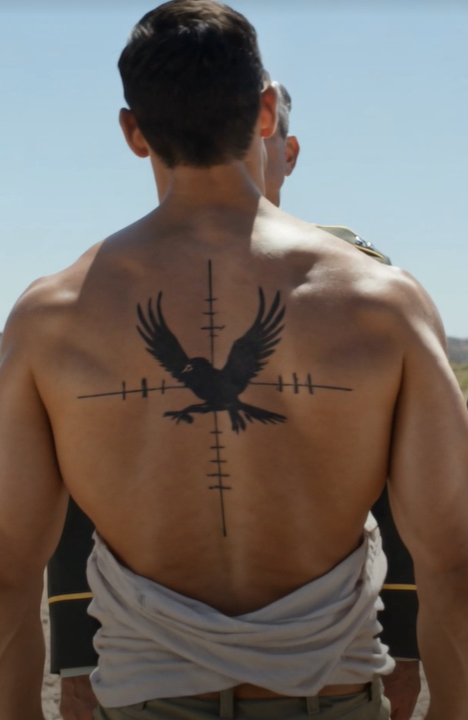
The movement pulled the fabric of my tank top across my back.
That was when he saw it.
The tattoo.
A black sniper’s crosshair wrapped around a raven in flight. Coordinates threaded through its wings. The same coordinates of the valley he’d left me to die in. The same mark every man in my unit had carved into his skin the night before the mission Blackwell sold out.
The color drained from his face.
The lieutenant’s smirk faded. “Sir…?”
No answer.
Blackwell’s lips moved before the sound came out.
“That’s not possible…”
I took one step closer. Close enough that only he could hear me.
“You’re right, sir,” I said softly. “It isn’t. Because according to your own report, you buried me yourself.”
His knees buckled half an inch. Just enough.
I leaned in, my voice barely above the wind.
“And the other four men you left in that valley? They didn’t all die either. Two of them are already inside this base. One of them is standing behind you right now.”
Blackwell’s eyes went wide.
He turned around slowly.
And when he saw which one of his “trusted” officers was staring back at him, the General did something I’d waited twelve years to watch him do.
He froze.
The young man with the smirk, Lieutenant Samuel Miller, was no longer smirking. His expression was a flat, cold mask of discipline. But his eyes burned with a fire that had nothing to do with military decorum. They were fixed on Blackwell.
“Miller?” Blackwell rasped, his voice a dry whisper.
“Sir,” Miller replied, his tone perfectly level. Yet the word hung in the air like an accusation.
Blackwell looked frantically between me and his aide. The pieces were clicking into place in his mind, but they were forming a picture he could neither accept nor deny. The world he had built for himself over the last decade was crumbling right here on the hot gravel of a training range.
“What is the meaning of this?” he blustered, trying to regain some shred of authority. “Sergeant, I don’t know who you are, but you and this lieutenant are on the verge of…”
“My name is Elias Vance,” I cut him off, my voice calm but firm. “I was Sergeant Elias Vance, Team Lead, Raven Unit. You signed my death certificate, sir. Along with four others.”
“It’s a mistake… a coincidence,” he stammered, looking at my tattoo again, then at Miller’s unreadable face.
“It’s no coincidence, General,” Miller said, his voice dropping low. “My older brother was Sergeant Robert Miller. He was on that team. You sent him there.”
The last bit of bravado evaporated from Blackwell’s posture. He looked like an old man, suddenly lost and terrified. The ribbons on his chest seemed to weigh him down physically.
“We need a more private place to talk,” I said. It wasn’t a request.
I glanced over his shoulder, toward the communications building a hundred yards away. In a second-story window, a man stood watching. He was dressed in a civilian contractor’s polo shirt, but the way he held himself was military. He gave a slight, almost imperceptible nod.
That was Marcus Thorne. Our tech genius. Our other ghost.
Blackwell followed my gaze, but saw nothing. He was too consumed by his own panic.
“This way, sir,” Miller said, gesturing toward a service vehicle parked nearby. The politeness in his tone was more menacing than any threat.
The General, a man who commanded thousands, had no command here. He was a prisoner, and he knew it. He stumbled toward the vehicle, his polished boots kicking up dust.
I got in the back with him. Miller drove.
The silence in the truck was thick and heavy. Blackwell just stared out the window, his reflection showing a pale, drawn face. I watched him, feeling not the hot rage I had expected for twelve years, but a cold, quiet finality.
We didn’t drive toward the main base headquarters. Miller took a turn down a forgotten service road that led to a decommissioned storage bunker, half-buried in the side of a dusty hill.
Marcus was waiting for us at the heavy steel door. He pushed it open and stood aside.
As Blackwell was herded inside, he finally looked at Marcus, truly looked at him. He saw the same quiet intensity that was in my eyes. The look of a man who had been through hell and come back with a purpose.
“Thorne,” Blackwell breathed. “You were the comms specialist.”
“Still am,” Marcus said, his voice flat. He closed the heavy door behind us. The sound echoed in the cavernous space, a definitive clang that sealed our little world off from the one outside.
The bunker was mostly empty, save for a single metal table and four chairs under a bare, flickering bulb. It smelled of dust and rust and secrets.
“Sit down, General,” I said, pointing to one of the chairs.
He obeyed without a word. He sat, hunching his shoulders as if expecting a blow.
Miller, Marcus, and I took the other three chairs, forming a triangle around him. The trial that had been deferred for twelve years was finally in session.
“You sold us out,” I began, my voice even. “Operation Nightingale. Five men. A high-value target in a fortified valley. You gave us the intel, you drew the mission parameters, and you promised us exfil.”
I leaned forward. “Then you gave our exact route and position to a rival warlord. An offering. A way to clear a path for your preferred asset in the region.”
Blackwell flinched. “You don’t understand the larger strategy. It was a necessary sacrifice.”
“A sacrifice?” Marcus shot back, his calmness finally cracking. “Five men isn’t a sacrifice. It’s a betrayal. Robert and David were cut down in the first thirty seconds. They never even had a chance to fire back.”
He pointed a finger at Blackwell. “You didn’t just leave us. You actively fed the ambush. We have the decrypted communiques. The ones you thought were erased from the archive.”
That’s when true fear entered Blackwell’s eyes. This wasn’t just about men he thought were dead showing up. This was about evidence.
“I watched Robert die,” Miller said, his voice thick with a grief that twelve years hadn’t managed to dull. “I was seventeen. The casualty assistance officers came to our door. They handed my mom a folded flag and told her he died a hero. They didn’t tell her his commanding officer traded his life for a promotion and a glowing performance review.”
Blackwell tried to speak, but no words came out.
I took over. “The ambush was brutal. But they miscalculated. They wanted prisoners. They took me, Marcus, and David Chen alive. What followed… was not quick.”
I didn’t need to give him the details. The scars on my arms and the haunted look that never quite left Marcus’s eyes told enough of the story.
“We were held for two years,” I said. “Two years in a hole in the ground. David… he didn’t make it past the first winter. He got sick. We begged for medicine. They just laughed.”
“We escaped during a raid by another faction,” Marcus continued. “Made our way east. It took us six months to cross the mountains into Pakistan. We had no country, no support. We were ghosts. The army we served thought we were buried in a mass grave you personally ‘discovered’ and ‘repatriated.’”
The heroism of General Blackwell, who braved enemy territory to bring his fallen men home. It was the story that had cemented his first star. A story built on empty caskets and lies.
“When we finally made it back to friendly territory, we had a choice,” I said. “We could report what happened. But who would believe us? Two broken men, officially dead, against a rising star General? Our files were sealed. Our records, gone.”
Blackwell looked up, a flicker of hope in his eyes. He thought we had nothing.
“So we made a different plan,” Marcus said with a cold smile. “We decided to stay dead. I used my skills to create new identities. Elias became ‘Al Vance,’ a civilian firearms instructor with an impeccable, if fabricated, record. The Army loves hiring experienced civilian contractors. It was easy to get you on this base, Eli.”
“And I became ‘Marcus Jones,’ a low-level IT contractor,” he added. “You know, the kind of guy nobody ever notices, who has access to everything. Servers. Encrypted files. Personal emails. Financial records. It’s amazing what you can find when you know where to look.”
The hope in Blackwell’s eyes died, replaced by utter dread.
“And me?” Miller said. “After Robert died, all I wanted was to find the person responsible. I joined the Army. I excelled. I made it my life’s mission to get close to you. I requested to be your aide. You saw a sharp, ambitious young officer. You had no idea I spent every night looking at a picture of the brother you murdered.”
The trap wasn’t something we’d sprung today. It had been closing around him for years, slowly, patiently, meticulously.
We weren’t here for a confession. We already had all the proof.
“For twelve years, you’ve been building a career on the bones of my team,” I said, my voice dropping to a near whisper. “Kandahar was just the beginning, wasn’t it? There were others. Other ‘necessary sacrifices.’ Other deals made in the dark.”
Marcus slid a slim tablet across the table. He tapped the screen.
It showed a list of file names. Dates. Coded operation names. Bank transfers to offshore accounts. Blackwell’s entire sordid history, laid bare.
“This is everything,” Marcus said. “Your entire house of cards, Preston.”
Using his first name was the final indignity. The final stripping of his rank and power.
He stared at the screen, his breath coming in ragged gasps. He was broken. The powerful General was gone, leaving only a weak, cornered man in his place.
“What do you want?” he finally choked out. “Money? Do you plan to kill me?”
I almost laughed. “Kill you? That’s your solution, not ours. That would make us no better than you. No, we want justice. The real kind. The kind that lasts.”
I leaned back, and the three of us just looked at him, letting the weight of his crimes press down on him in the silence of the bunker.
“You have two options,” I said finally, laying out the end game.
“Option A: We release all of this.” I tapped the tablet. “Every file, every decrypted message, every bank statement. We send it to every major news outlet and the Inspector General’s office. You’ll be publicly disgraced. Court-martialed. You will spend the rest of your life in a cell at Leavenworth, remembered as one of the greatest traitors in modern military history. Your family’s name will be mud. Forever.”
He visibly shuddered.
“Or,” I continued, “there is Option B.”
“You are going to write and sign a full confession. Not just about us. About everything. Every dirty deal, every life you traded for your own advancement. You will detail the corruption you know about, the names of your co-conspirators. Everything.”
“That confession will be delivered by us to two people: a journalist we trust, and a senator on the Armed Services Committee who still believes in the word ‘honor.’”
“Then,” I said, leaning in, “you will submit your immediate resignation, citing ‘severe and sudden health concerns.’ You will disappear. You will relinquish a significant portion of your illicit fortune to a fund we have established for the families of the soldiers you betrayed. Not just our team, but all of them.”
“The confession will be our insurance. If you ever resurface, if you ever try to deny it, it gets released. If you cooperate, the full truth will come out in a controlled way, through the senator, ensuring the right people are held accountable without tearing down the institution for the sake of one rotten apple. Your name will simply fade into obscurity, a quiet retirement. Your family will be spared the public shame.”
He slumped in his chair. It was checkmate. We hadn’t come for revenge. We had come for accountability. We weren’t destroying a man; we were demanding he fix the damage he had done, in the only way that now mattered.
“You honor the dead by telling the truth,” I said quietly. “Not by creating more graves.”
He looked from my face, to Marcus’s, to Miller’s. He saw no hatred. Just a profound, weary certainty. We weren’t monsters. We were the consequences of his actions, delivered with a clarity he couldn’t escape.
His shoulders sagged completely. The fight was gone.
“I’ll do it,” he whispered. “Option B.”
Marcus produced a pen and a stack of papers.
For the next hour, under the humming light of the bunker, Major General Preston Blackwell, a man who had commanded armies and decided the fates of nations, did as he was told. He wrote, his hand shaking, as the ghosts of his past stood watch.
When he was done, he looked smaller, emptier. A shell.
Miller took the signed papers. “I’ll escort you back to your office, sir. You can draft your resignation.”
The “sir” was pure formality now. A final twist of the knife.
Blackwell stood up and walked to the door like a man in a dream. He didn’t look back.
After they left, Marcus and I sat in silence for a long time. The weight of twelve years was finally beginning to lift. It wasn’t a feeling of triumph. It was just… quiet. The absence of a heavy burden.
“It’s over, Eli,” Marcus said softly.
“It’s over,” I agreed.
A few months later, I was standing in a small, quiet corner of a national cemetery. I wasn’t there as a visitor. I was there as a brother.
I had used some of my back pay, which had been quietly reinstated, to place a small, simple memorial stone. It wasn’t official, just a polished piece of granite tucked under an old oak tree.
It had three names on it.
Robert Miller.
David Chen.
And a third name. The fifth member of our team, whose fate we never knew for sure after the ambush. We had to assume the worst.
I ran my hand over the etched letters. The news had broken a week ago. General Blackwell had retired. An investigation, spurred by a confidential informant and a brave senator, was quietly cleaning house. The story of what really happened in that valley was now part of a sealed but official record. Justice was being served, not with a bang, but with the slow, grinding gears of truth.
My phone buzzed. It was a message from Marcus. A bank notification.
“The fund is active. First payments went out to the families this morning.”
A wave of emotion washed over me, so powerful it almost buckled my knees. It wasn’t rage. It wasn’t sorrow. It was peace.
Twelve years we had carried the fire of revenge, but somewhere along the way, we had realized that fire would only consume us, too. We had chosen a harder path. We chose to carry the heavy weight of justice instead.
Because true strength isn’t about how you repay a wrong. It’s about how you make things right. It’s about ensuring that the memory of the fallen is honored not with more bloodshed, but with a truth that is finally allowed to see the light of day.
Looking at the names on that stone, under the quiet shade of the oak tree, I finally felt the mission was complete. The ghosts of Kandahar could finally rest. And so could I.



