
“Watch your mouth,” Brooks snapped. Then the monitor flashed, and every laugh on the range died.
“Tell me, sweetheart – what’s your rank?”
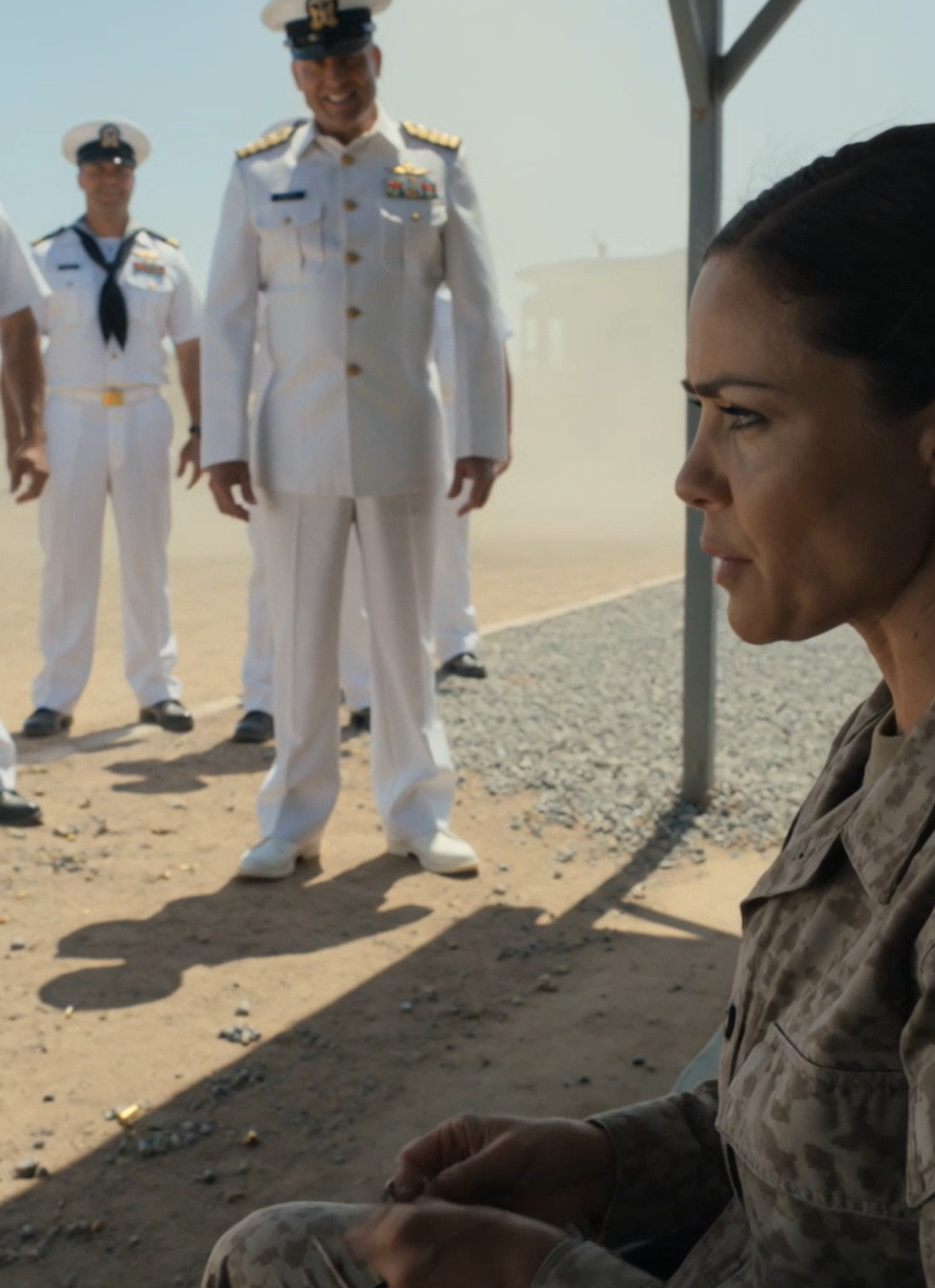
Admiral Victor Kane didn’t break stride. His boots crunched gravel as his voice cut across the firing line, edged with quiet contempt. Behind him, six naval officers were already laughing before the insult fully landed.
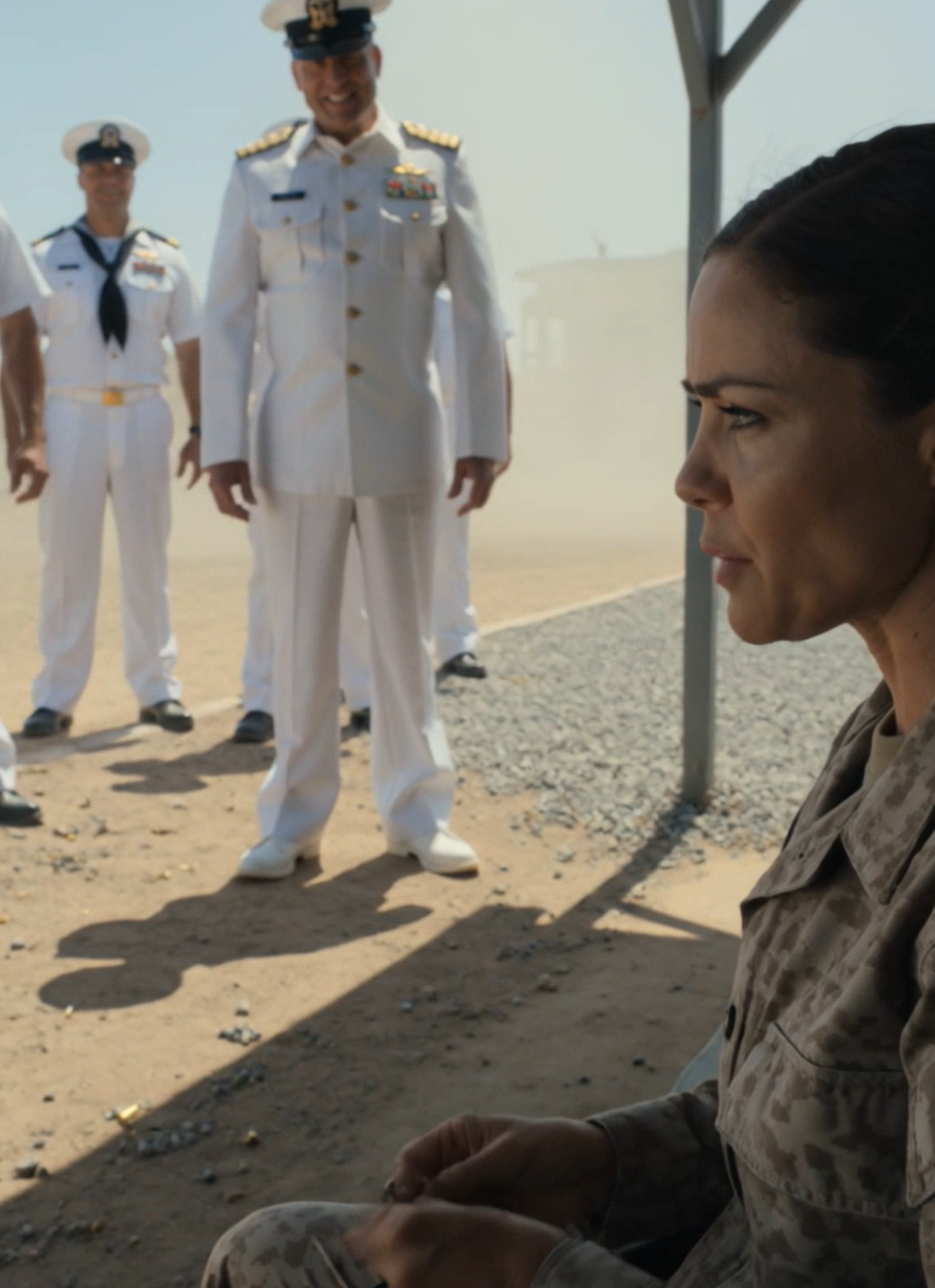
In the strip of shade beside the supply shed, the woman didn’t look up.
The rifle lay in pieces across her lap. Bolt separated. Barrel resting against her thigh. Her hands moved with the kind of precision that doesn’t come from training – it comes from repetition so deep the body forgets it’s working.
Fort Davidson baked under a brutal Arizona sky. Brass casings glinted in the dust. Diesel engines rumbled near the berm. Marines laughed too loud somewhere to the left. The air smelled of solvent, hot metal, and sweat.
But she was still. Unnaturally still. As if she’d stepped outside the rhythm of every living thing on that range.
That stillness was what slowed Kane down. Not the missing insignia. Not the worn fatigues. The stillness.
He turned to his officers, smirking. “Or are you just here to polish ours?”
The laughter came easier this time. Louder. Crueler.
She didn’t react. Not until the silence stretched a beat too long.
Then, slowly, she lifted her eyes.
Kane expected embarrassment. Or anger. Or the brittle panic of someone caught where they didn’t belong.
He got none of it.
Her eyes were gray. Storm-gray. And unnervingly calm.
She set the bolt down on the cloth beside her. Wiped her fingers, one by one. And when she finally spoke, her voice was so quiet that Kane had to lean forward to hear it.
“Admiral Kane,” she said softly, “do you remember Kandahar, 2011?”
The smirk on his face froze.
Behind him, Brooks’s radio crackled – and a voice from Command came through that made every officer on that line snap to attention.
But it was what she pulled out of her jacket pocket next that made Admiral Kane’s knees go weak right there in the dust.
Hanging from her index finger, twisting slowly in the dead desert air, was a single, battered dog tag.
It wasn’t hers.
Kane knew that tag. He knew the dent near the top hole. He knew the faint scratch that ran through the stamped name.
The name was Sergeant Marcus Thorne. A ghost.
A ghost Kane himself had created.
The radio static cleared, and a stern, impossibly high-ranking voice filled the silence. “Admiral Kane, this is General Peterson’s office. Can you confirm your delegation is on site at Fort Davidson?”
Brooks, his face suddenly pale, fumbled for his radio. “Yes, sir. Affirmative. We are… we are on the firing line.”
There was a pause. The voice came back, laced with ice. “Then can you explain to me why you are interrupting the work of our civilian consultant?”
Consultant. The word hung in the air, heavy and strange.
All six of them turned to look at the woman. At the quiet ‘mechanic’ in the shade.
She paid them no mind. Her gray eyes were locked on Kane, watching the color drain from his face.
She let the dog tag swing. Once. Twice.
“He asked me to give this back to you,” she said, her voice still a whisper. “Said you’d know what it meant.”
The memory hit Kane like a physical blow. Kandahar. A dusty village nested in a valley of death. A mission he commanded from the safety of an air-conditioned tent miles away.
He had a Seal team pinned down. A sniper team providing overwatch from a ridge. Team callsign: Ghost. Sergeant Thorne was their spotter. She was their sniper.
Intel said a high-value target was in the village. But the situation deteriorated fast. An ambush. A hornet’s nest.
The request came through for air support. A simple gun-run. A ten-minute pass that would have given Ghost team the cover they needed to extract.
Kane had looked at the assets map. Looked at his promotion packet sitting on his desk. A friendly fire incident, even a justified one, would be a black mark. A career killer.
So he’d hesitated. He’d asked for more confirmation. He’d delayed.
He’d made a choice.
He’d called off the air support, citing “unclear target identification” to cover his tracks. He had sacrificed the team on the ridge for the sake of a clean record.
The official report listed them as KIA. Lost to enemy action after their comms went dead. A tragic but unavoidable loss.
Kane got his promotion.
Now, standing in the Arizona sun, the sole survivor of that ‘unavoidable loss’ was looking right through him.
“You’re dead,” he breathed, the words escaping without his permission.
A flicker of something – not quite a smile—touched her lips. “Reports vary.”
She tucked the dog tag back into her pocket as if it were a grocery receipt. The casualness of the act was more chilling than any threat.
Brooks and the other officers stood frozen, realizing the catastrophic mistake they had just made. They weren’t just mocking a random woman. They were mocking a ghost with a direct line to the top brass.
One of the younger officers, a lieutenant with more ambition than sense, tried to salvage the situation. “Ma’am,” he stammered, stepping forward. “On behalf of Admiral Kane, we deeply apologize for any misunderstanding.”
She didn’t even glance at him. Her focus was a laser beam pointed at Kane.
“The rifle you’re here to evaluate,” she said, nodding toward the range. “The XM-500. It has a new targeting system. Advanced optics with thermal overlay and distance calculation that syncs directly with command.”
Kane swallowed, his throat dry as dust.
“It can lock onto a heat signature from three klicks away,” she continued. “Even through a sandstorm. It transmits a live feed. There’s no such thing as an ‘unclear target’ with this in the field.”
The unspoken accusation was deafening. This was the technology that would have saved them. The proof that their deaths were preventable.
“Why are you here?” Kane finally managed to ask, his voice hoarse.
“They brought me in to help with the final field tests,” she answered simply. “I know what it’s like when a scope fogs up. Or when the wind changes half a klick out.”
She paused, picking up the rifle’s barrel and inspecting it for imperfections. “And I know what it’s like to listen to your team die on the radio while a man who has never seen a day of combat decides your life isn’t worth his next star.”
The silence on the firing line was absolute. The rumbling engines, the distant shouts, the very hum of the desert seemed to have ceased.
Kane felt the weight of six pairs of eyes on his back. His men. His entourage. They had heard it all.
His legacy, his carefully constructed career of honor and decisive action, was crumbling into dust right here, next to a supply shed.
He could deny it. He could bluster and threaten her with an official inquiry. He could ruin her, whoever she was now. His rank still gave him that power.
But looking into her storm-gray eyes, he saw no fear. She wasn’t there for revenge. She was there for something far more devastating.
She was there for justice.
“I need to speak with you,” Kane said, his voice flat. “Alone.”
She looked up from the rifle parts, considering his request. “The demonstration is in thirty minutes, Admiral. You’ll be in the observation tower.”
“Not about the rifle,” he insisted.
She finished cleaning the last component and began reassembling the weapon with an economy of motion that was almost hypnotic. Click. Snap. Slide.
“Everything that needs to be said was said a decade ago over a crackling radio,” she replied without looking at him. “You just weren’t listening.”
She stood up, the reassembled rifle held loosely in one hand. She was shorter than he’d imagined, but she cast a shadow that seemed to stretch all the way back to that ridge in Kandahar.
Without another word, she walked away, leaving Kane standing there with his six silent, shame-faced officers.
Brooks finally found his voice. “Sir… what do we do?”
Kane didn’t answer. He turned and walked toward the observation tower, each step feeling heavier than the last. He knew he was walking toward a reckoning.
Inside the cool, dim tower, monitors displayed a dozen different angles of the firing range. The woman—he still didn’t even know her name—was on the line, prone in the dust, the XM-500 resting on its bipod.
A technician in a polo shirt hurried over to Kane. “Admiral, glad you could make it. We’re about to test the long-range capabilities. Our consultant will be taking the shots.”
He pointed to the main screen, where a camera zoomed in on her face. Her expression was serene. Focused.
“She’s incredible,” the technician gushed. “Best marksman I’ve ever seen. Civilian contractor. Her name is Anya. Just Anya. Said she used to be in the service.”
Anya.
The name meant nothing. The woman meant everything.
The test began. Targets popped up at impossible distances. 800 meters. 1,200 meters. 1,500 meters.
Each time, there was the sharp crack of the rifle, and a moment later, a puff of dust as the target was obliterated. Her work was flawless. Clinical.
Kane watched, his hands clenched on the railing. He wasn’t seeing a weapons test. He was seeing a ghost demonstrate the very tool that could have rewritten his history.
After the official demonstration, Anya ran a few more sequences on her own. She was testing the rifle against moving targets, in simulated wind, pushing it to its absolute limits.
This was Kane’s chance. He could find a flaw. Any flaw. He could write a report citing instability, a faulty targeting system, anything to delay or cancel the project. He could bury the rifle, and with it, her silent accusation.
He watched the data streams on the monitors, looking for an error, an anomaly. But there was nothing. The rifle was perfect. And so was she.
His career was on one side of the scale. His conscience, a thing he hadn’t consulted in years, was on the other.
He thought of Marcus Thorne. A young Sergeant with a wife and a baby daughter. He remembered the other members of the team. Faceless names in a report he had signed without a second thought.
He walked out of the observation tower, back into the blistering sun. He strode down to the firing line, ignoring the confused looks from his officers.
Anya was packing up the rifle, her work done.
He stopped a few feet away from her. “The rifle is impressive.”
She nodded, not looking at him. “It’ll save lives.”
“Yes,” he said. “It will.”
He took a deep breath. “My report will recommend immediate, top-priority acquisition. Full fleet deployment. No delays.”
This time, she did look at him. Her gray eyes searched his face, looking for the angle, the trick. She found none.
“That will raise questions,” she said quietly. “A recommendation that strong for a system this expensive. They’ll review every mission file where it could have been a factor. They’ll scrutinize every decision.”
“I know,” Kane said. He knew exactly what it meant. His file, his Kandahar file, would be reopened. The official story would be questioned. His path to the top of the Navy would end, right here.
He would be trading his future for a dead man’s past.
Anya watched him, a long, silent moment stretching between them. She saw not the arrogant Admiral from an hour ago, but a man finally facing the ghosts he’d tried to outrun.
“Why?” she asked, the single word holding the weight of a decade of pain.
“Because you were right,” he said, his voice raw. “I wasn’t listening.”
He reached into his own pocket and pulled out his pristine, gleaming Admiral’s challenge coin. It was a symbol of his power, his achievement, his entire world.
He held it out to her. “This is for Sergeant Thorne,” he said. “For his daughter. Maybe… maybe it will help pay for college.” It was a clumsy, inadequate gesture, but it was all he had to offer.
Anya looked at the coin, then back at his face. She didn’t take it.
“Keep it,” she said. “His daughter has a college fund. The Ghost team set it up before that deployment. They took care of their own.”
The words were another blow, a reminder of the honor and camaraderie he had so casually betrayed.
“What they never got,” she continued, her voice softening just a fraction, “was a commander who was brave enough to tell the truth. Not on a report. But to himself.”
She shouldered the rifle case. “Your recommendation for the XM-500. That’s for them. That’s enough.”
She started to walk away.
“Anya,” he called out.
She paused but didn’t turn around.
“Thank you,” he said.
She stood there for a moment, a silhouette against the harsh Arizona light. Then, she gave a short, almost imperceptible nod and kept walking, disappearing behind the supply shed, as quietly as she had appeared.
Admiral Victor Kane stood alone on the firing line. His officers kept their distance, watching him with a mixture of fear and confusion.
He looked down at the coin in his hand, then back up at the empty space where she had been.
The next day, his report landed on the desk of the Secretary of the Navy. It was a glowing, unequivocal recommendation for the XM-500. As Anya predicted, it triggered an automatic review of past incidents. Within a month, Victor Kane was quietly reassigned to a desk job at the Pentagon, his meteoric rise over. He never wore his Admiral’s stars with pride again.
But sometimes, late at night, in the quiet of his new, sterile office, he would think of a dusty ridge in Kandahar and a woman with storm-gray eyes. He had lost his career, but in that moment on the firing line, he had found something he hadn’t even realized he’d lost: a piece of his own humanity.
True strength isn’t measured in stripes on a sleeve or stars on a shoulder. It’s measured in the quiet courage it takes to face your mistakes, and the integrity to do the right thing, even when it costs you everything. It’s about listening to the quiet voices, for they often carry the heaviest truths.



