No one noticed the heat anymore.
Not the blazing Georgia sun. Not the rows of polished medals flashing like mirrors. Not even the weight of rank hanging heavy in the air.
Because something far more dangerous had just happened.
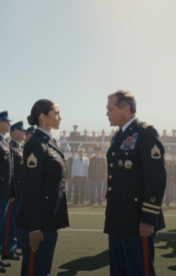
Captain Marcy Delgado refused to salute.
The silence that followed didn’t feel natural – it felt engineered, like the entire parade field had been stripped of oxygen. Hundreds of soldiers stood frozen at attention across Fort Benning, boots locked, eyes forward… but every instinct in their bodies screamed that something had just gone terribly wrong.
At the center of it stood General Wendell Hargrove.
Towering. Decorated. Untouchable.
And staring down at the one officer who had just defied him in front of everyone.
“Captain,” Hargrove said, his voice sharp enough to cut steel, “you will show respect to your superior officer – or you will face court-martial.”
Marcy didn’t move.
Her dress blues were immaculate, her posture flawless, her expression carved from discipline. She looked like the perfect officer – the kind the Army built, shaped, and displayed.
Except for one thing.
Her hand never rose.
“Your career ends today if you don’t salute me right now,” Hargrove added, louder this time.
Behind him, the reviewing stand was filled with dignitaries, officers, and civilians who had come for ceremony—not confrontation. A child whimpered somewhere in the crowd before being quickly hushed.
Still, Marcy didn’t blink.
“Do you understand what you’re doing?” the general demanded.
Her answer came calm. Steady.
“Yes, sir.”
A ripple passed through the formation—barely visible, but deeply felt. The kind of shift soldiers recognize before chaos breaks loose.
“Then salute.”
“No, sir.”
The words didn’t explode.
They landed.
Heavy. Final. Unshakable.
Hargrove’s jaw tightened. “Captain Delgado, this is your last warning.”
For twelve years, Marcy had followed orders in places where hesitation meant death—deserts, evacuation zones, field hospitals soaked in blood and static-filled radio calls. She had saluted men she didn’t trust, men she feared, men she knew were wrong.
Because that was duty.
But this?
This wasn’t duty.
This was something else.
And she would not surrender.
“You’re making a spectacle of yourself,” Hargrove said, stepping closer.
Marcy met his gaze without flinching. “No, sir. You did that years ago.”
The world seemed to tilt.
Just for a second.
“What did you say?” he asked, quieter now.
Marcy stepped forward—just enough to break the invisible line rank demanded. Behind him, Command Sergeant Major Roy Pickens stiffened, ready to intervene.
But Marcy didn’t raise her voice.
She leaned in, just enough for him to hear.
“You don’t remember me.”
That was the moment everything changed.
Hargrove stared at her—really stared this time. Searching her face. Her nameplate.
DELGADO.
At first, nothing.
Then—
Something cracked.
A flicker. A pulse. A memory clawing its way to the surface.
“Captain,” he said carefully, “step back.”
She didn’t move.
“You should have checked the name before today,” she whispered.
Hargrove snapped. “Remove this officer from the field.”
No one obeyed.
Not a single soldier moved.
Because now… something was wrong.
“Sergeant Major!” Hargrove barked.
Pickens stepped forward. “Captain Delgado.”
Marcy turned her head slightly. “Sergeant Major, I request Inspector General personnel and CID observers currently present identify themselves.”
That’s when the illusion shattered.
A woman in civilian clothing stood from the reviewing stand. A man near the press line raised a credential. Another officer broke formation.
The field transformed instantly—from ceremony… to investigation.
“What is this?” Hargrove demanded, anger cracking into something sharper.
Marcy reached into her jacket and pulled out a sealed envelope.
When she spoke again, her voice carried.
“General Hargrove, on behalf of the Office of Special Trial Counsel, you are being placed under administrative restriction pending investigation into obstruction, falsification of casualty records, unlawful command influence, and the disappearance of classified witness statements connected to Operation Lantern Ridge.”
The name hit like a bomb.
Operation Lantern Ridge.
Officers reacted before they could stop themselves. Eyes widened. Shoulders stiffened. Someone whispered under their breath.
And Hargrove—
Hargrove didn’t look at the envelope.
He looked at her.
Because now…
He remembered.
Not clearly. Not cleanly.
Fragments. Fire. A convoy burning under a foreign sky. A wounded interpreter bleeding out. A report rewritten in darkness. A name buried.
Delgado.
But not her.
Someone else.
Marcy saw it all in his face—the moment the past caught up.
“You have no authority to do this,” he said.
She raised the envelope higher.
“I’m not asking your permission, sir.”
CID agents began moving in.
Hargrove’s voice dropped, dangerous now. “You have no idea what you’re opening.”
Marcy’s eyes burned.
“I opened it twelve years ago… when they sent my brother home in a sealed coffin—and told my mother not to ask questions.”
The field went dead silent.
And for the first time, the general looked afraid.
Then Marcy reached into her jacket one more time—and what she pulled out next made Hargrove’s knees buckle right there on the parade field.
It wasn’t a weapon. It wasn’t a photograph.
It was a single, tarnished dog tag.
But it wasn’t Army issue. It was crude, hand-stamped with unfamiliar script, hanging from a frayed leather cord.
Hargrove stared at it, and the blood drained from his face. The towering general suddenly looked small, his broad shoulders slumping as if the weight of all his medals had finally crushed him.
He knew that tag.
He had ordered it to be buried with the rest of the evidence.
“Where,” he choked out, the word barely a rasp. “Where did you get that?”
Marcy didn’t answer him. Her gaze flickered past him, to Command Sergeant Major Roy Pickens.
Pickens, who had been a young sergeant back then. Pickens, who had stood beside a younger, more reckless Captain Hargrove in a dusty command tent. Pickens, who had helped write the lie.
The Sergeant Major’s eyes met hers. For a split second, a universe of shared knowledge, of buried guilt, passed between them. Then, he took a slow, deliberate step away from Hargrove.
It was the subtlest shift, but on that parade field, it was an earthquake. He was no longer standing with his general.
He was standing apart.
“Sir,” one of the CID agents said, gently but firmly taking Hargrove’s arm. “We need you to come with us.”
Hargrove didn’t resist. He was a ghost, his authority vanished into the hot Georgia air. His eyes were still locked on the simple dog tag in Marcy’s hand.
It was the key to everything.
The parade fell apart quietly. The formations were dismissed. The dignitaries were escorted away, murmuring in shocked whispers. The spectacle was over.
Marcy was guided to a sterile, air-conditioned office in the CID building. The lead agent, a man named Peters with tired eyes, gestured to a chair.
“Captain,” Peters began, “you took one hell of a risk out there.”
“It was the only way,” Marcy replied, her voice finally losing some of its iron control. “He would have buried it again. He’s been burying it for twelve years.”
She placed the hand-stamped dog tag on the table between them.
“My brother, Corporal Mateo Delgado, was in Hargrove’s unit during Operation Lantern Ridge,” she started, the story she had rehearsed in her mind a thousand times. “The official report says he was killed by friendly fire. A miscommunication during a chaotic engagement.”
Peters nodded, pulling a file toward him. “We have the after-action report.”
“It’s a lie,” Marcy said flatly. “Every word of it.”
She took a deep breath. “Mateo wasn’t just a combat medic. He was good with people. He had earned the trust of a local asset, an informant named Zabiullah. Zabiullah had proof Hargrove was selling off military fuel and comms equipment on the black market.”
The agent’s eyes narrowed. This was far bigger than falsifying casualty records.
“Zabiullah was scared,” Marcy continued. “He gave my brother this,” she nudged the tag, “as a sign of trust. It’s a Pashtun protection charm, with his family name stamped on it. He told Mateo he would meet him at a designated safe house with the ledger that proved everything.”
Her voice trembled, just for a moment. “Mateo went to Hargrove. He reported what he knew. He trusted the chain of command.”
“And Hargrove?”
“Hargrove saw his career about to go up in flames. So he made a choice. He sent my brother and his squad to the ‘safe house,’ but he also called in an airstrike on that same location, claiming enemy combatants were massing there.”
Peters leaned back, the pieces clicking into place. “He planned to eliminate your brother and the informant at the same time.”
“Yes. But Mateo wasn’t stupid. He must have suspected something. The last radio transmission from him wasn’t a call for help. It was a warning. He was screaming, ‘Civilian on site! Abort! Abort!’”
Her hands clenched into fists on the table. “They have that recording. It was logged and then classified as ‘unintelligible static.’ Another lie.”
“How did you get this?” Peters asked, pointing to the tag.
“Hargrove’s men were sent to clean up. They took the tag off Zabiullah’s body and were supposed to destroy it. But one of them didn’t. A specialist on the recovery team… he had a conscience. He couldn’t go against a captain, but he couldn’t throw it away either. He mailed it anonymously to my mother a year later with a note that just said, ‘Mateo was a hero. Don’t believe them.’”
That was the seed of her twelve-year mission.
“I joined the Army to find out what really happened,” she said. “I spent years digging, hitting dead ends, getting stonewalled. Every time I got close to Lantern Ridge, doors would slam shut. Hargrove’s promotions were promotions for everyone who kept quiet.”
“What about Sergeant Major Pickens?” Peters asked.
“Pickens was the key,” Marcy admitted. “He was Hargrove’s radio operator back then. He heard Mateo’s final transmission clearly. He saw Hargrove ignore it. And he wrote the false report that Hargrove dictated. It haunted him.”
“How did you get him to talk?”
“I didn’t,” Marcy said, and here came the twist she had held back. “His wife did. I found her through an old base newsletter. She said he had nightmares for years, always muttering the same name: Delgado. When I told her who I was, she cried. She told me the guilt was destroying him, and she couldn’t watch it anymore.”
Pickens had agreed to cooperate, but only if Marcy could guarantee an open, undeniable investigation. He was terrified that Hargrove would silence him, too.
“That’s why I did it on the parade field,” Marcy explained. “In front of everyone. It was the only place he couldn’t hide, where witnesses couldn’t be intimidated, and where the evidence couldn’t be buried again.”
The investigation unfolded swiftly.
Command Sergeant Major Pickens gave a full confession, corroborating every detail of Marcy’s story. The classified radio log was pulled, and with modern audio recovery technology, Mateo’s final, desperate words—”Civilian on site! Abort!”—were clear as day.
The soldier who had mailed the tag came forward, now a civilian ready to testify.
The case against Hargrove was airtight. But the final, karmic hammer fell from an unexpected place.
It turned out Zabiullah, the informant Hargrove had murdered, wasn’t just some local asset. He was the younger brother of a powerful provincial governor, a key ally the U.S. had spent years cultivating.
Hargrove’s cover-up wasn’t just to save his career; it was to prevent an international incident that would have exposed a rot that went even higher up the chain. The government had quietly paid reparations to the governor’s family and classified the incident at the highest level to maintain regional stability.
By exposing Hargrove, Marcy had unknowingly reopened a wound that powerful people wanted to keep closed forever.
For a week, it seemed her career, and the entire case, might be sacrificed for political expediency. She was told to stand down.
But Marcy didn’t back down. Not after coming this far. She leaked one piece of non-classified information—the story of a brother’s love for his sister, and a sister’s fight for her brother’s honor—to a trusted reporter.
The story was human. It was simple. It was powerful. It went viral.
Public pressure became immense. The Army, faced with a choice between protecting a corrupt general and honoring a true hero, made the right call.
Wendell Hargrove was court-martialed. He was found guilty on all charges. In a packed military courtroom, he was stripped of his rank, his medals, his pension, and sentenced to life in the disciplinary barracks at Leavenworth.
Command Sergeant Major Pickens, for his cooperation, received a letter of reprimand and was allowed to retire, his conscience finally clear. He met Marcy and her mother one last time, a broken man asking for a forgiveness they weren’t ready to give, but they accepted his apology.
Corporal Mateo Delgado was posthumously awarded the Silver Star for his attempt to save a non-combatant’s life at the cost of his own. His official record was changed from “killed by friendly fire” to “killed in action while upholding the highest ideals of the Army.”
Months later, the Georgia sun felt different. It was warm, not oppressive.
Marcy stood in front of a simple, polished headstone in a national cemetery. Her dress blues were just as immaculate as they were on the parade field, but today, her salute was sharp, immediate, and full of love.
She gently placed the small case containing her brother’s Silver Star against the stone.
“We did it, Mateo,” she whispered, her voice thick with emotion. “They know the truth now. Everyone knows you were a hero.”
She wasn’t a captain seeking revenge. She was a sister who missed her brother. And in bringing the truth to light, she had found a kind of peace that had eluded her for twelve long years.
Her fight was over. She had chosen integrity over obedience, truth over silence. She had held the line.
Her own career wasn’t over. It was reborn. The Inspector General’s office had offered her a position, recognizing that her brand of courage was exactly what the uniform needed. She would now be the person who ensured no family ever had to go through what hers did.
The story of Captain Delgado became a quiet legend in the barracks and training fields—a lesson not about defiance, but about the true meaning of honor. It taught a new generation of soldiers that the uniform doesn’t protect those who hide behind it; it honors those who are willing to risk everything for what it truly represents.
And sometimes, the most profound act of loyalty is not to salute, but to stand for the truth, no matter the cost.