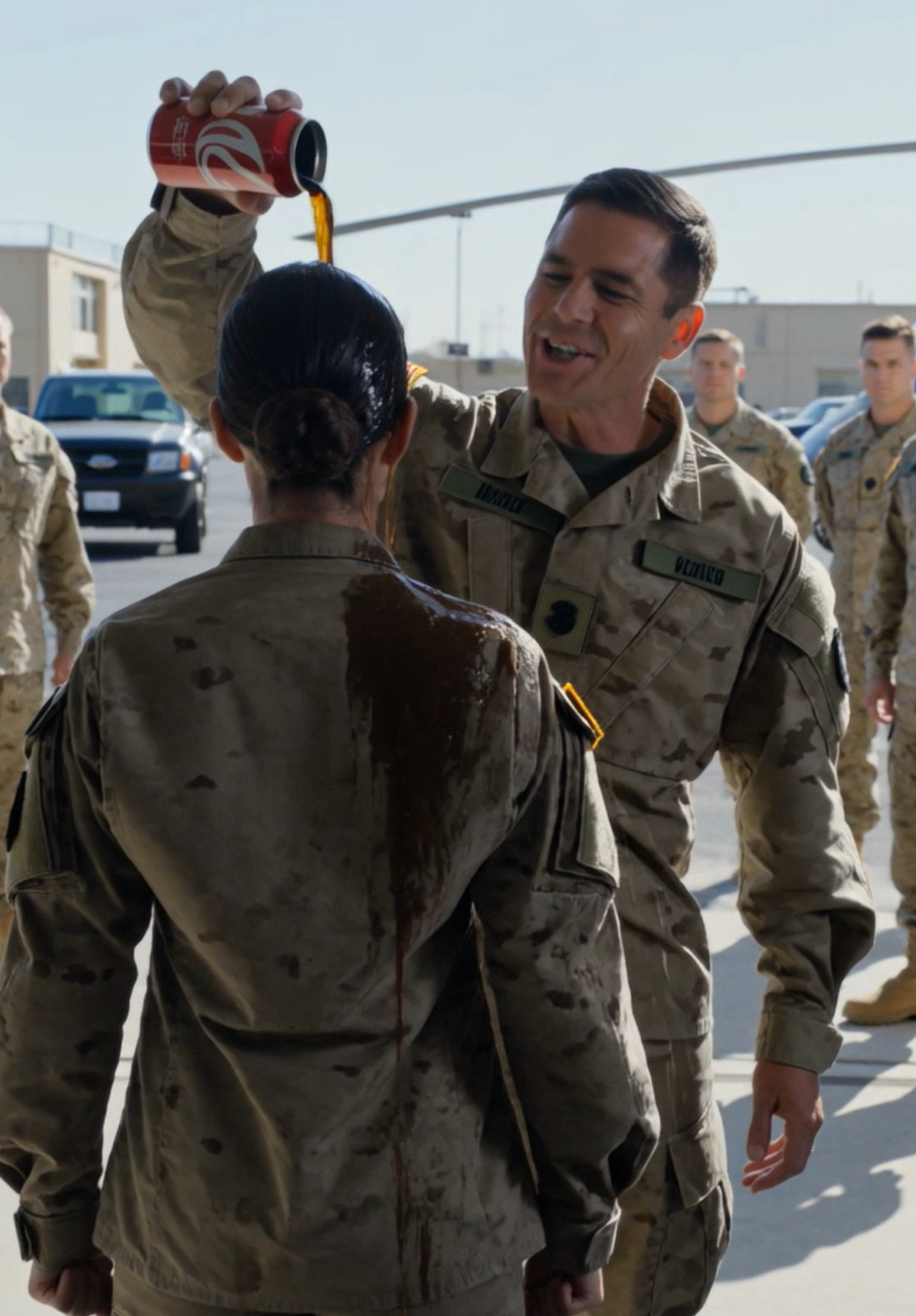
He poured a full can of Coke directly over my head in front of thirty of my soldiers. And then he smiled, like he’d just done me a favor.
It was 0700 at our Forward Operating Base, and the motorpool was already sweltering. Earning respect as a logistics officer on your first deployment means working twice as hard and never losing your cool.
But Captain Drake, a notoriously arrogant officer from a nearby battalion, didn’t care about the work. He only cared about putting on a show.
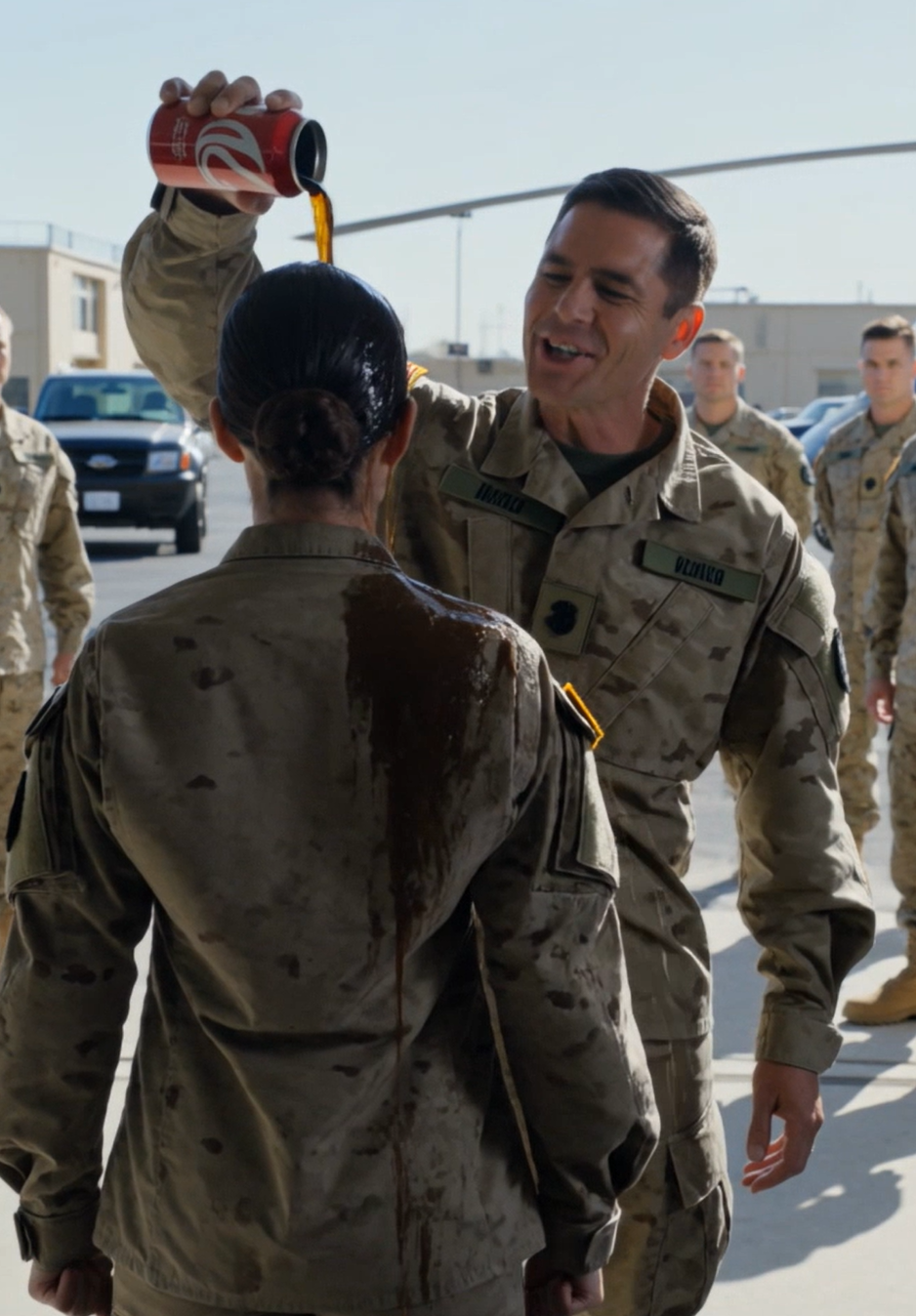
“You look like you need a shower, sweetheart,” he laughed, tipping the can over my hair.
The sticky syrup pooled in my collar and dripped down my sleeves. The entire maintenance bay went dead silent. The only sound was the distant hum of the generators. My blood was boiling. My hands shook so hard I had to clench my fists.
He told me it was just a “joke” and to lighten up. He wanted a reaction. He wanted me to scream or break down.
Instead, I wiped the soda from my eyes, picked up my clipboard, and walked straight to my office in total silence. I sat down, my uniform sticking to my skin, and typed up a flawless, undeniable incident report. No emotion. Just facts, witness names, and protocol violations.
I handed it to my battalion commander, Colonel Bradley. He read the part about the soda, and his jaw locked. “Did you keep your composure, Lieutenant Hoffman?” he asked.
“Yes, sir,” I replied.
What Drake didn’t know was that he already had a thick, hidden file of “quiet” complaints that had been swept under the rug. Three women before me. Two enlisted men. All buried.
And what he definitely didn’t know was who was landing on the base in a Blackhawk just three hours later.
When the rotors kicked up dust on the tarmac, Drake was standing at attention with the rest of the command staff, wearing that same smug smirk. He thought this was a routine inspection. He even straightened his cover, ready to shake the General’s hand.
But the General didn’t greet the colonels. He didn’t salute the command staff. He marched straight past them, his boots pounding the concrete, and stopped inches from Drake’s chest.
He held up a single printout. My report.
The entire base went still. Two hundred soldiers held their breath.
The General looked Drake dead in the eye, and in a voice that carried across the entire flight line, he said, “Captain Drake. This report indicates you amused yourself by pouring a sugary beverage on a fellow officer.”
The General’s voice wasn’t a shout. It was low, cold, and carried a weight that a thousand shouts could never match.
“Sir, it was just a misunderstanding, a joke,” Drake stammered, his smirk finally melting away into a mask of pure panic.
The General took a slow step closer, invading Drake’s personal space. “A joke? My father worked in a steel mill for forty years, Captain. Came home every day covered in grease and sweat so that I could have the privilege of wearing this uniform.”
He paused, letting the silence hang heavy in the searing desert air.
“He taught me that you can judge a man’s character by how he treats the people who do the real work. The ones with dirt under their fingernails and sweat on their brow.”
The General tapped the report against Drake’s chest. Once. Twice.
“So you tell me, Captain. What kind of character does a man have who thinks it’s funny to pour sugar on someone who actually works for a living?”
Drake’s face went from pale to ghostly white. His knees visibly trembled. He opened his mouth, but no sound came out.
“Military Police,” the General called out without breaking eye contact with Drake. “Take the Captain’s sidearm. He is relieved of command, effective immediately. Confine him to quarters under guard. He has a formal investigation to prepare for.”
Two MPs, their faces like stone, stepped forward. They professionally and efficiently disarmed a frozen Captain Drake and escorted him off the tarmac, one on each arm. He didn’t even look back.
The entire base seemed to exhale at once.
I watched from the door of the maintenance bay, still in my clean, dry replacement uniform. I expected to feel a surge of triumph, a rush of victory.
Instead, I just felt a profound sense of quiet relief. The storm had broken.
That afternoon, I was summoned to the small, plywood office the base reserved for visiting senior commanders.
The General, whose name I now knew was General Alistair Vance, was sitting behind a makeshift desk, my report still lying in front of him.
“Come in, Lieutenant. Close the door,” he said kindly.
I stepped inside, my heart thumping against my ribs. I stood at attention. “Lieutenant Hoffman reporting as ordered, sir.”
He waved a hand dismissively. “At ease, Lieutenant. Please, have a seat.”
I sat on the rickety chair, my posture ramrod straight.
“Colonel Bradley speaks very highly of you,” the General began. “Says you’re the best logistics officer he’s seen in a decade. Keeps this whole operation running on time.”
“I just do my job, sir,” I managed to say.
He smiled, a genuine, warm smile that completely changed his stern face. “Your last name is Hoffman. Any relation to Command Sergeant Major Michael Hoffman?”
I was taken aback. “Yes, sir. He’s my father.”
General Vance leaned back in his chair, a nostalgic look in his eyes. “I thought so. You have his eyes. And apparently, his spine.”
He continued, “Your father was my first platoon sergeant when I was a brand-new, know-it-all second lieutenant just like you. He saved my career, and probably my life, more times than I can count.”
A lump formed in my throat. My dad rarely talked about his service in detail.
“He taught me that leadership isn’t about being the loudest voice in the room. It’s about quiet competence. It’s about integrity when no one is watching,” the General said.
He picked up my report. “When Colonel Bradley sent this up the chain this morning, he knew I was coming. He flagged it for my personal attention. When I read it, I knew exactly who wrote it without even looking at the name.”
“Sir?” I asked, confused.
“It was just the facts. No emotion, no drama. Just a precise, undeniable account of a failure in leadership and a violation of our values. It was exactly the kind of report your father would have written. The deadliest kind.”
That was the first twist I never saw coming. The General’s arrival wasn’t a coincidence. My own commander had used his knowledge of the system and my own simple, honest work to set a trap.
And the General didn’t just see a wronged lieutenant. He saw the daughter of a man he deeply respected, a man who had shaped the officer he became.
“Drake’s career is over, Lieutenant,” the General said, his tone turning serious again. “But this isn’t just about him.”
He explained that Drake’s family was well-connected, which was how he’d managed to float for so long, his record of minor infractions and ‘misunderstandings’ always getting wiped clean by a phone call from back home.
“This time is different,” General Vance assured me. “Because you gave us the perfect tool. An unimpeachable report from an officer with a flawless record of her own. You fought him on your terms. Not his.”
Over the next few days, something incredible started to happen.
The investigation wasn’t just about the soda incident. It cracked open the door to Drake’s entire history on the base.
A young female private, who I knew Drake had relentlessly mocked for her weight, came forward. She provided a written statement about his constant verbal abuse.
Two of my own mechanics, men Drake had berated for being “grease monkeys,” gave statements about how he would constantly interfere with their work and demand they service his personal vehicle ahead of mission-critical trucks.
Even one of the cooks from the dining facility came forward, detailing how Drake would regularly humiliate him in the chow line, complaining about the food in front of everyone.
It was a floodgate of quiet grievances, unleashed because for the first time, people felt safe. They saw that the system might actually work.
A week later, Colonel Bradley called me into his office. He looked tired but satisfied.
“The investigation is nearly complete,” he said. “It’s worse than we thought. But it’s also better.”
I was confused. “Sir?”
He gestured to a chair. “Drake thought this was all about a single incident. He thought he could fight it. But he was wrong.”
The Colonel slid a thick, two-inch binder across his desk towards me. It was worn and filled with page markers.
“This,” he said, tapping the binder, “is the real reason Captain Drake is finished.”
I opened it. Inside were meticulously typed pages, detailing dozens of incidents over the past three years. Times, dates, locations, witnesses, and relevant articles of the Uniform Code of Military Justice.
It was the hidden file I’d heard rumors about. It was real.
“This isn’t my report,” I said.
The Colonel shook his head. “No. Your report was just the key that unlocked the vault.”
He then told me the second twist, the one that truly changed how I saw everything.
The file wasn’t compiled by him, or by some high-ranking investigator. It was built, piece by piece, by a man Drake saw as completely insignificant.
“Do you know Chief Warrant Officer Peterson?” the Colonel asked.
I nodded. CWO Peterson was a quiet, bookish man in his late forties who ran the supply depot. He was a logistics wizard, but so unassuming you’d barely notice he was in a room. Drake had once called him a “glorified stock boy” to his face.
“Peterson was one of the first people Drake targeted when he got here,” the Colonel explained. “He made some remark about Peterson’s age and how he was ‘still just a warrant.’ But he underestimated him.”
“Peterson is a master of regulations and documentation. It’s his entire world. Instead of getting angry, he got methodical. He started a file. Every time he heard of Drake pulling something, he’d quietly talk to the person, advise them on their rights, and help them document it. For years.”
My mind was reeling. All those buried complaints weren’t buried at all. They were being collected, archived, and cross-referenced by the quietest man on the base.
“Most people were too scared to file a formal complaint,” Colonel Bradley continued. “So Peterson just kept the records, waiting. He knew that eventually, Drake would cross a line with someone who wouldn’t just take it. Someone who would fight back the right way.”
“He was waiting for you, Lieutenant Hoffman,” the Colonel said. “He told me so himself.”
My simple, factual report wasn’t the first shot. It was the final, confirming piece of a giant, intricate puzzle of misconduct, assembled by a man Drake had dismissed as a nobody.
Captain Drake wasn’t brought down by a punch; he was crushed by the weight of a thousand pieces of paper.
The final verdict was swift. Drake was offered a choice: face a full court-martial that would make his family’s name synonymous with disgrace, or accept an Other Than Honorable discharge and disappear.
He chose to disappear. He was flown out of the country within 48 hours, stripped of his rank, his career, and the arrogant pride that had been his entire identity.
The day he left, CWO Peterson walked past my office. He didn’t stop, but he caught my eye and gave me a slow, single nod. I nodded back. No words were necessary.
A few months later, my deployment ended. Before I flew home, General Vance made a special trip back to our base. In front of the entire battalion, he pinned a commendation medal on my chest.
The citation wasn’t for courage under fire. It was for “Leadership, Integrity, and Upholding the Highest Standards of the Officer Corps.”
When I got home, my dad was waiting for me at the airport. He held up a copy of the base newspaper with a picture of me getting the medal.
“I heard you made some waves,” he said, a proud smile crinkling the corners of his eyes.
“I just did my job, Dad,” I replied, hugging him tightly.
Looking back, the whole ordeal taught me a lesson that has stayed with me ever since.
Revenge is a flash of fire, hot and loud, but it burns out quickly.
Justice, true justice, is different. It’s quiet. It’s patient. It’s built not with loud anger, but with steady hands, undeniable facts, and unwavering integrity.
It’s the quiet professionals, the ones doing the work when no one is watching, who hold the real power. They are the foundation upon which everything else is built.
And when you’re wronged, you don’t have to sink to their level. You rise above it, you do your job better than anyone else, and you let the weight of your own quiet competence become the force that brings their loud, empty world crashing down.