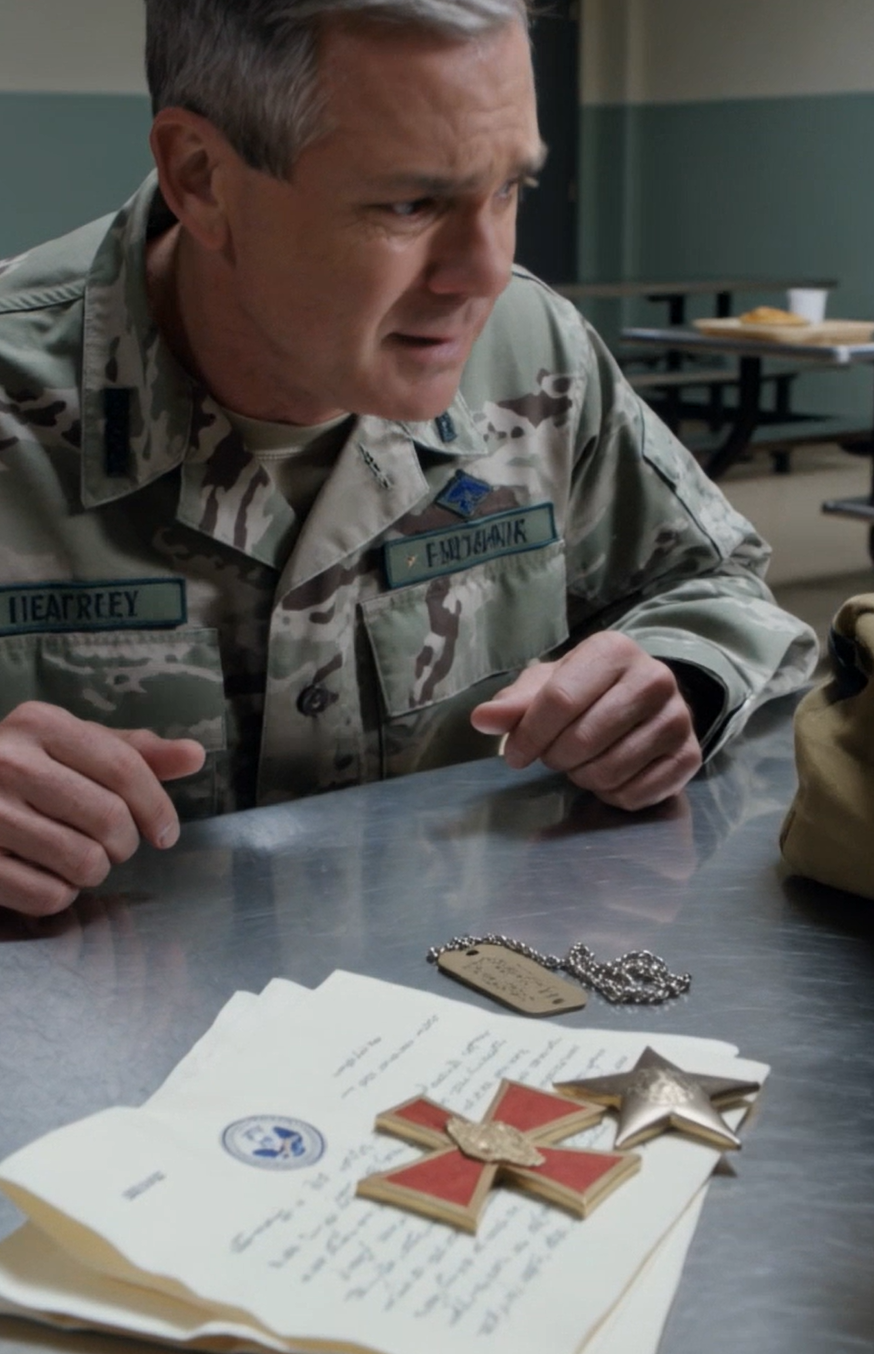
His hands started to shake.
“Where… where did you get these?” he stammered, his voice cracking. The mess hall was so quiet you could hear the hum of the fluorescent lights.
Sarah finally looked up. Her soft eyes were suddenly cold, sharp – the eyes of someone who had seen things the men around her only had nightmares about.
“Keep digging, Sergeant,” she said quietly.
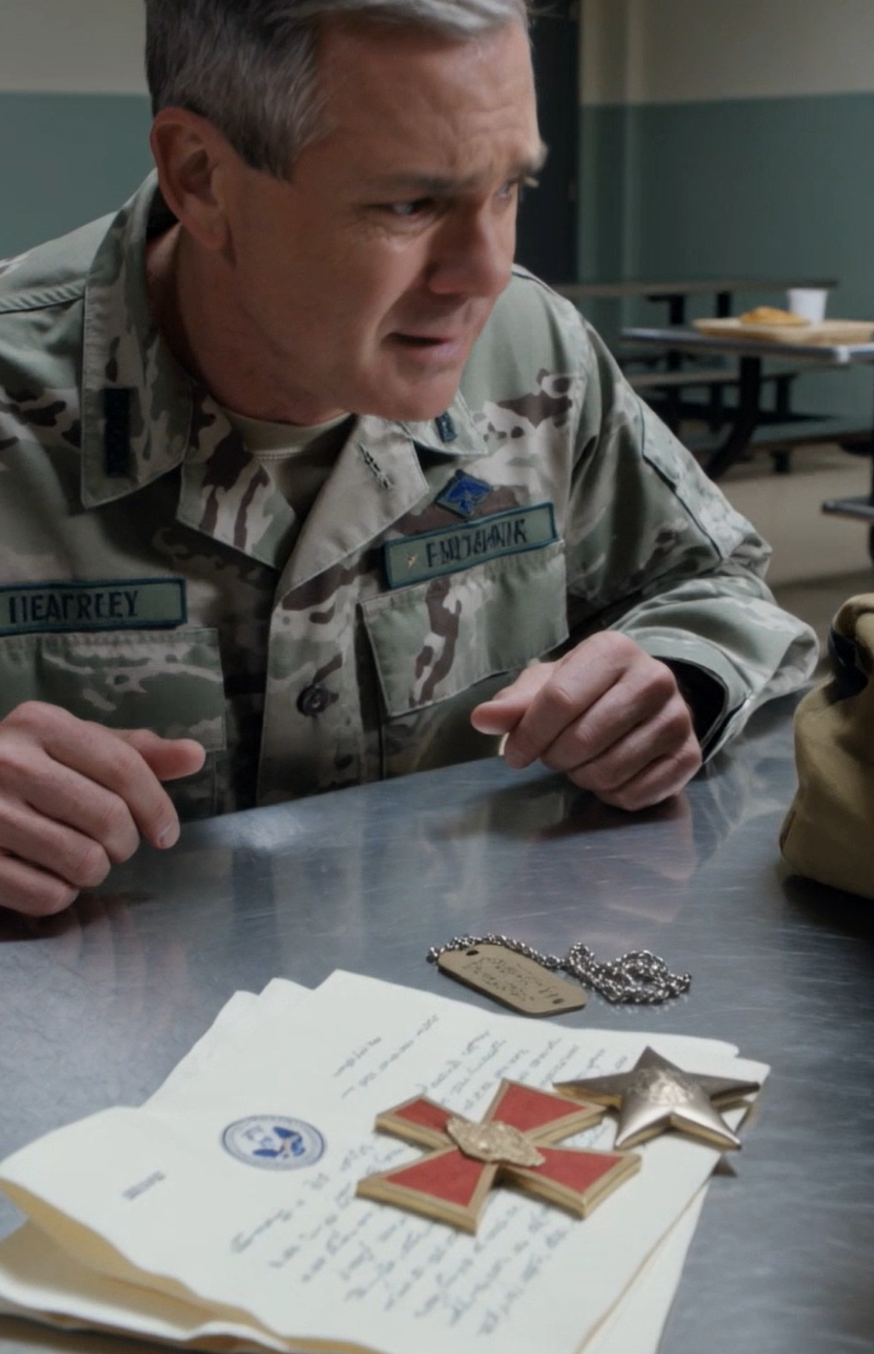
His trembling fingers lifted the citation. He read the name at the top. Then he read it again. The paper slipped from his fingers and floated to the floor.
A Colonel who had been sitting three tables down stood up so fast his chair flew backward. He walked over, looked into the box, and immediately snapped to attention. He saluted Sarah so sharply his knuckles cracked.
“Ma’am,” the Colonel said, his voice booming through the silent hall. “I didn’t know you were the one they sent.”
Thompson turned to the Colonel, confused, terrified. “Sent? Sent for what, sir?”
The Colonel didn’t take his eyes off Sarah.
“She wasn’t here to enlist, Sergeant. She’s here to investigate. And the person she’s investigating…”
He slowly turned his head toward Thompson.
“…is sitting at this table.”
Thompson’s knees buckled. Because at the very bottom of the velvet box, underneath the medals, was a folded manila envelope. And written across the front, in thick black marker, was a single word that made every veteran in the room go pale.
STOLEN VALOR.
The words slammed into Thompson like a physical blow. His breath caught in his throat, a dry, choked sound.
The air in the mess hall turned thick, heavy with judgment. Whispers started to ripple through the room, quiet at first, then growing into a low, angry hum.
Faces that had offered him respect just minutes ago were now twisted with suspicion and contempt. He felt a hundred pairs of eyes drilling into him, stripping away the uniform, the rank, the man he had pretended to be for twenty years.
Colonel Miller gestured to two military policemen standing by the door. “Escort Sergeant Thompson to my office. Ma’am, if you’ll join us.”
Sarah nodded, her expression unreadable. She carefully placed the Medal of Honor citation back into the velvet box and closed the lid with a soft, final click.
The walk across the mess hall felt like a mile. Every footstep echoed. Thompson didn’t dare look up. He just stared at the floor, his world shrinking to the scuffed toes of his boots.
The Colonel’s office was sparse and immaculately tidy. He dismissed the MPs with a wave of his hand, leaving just the three of them in the sterile silence.
“Sit down, Thompson,” the Colonel said, his voice stripped of all warmth.
Thompson couldn’t move. He felt rooted to the spot, a statue of shame.
Sarah placed the box on the corner of the Colonel’s desk. “Please, Sergeant. Sit.”
Her voice was softer now, almost gentle, which was somehow worse than the anger. He finally collapsed into the chair opposite the desk.
Colonel Miller remained standing, his arms crossed over his broad chest. “This is Special Investigator Wallace,” he stated. “She reports directly to the Joint Chiefs. She’s been on this base for two weeks, undercover. And her only case file… is you.”
Thompson looked at Sarah, truly looked at her for the first time. She wasn’t a girl. She was a woman who carried an immense weight, and he was just beginning to understand what it was.
“The medals,” he whispered, his throat raw. “The citation.”
“They belonged to my grandfather,” Sarah said, her voice even. “General Michael Wallace.”
The name hit Thompson harder than the envelope had. General Wallace was a legend, a touchstone of integrity for generations of soldiers. To have his name spoken in this room, in this context, felt like a desecration.
“He was the reviewing officer for the after-action reports from the Battle of Al-Karin,” she continued, her gaze unwavering. “The battle where you ‘earned’ your Silver Star.”
Thompson flinched. The word “earned” was a dagger.
“My grandfather read the official report. He read the commendations. And he didn’t believe it.”
“He couldn’t prove it,” she went on. “The paperwork was perfect. The witnesses all had the same story. But he knew. He felt it in his bones that something was wrong.”
“He carried that doubt with him for the rest of his life. He kept a private file, unofficial notes, interviews he conducted after he retired.”
Sarah paused, tapping a finger on the velvet box. “After he passed away, I found his files. And I decided to finish what he started.”
Thompson finally found his voice, a broken, desperate plea. “It’s not what you think.”
The Colonel scoffed. “Isn’t it? You walk around this base like a hero. You tell stories to the young recruits. Stories that aren’t yours to tell.”
“I was there!” Thompson insisted, a flicker of his old authority returning. “I was in that firefight!”
“No one is denying that,” Sarah said calmly. “We know you were there, Sergeant. The question is, what did you really do?”
She opened the manila envelope. She didn’t pull out documents or photos. She pulled out a single, dog-eared piece of paper. It was a page torn from a cheap notebook, the writing in faded pencil.
She slid it across the desk toward him.
Thompson looked down. It was a list of names. His name was on it. And next to it, two words: “Took credit.”
Underneath his name was another. Private First Class Daniel Foster. Next to that name, there was only one word, circled three times.
“Hero.”
The sight of Daniel’s name shattered the last of Thompson’s composure. The carefully constructed walls he had built around his heart for two decades crumbled into dust.
Tears he hadn’t shed since he was a boy burned his eyes and streamed down his face. He didn’t bother to wipe them away. The effort was too much.
“Danny,” he choked out, the name a painful stone in his throat.
Sarah’s cold demeanor softened into something that looked like pity. “Tell us about him, Sergeant. Tell us the real story.”
The dam broke. The words came flooding out, a torrent of guilt and grief held back for twenty years.
“We were pinned down,” he began, his voice raspy, his eyes seeing a dusty street half a world away. “It was an ambush. A bad one. Our Lieutenant was green, straight out of West Point. He froze.”
“He just kept screaming into the radio, but his orders made no sense. ‘Hold the line!’ he kept yelling. There was no line to hold. We were in a kill box.”
Thompson took a shuddering breath. “We were all going to die. I knew it. Every man there knew it.”
“Then Danny… he just moved. He was just a kid. Eighteen years old. Quietest guy in the platoon. Loved reading fantasy novels. Never said a word to anyone unless you spoke to him first.”
“He saw the machine gun nest that had us pinned. It was on a rooftop, behind a low wall. No one could get a clean shot.”
“Before I could stop him, he was running. No orders. No cover. Just running straight into the street, drawing all the fire to himself.”
The Colonel and Sarah were silent, listening intently. The story was familiar, but the name of the hero was wrong.
“He tossed his two grenades over the wall. He got them. He saved us all. But they cut him down just as the second one went off.”
Thompson’s shoulders shook with silent sobs. “He didn’t even make a sound when he fell. He just… folded.”
“We won the firefight after that. The tide turned. We evacuated our wounded.”
“When the dust settled, our Captain came in,” Thompson continued, his voice barely a whisper. “He saw the situation. He saw our dead Lieutenant. He saw Danny.”
“And he saw me. The senior NCO left standing. The one who hadn’t frozen.”
The memory was so vivid, it was like a brand on his soul. The Captain pulling him aside, the smell of cordite and dust still thick in the air.
“The official report can’t say a Private disobeyed a direct order from a dead officer to save the day,” the Captain had told him. “It’s a mess. It questions the chain of command. It makes the Lieutenant look bad, and by extension, it makes us all look bad.”
“He told me, ‘We need a hero, Sergeant Thompson. A clean one. Someone who followed orders and showed courage.’”
“I tried to refuse,” Thompson pleaded, looking from Sarah to the Colonel. “I swear I did. I told him it was Danny. It was all Danny.”
“But he wouldn’t listen. He said Danny would get a posthumous Purple Heart, and that his family would know he died bravely. He said my story would be good for morale. Good for the Army.”
“I was twenty-two years old. I was in shock. I had just watched a kid die to save me. And my Captain, a man I respected, was telling me this was the right thing to do. The necessary thing.”
So he agreed. He went along with the lie.
The first time he told the story, the lie felt like acid in his mouth. But they gave him a medal. They clapped him on the back. They called him a hero.
Danny’s parents were at the ceremony. They gave Thompson a hug, tears in their eyes, and thanked him for being there with their son.
That was the moment the guilt truly took root. It was a poison that seeped into everything.
“I took the Silver Star,” Thompson confessed, his voice hollow. “I took the promotions. I built a career on that kid’s grave. Every time someone called me a hero, I felt sick. But I was in too deep. How could I ever take it back?”
The office was quiet for a long time. The only sound was Thompson’s ragged breathing.
Colonel Miller looked at Sarah. His expression was no longer just angry; it was complicated.
Sarah finally spoke. “My grandfather interviewed three other men from your platoon. Unofficially. Years later. They were all out of the service by then.”
“They all told him the same thing,” she said, tapping the notebook page. “They were scared to speak up at the time. They were just kids, too. But none of them ever forgot Daniel Foster.”
“That’s what this page is,” she explained. “My grandfather’s notes from his conversation with a Specialist Martinez. He drew a line from Danny’s name to yours.”
This was the twist he never saw coming. It wasn’t just his guilt. The truth had been out there all along, a ghost waiting in the wings.
“The Captain,” the Colonel said grimly. “His name was Reynolds. He’s a General now. At the Pentagon.”
Thompson’s head snapped up. Reynolds had built a career on that lie, too, but on a much grander scale.
“What you did was a profound dishonor,” the Colonel said, his voice like granite. “You will be stripped of your rank. You will be dishonorably discharged. You will lose your pension. The medals will be officially rescinded.”
Thompson nodded slowly. He had expected it. He deserved it. It was a relief, in a strange way. The heavy costume of the hero was finally being removed.
“But we’re not just here for you, Thompson,” Sarah said, and this is where her voice turned to steel. “We’re here for Daniel Foster.”
“This investigation was never about punishment,” she continued. “It was about correction. About restoring an honor that was stolen.”
Over the next two months, things changed. An official inquiry was launched, spearheaded by Special Investigator Wallace.
General Reynolds was quietly but firmly forced into early retirement, his pristine record forever tarnished by a formal letter of reprimand that would follow him to the grave.
The Army officially amended the records for the Battle of Al-Karin. Sergeant Thompson’s Silver Star citation was erased.
And a new one was written.
Three months later, on the same parade ground where Thompson had received his stolen medal, a different ceremony was held.
Daniel Foster’s parents, now frail and gray, sat in the front row. They had been flown in by the Army.
Thompson was there, too. He stood at the very back of the crowd, in civilian clothes, a nobody. He had lost his career, his reputation, his identity. But for the first time in twenty years, his shoulders didn’t feel heavy.
The Secretary of the Army stood at the podium. He spoke of courage, sacrifice, and the enduring importance of truth.
He then read the citation, describing how a young Private First Class, in an act of supreme bravery, had disregarded his own safety to save his entire platoon.
The President of the United States placed the Medal of Honor around the neck of Daniel’s mother. She clutched it to her chest, her body shaking with a grief and a pride that were twenty years old.
After the ceremony, as the crowds dispersed, Thompson saw Danny’s parents standing alone by the memorial wall. He took a deep breath and walked toward them. This was his final penance.
They saw him coming. There was no recognition at first, then a flicker of confusion.
“Mr. and Mrs. Foster,” he said, his voice thick.
“I know you,” Danny’s father said, his eyes narrowing. “You were…”
“My name is Robert Thompson,” he said simply. “I was with your son that day. I’m the man who lied.”
He told them everything. Not the clean, official version, but the ugly, personal truth. He told them about Danny’s favorite book, about how he was too scared to act, and how their son, their quiet, brave boy, had done what no one else could.
He cried. They cried. And in the middle of all that shared pain, something incredible happened. Danny’s mother reached out and took his hand.
“Thank you,” she whispered. “For finally giving us our son back.”
In that moment, Thompson felt a redemption that no medal or rank could ever provide. He hadn’t earned a Silver Star, but he had finally earned a small measure of peace.
He saw Sarah watching him from a distance. She gave him a small, almost imperceptible nod before turning and walking away, her own family’s honor finally satisfied.
Robert Thompson left the base that day with nothing but the clothes on his back and a single, hard-won truth in his heart. Honor isn’t a piece of metal you pin to your chest. It’s not about the stories people tell about you. It’s about the truth you’re willing to tell about yourself, no matter the cost. And sometimes, the most heroic act of all is simply to set the story straight.