The sun was brutal that afternoon. Another team had just crossed the finish line, doubled over, cursing, nowhere near the legendary 18:12. That record wasn’t a number anymore. It was a ghost. A wall no operator on base believed could ever fall.
Then she walked in.
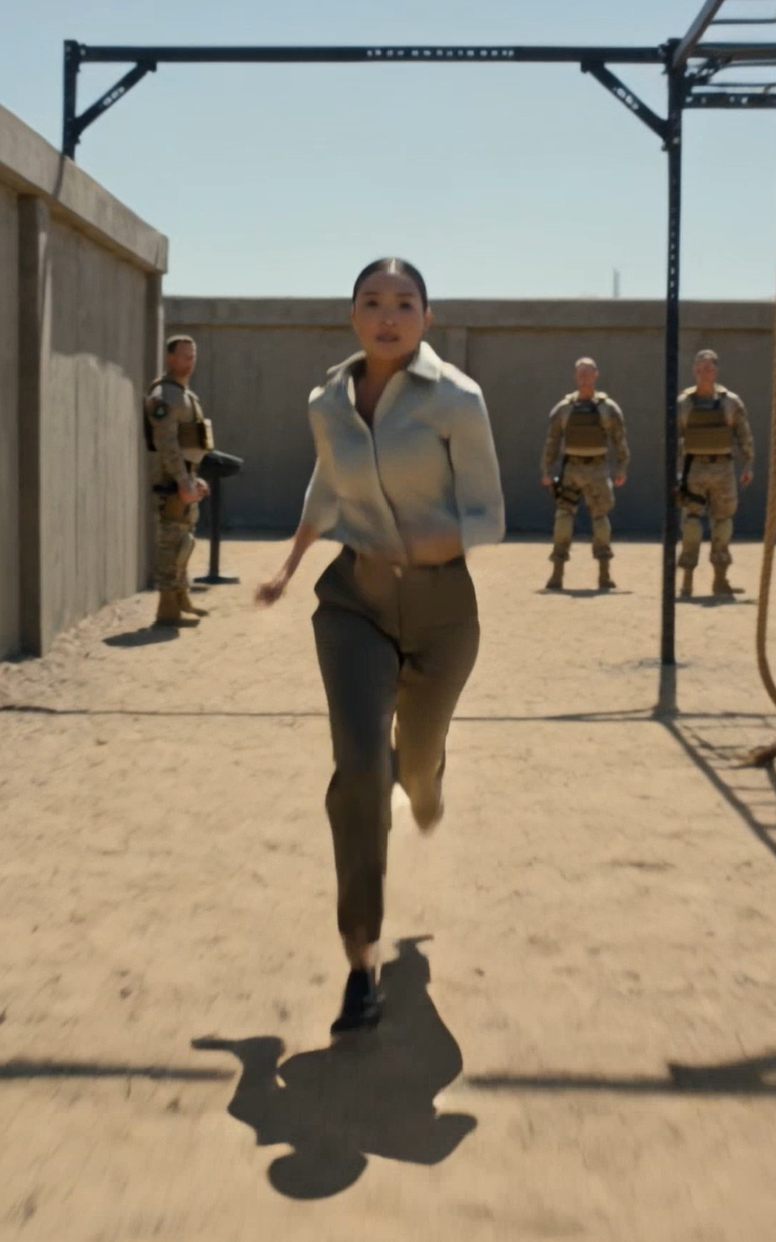
No swagger. No uniform. Just a woman in a gray t-shirt, walking with a careful, deliberate limp – like every step had been bargained for. A civilian. A doctor, someone whispered. Here to ask permission to run the course that had broken men twice her size.
Lieutenant Brenda Mitchell crossed her arms. “This isn’t a lab, Dr. Chen.”
Chen didn’t blink. “I’m not here to observe anymore. I need to feel it.”
A few of the guys smirked. Petty Officer Darrell Morrison didn’t. Something about the way she stood made the back of his neck go cold.
Then she said it.
“Commander. May I take a turn?”
The silence that followed wasn’t polite. It was the kind of silence that happens right before something you can’t take back.
Minutes later, she was at the start line. Smaller than everyone. Quieter than everyone. And somehow – calmer than anyone Morrison had ever seen standing there.
Mitchell raised the stopwatch. “On you.”
The buzzer cracked the air.
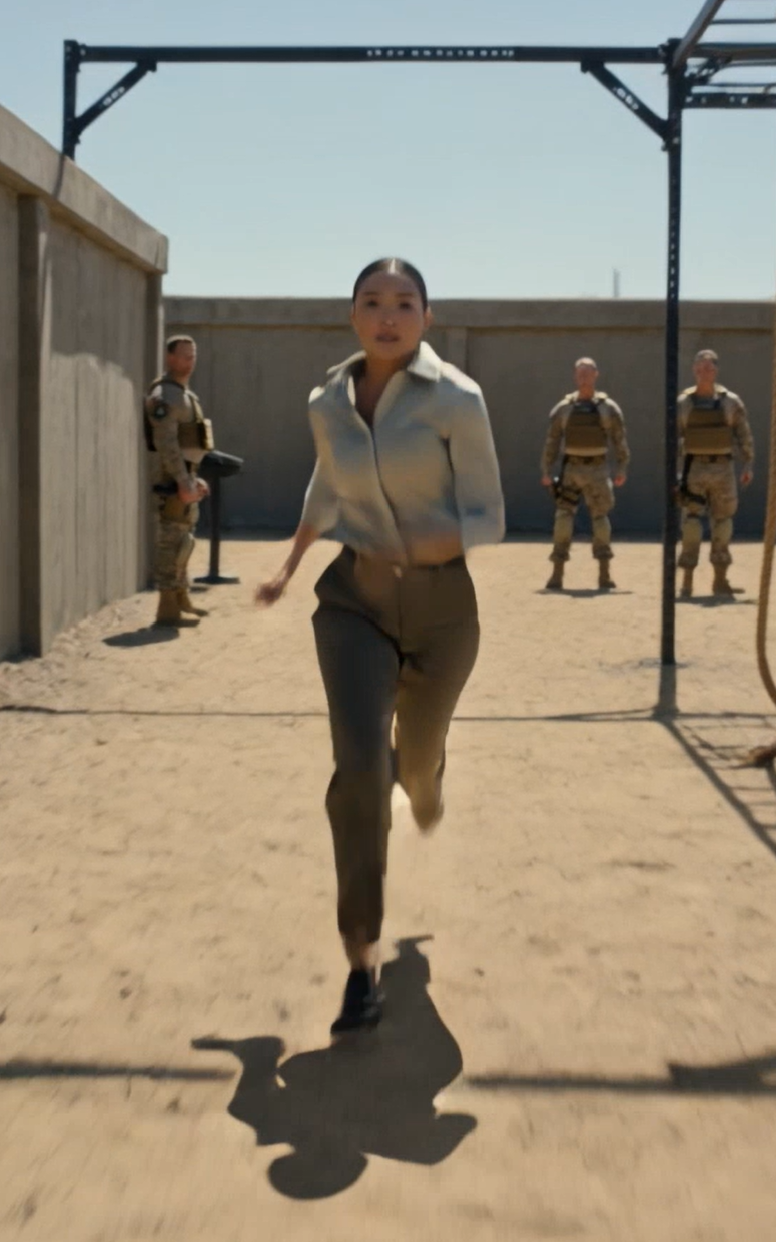
She didn’t attack the rope. She flowed up it. No legs. No wasted motion. Shoulders working like she’d done this ten thousand times in another life.
At the walls, she didn’t muscle through. She solved them.
At the carries, she didn’t fight the weight. She moved with it, like she already knew exactly where her spine could bend and where it couldn’t.
At the pistol station – where grown operators’ hands shook –
She didn’t miss. Not once.
Morrison checked the clock. Then again. Then a third time.
“She’s ahead,” he whispered. “She’s ahead of the record.”
Nobody laughed. Nobody breathed.
By the final stretch, the whole compound had gone still. No shouting. No radios. Just sixty hardened men watching a woman with a limp do something none of them had ever done.
Mud. Wire. The last crawl.
She dropped low, slow, surgical. Every inch measured. Every breath placed exactly where she wanted it.
17:38.
Thirty-four seconds. Two hundred yards.
Morrison felt his chest tighten – and he realized, with a sick jolt, that it wasn’t excitement. It was fear. Because he suddenly understood he wasn’t watching a civilian try something stupid.
He was watching someone come back for something.
She rose from the mud. Calm. Composed. And she started to run.
That’s when Mitchell lowered the stopwatch, her face going pale, and Morrison heard her whisper a name he hadn’t heard in fifteen years — a name carved into the memorial wall behind them.
“Vance…”
And then Dr. Chen turned her head as she ran past, looked Morrison dead in the eye, and said the six words that made every man on that field understand who she really was…
“This was always Elias Vance’s course.”
The name hit Morrison like a physical blow. Elias Vance. Sergeant Elias Vance. The man who had set the 18:12 record. The man whose picture, young and grinning, was tacked to the board in the mess hall.
The man whose name was etched in cold, hard granite on the Wall of Heroes, a place for those who made the ultimate sacrifice.
Suddenly, the whole impossible picture snapped into focus. The uncanny grace. The flawless technique. The way she moved like she knew the course better than the men who built it.
She wasn’t just running a course. She was re-tracing a memory.
Every man on that field, every operator who had ever heard the legend of Elias Vance, knew he had a sister. A brilliant kid sister he doted on, who he used to say was smarter and tougher than his whole platoon combined.
They knew this because he talked about her constantly. Anya.
Anya Chen. Dr. Anya Chen. The civilian doctor.
The compound remained silent, but it was a different kind of silence now. It was reverence. It was awe. It was the humbling quiet of men realizing they were witnessing something sacred.
The finish line was just fifty yards away. The big digital timer on the stand glowed red.
18:01.
18:02.
She was going to shatter the record. She was going to erase the ghost that had haunted this compound for a decade and a half.
Morrison found himself holding his breath, his heart pounding a frantic rhythm against his ribs. It felt like watching history not just being made, but being reclaimed.
Then, she did something that broke every man there for the second time that day.
She slowed down.
It wasn’t the stumble of exhaustion. It was deliberate. A smooth, measured deceleration from a sprint to a jog, then to a walk.
The timer kept climbing, mercilessly.
18:09.
18:10.
She was ten feet from the line. She could have crawled and still broken it.
18:11.
She stopped.
She stood there, breathing evenly, her chest rising and falling. Her eyes were fixed on the timer, just watching the numbers.
She looked over at the memorial wall, a hundred yards away, where the morning sun glinted off the polished stone.
The timer clicked over. 18:12. A collective sigh, a gasp, rippled through the crowd of soldiers.
Then, with a single, calm step, she crossed the line.
The official time flashed on the board: 18:13.02.
One second slower.
She hadn’t come to beat him. She had come to honor him. To leave his legacy untouched, right where he had left it. A monument that could be approached, but never surpassed, at least not by her.
She swayed then, a slight wobble, and her hand went to her hip, the one that favored her limp. Morrison and Lieutenant Mitchell were moving before anyone else.
They reached her as her knees began to buckle. Morrison caught her, surprised at how light she was. She wasn’t panting from exertion. Her face, smeared with mud and sweat, was a mask of pure, unadulterated grief.
The strength that had powered her through the course had finally left her. Fifteen years of it, all spent on that one, perfect, heartbreaking run.
“Why?” Mitchell asked, her voice surprisingly gentle. “Dr. Chen… Anya… why do this?”
Anya looked up, her eyes locking with Morrison’s. There was an ocean of pain in them.
“Because the way he died… they got it wrong,” she whispered, her voice cracking. “Everyone thinks he was reckless. That he pushed himself too hard.”
She took a shaky breath. “He wasn’t reckless. He was taught wrong. Right here. On this course.”
Morrison looked from her pained face to the obstacle course, the familiar shapes of wood and steel now looking alien and menacing.
“What do you mean?” he asked.
“The Weaver,” she said, naming the treacherous obstacle of interlaced logs that operators had to navigate over and under. “It’s the twelfth station. There’s a shortcut. A way to shift your body weight to gain a few seconds.”
Mitchell nodded slowly. “We call it the Vance Roll. He invented it. It’s what gave him the record.”
“It’s a flaw,” Anya said, her voice gaining strength. “A biomechanical deathtrap. It puts an unnatural torque on the L4 and L5 vertebrae. Under normal weight, you can get away with it. But under full combat load, on uneven terrain, after hours of exhaustion…”
Her voice broke again. “It creates a catastrophic failure point. It wasn’t his fault. The course taught him a bad habit. A fatal habit.”
Morrison felt a chill run down his spine. The official report on Sergeant Vance’s death had been classified, but the rumors were simple. A tragic fall during a live-fire training exercise in the mountains. A misstep. Operator error.
“How do you know?” Mitchell asked, her tone shifting from commanding officer to investigator.
Anya looked down at her own leg. “I was there.”
The air grew thick and heavy. The sixty soldiers stood like statues, straining to hear.
“We grew up doing this stuff,” Anya explained, her voice distant, as if traveling back through time. “Our dad was a Marine. He built us obstacle courses in the backyard. Elias… he loved it. He was a natural. I was the bookworm, the one who studied how the body worked.”
She smiled, a faint, sad smile. “He was the brawn, I was the brains. He’d find a way to get over a wall faster, and I’d tell him which muscles he was using and why it was or wasn’t a good idea.”
“The week before he deployed for the last time, he came to visit me. I was in my residency. He was so proud of that record. He took me to a local training course, wanted to show me the ‘Vance Roll’ he’d created.”
Her eyes glazed over, lost in the memory.
“I saw it immediately. The way he had to twist his spine. I begged him not to do it. I told him it was dangerous, that the risk wasn’t worth the reward of a few seconds. I showed him the physics, the medical journals.”
A tear traced a clean path through the mud on her cheek.
“He just laughed. Said it was my job to worry, and his job to be fast. He convinced me to try the course with him. For old time’s sake.”
She paused, swallowing hard.
“He went first. At the weaver, he did the roll. And his foot slipped. Not a big slip. Just a little one. But the torque… the unnatural pressure… it was enough. He came down wrong. It was a bad fall.”
“I ran to him. He was… he was hurt bad. A piece of the structure had broken loose in the fall. It was shifting, about to fall on him.”
Her hand instinctively went to her hip. “I got him clear. I pulled him out from under it. But just as I did, it gave way completely.”
Morrison looked at her leg, her deliberate limp, and finally understood. The limp wasn’t a weakness. It was a scar. A medal. A receipt for an act of impossible love.
“It crushed my leg,” she said, her voice flat. “But I didn’t care. I was just trying to keep Elias awake. Talking to him. Medics were on the way. I thought… I thought he’d be okay.”
“He looked at me,” she whispered, her gaze now on the memorial wall. “He wasn’t grinning anymore. He just said, ‘You were right, Anya. You were right.’ And then he was gone.”
The story hung in the air, heavy and suffocating. The official narrative was that he died in the mountains, a hero’s death. The truth was messier. More tragic. A quiet death on a practice field, with his sister watching.
“The Navy classified it,” Mitchell said, putting the pieces together. “To protect the integrity of the program. To protect his legacy.”
“They buried the truth,” Anya corrected, a spark of fire returning to her eyes. “They called my brother reckless to cover up for a flaw in their own training. His legacy isn’t that stupid record. His legacy is the dozens of men who came after him, men who learned the ‘Vance Roll’ and got hurt. Men who have chronic back pain. Men who have had their careers cut short.”
She looked around at the faces of the operators watching her. “I’ve been observing for six months. I’ve read your medical files. I’ve seen the pattern. All of you. You’re strong enough to hide it, but the damage is there.”
She pushed herself up, standing on her own, refusing Morrison’s support. She was Dr. Chen again.
“I am not just a grieving sister, Lieutenant. I am a doctor of sports medicine and rehabilitative science. For fifteen years, I have studied this specific injury. I have dedicated my life to it. Today, I did not just run this course. I documented every single biomechanical strain.”
She pointed to a small, waterproof camera strapped to her chest, its green light blinking.
“I have just created an irrefutable data set. I did it slowly, so every motion could be analyzed. I ran it in 18 minutes and 13 seconds to prove that safety does not have to mean failure. To prove that you can still be elite without breaking your body.”
She looked directly at Mitchell. “My brother’s record can stand. But the ‘Vance Roll’ dies today. It’s not a badge of honor. It’s a flaw in the system. And it is going to get more of your men killed if you don’t fix it.”
The silence that followed was the most profound of all. It was the sound of a paradigm shifting. The sound of dogma being shattered by undeniable truth, delivered by the one person who had earned the right to speak it.
Lieutenant Mitchell stood straight, her military bearing clicking back into place, but her eyes were different. Softer. Wiser.
“Petty Officer Morrison,” she said, her voice ringing with authority. “Escort Dr. Chen to the infirmary. Get her cleaned up. Then bring her to my office. And bring me the files on every back injury we’ve had in the last ten years.”
She turned back to Anya. “Dr. Chen. Your report. I want to see it.”
Three months later, the course was changed. Obstacle twelve, the Weaver, now had a new sign bolted to its base. It read: “The Vance Correction.” The shortcut was gone, replaced by a method that was safer, more stable, and only fractions of a second slower.
The official record of Sergeant Elias Vance’s death was quietly amended. The new report cited a training equipment failure, exonerating him of the “operator error” that had stained his file. His honor was restored.
One cool autumn evening, Morrison was standing near the memorial wall, just finishing his shift. He saw a figure walking towards it, no longer with a limp, but with a smooth, easy stride.
It was Anya Chen.
She stopped in front of her brother’s name. She didn’t look sad. She looked peaceful.
“They did it,” Morrison said, walking up to stand beside her. “You did it.”
She looked at him and smiled, a real smile this time. It lit up her whole face. “My first reconstructive surgery was last month. The doctors say I’ll be running marathons by next year, if I want.”
“Something tells me you’ve already run the only race that mattered,” he said softly.
She nodded, touching her brother’s name on the cold stone. “He was the fastest. I was the smartest. We always knew we made a good team.”
Morrison looked from the name on the wall to the brilliant, resilient woman standing next to him. He finally understood the lesson of that strange, brutal, beautiful day.
True strength isn’t about the records you can break or the ghosts you can outrun. It’s about the courage to face the truth, to carry the weight of love, and to use your own pain to heal the wounds of others. It’s about ensuring that the people who come after you are safer, stronger, and better because you had the courage to show them the way.