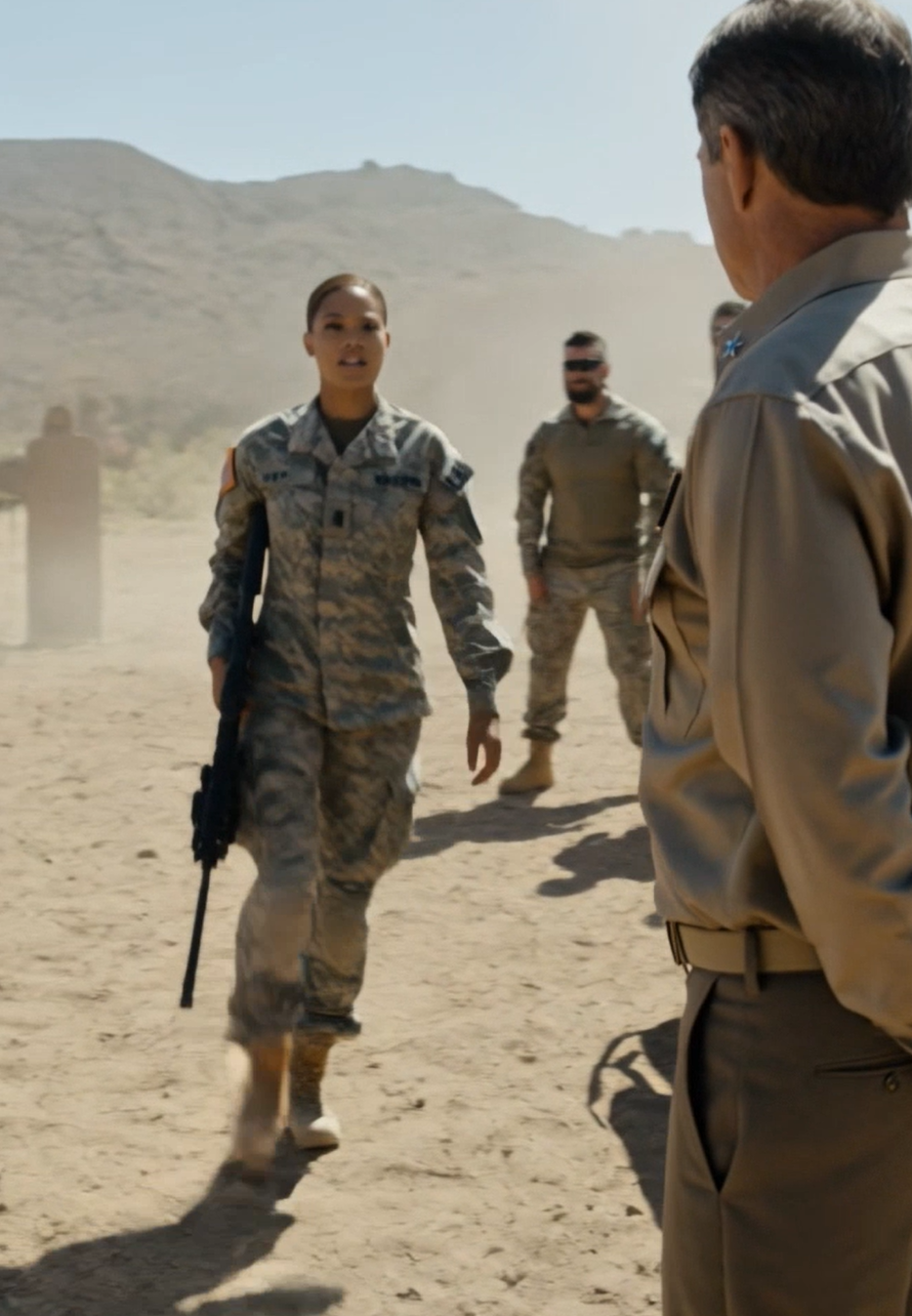
The Arizona heat didn’t just burn – it stripped you down to the raw truth of who you really were. Out on the range, the “real soldiers” stood lined up, their cool-guy beards and designer optics gleaming, taking turns missing a target so far away it might as well have been on the moon.
4,000 meters. One shot. No do-overs. No second chances to “walk it in.”
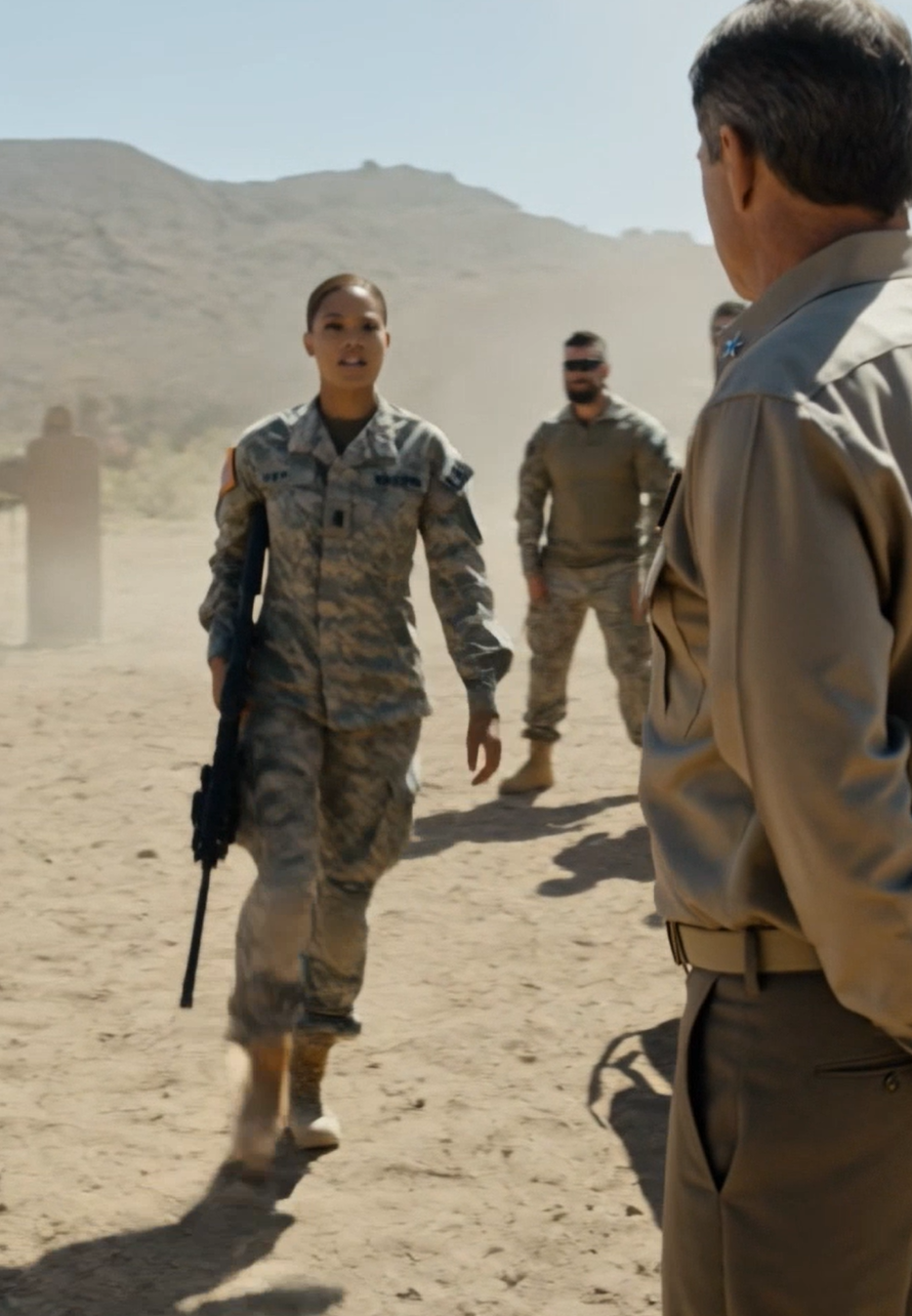
Thirteen of the best snipers on base.
Thirteen clean misses.
The wind howled sideways at the muzzle. Mirage shimmered on the valley floor. Dust devils swirled halfway to the target. Every excuse imaginable was on full display.
“Sir, the atmospherics are trash – “
“The flags are lying – “
“That bullet can’t even fly that far—”
General Carter stood motionless, staring at the mountain, jaw clenched, hands clasped behind his back. He looked like a man watching his faith die in slow motion.
Behind them, half in the shadow of the supply truck, I stood where I always did: out of the way, forgotten. Tablet tucked under my arm, hair pulled back tight, name tag reading CAPT BROOKS. My reputation was coffee girl, inventory princess, warehouse witch.
I was the one who made sure their ammo showed up on time. The one they shouted at when rounds were delayed. The one they joked about when they jogged past.
“Hey, Captain, you got any extra donuts in that magic supply cave?”
“Need more coffee, Office Girl. We’re doing the real work out here.”
Right. Real work.
Now, those same men were lying in the dust, shoulders burning, egos bruised, while a white steel plate two and a half miles away stayed perfectly—offensively—untouched.
General Carter turned, scanning the line as if hoping for a miracle to step forward and salute.
No one moved.
So I did.
“Sir,” I said, stepping out from behind the truck. My voice didn’t carry like his, but in the silence that followed, it might as well have been the shot heard around the world. “Request permission to take a lane.”
A laugh cracked from somewhere down the firing line. Sergeant Hollis—the loudest mouth on the range, the one who called me “Clipboard” like it was a slur—rolled onto his back in the dust, howling.
“Oh, this I gotta see. The supply captain’s gonna show us how it’s done.”
A few of the others snickered. One of them sat up on his elbows and made a show of dusting off his rifle like he was offering it to a toddler.
“Careful, ma’am. Recoil’s a real thing. Wouldn’t want you to chip a nail.”
I didn’t look at him.
I looked at General Carter.
And General Carter… didn’t laugh.
He didn’t smile. He didn’t shake his head. He didn’t even blink.
What he did do made every single man on that line stop breathing.
He came to attention. Slowly. Deliberately.
And then the four-star general of the entire Western Command—the man who chewed colonels for breakfast and made majors cry in their trucks—raised his hand to his brow and saluted me.
Held it.
Hollis’s grin slid off his face like melted wax. Someone behind him whispered, “What the f—”
“Captain Brooks,” the General said, his voice low and rough, the way a man speaks at a funeral. “The lane is yours. And gentlemen—” his eyes swept the line, ice cold, “—you might want to sit up for this. Because the woman you’ve been calling ‘Office Girl’ for the last eight months is the only reason half of you are still breathing after Kandahar.”
The dust seemed to stop moving.
Hollis’s mouth opened. Closed. Opened again.
“Sir… I don’t—”
“You don’t know,” Carter snapped, “because her file is classified above your pay grade. Above mine, technically. The only reason I know who she is, is because three years ago, at 4,200 meters, in worse wind than this, she put a single round through the throat of the man who was about to detonate a vest in a market full of children.”
He turned back to me. His voice softened, just a hair.
“Take your shot, Ghost.”
Ghost.
The callsign hit the line like a thunderclap. I saw it register on their faces one by one—the beards, the optics, the bravado—all of it draining out of them as they finally understood who’d been carrying their coffee.
I walked past Hollis. He couldn’t look at me.
I knelt down beside the rifle he’d just missed with. Ran my hand along the stock. Adjusted the bipod by a quarter inch.
Then I looked downrange at that little white plate, shimmering in the heat two and a half miles away.
And I smiled.
Because what none of them knew—not even the General—was that the real reason I’d been hiding behind a clipboard for the last eight months wasn’t a demotion.
It was an assignment.
And the target on that mountain?
It wasn’t a steel plate at all.
I chambered the round, settled into the glass, and as my finger curled against the trigger, I finally let myself look at what was really sitting in that valley.
Through the powerful scope, the world compressed. The shimmering mirage was a river of heat I had to cross. The distant white plate wasn’t just a plate.
Tucked just behind it, bolted to the metal frame that held the target up, was a small, grey box. It was no bigger than a paperback book, with a tiny, almost invisible black antenna.
It was designed to look like a shadow. Part of the mount. Insignificant.
To the naked eye, even with binoculars, you’d never see it. You had to know it was there. And you had to have the magnification to find it.
For seven weeks, I had tracked it. An anomalous signal. A tiny whisper of encrypted data being siphoned from the base’s secure network. It was brilliant. It piggybacked on the range’s own communication systems, hiding in plain sight.
The culprit was smart. They knew we ran long-range exercises here. They knew we set up targets on that mountain. They’d built their listening post into the very thing we were trying to shoot.
The only way to stop it, without revealing that we even knew about the breach, was to physically destroy it from a distance.
Make it look like a stray round. An accident. A lucky shot on a difficult day.
A day just like this.
I took a breath, letting half of it out. My world shrunk to the space between my eye and the scope. The wind was a living thing. It spoke a language of pressure and temperature. It told you its secrets, if you knew how to listen.
The flags were lying, Hollis had said. He was right. The little red flags they’d set up were only telling part of the story. They showed the ground wind.
But the bullet would travel through three different wind zones on its way there. It would climb into the thinner, faster air of the high valley, then drop back down through the churning thermals rising off the rocks.
I didn’t need the flags. I watched the dance of the dust devils. I saw the way the grass bent on a ridge a mile away. I felt the pressure change against my own cheek.
My calculations weren’t on a tablet. They were a feeling. An instinct honed over a thousand lonely hours.
Hold left for the spin drift. Hold high for the drop. Add twelve clicks for the wind you could see, and three more for the one you couldn’t.
And one extra click. For the soul of the machine.
My finger gently squeezed the trigger. There was no pull, no jerk. Just a slow, steady increase of pressure until the rifle decided it was time.
The world exploded in a controlled blast of sound and force. The rifle bucked hard against my shoulder, a familiar and comforting pain.
For a moment, I lost the target in the recoil.
Then the scope settled.
About seven seconds passed. An eternity. Enough time to live a whole life. Enough time to remember the market in Kandahar, the scent of spices and fear. Enough time to wonder if I’d made the right choice, coming back to this world.
Then, a tiny puff of dust and sparks erupted from the target stand.
It wasn’t the loud, satisfying clang of a bullet hitting a two-inch-thick steel plate.
It was a dull, hollow thwack. Followed by a fizzing sound so faint I almost thought I’d imagined it. A wisp of black smoke curled up from behind the plate.
The signal was gone.
Silence on the range.
Sergeant Hollis was the first to break it. He was peering through a spotter scope, his face pale.
“Hit,” he whispered, his voice choked with disbelief. “It’s a hit. But… not on the plate. It’s low. Just below it.” He looked up, confused. “She missed.”
Another sniper chimed in. “No, look. The whole mount is busted. Something’s smoking.”
General Carter walked over, his boots crunching in the gravel. He didn’t look at the target. He looked at me.
“Explain, Captain,” he said, his voice flat. Not an accusation. A demand for the truth he sensed was there.
I stood up, dusting off my knees. The “Office Girl” returning.
“Sir, there was a hostile device on that target mount,” I said quietly, so only he could hear. “A data exfiltration unit. It was stealing classified network traffic.”
His eyes widened, just for a second. The implications hit him like a physical blow. A breach of that magnitude, on his watch…
“How?” he rasped.
“It was placed there by the contractor who services the ranges,” I continued. “A Mr. Davies. His company installed those new target stands three months ago.”
“How do you know this?” The General’s voice was sharp. This was moving fast.
This was the part I hadn’t planned on. This was the moment my cover evaporated completely.
“He’s been ordering specialized, long-life lithium batteries. Military grade. But he’s been billing them to a civilian account and having them delivered to a P.O. box,” I said. “I saw the procurement anomaly in the supply logs two months ago.”
My clipboard. My inventory. The things they all laughed at.
“The order didn’t make sense for a guy who just hangs steel plates,” I said. “So I ran a check on the battery type. It’s the primary power source for a very specific, very illegal aether-net tap. I cross-referenced the delivery dates with the days the network showed micro-second lags. They matched.”
The General stared at me. The hard lines of his face seemed to soften, replaced by a look of sheer, unadulterated astonishment.
“You found an enemy spy ring… by doing inventory?”
I gave a small shrug. “Someone has to make sure the numbers add up, Sir.”
A smile, the first I’d ever seen, touched the corner of his mouth. It vanished as quickly as it appeared.
He turned. “Hollis! Get on the horn. I want Military Police to pay a visit to a Mr. Davies of ‘Davies Range Solutions.’ Place him in custody. Tell them to search his workshop for communications equipment. Tell them it’s on my authority.”
Hollis, who had been trying to overhear our conversation, jumped as if struck by lightning. “Sir, yes Sir!” He scrambled for the radio, his entire demeanor changed. He wasn’t arrogant anymore. He was terrified and impressed.
General Carter turned back to me. The other snipers were keeping their distance, watching us with a mixture of awe and fear. They were looking at a ghost, and they knew it.
“Your file said you retired from field ops, Captain. That Kandahar was your last shot.”
“It was,” I said honestly. “I requested a transfer to Logistics. I was tired of the noise.”
Tired of the weight. The rifle was heavy, but the responsibility was heavier. After Kandahar, I’d sworn I was done. I just wanted to count boxes. I wanted a job where the worst thing that could happen was a misplaced shipment of toilet paper.
Fate, it seemed, had other plans.
“Somehow, I don’t think you’re meant for a quiet life, Brooks,” the General said. He looked over my shoulder at the thirteen defeated men. “These boys are the best shots we have. And they couldn’t see it.”
“They were trying to hit the target, Sir,” I replied. “I was trying to solve a problem. It’s a different mindset.”
He nodded slowly. “Indeed.” He paused, a thought flickering in his eyes. “Tell me one more thing. If you knew the device was there, why this whole charade? Why wait for all of them to fail? Why not just tell me?”
It was a fair question. The twist I hadn’t revealed.
“Because the man who put it there needed to believe it was a fluke,” I said. “He needed to think a stray round got lucky. If I’d come to you, we would have launched a full-scale investigation. He would have been spooked, wiped his systems, and we’d have lost his entire network.”
I took a breath, letting the final piece fall into place.
“And besides,” I said, a little more softly. “Mr. Davies wasn’t just the contractor, Sir. He’s been on the range with us all morning.”
I subtly inclined my head towards a man standing near the supply truck. A civilian in a dusty polo shirt and a baseball cap, holding a tablet of his own. He was one of the technical reps for the electronic scoring system.
The man who had been conveniently “monitoring atmospheric conditions” for everyone.
The man who had just a moment ago been smiling, but was now looking very, very nervous.
General Carter’s eyes followed my gaze. His face turned to stone. He understood immediately. The rep wasn’t just a spy; he was his own spotter, watching and waiting to confirm his device was still safely transmitting.
“He needed to see his own device destroyed by what looked like an impossible, lucky shot from a low-level supply captain,” I finished. “He needed to be humbled. To be sure it was over. So he wouldn’t try to activate a failsafe.”
The General’s jaw worked silently for a moment. He raised his hand to his radio. “Sergeant, amend that order. Apprehend the civilian range tech. Name of Davies. He’s standing twenty feet from your position. He is the primary target.”
Hollis’s voice crackled back over the radio, confused but obedient. “Sir?”
“Just do it, Sergeant!” Carter barked.
We watched as two of the other snipers, now acting as impromptu military police, strode over to the very surprised Mr. Davies. The man’s face went from confusion to panic to resignation in the space of five seconds.
The trap had closed.
The day ended. The sun began its slow descent, painting the sky in colors of orange and purple. The snipers packed up their gear, quieter now, more thoughtful.
As I was about to head back to the warehouse, a shadow fell over me. It was Sergeant Hollis.
He held his helmet in his hands. His face, stripped of all its earlier bravado, looked younger, uncertain.
“Captain,” he started, then stopped. He couldn’t seem to find the words.
“It’s alright, Sergeant,” I said. My voice was gentle. There was no victory in rubbing it in.
“No, Ma’am, it’s not,” he said, finally meeting my eyes. “I… we… we were fools. Arrogant. I disrespected you. And I disrespected the uniform you wear.”
He took a deep breath. “What you did today… it was the greatest display of skill I have ever seen. Not just the shot. All of it. The planning. The… the whole thing.”
He held out his hand. “I am sorry, Captain Brooks.”
I looked at his hand, then back at his face. I saw genuine remorse there. I saw a man who had learned a hard lesson.
I shook his hand. “Just do your job, Sergeant. That’s all anyone asks.”
He nodded, a weight seemingly lifted from his shoulders. “Yes, Ma’am.”
As he walked away, General Carter came and stood beside me. We watched the last of the trucks roll out.
“They’ll never call you ‘Office Girl’ again,” he said.
“That’s a shame,” I replied, a small smile on my lips. “I was just getting used to it.”
He chuckled, a low, rumbling sound. “I’m re-opening your field file, Ghost. The world needs people who can solve problems, not just hit targets.”
I looked out at the mountain, at the place where a tiny box had once threatened to bring down a mountain of secrets. My clipboard lay on the seat of my truck. My rifle was cased in the back. They weren’t opposing forces. They were two different tools for the same job: to serve, to protect, to see what others don’t.
True strength isn’t always loud. It isn’t always dressed in tactical gear or announced with a bang. Sometimes, it’s quiet. It’s found in the numbers, in the details, in the thankless jobs no one wants. Sometimes, the most powerful person in the room is the one nobody is watching. And sometimes, the hand that holds the clipboard is the same one that can steady a rifle and change the world, one impossible shot at a time.