
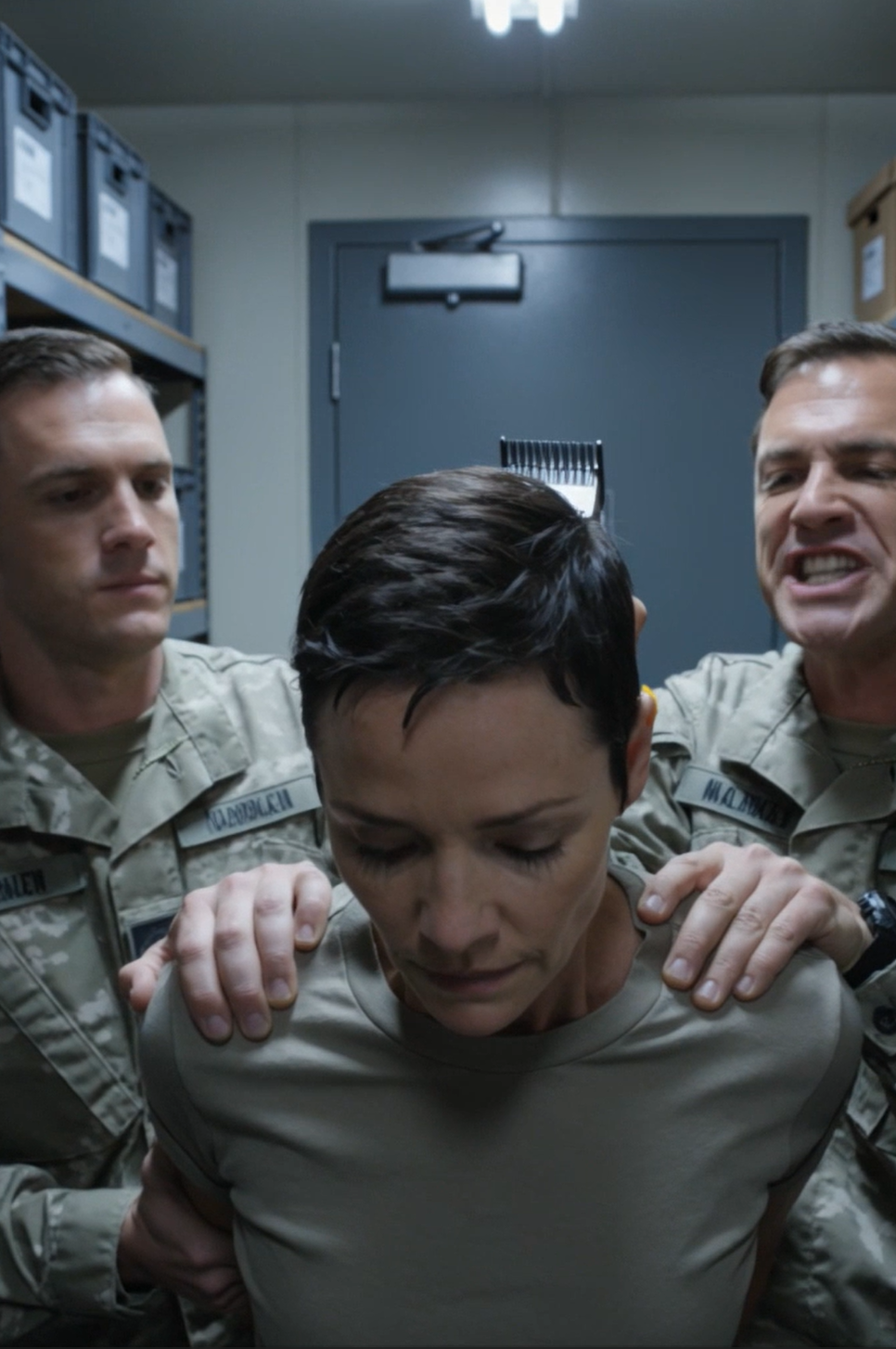
The clippers buzzed an inch from my scalp.
“Hold her still,” Sergeant Bruce Daley sneered. “Captain’s orders. She needs to learn what discipline looks like.”
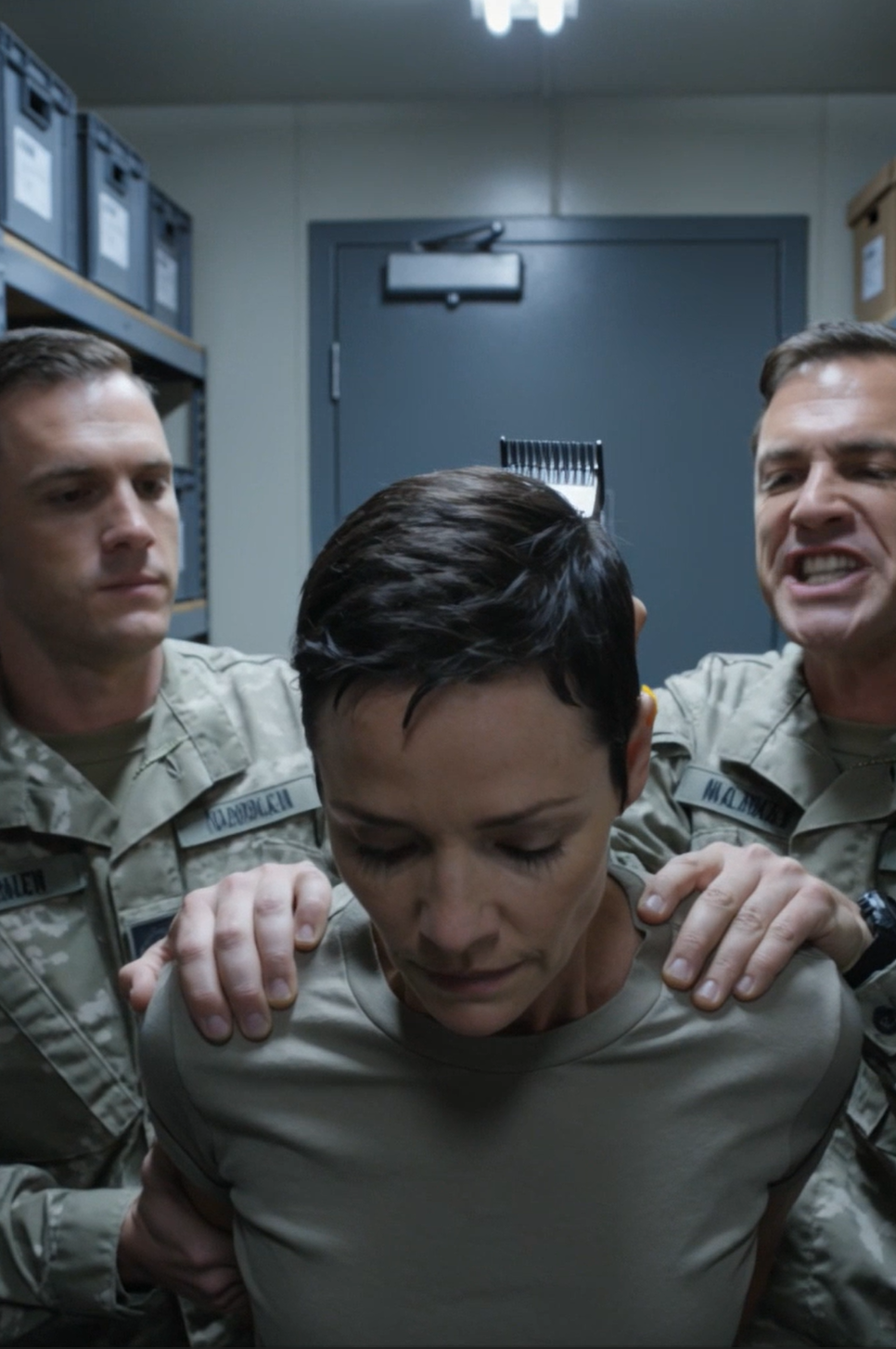
Two privates gripped my arms. I didn’t fight. I just stared at the floor of that supply closet, counting the names I had memorized over the past six weeks.
Forty-three names. Forty-three soldiers extorted, humiliated, or buried in falsified paperwork.
They thought I was Diane Ross. A nobody. A washed-up forty-four-year-old transfer with a bland file and tired eyes. The perfect target.
For six weeks at Fort Morrison, I had scrubbed latrines at 3 AM as “corrective training.” I had watched Captain Wendy Schroeder pocket reenlistment bonuses meant for privates. I had photographed ledgers. I had recorded Major Glenn Tomlin laughing about the soldier he drove to a hospital bed last spring.
I had everything. Every receipt. Every voice memo. Every name.
But tonight, they crossed the final line. Tonight was supposed to be my “welcome ceremony” – the ritual they did to every female transfer who didn’t smile wide enough. Shave her head. Film it. Pass it around the officers’ club for laughs.
Daley leaned close. His breath smelled like cheap whiskey. “Smile, Ross. You’re about to be famous.”
The clippers touched my skin.
That’s when the supply closet door creaked open behind him.
Daley didn’t even turn around. “Get out. This is a private session.”
The voice that answered wasn’t a private’s voice. It wasn’t scared. It was calm. Cold. Familiar in a way that made Daley’s hand freeze mid-air.
“Sergeant Daley. Step away from Colonel Hayes.”
The clippers dropped. The privates released my arms like I was on fire.
I stood up slowly, brushed the hair off my shoulders, and turned to face the man in the doorway. Behind him stood twelve MPs in full gear, and behind them – every single officer on my list, already in cuffs, already pale, already realizing.
Captain Schroeder saw my face. Really saw it. And she whispered the one word that told me she finally understood who I was.
But it wasn’t my rank that made her knees buckle in that hallway. It was what I pulled out of my pocket next – the one thing she’d sworn six weeks ago could never exist…
It was a single dog tag, dangling from a tarnished silver chain.
I held it up so the cheap fluorescent light caught the name stamped into the metal. PACE, A.
Captain Schroeder’s face went from pale to the color of ash. Her tough, commanding posture dissolved into nothing.
“No,” she breathed, the word a tiny puff of air. “It can’t be. We searched… we took everything.”
I took a step closer to her, my voice low and clear, cutting through the stunned silence of the hallway. “You took everything from Private Aaron Pace. His bonus, his dignity, and finally, his life.”
I let my gaze drift to Major Tomlin, who was being held firmly by two stern-faced MPs. His bravado was gone, replaced by a twitching nerve in his jaw.
“You called it a training accident, Major,” I said, my voice rising just enough to carry. “You said he panicked during a night-time vehicle exercise. You falsified the report.”
Tomlin didn’t answer. He just stared at the dog tag in my hand.
I turned my attention back to Schroeder. “But you were the one who cleaned it up, weren’t you, Captain? You were the one who went to his personal effects. You made sure there was nothing to contradict the official story.”
Her eyes were wide with a terror that was almost primal. “I don’t know what you’re talking about.”
“You told Sergeant Daley that Private Pace’s dog tags were lost in the accident,” I continued, ignoring her denial. “You personally signed the report. You swore they were gone forever.”
I let the tag swing gently from my fingers. “So tell me, Captain. How did I find this in the lining of the duffel bag you stored in your own off-base locker?”
That was it. That was the moment her world shattered. The carefully constructed fortress of lies she’d built for years crumbled with the weight of one small piece of metal.
She looked at her co-conspirators, her eyes pleading. But they were all staring at the floor, at the walls, anywhere but at her. The chain of corruption had broken.
“You see,” I said, my voice softening just a little, “for six weeks, I wasn’t just Diane Ross, the new transfer. I was the person cleaning your offices late at night. The one restocking your supply closets.”
I remembered the feel of the lock pick in my hand as I opened her locker. The quiet click in the dead of night.
“I was the one you never saw,” I finished.
The senior MP, a Master Sergeant with a face like carved granite, stepped forward. “Colonel Hayes, your orders?”
I looked at the assembled forty-three faces of greed and cruelty. From the Major who ran the show down to the privates who acted as his muscle.
“Process them all,” I said. “Every single one of them. I want full statements. No deals. The evidence is airtight.”
As the MPs led them away, a parade of defeated power, I finally felt the exhaustion of the past six weeks settle into my bones. I had lived on four hours of sleep a night, eating cold rations and feigning incompetence.
I remembered mopping the latrine floor while Daley stood over me, making jokes about my age. I had smiled meekly and found the perfect spot under the sink to hide a tiny microphone. It recorded everything for three weeks.
I remembered working a shift in the mess hall, listening to two finance clerks complain about how Schroeder made them re-route bonus payments to her offshore account. I befriended one of them, a young man named Simon Carter, who was drowning in debt after his own bonus mysteriously vanished.
He was scared, but he was good. He was the first person who trusted me, the first crack in their wall of silence. He fed me schedules, times, names.
He thought he was helping a fellow downtrodden private get some justice. He had no idea what he had set in motion.
The hallway was quiet now, save for the hum of the lights. The man who had first called out my name, General Mark Peterson, walked towards me from the end of the hall. He had been my commanding officer and mentor for twenty years.
“It’s over, Katherine,” he said, calling me by my first name for the first time in what felt like a lifetime.
I finally let myself breathe. “It’s over, sir.”
He looked at the discarded clippers on the floor. “They were really going to do it.”
“It’s what they do, Mark,” I said, my voice weary. “They prey on anyone they see as weak. It’s not about discipline. It’s about power.”
He put a hand on my shoulder. “You did more than just expose them. You gave this entire base its soul back.”
The days that followed were a blur of debriefings, reports, and legal proceedings. The 43 members of the corruption ring were formally charged with everything from extortion and fraud to negligent homicide and conspiracy.
The story of “Diane Ross” spread like wildfire through Fort Morrison. The quiet, middle-aged woman everyone had ignored or belittled was actually Colonel Katherine Hayes, an internal affairs legend known as ‘The Ghost.’
Soldiers I’d never spoken to would stop and salute me, a look of awe and gratitude in their eyes. The fear that had permeated the base for years was gone, replaced by a cautious sense of hope.
I made sure that every soldier who had been cheated received their stolen money, with interest paid out of the seized assets of Schroeder and her cronies. Young Simon Carter, the mess hall cook, was given a formal commendation for his courage. I personally went to his promotion ceremony.
He came up to me afterward, his new corporal stripes gleaming on his sleeve. “Ma’am… Colonel… I had no idea.”
“You just knew something was wrong, and you did the right thing, Simon,” I told him. “That’s all that matters. You’re the kind of soldier this army needs.”
My work at Fort Morrison was done, but one last task remained.
A week later, I drove my civilian car down a quiet suburban street in Ohio. I parked in front of a small, neat house with a perfectly manicured lawn and a flag flying from the porch.
A woman with kind eyes and hair the color of my own answered the door. Her name was Mary Pace. We had been roommates at West Point, best friends for over two decades. She was Aaron’s mother.
She knew about the arrests. It had been all over the news. But she didn’t know the whole story.
“Kathy,” she said, her voice thick with emotion as she pulled me into a hug.
We sat at her kitchen table, the same one where Aaron used to do his homework. I told her everything. I told her how her son hadn’t panicked, how he had been a good soldier targeted by bad men.
And then, I took the chain from my pocket.
“They said it was lost,” she whispered, her fingers tracing the worn letters of his name. Tears streamed down her face, but for the first time in a year, they weren’t tears of just sorrow. There was relief in them. There was peace.
“He was a hero, Mary,” I said softly. “They tried to take that away from him. But they couldn’t.”
We sat there for a long time, two old friends sharing in a quiet, painful victory. When I left, she hugged me again, squeezing my hand tightly.
“You kept your promise,” she said.
I had. When Aaron was killed, and the official report felt so wrong, I had promised her I would find the truth, no matter what it took. Going undercover as Diane Ross was the only way.
Back in Washington, during my final debrief with General Peterson, he slid a file across the table.
“One last thing has been puzzling the investigators,” he said. “The timing of the takedown. It was perfect. Almost too perfect.”
He leaned forward. “Your plan was to extract yourself the next morning. But the raid happened that night, right as Daley was about to assault you. Your emergency signal wasn’t activated. So how did we know to go in right at that moment?”
I smiled, a real smile this time. “It wasn’t me, sir.”
I told him about Simon Carter. About how, from his post in the mess hall, he had seen Daley and the two privates dragging me towards the supply closets. He knew what that ‘welcome ceremony’ meant; he’d seen it happen before.
He couldn’t intervene himself, but he remembered the burn phone number I had given him for emergencies, a direct line to the General’s aide.
“A private saw something wrong,” I explained. “And he made a phone call. He didn’t know who he was calling. He just knew he had to do something.”
General Peterson sat back in his chair, a slow look of understanding spreading across his face. He was a man who understood strategy, tactics, and force. But this was something different.
“All that planning,” he mused. “All that evidence, all those resources. And in the end, it all came down to one kid in a kitchen who decided to be brave.”
That was the real lesson. It wasn’t about my rank or my investigation. It was about the fact that corruption thrives in silence, when good people are too afraid to speak up.
They thought I was weak, a nobody, the perfect victim. They were wrong. But what they really misjudged was the courage of the very people they stepped on every day. They thought power came from stripes on a sleeve or money in a hidden account.
They never understood that true strength, the kind that can bring down empires, can be found in a whispered promise between friends, in the quiet integrity of a young soldier, and in the simple, unshakable belief that no one is a nobody.



