The mahogany courtroom felt suffocating, like the wood itself was designed to bury the truth. I sat at the witness table, tracing the rim of a paper cup with my thumb. My hands were steady. They are always steady.
It’s the one thing the military spent millions perfecting. The one thing they couldn’t take from me, even after they took the uniform.
I wore a faded gray sweater and worn jeans. In a room filled with pristine Navy whites and gleaming ribbons, I looked like a stray dog who’d wandered into a palace.
And they made sure I felt it.
Across the aisle sat Captain Brenda Holcomb. Immaculate uniform. Perfect posture. The decorated hero the public believed her to be.
But I knew what she had done in the dusty valleys of Kunar Province. I knew how she ordered an evacuation and left three of my spotters to bleed out because extracting them would have risked her transport.
Holcomb assumed there were no survivors. She hadn’t counted on the sniper positioned six hundred yards up the ridge, watching the entire betrayal through a scope.
Three years and fourteen surgeries later, I was here to testify. But a medical discharge and a redacted file had stripped me of rank and uniform. On paper, I was just “Ms. Cheryl Wagner, civilian contractor.”
Lieutenant Commander Darrell Tipton paced the floor like a shark in tailored cloth. He stopped and turned mocking eyes toward me.
“Ms. Wagner,” he began, voice dripping condescension. “You claim you were on Ridge 4. You claim visual confirmation of Captain Holcomb’s departure. And, most miraculously, you claim you are a Tier-One marksman. A sniper.”
A murmur rippled through the gallery of Holcomb’s loyalists.
“I am,” I said quietly. My voice carried. A voice used to cutting through wind on a mountain pass.
Tipton laughed theatrically. “Records show you as a logistics coordinator. A supply clerk injured in a mortar attack. No record of elite training. No record of a rifle.”
“The records are classified,” I said evenly. “Because my unit didn’t officially exist.”
“How convenient,” Tipton sneered. “A phantom sniper. A ghost in civilian clothes accusing a decorated officer of treason.”
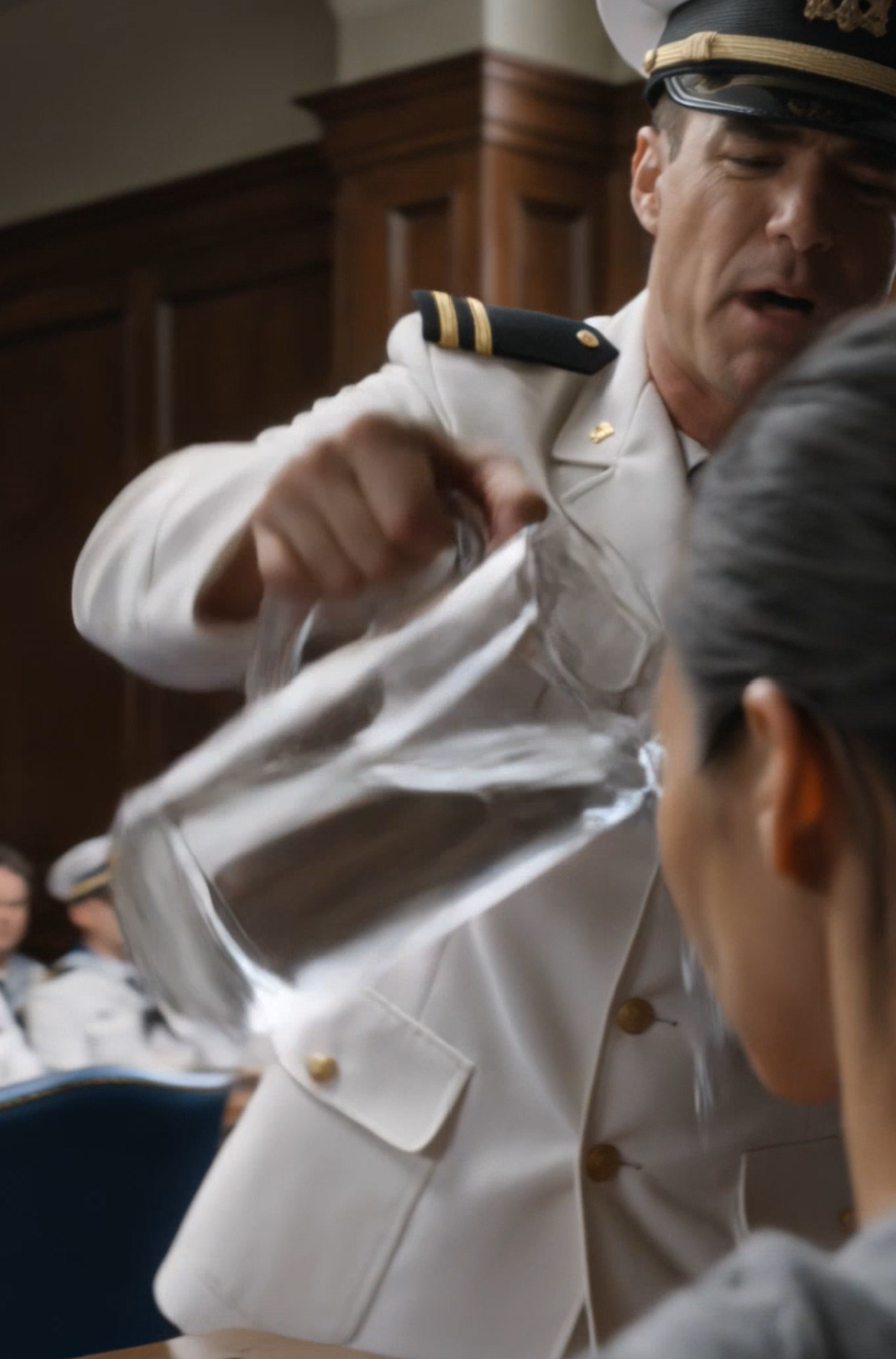
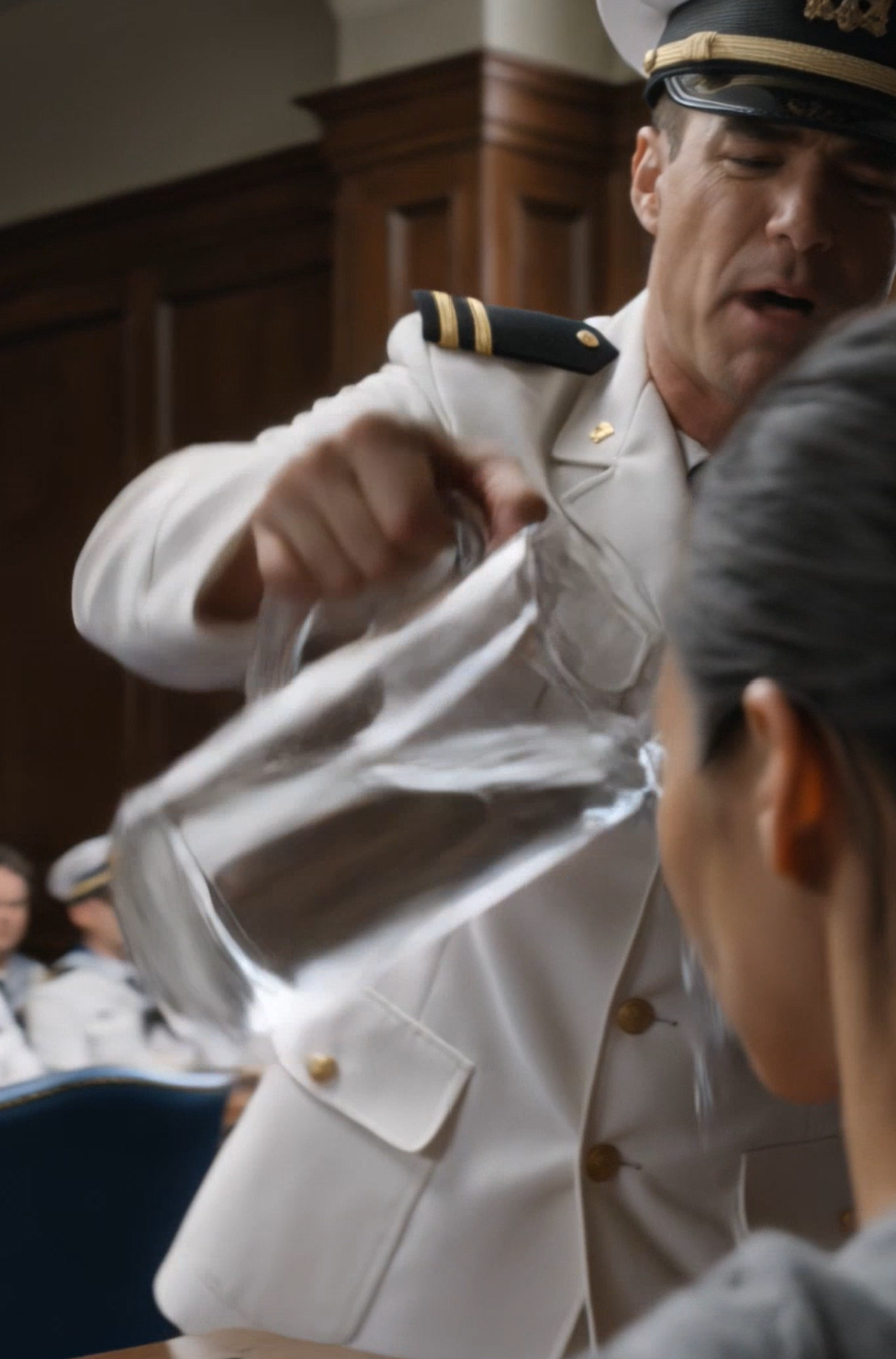
Then he seized the water pitcher – and hurled its contents in my face.
The room gasped. Water dripped from my jaw onto the mahogany. I didn’t flinch. My hands remained steady.
At the bench, Admiral Lorraine Pickett slowly rose.
The gallery froze.
With deliberate precision, she raised her hand and saluted me.
“Ma’am,” she said, her voice cracking through the silence like a rifle shot, “on behalf of operations this court was never cleared to know existed…”
And then she said the six words that made Tipton drop the pitcher and turned Captain Holcomb’s face the color of bone.
“We recovered the data from your scope.”
The heavy glass pitcher slipped from Tipton’s numb fingers. It hit the floor and shattered, the sound unnaturally loud in the dead-quiet room.
I finally allowed myself to blink, clearing the water from my eyelashes. I looked at Holcomb.
The mask of decorated confidence had shattered along with the pitcher. Her face was a ruin of terror, her mouth a perfect ‘O’ of disbelief. Her carefully constructed world had just been leveled by six simple words.
Admiral Pickett’s gaze never left me. Her salute remained, a rigid, unwavering sign of respect that silenced every whisper and every doubt.
“Lieutenant Commander Tipton,” the Admiral said, her voice dropping to a dangerously low temperature. “You will stand down. Now.”
Tipton, who had been staring at the shards of glass at his feet as if they were his own career, snapped his head up. He looked from the Admiral to me and back again, his mind failing to compute the new reality.
The smirk was gone, replaced by a dawning horror. He had just assaulted a witness who was, apparently, under the personal protection of a four-star Admiral.
“Admiral, I… I was merely testing her composure,” he stammered, his bravado evaporating like a puddle in the desert.
“You are a disgrace to that uniform, Darrell,” Pickett said, her voice cutting him down. “Bailiff, escort the Lieutenant Commander to my chambers. He will wait for me there.”
Two stone-faced Marines stepped forward, their presence suddenly feeling more ominous. Tipton, pale and trembling, was led away without a backward glance. The shark had been defanged.
Then, the Admiral’s attention turned to the real target. “Captain Holcomb, please rise.”
Holcomb rose, but it was a mechanical, puppet-like movement. The strings of her composure had been cut.
“Admiral Pickett, I can explain,” she began, her voice thin and reedy.
“No, Captain, you cannot,” the Admiral interrupted, finally lowering her salute to me. She picked up a small remote from her bench. “But she can.”
The Admiral gestured to me. Her eyes held an apology for what I had endured in this room. And they held a promise of justice.
“As Ms. Wagner stated,” the Admiral announced to the court, “her unit was classified. So classified, in fact, that their operational gear was two generations ahead of anything in standard inventory.”
She pointed the remote at a large screen on the wall, which until now had been dormant. “Every action, every shot, every second of observation through the scope of her rifle was recorded. Encrypted, time-stamped, and geo-tagged.”
The screen flickered to life.
My own breath hitched. I hadn’t known they recovered it. I thought the data was lost with my rifle when I was hit.
The image that appeared was one I had seen a thousand times in my nightmares. It was the valley, viewed through the familiar crosshairs of my scope. The quality was impossibly clear.
You could see the heat haze rising from the rocks. You could see the dust kicked up by the boots of my spotters, Elias, Ben, and Marcus, as they took cover behind a low wall.
“This is the feed from Ms. Wagner’s rifle, designation ‘Wraith’, on the day in question,” the Admiral explained.
The video played. It was silent, but I could hear it all in my head. The crackle of the radio. The distant pop of enemy fire. Ben’s laughter from an hour before, telling a stupid joke.
I watched as Holcomb’s transport, a state-of-the-art Osprey, landed in the designated safe zone a click away. It was supposed to be the first of two pick-ups. One for her personnel, one for my team.
But then the court saw what I saw. Holcomb’s team scrambled aboard. My men were signaling, their position clearly compromised, taking sporadic fire.
On the screen, my crosshairs zoomed in on Captain Holcomb standing on the Osprey’s ramp. She looked at her watch. Then she looked directly toward my team’s position.
She knew they were there.
Then she gave the signal. Not a signal to wait, but a sharp, dismissive wave to the pilots. A wave to go.
The ramp began to close. The Osprey’s rotors kicked up a massive cloud of dust, and it lifted off. It left them behind.
My hands, which had been so steady, were now clenched into fists on the table. The grief was a physical thing, a rock in my throat.
“As you can see,” Admiral Pickett’s voice narrated the cold betrayal, “Captain Holcomb made a choice. She abandoned three American soldiers.”
A collective gasp went through the gallery. Holcomb’s loyalists were now silent.
“That’s not… It was a tactical decision!” Holcomb cried out, her voice breaking. “The landing zone was hot! I was saving the transport and my crew!”
“Your crew?” the Admiral said, her voice laced with ice. “Or your career? An inquiry into a damaged transport would have delayed your promotion, wouldn’t it, Brenda?”
Holcomb paled further. She had no answer.
But the Admiral wasn’t finished. This was the first twist, the one I knew was coming. The next one, however, was a surprise even to me.
“But abandoning your comrades was only your second-worst crime that day,” the Admiral stated. “Let’s examine the first.”
She spoke into the remote. “Computer, rewind to timestamp 14:32:05. Enhance audio.”
The recording spooled back. My scope was still focused on Holcomb, who was speaking into her wrist-comm just before she boarded the Osprey. The scope’s high-sensitivity microphone, a feature I barely used, had picked up her words.
Her voice, tinny and distorted but clear enough, echoed through the silent courtroom.
“…the coordinates are confirmed. Ridge 4. The asset is exposed. You have a thirty-minute window after I depart.”
A cold dread, colder than any mountain wind, washed over me. Ridge 4. That was my position. I was the asset.
The Admiral paused the video. She looked at Holcomb, her face a mask of pure revulsion.
“That wasn’t a call to Command, was it, Captain?” the Admiral asked softly. “You weren’t coordinating extraction. You were giving up the position of your own sniper.”
The room spun. It wasn’t just abandonment. It was a setup. She was talking to the enemy. Or someone who was.
“No,” Holcomb whispered, shaking her head frantically. “No, you don’t understand.”
“Oh, I think we’re all beginning to understand,” the Admiral replied. “Lieutenant Commander Tipton mentioned a mortar attack. The one that nearly killed Ms. Wagner and led to her ‘logistics clerk’ cover story.”
She turned to the gallery. “That attack wasn’t random enemy fire. It was a targeted strike, precise and deadly, meant to eliminate the one witness to Captain Holcomb’s treason.”
It all clicked into place. The sudden, accurate barrage. The fact that they knew exactly where my hide was. Holcomb hadn’t just left my team to die. She had tried to have me murdered to cover it up.
But why? What was worth that much?
The Admiral answered the question before it could fully form in my mind.
“We wondered what could possibly motivate a decorated officer to commit such a heinous act. Money? Ideology? Blackmail?” Admiral Pickett continued, walking down from the bench to stand in the center of the room.
“It turns out,” she said, her eyes boring into Holcomb, “it was simply about access. The enemy didn’t want our secrets. They wanted our supply lines.”
The pieces fell into place with a sickening crash.
“Captain Holcomb’s family has a shipping business. A business that was on the verge of bankruptcy. Until it magically received a series of lucrative, private contracts to move ‘goods’ in and out of active war zones.”
The Admiral’s gaze swept the room. “She wasn’t selling secrets. She was selling safe passage. For a price, she would create ‘black spots’ in our operational awareness. Dead zones where enemy suppliers could move their own materials without interference.”
My men weren’t just abandoned. They were a sacrifice made to create one of those black spots. And I was the loose end she needed to tie up.
Holcomb finally broke. A gut-wrenching sob escaped her lips, and her perfect posture collapsed. She sank into her chair, a disgraced officer who had traded American lives for shipping contracts.
“Captain Brenda Holcomb,” the Admiral’s voice boomed with authority. “You are hereby stripped of your command and rank. You are under arrest for treason, conspiracy, and the murders of Petty Officer Elias Thorne, Petty Officer Benjamin Carter, and Specialist Marcus Cole.”
At the mention of their full names and ranks, a tear I hadn’t allowed myself to shed for three years finally traced a path through the water on my cheek. They were being seen. They were being honored.
The two Marines who had escorted Tipton out returned. They moved past him and stood on either side of Holcomb. She didn’t resist as they pulled her to her feet. As they led her away, her perfect white uniform seemed to mock the person wearing it.
The courtroom began to clear, a low buzz of shocked conversation filling the air. Soon, it was just me, Admiral Pickett, and the ghosts of my men.
The Admiral walked over to my table. She looked down at my worn jeans and gray sweater.
“I’m sorry you had to go through that, Chief Wagner,” she said, using a rank I hadn’t held in years.
“It was worth it, Admiral,” I said, my voice thick with emotion. I finally felt the tension leave my body, the tightness in my shoulders that had been my constant companion for three years.
“Your official record, your real one, is being reinstated as of this moment,” she said. “Full honors. Full benefits. And the back pay will be substantial.”
I nodded, grateful but knowing it could never bring my men back.
“They posthumously awarded you the Navy Cross for your actions after the mortar strike,” she continued softly. “Even wounded, you managed to hold off their advance long enough for a Ranger unit to stumble upon the firefight. You saved them, Cheryl. You saved an entire platoon after Holcomb sold you out.”
This I didn’t know. In the haze of pain and surgery, the details were blurry. All I remembered was the cold certainty that I would die on that ridge, but I would take as many of them with me as I could.
“The men you left behind,” I said, my voice barely a whisper. “Elias, Ben, Marcus. Their families need to know they were heroes, not victims.”
“They will,” the Admiral promised. “Their records will be amended to reflect death in action, killed by the enemy. They will receive the honors they are due. I will see to it personally.”
We stood in silence for a moment. Then she surprised me again.
“What’s next for you, Chief?”
I just shrugged. “I don’t know, Admiral. I’m good at one thing. It’s not a skill you can put on a resume.”
A small, genuine smile touched her lips. “On the contrary. People with your integrity and skillset are exactly what we need. We’re putting together a new unit. An internal affairs division for the unconventional warfare community. Ghosts watching ghosts.”
She paused, letting the offer hang in the air. “We need someone to lead the training. Someone to teach new recruits what honor and steadiness under pressure really look like. Someone who knows the difference between a tactical decision and a moral failure.”
She was offering me a way back. Not to the ridges and the dust, but to a new kind of front line. A way to ensure this never happened again.
“I’ll think about it,” I said, but we both knew my answer.
A few months later, I stood on a windy training range. The air smelled of gunpowder and crisp autumn leaves. I wasn’t wearing a gray sweater, but a proper instructor’s uniform.
In front of me was a class of young, hopeful soldiers, men and women from every branch, all vying for a spot in a program that didn’t exist on paper.
My hands were steady as I held up a single, spent shell casing.
“This is just a piece of brass,” I told them, my voice carrying easily over the wind. “The rifle is just wood and steel. The scope is just glass. They are tools. They are not what make you a warrior.”
I looked into their eager faces. “Your heart. Your integrity. Your willingness to stand for the person next to you, even when the whole world tells you to run. That is what makes you a warrior.”
Behind me, on a small, granite wall, were three newly carved names: Elias Thorne, Benjamin Carter, and Marcus Cole. Their sacrifice would not be in vain. Their watch was over.
Mine was just beginning.
The path to justice is often long and difficult, hidden in shadows and classified files. But the truth, like a well-aimed shot, only needs one chance to hit its mark. True honor is not measured by the ribbons on your chest, but by the quiet integrity of your actions when you think no one is watching.