
Part 2
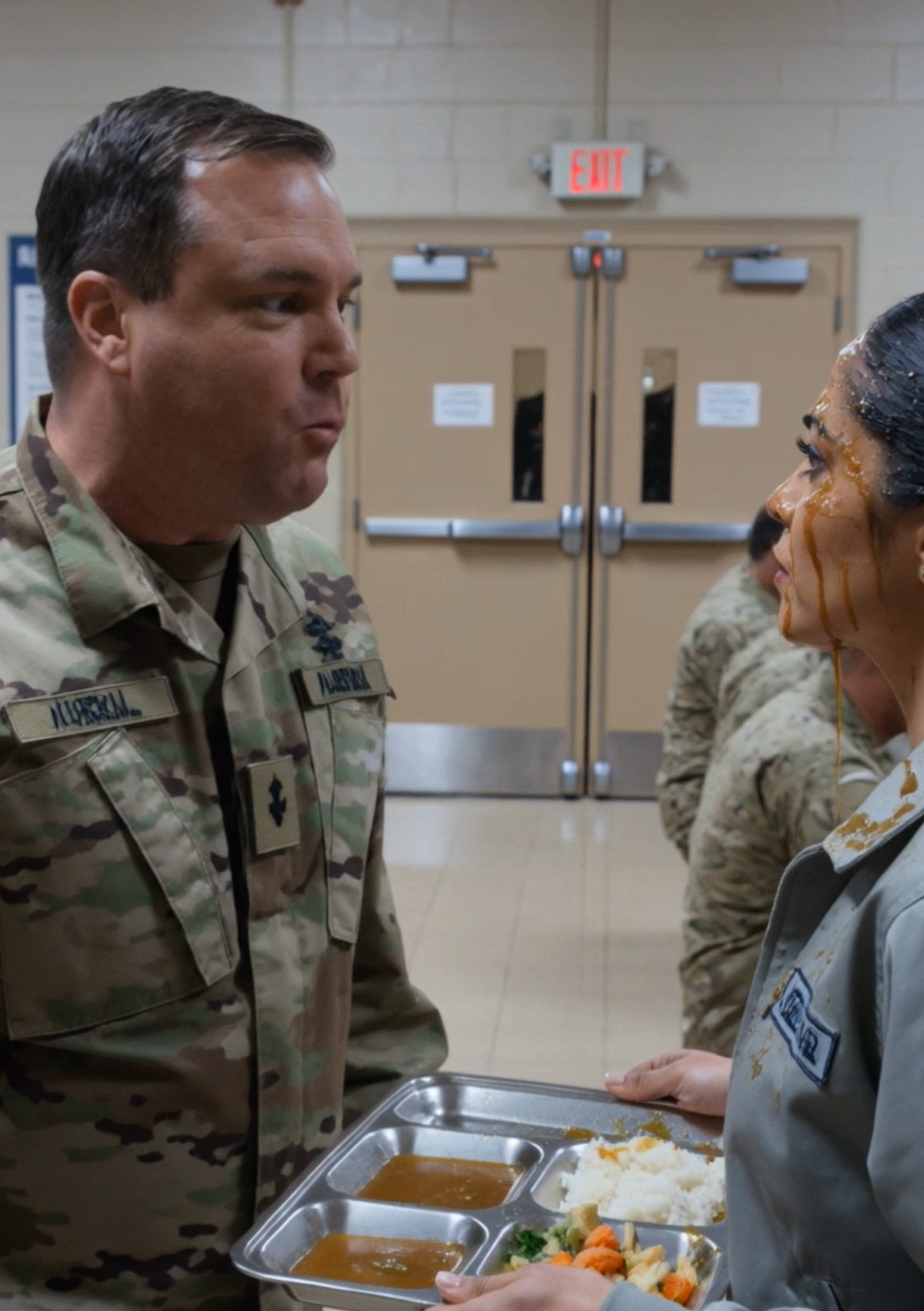
Valerie didn’t turn around right away. She set her tray down on the rail, slow and deliberate, the way someone disarms a bomb. The line went quiet. A young private behind her took one step back, sensing the air shift.
“Excuse me?” she said. Her voice was soft. Too soft.
Harlow laughed. He looked her up and down – the dusty trail shoes, the unzipped jacket, the loose ponytail – and shook his head like he’d seen a hundred lost spouses wander onto his base before. “You heard me, ma’am. You wanna eat? There’s a Denny’s off Exit 14. Civilians don’t belong in the chow hall during turnover.”
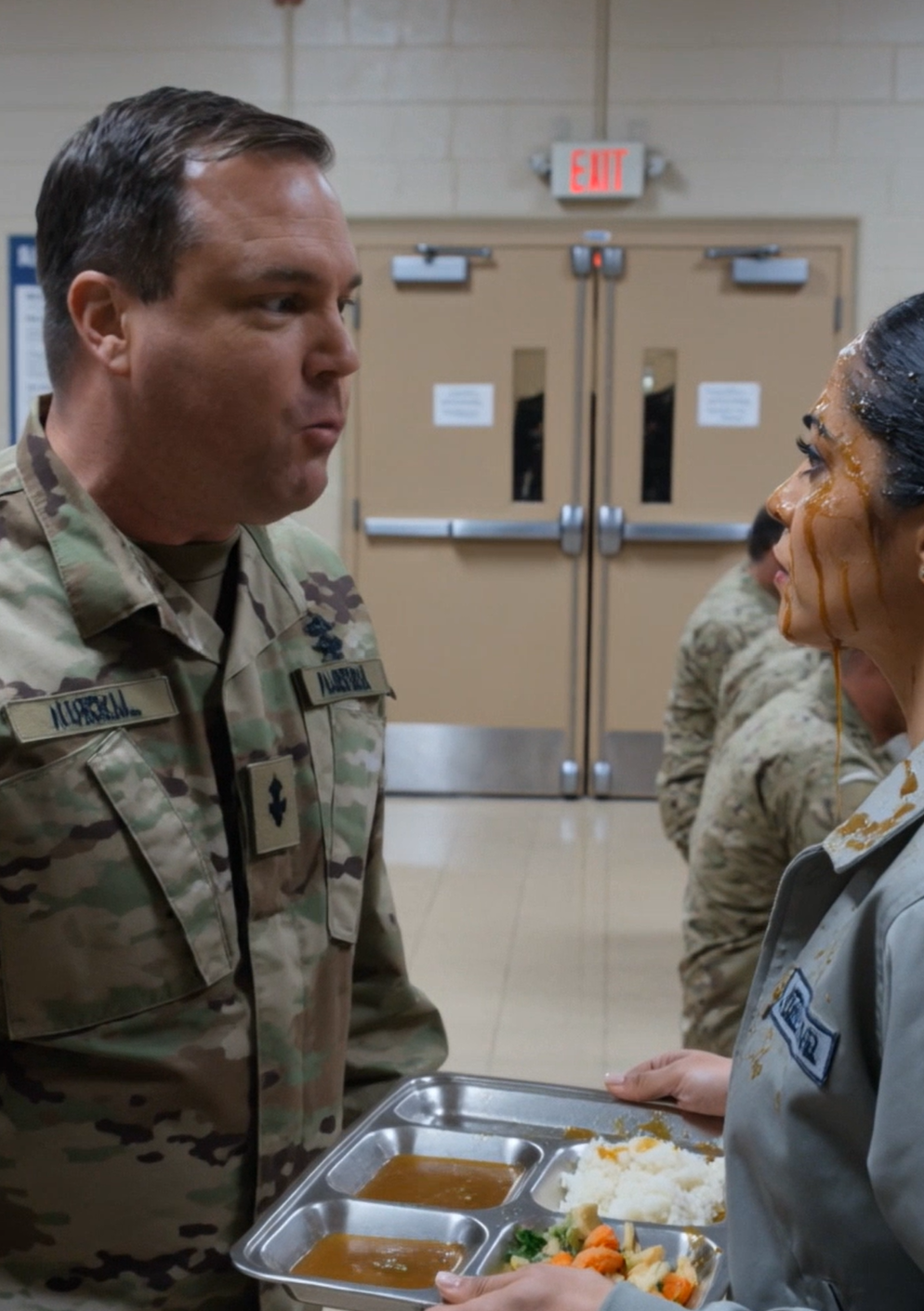
“I’m authorized to be here.”
“Yeah?” He stepped closer. Close enough that she could smell the coffee on his breath. “By who? Your husband? Let me guess – some captain you’re sleeping with told you it’d be fine.”
A corporal two trays down sucked in a breath. Somebody dropped a fork.
Valerie finally turned. She looked up at Harlow – and she wasn’t angry. That was the strange part. She looked almost… patient. Like a teacher watching a kid about to walk into a glass door.
“Sergeant Harlow,” she said, reading the name tape. “I’m going to say this one time. Step back.”
He didn’t. He reached out and grabbed her elbow – not hard, but hard enough — and started to steer her out of the line.
That’s when she said it.
“Touch me once more, Sergeant, and you’ll regret it.”
He laughed again. Louder this time. He looked around for backup from the other Marines, expecting them to laugh with him.
Nobody laughed.
In fact, three of them were staring at the doors behind her — eyes wide, faces draining of color. A gunnery sergeant near the salad bar slowly set down his tray and came to attention so fast his heels cracked against the tile.
Harlow frowned. “What are you idiots—”
The mess hall door swung open. A two-star general walked in, followed by the base commander, followed by four officers with folders pressed tight against their chests. They were looking for someone.
The base commander spotted her first. His face went pale. He didn’t shout. He didn’t have to.
“ATTENTION ON DECK!”
Every boot in the room slammed together. Trays froze mid-air. Two hundred Marines snapped rigid as steel.
Harlow’s hand was still on her elbow.
The general crossed the room in long, furious strides, stopped six feet from them, and looked directly at the woman in the gray jacket and dusty trail shoes.
Then he saluted her.
Harlow’s mouth opened. No sound came out. He looked down at the patch she’d just pulled from her jacket pocket — a small, folded ID with a gold seal he’d only ever seen in briefings.
And when he read the title printed under her name, his knees actually buckled.
Because Valerie Simms wasn’t a wife. She wasn’t a guest. She wasn’t even military, exactly.
She was the one person on this entire base who had the authority to end his career with a single sentence — and what she said next, with his hand still trembling on her arm, made the general go absolutely still.
“General Mitchell,” Valerie said, her voice perfectly even. “It appears I’ve found what I was looking for.”
Her title was simple and terrifying: Special Investigator, Office of the Inspector General.
Harlow’s hand dropped from her elbow as if it had been burned. All the blood drained from his face, leaving behind a pasty, sick-looking mask. He was a statue made of pure fear.
General Mitchell’s eyes, hard as granite, flickered from Valerie to Harlow, then to his trembling hand, and finally to the sergeant’s name tape. The air in the mess hall grew thick enough to choke on.
“Commander,” the general said, his voice a low growl that carried across the silent room. “Escort Sergeant Harlow to the base security office. He is to speak to no one.”
Two military police officers, who had entered with the command group, moved forward immediately. They didn’t put hands on Harlow; they just stood on either side of him. It was enough.
Harlow swallowed hard, his Adam’s apple bobbing. He looked at Valerie, a desperate, silent plea in his eyes.
She just looked back, her expression unreadable. But there was no triumph in it. Only a deep, profound weariness.
As they led him away, the rigid formation of Marines parted like the Red Sea. The only sound was the scuff of Harlow’s boots on the tile floor, a sound that seemed to echo his entire career falling apart.
Once he was gone, General Mitchell turned back to Valerie. “Ma’am. My profound apologies. This is unacceptable.”
Valerie finally let out a long, slow breath. “It’s more than unacceptable, General. It’s a symptom.” She gestured around the mess hall. “At ease,” she said, her voice carrying a strange, unofficial authority that everyone instantly obeyed.
The Marines relaxed, but nobody dared move. They just watched, eyes wide with a mixture of awe and fear.
“I came here unannounced for a reason,” Valerie continued, speaking directly to Mitchell and the base commander, Colonel Davis. “We’ve been getting reports for months. Quiet whispers. Low morale, abuse of authority, a culture of… disrespect filtering down from leadership.”
She picked up her tray again. “I was on this base for less than an hour, dressed like this on purpose. I wanted to see it for myself. I wanted to see if the stories were true.”
She looked the general straight in the eye. “Sergeant Harlow just confirmed them for me.”
Colonel Davis stepped forward, his face flushed with shame. “Investigator Simms, I assure you, this is an isolated incident. Sergeant Harlow will be dealt with severely.”
Valerie shook her head slowly. “No, Colonel. It’s not. Look around.”
She gestured to the young corporal who had backed away earlier. “You, Corporal. What’s your name?”
The Marine stiffened. “Corporal Esposito, ma’am.”
“Corporal Esposito, did you think Sergeant Harlow’s behavior was appropriate?”
Esposito’s eyes darted nervously towards the door where Harlow had disappeared. He hesitated.
“The truth, Corporal,” Valerie said gently. “I’m not here to get you in trouble. I’m here to fix things.”
He swallowed. “No, ma’am. I did not.”
“Have you seen him act like that before? Towards other junior Marines? Towards civilians?”
Esposito’s silence was his answer.
Valerie nodded. “Thank you, Corporal. That’s all.”
She turned back to the commanders. “My investigation begins now. I’ll need a secure office, access to all personnel files, and a schedule of interviews starting this afternoon. My first interview will be with Sergeant Harlow.”
Later that day, Harlow sat in a sterile, gray interview room. The arrogance from the chow hall was gone, replaced by a deep-set dread. He looked smaller somehow, hunched over in the metal chair.
Valerie entered alone, carrying a simple folder. She didn’t wear a uniform, just a professional blouse and slacks. She sat down across from him and opened the folder.
“Sergeant Harlow,” she began, her tone all business now. “Your service record is exemplary. Multiple combat deployments. Decorated for valor. Your fitness reports from your previous command describe you as a model Marine.”
He didn’t respond. He just stared at the table between them.
“So what happened, Sergeant? What turned that model Marine into the man I met this morning?”
Harlow finally looked up, his eyes bloodshot. “I made a mistake, ma’am. There’s no excuse.”
“I’m not looking for an excuse,” she said. “I’m looking for a reason. Because the problem on this base is bigger than one sergeant having a bad day. My real investigation is about something else entirely.”
She slid a document across the table. It was a logistics report for the base’s motor pool. Several items were highlighted in red.
“Night vision goggles. High-frequency communication sets. Advanced GPS modules. Over a quarter of a million dollars’ worth of equipment signed out to your battalion has vanished over the last six months. It’s not reported as broken or lost in training. It’s just… gone.”
She leaned forward. “The prevailing theory is that someone is stealing it and selling it. You’re the platoon sergeant for the motor pool. You sign off on all the gear. And you have an attitude that seems designed to keep people from asking too many questions.”
Harlow’s face went rigid. This was a different kind of fear. Not the fear of a reprimand, but the fear of a federal prison.
“Tell me what’s happening, Sergeant,” Valerie said, her voice softening slightly. “Help me understand.”
For a long moment, Harlow just sat there, a war raging behind his eyes. Then, something inside him broke.
“They’re not stolen,” he rasped, his voice cracking. “They’re not gone.”
He took a shaky breath. “They’re in pieces.”
Valerie frowned. “Explain.”
“The Humvees, ma’am,” he said, the words spilling out now. “Our vehicles are falling apart. We’ve been stateside for two years, and command keeps cutting our maintenance budget to fund other priorities. We put in requests for replacement parts, and they get denied. Form 44-B gets kicked back nine times out of ten. We’re told to ‘make do.’”
He leaned forward, his hands clenched into fists on the table. “Make do? My Marines are about to go on a six-month training rotation in the desert. You can’t ‘make do’ when a transport vehicle’s transmission fails in the middle of nowhere. You can’t ‘make do’ when comms go down because the wiring is shot.”
He looked up at her, anguish written all over his face. “I lost a Marine once. In Afghanistan. Not to enemy fire. To a faulty fuel line that a slick-sleeve lieutenant told us was ‘good enough.’ The vehicle caught fire. He burned to death because of a ten-dollar part we’d requested six times.”
Tears welled in his eyes, but he refused to let them fall. “Never again. I swore to myself, never again.”
He pointed at the report. “So, yeah. I told my mechanics to strip the new GPS units for their wiring harnesses to fix the old comms sets. I had them take the focusing lenses out of the new night vision scopes to repair the worn-out ones. We’ve been cannibalizing brand new gear to keep the essential stuff running, because it’s the only way I can guarantee my Marines will come home safe from a damn training exercise.”
He sank back in his chair, defeated. “I falsified the logs. I know. I bullied anyone who came snooping around because I was terrified someone would find out and shut us down. I was so wound up… so stressed out… and then you showed up, looking like another problem I couldn’t control.”
He looked at her, his shame palpable. “What I did to you this morning was wrong. Period. I own that. I was a bully. But I’m not a thief.”
Valerie sat in silence for a long time, just watching him. She saw the decorated Marine. The broken leader. The man trying to hold his world together with duct tape and sheer force of will.
She finally closed the folder.
“You broke about a dozen regulations, Sergeant. Falsifying federal documents, destruction of government property, conduct unbecoming… not to mention the incident in the mess hall.”
Harlow nodded slowly. “I know.”
“You also put your finger on the exact problem I was sent here to find,” she continued. “It was never about a few bad attitudes. It was about a systemic failure. The reports we were getting were about a command climate so broken that good NCOs felt their only option was to commit felonies to protect their troops.”
She stood up. “Your methods were wrong, Harlow. Toxic. You can’t lead by fear and intimidation. You nearly ruined the careers of your own mechanics to cover your tracks. You let the pressure turn you into the kind of leader you despise.”
He flinched, knowing she was right.
“But your motive…” she trailed off, looking out the small window. “Your motive was to protect your people.”
She walked to the door. “The investigation is far from over. But it’s taking a new direction.”
Over the next week, Valerie worked relentlessly. She showed her findings to General Mitchell, not as an indictment of a single sergeant, but as proof of a catastrophic supply chain failure that was putting lives at risk. She presented Harlow’s makeshift logs alongside the stack of denied official requests.
The General, a man who had started his own career as a second lieutenant in a motor pool, saw it immediately. The problem wasn’t Harlow; it was the layers of bureaucracy above him that had lost sight of the mission.
Valerie’s final report was a masterpiece of professional justice.
It recommended immediate and severe disciplinary action against Sergeant Harlow for his conduct, the bullying, and the harassment. He was to be demoted to Corporal and required to attend extensive leadership and anger management counseling. His career as a senior NCO was over.
But the bulk of the report, the part that had General Mitchell’s full backing, was aimed squarely at the systemic issues. It detailed the critical shortfalls in funding and parts, and recommended a complete overhaul of the regional supply command.
The conclusion was a quiet, powerful earthquake. Within a month, the base’s maintenance budget was TRIPLED. New vehicles and parts started arriving. The commander of the regional logistics unit was quietly reassigned to a desk job in the Pentagon basement.
Six months later, Valerie returned to the base for a follow-up assessment. The atmosphere had changed completely. There was a lightness, a sense of purpose that had been missing.
She was walking past the motor pool when she saw a group of Marines working on a Humvee. A corporal was patiently showing a young private how to correctly route a new wiring harness.
The corporal looked up and saw her. It was Harlow.
He was leaner, calmer. The toxic anger was gone, replaced by a quiet competence. He wasn’t the feared platoon sergeant anymore; he was a teacher. His Marines looked at him with respect, not fear.
He wiped his hands on a rag and walked over to the fence, meeting her halfway.
“Ma’am,” he said, with a simple nod. No salute was necessary; they were just two people.
“Corporal Harlow,” she replied with a small smile. “Looks like you got that new harness.”
He looked back at his team. “We got more than that. We got what we needed.” He turned back to her. “Thank you.”
It was a simple phrase, but it carried the weight of everything that had happened.
“You earned a second chance, Corporal,” Valerie said. “You messed up, you faced the consequences, and you learned from it. That’s more than a lot of people can say.”
He nodded, a hint of the old pride returning to his eyes, but this time it was tempered with humility. “My guys are ready for their deployment. Properly ready.”
That was all the thanks she needed.
Valerie walked away, leaving him to his work. She had come to the base expecting to expose a thief or a tyrant. Instead, she had found a flawed man trying to do the right thing the wrong way, and in doing so, had uncovered a much deeper truth.
Sometimes, the person who seems like the problem is actually the first clue to solving it. True strength isn’t about never making mistakes; it’s about having the courage to face them, the humility to learn, and the grace to give others the chance to do the same. A system is only as strong as its willingness to listen to the people on the ground, even when their message is delivered the wrong way.



