
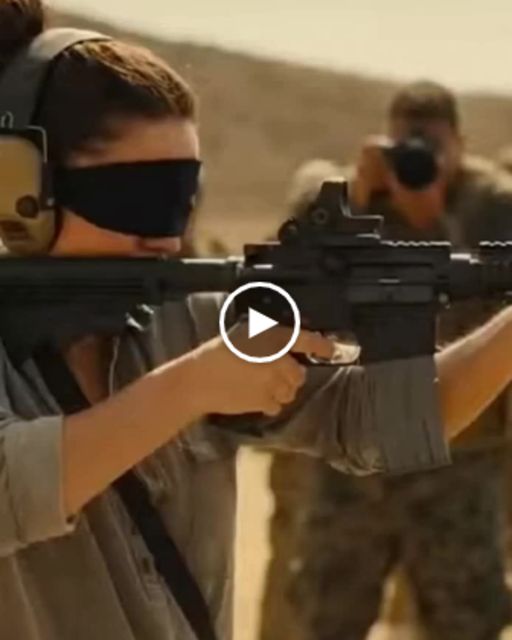
On the Firing Line
Commander Walsh dragged the toe of his boot through the dust and frowned at the young woman in front of him. ‘You’re holding that rifle like a broom,’ he said, voice sharp. ‘We don’t have time for anyone who isn’t taking this seriously.’
She looked small inside an oversized gray T-shirt, steady despite the quiet laughter spreading down the firing line. Her name tag said Miller. To most of the platoon, she looked out of place, like someone who had wandered onto the wrong field. To Walsh, she looked like one more thing slowing him down.
‘Move,’ he barked, louder this time. The late afternoon air smelled like metal and old smoke. Heat shimmered on the range. Somewhere behind them, a generator hummed.

‘One test,’ the recruit said, voice even. ‘Blindfolded.’

Walsh let out a hard laugh that made a few shoulders jump. ‘Fine. Miss it, and you’re clearing out by sundown.’
She tied a strip of black cloth over her eyes, set her feet, and adjusted her grip on the old, battered training rifle most newcomers learned to dislike. She took one steady breath, as if the world had narrowed to her hands and the breeze.
Crack. Crack. Crack.
Three shots, so close together they sounded like a single drum.
At the spotting scope, a young private jerked back, as if the glass had stung him. ‘Center mass,’ he said, thin-voiced. ‘All three. Same hole.’
The laughter died the way a door shuts in a quiet house. What settled over the line wasn’t cheering. It was a stillness that said something just changed, and everyone felt it.
Walsh’s face darkened. He strode forward and clamped a hand down on the recruit’s shoulder. ‘Who are you?’ he demanded. ‘Who signed off on you?’
He tugged to spin her around, and his heavy watch snagged on her frayed sleeve.
Rrrrip.
The thin fabric tore from shoulder to elbow. Walsh stopped breathing for half a second. He didn’t look at the target. He didn’t look at the rifle. He looked at the bare skin of her arm.
There, in black ink, a skull under crosshairs stared back. The mark some people whispered about after lights out. Reaper 6. A rumor dressed like a story no one could confirm. A unit that, if it ever truly existed, had been erased from records years ago.
Walsh let go as if he’d touched a hot stove. His voice, when it came, was not the voice he used on the range. ‘Dismissed,’ he said to the platoon, each syllable heavy as a boot. He cleared his throat. ‘Now.’
The trainees scattered fast, stealing glances but keeping their questions to themselves.
The Conversation No One Expected
The range fell quiet, just the wind brushing along the berm and the soft clink of cooling brass. The recruit slid the blindfold up and met Walsh’s eyes. Cool gray. Not hard. Not angry. Just tired in a way that lives deep down.
‘My office,’ Walsh said. He didn’t wait for an answer. He walked, and she followed, steps light and even in the dust.
His office smelled like old coffee and gun oil. Stacks of paperwork leaned like small, unsteady buildings. Walsh dropped into his chair, its springs complaining about another long day.
He pointed to the simple wooden chair across from him. She sat straight without stiffening, attentive and calm. Her torn sleeve slipped, and the tattoo’s black lines stood out in the half-light.
Reaper 6. The Ghosts of the East. He had heard the stories long ago, traded over bad meals and late watches. A scalpel team that went where others would not. If memory served, they were said to have vanished in fire and silence, their names wiped from files that officially never existed.
‘The report said no one made it out,’ Walsh said. He heard how small his own voice sounded and did not like it.
‘Reports get written by people who weren’t there,’ she replied, steady and untroubled.
He fumbled for a cigarette and failed to light it on the first strike. The second, too. ‘What are you doing here? In basic?’ he asked. It came out sounding like curiosity, but he knew better. It was fear in a borrowed coat.
‘I’m here to enlist,’ she said.
Walsh let out a dry laugh. ‘Someone with that ink doesn’t need remedial anything. You could go anywhere you want on this base and be waved through.’
‘I need this,’ she said again, with the patience of a teacher repeating the important part.
He finally got the lighter working and took a breath that didn’t fit right in his chest. ‘If this is some kind of test,’ he said, ‘if you’re here to grade me or break me, say it now. I’ll transfer. I’ll empty this desk by noon.’
Then, before he could stop it, the truth slid out. The shouting. The dust-kicking. The need to be the loudest. He had called it discipline. He had called it efficiency. It was really noise to drown out the quiet inside his own head.
‘I’m not here for you, Commander,’ she said gently.
She reached into a pocket and set a worn photograph on the desk. A boy of eighteen smiled back, open and sure, gray eyes bright with hope. He stood in front of a recruiting poster, the future shining on his face.
‘My brother,’ she said. ‘Thomas.’
Walsh studied the photo, then looked up. The family resemblance slid into place. The set of the mouth. The steadiness in the eyes.
‘He wanted this more than anything,’ she said. ‘He memorized the creeds. He practiced field-stripping from memory. He was set to ship here, into your training cycle.’
She paused, and the air in the room grew heavy, like a storm that refuses to break.
‘Two weeks before his date, his heart failed. Something he was born with but no one caught. His bag was on the bed. One minute he was zipping it. Then…’ She let the sentence end where words can’t go.
‘I’d already left the service by then,’ she added after a moment. ‘I was far away. I didn’t get to say goodbye.’
Walsh swallowed. ‘I’m sorry,’ he said. The words felt too small for the space they tried to fill.
‘Thomas used to say I always chose the hard road,’ she said, a shadow of a smile crossing her face. ‘He said he wanted to do it the right way. Start at the beginning. Earn every inch. He told me, “You see the end of the road, Hazel. I want to walk the whole path.”‘
She folded her hands, steady. ‘So I’m walking it for him. From the start. With his eyes.’
What the Past Demands
Walsh stared through her and back into a night from three years earlier. The memory tilted the room. A radio hissed like an angry insect. A new pattern, faint and brief, flitted through the static on an odd frequency. Protocol said to flag anything new, no matter how small.
He remembered the end of a sixteen-hour shift, the ache behind his eyes. He remembered the eager young specialist who showed up early to take over, a good kid named Miller who wanted to learn everything and do it right. Walsh had wanted hot food before the mess ran out. He mentioned the odd little signal, waved it off like a gnat, and handed over the desk. ‘Probably nothing,’ he said, already halfway out the door.
An hour later, everything went wrong. Reaper 6 went in under a sky the radios couldn’t explain, and the enemy was waiting with a trap timed down to the breath. That quiet signal had been the key turning in a lock. The official story blamed a satellite hiccup and a bad tip. The unofficial truth was uglier. A senior officer needed a neat answer for a messy night.
Logs disappeared. Questions got turned into conclusions. Walsh wasn’t called in. The young specialist, scared and alone, took the blame rather than pull his officer into the light. He was demoted and shipped north, far from sunlight and purpose. Walsh let himself believe a lie that grew like ivy. It was one mistake. It was out of his hands. He didn’t even hold the boy’s first name steady in his mind.
Now the truth sat in front of him with a torn sleeve and quiet gray eyes.
‘Commander?’ the recruit asked softly, as if waking him from a bad dream. ‘You alright?’
‘Miller,’ he whispered, the word dry on his tongue. ‘Your other brother. The signals specialist.’
She blinked. Surprised. ‘You know Michael?’
Michael. The name landed like a final puzzle piece. Walsh’s throat closed. For three years he had carried a man’s career and never even held the name properly. All the precision he demanded on the range had vanished when it mattered.
‘I was his OIC at FOB Dagger,’ Walsh said, voice scraping like gravel. ‘There was an intercept I brushed off. I left him with it. He took the blame. I let him. I let it happen.’
He braced for anger. It didn’t come. The recruit’s face softened with something like understanding, and that nearly undid him.
‘Michael never told us details,’ she said. ‘He said he made a mistake. That was all. He left the service a year later. Works in logistics now. He won’t talk about it.’
Silence settled, but not the hard kind. The admitting kind. The kind that lets a person tell the truth out loud.
‘I became a man who shouted because I was afraid of the quiet,’ Walsh said at last. ‘Afraid of what I’d hear if I stopped.’
‘I’ve seen what guilt does,’ she said. ‘It turns up the volume on everything. People get loud. They get hard on themselves first. And then they get hard on everyone else because it feels familiar.’
She glanced at his careful stacks, the boots lined just so, the manuals squared with the desk’s edge. ‘You’ve been punishing everyone else for a weight you’ve carried alone.’
Walsh covered his face. A dry, shaking sob moved through him like a fault line giving way. He barely recognized the sound. For once there was no act to put on. No posture to hold. Just a man and the truth he had been dodging for years.
A Different Marching Order
After a long, quiet minute, he lowered his hands. ‘What now?’
‘Now you choose,’ she said. ‘Let that day keep commanding you. Or start commanding yourself.’
She stood and picked up Thomas’s photo. ‘I’m here to honor my brother’s dream. I’m Recruit Miller. That’s all I need to be. The rest is up to you, Commander.’
At the door, she paused. Her voice stayed gentle. ‘For what it’s worth, I think Michael forgave you a long time ago. Maybe it’s time you try the same.’
She stepped out. The small sounds of the office returned, the soft hum of the vent and the faint tick of a cooling kettle. It felt like the room itself had taken a breath.
Quiet Changes
Morning came, and with it a change so simple it was easy to miss. The shouting on the range stopped. The swagger didn’t vanish. It softened into purpose. Walsh met his platoon with clear instructions and a calm he wasn’t sure he could keep, until he did.
He didn’t tell stories. He didn’t perform. He changed how he carried himself. He watched before he decided. He noticed the recruits on the edge, the ones who looked at the ground too long, the ones whose hands shook when they loaded a magazine, the ones who were already homesick and trying not to show it.
Instead of barking, he called them aside and spoke plainly. He asked what part wasn’t working. He offered small corrections and simple, steady practice plans. He helped them get better without breaking them. And the platoon changed with him.
They weren’t afraid of him anymore. They respected him. He learned that respect is not louder than fear, but it goes farther. They moved with one intention instead of a dozen nerves. Scores rose. Shoulders rose with them. Before tests, they looked at each other and found trust there instead of dread.
Recruit Miller never flashed her past or leaned on what she had already survived. She volunteered early, stayed late, and took the thankless tasks without being seen to do it. She showed a teammate how to clear a stubborn bolt. She stood beside a shaky shooter and breathed until their sight picture steadied together. No speeches. No big gestures. Just quiet, repeatable work done the right way.
Every day she walked the road she had chosen in Thomas’s name. More and more, it was clear she was walking it for herself too.
Graduation Day
Graduation morning broke clear and bright. Sunlight laid a sharp shine across the parade ground. Boots lined the walkway like neat punctuation. The new soldiers stood tall, uniforms pressed, faces bright with the good kind of tired.
Walsh stepped to the podium and let his gaze sweep the formation until it found Miller. When he spoke, the words were the ones he wished he had heard years earlier.
‘People are more than what you notice at first glance,’ he said. ‘Every person here carries a story, a promise, a grief, or a goal you can’t see. Don’t mistake silence for weakness. Don’t mistake noise for strength.’
‘Real strength isn’t about being the loudest voice in the room or pretending you never get it wrong. Real strength is admitting where you missed, then choosing to be better tomorrow than you were today. That’s the kind of strength people can trust.’
He talked about integrity without hiding behind the word. He talked about service that doesn’t need applause. He talked about the honor of beginning at the beginning, even when your past could let you skip the line.
‘Take care of each other,’ he finished. ‘Don’t assume you know the whole of anyone’s story. Be the kind of soldier who helps the person beside you stand steadier.’
After the ceremony, families flowed onto the field. Hugs. Photos. Laughter. The happy noise of something hard won. Walsh found Miller standing a little apart, diploma in hand, her face thoughtful and bright.
‘You earned this, Miller,’ he said.
‘We all did,’ she answered. The quiet pride in her voice said everything else.
He hesitated, then held out a sealed, official-looking envelope. ‘I made some calls. Your brother Michael’s record has been reviewed. The demotion was marked as a clerical error. It’s been corrected.’
Her eyes widened. A single tear slipped down, cutting a clean path through the dust on her cheek.
‘Why?’ she asked, almost whispering.
‘Because it’s right,’ he said. ‘And because it’s a start.’
He told her he had put in for a new assignment. He wanted to teach the next generation to listen first, to question easy shortcuts, and to lead the way they would want to be led. Not because anyone made him. Because the work mattered to him again.
She studied him for a moment. He no longer looked like the red-faced tyrant from the first day on the range. The edges had softened, not into weakness but into something steadier. He looked like a man who had made peace with his past and meant to keep it.
She reached into her pocket and took out the photo of Thomas, the young man smiling like the start of a good day.
‘Keep this,’ she said, offering it to him. ‘Let it remind you why you started.’
Walsh took the picture. For the first time in years, his hand didn’t shake. He looked from Thomas’s smile to the soldier standing before him, the woman whose quiet courage had changed more than a training cycle, and felt the ground under his boots turn solid.
What Strength Really Looks Like
We often learn to think strength is loud. It shouts orders. It slams doors. It fills a room and makes everyone smaller to make itself look big. But that kind of power burns fast and burns people with it.
The kind of strength that lasts is usually quiet. It is the veteran who owns a mistake and makes it right even when nobody is watching. It is the recruit who does not lean on old glories, who shows up early and leaves late because a promise is a promise. It is the leader who learns to listen. It is the instructor who corrects without cutting. It is the teammate who steadies your hand when yours won’t stop shaking.
Strength shows up in forgiveness too. Not the kind that forgets, but the kind that lets a person begin again with clear eyes. It stood on a firing range the day a woman asked for a blindfold and three shots. It stood in a small office when a man stopped hiding from himself.
In the end, the mark on her arm did not define her. The mark in his conscience did not define him either. What defined them both were the choices they made after the truth stepped into the light.
And that is the quiet power of promises we make to the people we love. Those promises can steady our aim. They can help us walk the path we were meant to walk. Sometimes they can even pull another person out of the dark and set them firmly on their feet. That is the kind of strength that lasts, the kind you can trust when things get heavy, and the kind worth passing on.



