
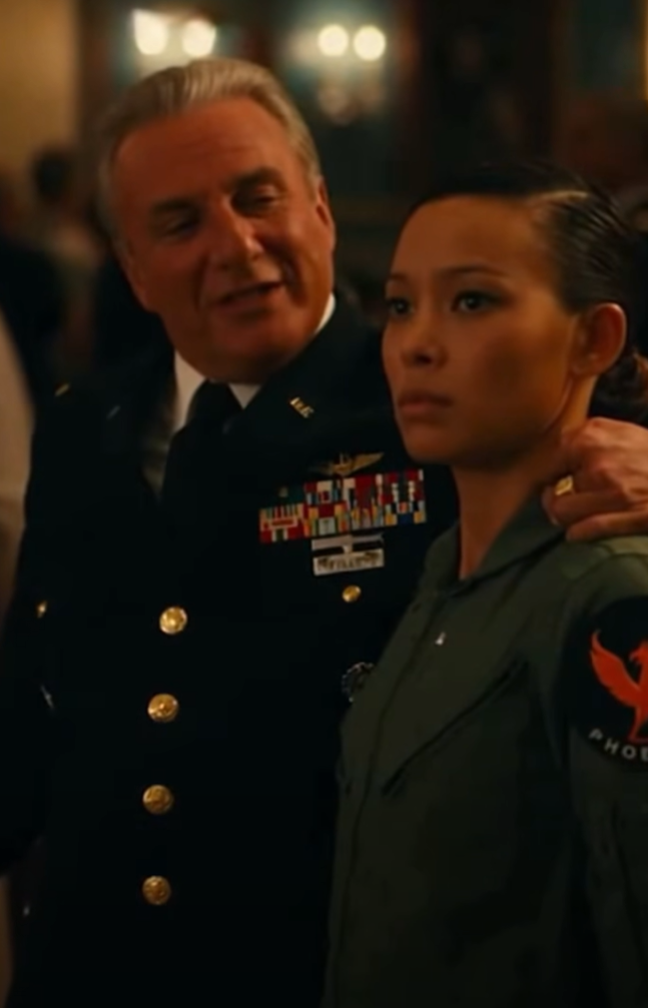
The worst humiliation of my life didn’t happen in uniform. It didn’t happen under fire. It happened under a chandelier.
The Virginia Officers Club was exactly the kind of place my uncle Robert loved. Polished brass. Oil portraits of dead generals. Carpet so thick your footsteps vanished before they could offend anyone. The air smelled like whiskey and prime rib.
I was standing near the bar in a plain dark blouse, trying to be invisible, when Robert spotted me.
“There she is!” he boomed, already pink with scotch. “My favorite charity case.”
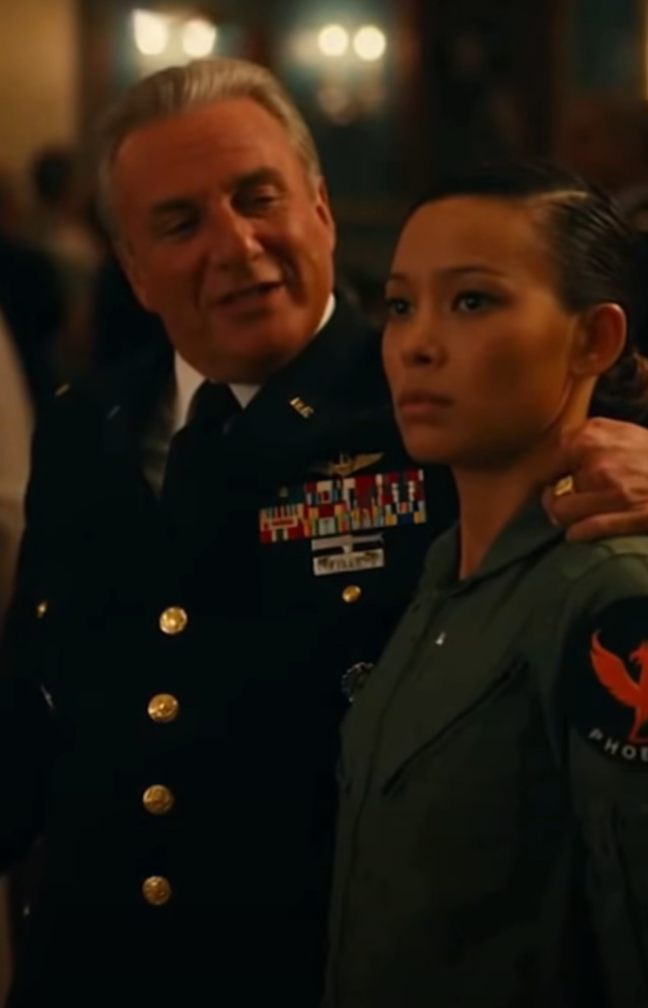
A few men chuckled because they thought they were supposed to.
He crossed the room with that broad stride retired officers use when they miss being saluited. His heavy hand landed on my shoulder like I belonged to him. He turned me toward his circle of friends – three men with silver hair and gold watches, smiling the way wolves smile.
“Gentlemen,” Robert announced. “This is my niece, Denise. Sweet girl. Bit of a drifter. Couldn’t hack college, couldn’t hold a real job. My sister begged me to bring her tonight.”
My face burned. I opened my mouth, but he wasn’t finished.
“So I’m making it my mission,” he said, raising his glass to the room. “FIND THIS INTERN A JOB! Anything. Filing. Coffee runs. Somebody here must need a warm body.”
The laughter spread. Real laughter now. A woman in pearls actually clapped.
I stared at the floor. Twenty-nine years old. Two tours I couldn’t talk about. A clearance level my uncle didn’t know existed. And here I was, being auctioned off like a stray dog in front of a hundred strangers.
“Come on, sweetheart,” Robert said, tugging at my sleeve. “Don’t be shy. Show them you can at least smile.”
He yanked my arm.
My jacket sleeve rode up.
Just two inches. Just enough.
And across the room, near the fireplace, a gray-haired man in a charcoal suit froze mid-sentence. His drink stopped halfway to his lips. His eyes locked onto my forearm – onto the small, faded patch stitched into the inside cuff of my blouse. The patch I forgot to remove. The patch civilians weren’t supposed to ever see.
A black phoenix. Wings folded. No words. No unit number.
The man set his glass down so carefully it didn’t make a sound.
Then he started walking toward us. And every officer in that room who outranked my uncle turned to watch him do it.
Robert was still laughing when the man stopped behind him and said, in a voice quiet enough to cut glass:
“Colonel Hayes. Step away from her. Right now.”
Robert turned, still grinning. “I’m sorry – Colonel? There must be some mistake. This is just my niece, she’s – “
The gray-haired man didn’t even look at him. He looked at me. And what he said next made every glass in my uncle’s hand start to shake.
“Let me be clear, Robert,” the man said, his eyes still fixed on me. “You will apologize to this officer. Then you will find the exit.”
The room went completely silent. You could have heard a pin drop on the thick carpet.
My uncle’s face, which had been a cheerful pink, slowly turned a blotchy, confused red. “Officer? What are you talking about, Marcus? This is Denise. She’s a kid.”
The man, Marcus, finally tore his gaze from me and leveled it on my uncle. It was like watching a glacier move. Slow, cold, and unstoppable.
“She is not a kid,” Colonel Thorne said, his voice dropping even lower. “And I promise you, she has held jobs you aren’t qualified to even apply for.”
Someone in Robert’s circle of friends coughed nervously. Another one took a sudden, intense interest in his shoes.
Robert sputtered, trying to regain his footing. “Now see here, Marcus. I don’t know what you think you saw, but she’s my sister’s girl. Floats from one temp job to another. I’m just trying to help her out.”
Colonel Thorne took one step closer. He was shorter than Robert but seemed to take up all the air in the room.
“Your help is humiliation. Your mission is peacocking for your friends,” he stated, not as an accusation, but as a simple fact. “You are embarrassing yourself, and you are insulting a decorated soldier.”
The word ‘soldier’ hung in the air, heavy and undeniable.
My uncle was finally speechless. His mouth opened and closed like a fish. He looked from the Colonel to me, his eyes wide with disbelief. He glanced at my sleeve, which had fallen back into place, hiding the patch.
“I… I don’t understand,” Robert stammered.
“You don’t need to understand,” Colonel Thorne replied. “You just need to leave.”
He gestured with his chin toward the ornate double doors at the entrance. It wasn’t a suggestion. It was an order carried on the back of decades of command.
My uncle Robert, a man who lived for the respect of his peers in this very room, wilted. His shoulders slumped. The arrogant swagger was gone, replaced by the shuffling gait of a man who had just lost everything.
He didn’t look at me. He couldn’t.
Without another word, he placed his glass on a nearby table and walked out of the Officers Club. The whole room watched him go, the silence following him like a shroud.
The moment the doors swung shut, a low murmur rippled through the crowd. Colonel Thorne ignored it. He turned his full attention back to me. His expression softened from icy command to something like concern.
“Are you alright, Specialist?” he asked quietly.
The old rank, one I hadn’t heard in years, felt strange. It felt like coming home.
I could only nod, my throat tight. The heat in my cheeks was finally starting to fade, replaced by a tremor in my hands.
“Let’s get some air,” he said gently. He placed a light hand on my back, not proprietary like my uncle’s, but steady and respectful. He guided me away from the prying eyes, through a side door and onto a quiet, stone-paved veranda.
The cool night air was a relief. We stood there for a moment, listening to the distant hum of traffic.
“I’m sorry you had to see that, sir,” I finally managed to say. “I’m sorry he acted that way.”
Colonel Thorne leaned against the railing, looking out into the dark. “Don’t apologize for him. Men like your uncle build their worlds on perceived status. They can’t comprehend a world where a twenty-nine-year-old woman in a plain blouse outranks them in every way that truly matters.”
He paused, then looked toward my sleeve. “The Phoenix Project. I thought they’d all been folded back into the ether.”
“Most of us were, sir,” I said. “Three years ago.”
The Phoenix Project wasn’t a combat unit. We were signals intelligence. We went where the noise was thickest, where data was a weapon. We were the ghosts who listened, the interpreters of whispers. The patch was a quiet acknowledgment among those who knew. We rose from the ‘ashes’ of failed intelligence, our job to ensure it never happened again.
“It’s a small detail,” he said, gesturing to the patch. “But it means a great deal. My son’s fire team was pinned down outside Kandahar seven years ago. Comms were down, a storm was rolling in. They were blind.”
He looked at me, and I saw a story in his eyes that wasn’t about a Colonel, but about a father.
“Air support was deaf. Command was mute. The last message they got out was corrupted, just digital screaming. Then, nothing for six hours.”
He took a deep breath. “The official report said a ‘technical glitch’ was resolved by an anonymous signals asset in-country. This ‘anonymous asset’ rebuilt the comms link piece by piece from battlefield static, pinpointed the enemy mortar position from their radio’s battery frequency, and relayed the coordinates directly to a drone pilot.”
I stayed quiet. I remembered that storm. I remembered the static.
“My son came home,” the Colonel said, his voice thick with emotion. “His whole team came home. The after-action report I was unofficially shown had a footnote. Just a symbol drawn in the margins by the drone pilot.”
He looked at me with an intensity that saw right through the blouse, the jacket, and the years. “A black phoenix, with its wings folded.”
My own breath caught in my chest. I remembered that night. Staring at raw data for hours, my eyes burning, translating chaos into a solution. I never knew who was on the other end. You never did. You just did the job.
“I… I was there, sir,” I whispered. “That was my operation.”
A slow, genuine smile spread across his face. It transformed him. The hard lines of command softened into pure, unadulterated gratitude.
“I had a feeling,” he said. “For seven years, I’ve wanted to thank the ghost who saved my boy. I never imagined I’d get the chance.”
We stood in silence for a while longer. The weight of my uncle’s humiliation was gone, replaced by a profound sense of connection I hadn’t felt since I left the service.
“That ‘drifter’ life your uncle mentioned,” he began, turning to face me fully. “Is that your choice?”
I shook my head, feeling a fresh wave of frustration. “No, sir. It’s… difficult. My resume has these huge, unexplainable gaps. Most of my skills are classified. I can tell a potential employer I’m a ‘problem solver’ with ‘experience in high-stress environments,’ but it just sounds like fluff. To them, I look unreliable.”
“You look like a civilian,” he corrected me gently. “And you’re trying to play by their rules, using a language they don’t understand.”
He reached into his jacket and pulled out a simple business card. “I’m retired now, too. I consult for a few firms. One of them is a company called North Star Analytics. They do risk assessment and data security for global corporations.”
He held the card out to me. “They specialize in hiring people with ‘unexplainable gaps’ in their resumes. They understand the language. They know what a Phoenix patch really means.”
I took the card. The paper was heavy, the lettering simple and direct. Marcus Thorne. Senior Advisor.
“Your uncle was trying to find you a job running for coffee,” he said with a wry smile. “I think North Star might have something a little more challenging. They need people who can find a signal in the noise.”
Tears welled in my eyes. Not from sadness or humiliation, but from overwhelming relief. It was more than a job offer. It was validation. It was being seen for who I really was.
“Thank you, sir,” I said, my voice cracking. “You have no idea what this means.”
“I think I do, Denise,” he said, and for the first time, he used my name. “Now, about your uncle.”
He paused, a thoughtful look on his face. “There’s a reason he’s like that. It’s not just arrogance.”
I must have looked confused, because he elaborated.
“Twenty years ago, Robert Hayes was a Captain. He applied for a special assignment. A liaison posting with a very exclusive intelligence group. He was brilliant on paper, but he failed the psychological evaluation. The report said he was too concerned with status and lacked the humility for collaborative, low-visibility work.”
Suddenly, it all clicked into place. My uncle’s constant need to be the big man. His belittling of anyone he perceived as lesser. His rage at being dismissed.
“He never got over it,” Colonel Thorne continued. “He topped out as a Colonel and retired, bitter. He resents anyone who represents the world he couldn’t get into. Especially a young woman from his own family who, sight unseen, walked a path he was told he wasn’t good enough for.”
The twist wasn’t just that the Colonel knew my unit; it was that he knew my uncle’s deepest failure. Robert wasn’t just punching down; he was punching at a ghost, the ghost of his own inadequacy, and I just happened to be standing in the way.
A strange sort of pity mixed with my anger. All that bluster, all that noise, was just to cover up one single, defining failure.
I went for the interview at North Star the following week. It wasn’t like any interview I’d ever had. They didn’t ask me about the gaps in my resume; they asked me what I did in them. I spoke a language I hadn’t used in years, and they understood every word.
I was hired on the spot. Not as an intern, but as a senior analyst. My job was to find patterns in chaos, to listen to the whispers in the data, and to protect the company from threats it didn’t even know existed. I was a Phoenix again, just in a different sky.
A few months later, I was having lunch with Colonel Thorne—Marcus, as he insisted I call him.
“I saw your uncle the other day,” he mentioned casually.
“Oh?” I asked, trying to sound indifferent.
“He was at the club,” Marcus said. “He looked smaller. People don’t flock to him anymore. The story, well, the story got around. The real version of it.”
It turned out that when a man like Colonel Thorne dresses you down, people listen. They start asking questions. And in a community that values honor and quiet service above all else, my uncle’s performative bravado was suddenly seen for what it was: hollow. He hadn’t been blackballed, but his social currency had plummeted to zero. He had become invisible in the one place he desperately needed to be seen.
One evening, I got a call from my mother. She was hesitant. “Denise, honey. Your uncle Robert called. He asked for your number. I didn’t give it to him, but… he sounded different.”
She told me he had apologized to her. He had said he was wrong about me and that he was ashamed.
I never called him. But a week later, a letter arrived. It was from him. The handwriting was shaky. It wasn’t an excuse or a justification. It was just a few lines.
“I am sorry, Denise. I was wrong. The man I wanted to be would be proud of the woman you are.”
I folded the letter and put it away. It didn’t erase the humiliation, but it closed the circle. His punishment wasn’t social exile; it was self-awareness. It was the quiet, lonely realization that he had spent his life chasing a shadow while I had been living the substance.
My new life is quiet, but it’s mine. I don’t wear a uniform, but I have a mission. The people I work with don’t have military ranks, but they have a shared code of quiet competence.
Sometimes, when I’m deep in a complex problem, I’ll unconsciously touch my cuff, right where the patch used to be. It’s a reminder. A reminder that true strength doesn’t need to be announced. It doesn’t need an audience or applause.
Real value, real honor, is often hidden. It’s stitched into the lining, not displayed on the lapel. It’s in the quiet work you do when no one is watching, and in the person you are when the chandeliers are turned off and all the loud voices have gone home.



