
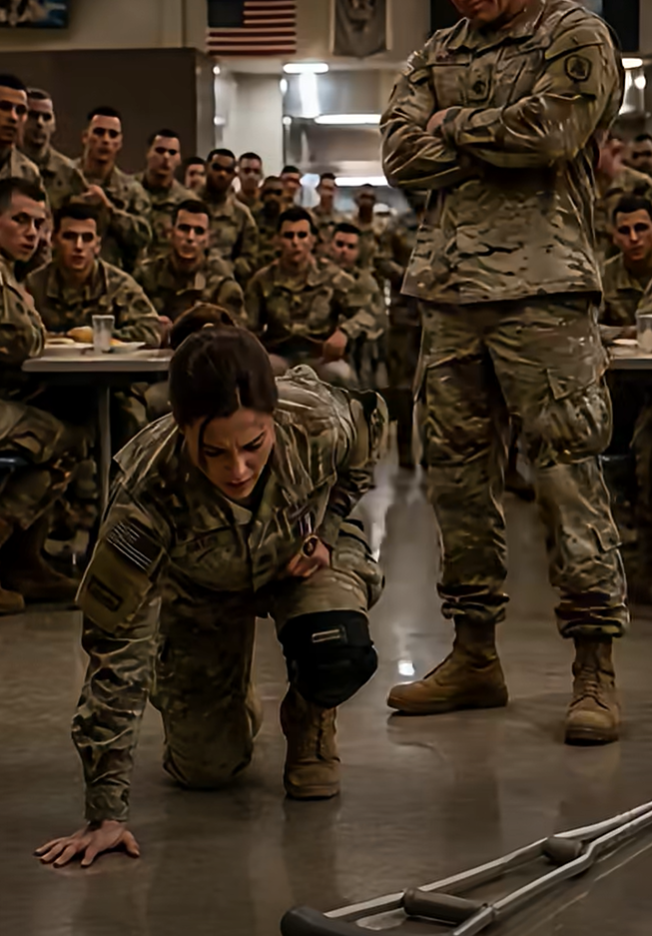
“Move your crutch, Lieutenant, before somebody trips over your pity parade.”
The words cut through the Fort Campbell dining facility just as Natalie Hayes planted one trembling hand against the edge of a table to keep herself upright.
The cafeteria went quiet in layers.
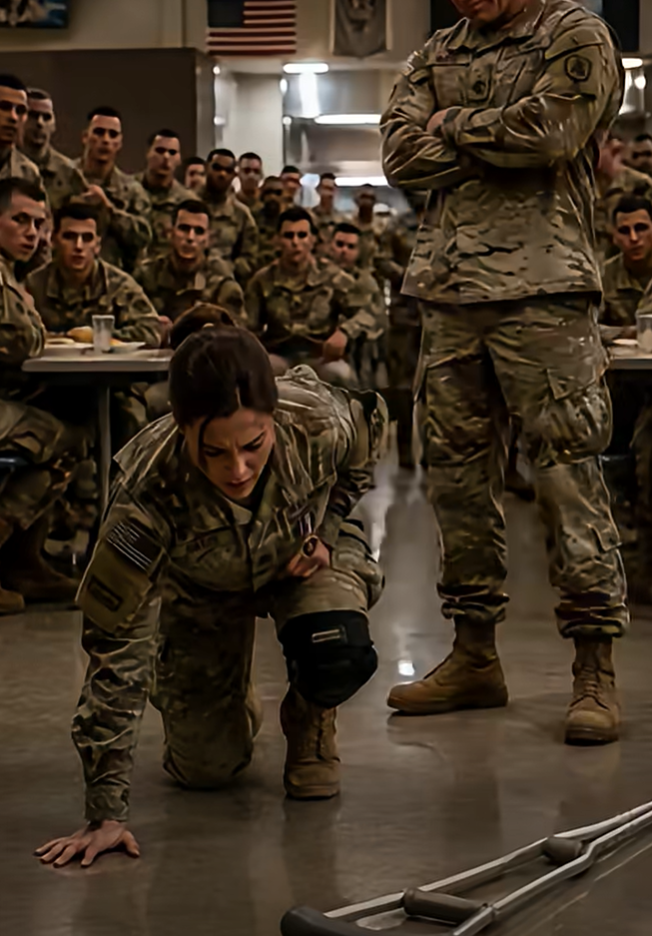
Sergeant Briggs stood behind her. Broad shoulders. Square jaw. The kind of man who had spent twenty years being loud because nobody ever told him to stop.
“Sergeant,” she said evenly, “step back.”
He hooked his boot around the bottom of her crutch and swept it sideways.
Natalie hit the floor on one knee, then one hand. Pain flashed up her leg so sharply her vision whitened. Her crutch skidded under a chair and clanged against the metal leg.
Briggs laughed.
“Some hero,” he said, pointing down at her. “Can’t even stand on her own two feet.”
A few soldiers laughed with him. The nervous kind. The kind that came from people deciding whether cruelty counted if it wore rank.
Natalie closed her eyes.
Just for a second.
Long enough to keep the memory from breaking open. Dust. Heat. Private Coleman bleeding under a shredded door panel. The smell of burning rubber. Rounds snapping past her cheek.
Briggs had not been there.
He had only heard she came back decorated. And wounded. And young.
That was enough for him.
“Come on, Lieutenant,” Briggs said, folding his arms. “Show us how they make officers now.”
Lieutenant Grant pushed back from her chair, but Natalie raised one hand without looking.
“No,” Natalie said.
Her voice was quiet, but it carried.
She pressed her palm flat against the tile. Her injured leg shook. She got her good knee under her. Then, slowly, with the entire cafeteria watching, she began to push herself up.
That was when the double doors at the back of the dining facility slammed open.
A civilian kitchen worker dropped a metal tray. It clattered against the serving line like a gunshot.
Every soldier in the room snapped to attention so fast the benches scraped the floor.
Every soldier except Briggs, who was still smiling down at Natalie when the voice behind him spoke.
“Sergeant.”
Briggs turned.
And the color drained out of his face the moment he saw the four stars on the man’s collar – and the second figure standing just behind the General’s right shoulder.
Because the woman in the wheelchair beside the General wasn’t a stranger.
She was wearing a Gold Star pin.
And she was holding a folded American flag with the name COLEMAN stitched along the edge.
She looked at Briggs. Then she looked at Natalie on the floor. And what she said next made every soldier in that cafeteria turn and stare at Sergeant Briggs like he was already a dead man walking.
“Is this the honor you speak of in your letters?” Mrs. Coleman asked, her voice not loud, but carrying the weight of a silent battlefield.
Her eyes were fixed on Briggs.
“The honor you promised to uphold for my son?”
Briggs looked like he’d been struck by lightning. His mouth opened, but no sound came out.
The General, a man named Thompson whose face was carved from granite and experience, stepped forward. His presence alone seemed to suck the air out of the room.
He didn’t raise his voice. He didn’t have to.
“Lieutenant Grant,” the General said, his gaze sweeping past Briggs as if he were a piece of furniture. “Help Lieutenant Hayes.”
Grant was by Natalie’s side in a second, her hands gentle as she helped Natalie find her footing and retrieved her crutch.
Natalie finally stood, her face pale but her expression composed. She met the General’s eyes and gave a sharp, correct nod.
“General,” she said.
His focus then landed squarely on Briggs. The full, undivided attention of a four-star General was a terrifying thing.
“Sergeant Briggs,” General Thompson said, the words cold and precise. “You will hand your sidearm to my aide. You will then report to my office. You will wait there until I arrive.”
He paused, letting the silence stretch. “Do you understand me, Sergeant?”
Briggs, red-faced and trembling, managed a strangled, “Yes, sir.”
He unholstered his weapon with clumsy fingers and passed it to the stone-faced Colonel beside the General. Then, without looking at anyone, he turned and walked the longest walk of his life out of the dining facility.
The silence he left behind was absolute.
General Thompson turned his attention back to Natalie. His expression softened almost imperceptibly.
“Lieutenant Hayes. Mrs. Coleman and I were on our way to find you.”
Mrs. Coleman wheeled herself forward, her hands never leaving the folded flag in her lap. Her eyes, filled with a sorrow so deep it seemed endless, looked at Natalie’s injured leg and then back to her face.
“They told me you were brave, Lieutenant,” she said softly. “They didn’t tell me you were still fighting battles here at home.”
Natalie felt a lump form in her throat. “Ma’am, I am so sorry for your loss.”
Mrs. Coleman reached out and placed a hand on Natalie’s arm. “I know you are, child. I know you are.”
An hour later, Natalie sat in a stiff chair in General Thompson’s expansive office. The room was a museum of a long and storied career, but she barely saw it.
Across from her sat Mrs. Coleman, a picture of quiet dignity.
The door opened and Sergeant Briggs was marched in by the aide. He was told to stand at attention in the center of the vast rug. He stared straight ahead at the wall behind the General’s desk.
General Thompson walked in behind him and closed the door, shutting them all in together. He didn’t sit down. He walked over to the window and looked out over the base.
“Sergeant Briggs,” he began, his back still to the room. “I’ve been reviewing your file. Twenty-two years of service. Multiple commendations. A good NCO, by all accounts. Until today.”
He turned around. “So I find myself asking why. Why would a man with your record publicly humiliate a commissioned officer, a fellow soldier, a war hero?”
Briggs remained silent, his jaw clenched tight.
“I asked you a question, Sergeant.”
Briggs’s eyes flickered toward Natalie, then to Mrs. Coleman. A dam of resentment inside him finally broke.
“Sir,” he started, his voice thick with emotion. “With all due respect to you, and to Mrs. Coleman… I can’t respect her.” He gestured vaguely toward Natalie.
“Her?” the General repeated, his voice dangerously low. “You mean Lieutenant Hayes?”
“Yes, sir. Lieutenant Hayes,” Briggs spat out. “She’s the reason Private Daniel Coleman is dead.”
The air in the room went still.
Natalie felt her stomach drop. She had carried that weight, that fear, that exact accusation in her own heart for months. To hear it said aloud was like a physical blow.
Mrs. Coleman let out a small, quiet gasp.
“Daniel was from my hometown, sir,” Briggs continued, his composure crumbling. “I grew up with his father. I promised his parents I’d look out for him when he got assigned here.”
His voice cracked. “He was a good kid. A great soldier. And he was put under the command of a Lieutenant fresh out of the academy who didn’t know the first thing about a real firefight.”
He finally looked at Natalie, his eyes burning with a mixture of grief and pure hatred.
“She got him killed. She got a medal, and Daniel got a flag.”
General Thompson listened, his face an unreadable mask. When Briggs finished, the silence was heavy, suffocating.
He walked over to his desk and picked up a file. It was thick.
“Lieutenant Hayes,” the General said, turning to her. “I have read the after-action report. I have read the witness statements. Now, I want to hear it from you.”
Natalie took a deep breath, her hands clenched in her lap. “Sir.”
She looked not at the General, but at Mrs. Coleman. She owed this to her.
“We were on patrol in Kandahar Province,” she began, her voice steady despite the tremor she felt inside. “Intel said the sector was clear, but it felt wrong. Too quiet.”
“We were moving through a narrow street. Private Coleman was on point. I was right behind him.”
Her gaze drifted, seeing the memory instead of the office.
“The IED was buried in a culvert. It wasn’t meant for us. It was meant for the heavy vehicle behind us. But a spotter must have seen us on foot.”
“They detonated it early. The blast threw me and Coleman against a wall. The rest of the squad was pinned down by machine-gun fire from the rooftops.”
She paused, swallowing hard. “Coleman… his legs were hit badly. The shrapnel from the culvert. He was bleeding out, fast.”
“My leg was broken. I knew it the second I tried to move. But Daniel was exposed. The fire was concentrated on our position.”
“I told him to stay down,” she said, her voice dropping to a whisper. “I told him I was coming for him. But he saw it before I did.”
A tear traced a path down her cheek. She didn’t wipe it away.
“There was another team member, Private Rossi, who had been knocked unconscious by the blast, even further out in the open. The gunfire was walking its way toward him.”
“Daniel looked at me,” she said, her eyes meeting Mrs. Coleman’s. “He knew he was dying. He knew it. And he knew I couldn’t get to Rossi in time.”
“He said, ‘Tell my mom I love her, L.T.’ And then he pushed himself up.”
“He drew their fire,” Natalie said, her voice raw. “He laid down suppressive fire with his own rifle, giving me just enough time to drag Rossi back behind cover. He saved Rossi’s life.”
“The rounds that hit him… they were meant for me. For Rossi. He took them all.”
She finally broke eye contact with Mrs. Coleman and looked at the floor.
“I crawled to him. I tried to stop the bleeding. I held his hand until he was gone. My injury happened when the wall collapsed on me after a secondary explosion. But it doesn’t matter. Sergeant Briggs is right in one way. I was his commander. He died on my watch.”
The room was utterly silent, save for the sound of Natalie’s quiet, ragged breaths.
Briggs stared at her, his face a canvas of confusion and shock. The simple, hateful story he had told himself for months had just been torn to shreds by the brutal, heroic truth.
Then Mrs. Coleman spoke, her voice gentle but firm.
“Sergeant Briggs,” she said.
He flinched, finally looking at the grieving mother he thought he was defending.
“My Daniel was a stubborn boy,” she said, a faint, sad smile on her lips. “He always wanted to be the protector. It doesn’t surprise me one bit that he chose to save a friend rather than himself.”
She reached into a bag hanging on the back of her wheelchair and pulled out a worn, folded piece of paper.
“This is the last letter he sent me,” she said, unfolding it carefully. “He wrote it two days before his last patrol.”
She looked at Briggs. “He wrote about you, Sergeant. He said you were a tough old bear but that you taught him how to pack his gear right and how to keep his head on straight. He looked up to you.”
Briggs squeezed his eyes shut.
“And he wrote about his new Lieutenant,” Mrs. Coleman continued, her gaze shifting to Natalie.
She read from the letter. “‘Mom, you wouldn’t believe my L.T. She’s younger than most of us, but she’s brilliant. She’s fair, and she listens. She pushes us hard, but she’s always the first one up and the last one to bed. I’d follow her anywhere. We all would.’”
She folded the letter and placed it back on her lap, on top of the flag.
“My son didn’t die because of Lieutenant Hayes, Sergeant. He died for her. He died for his friend. He died a hero, making a choice that was entirely his own.”
She looked at the flag in her lap. “This anger you’re carrying… this… ugliness you displayed today… it dishonors the sacrifice my son chose to make. You are not protecting his memory. You are staining it.”
Each word was a hammer blow to Briggs’s soul. He fell to his knees on the office rug, the sound shockingly loud in the quiet room. Sobs tore from his chest, the wrenching sound of a man whose grief had finally broken free from the armor of rage.
It wasn’t an act. It was the complete and total collapse of a man who realized he had aimed his pain at the wrong person, for the wrong reasons, for far too long.
General Thompson let him weep for a long moment before he spoke again.
“Sergeant Briggs. Get up.”
Briggs shakily rose to his feet, his face streaked with tears.
“Your actions in the dining facility were inexcusable,” the General stated calmly. “They were an affront to an officer, a violation of your oath, and an embarrassment to this uniform. There will be consequences. A full Article 15. Reduction in rank. Reassignment to a post where you will spend the remainder of your career counting paperclips.”
He paused. “That is the punishment for your actions.”
“However,” he continued, walking over to his desk. “It seems your motivation was based on a fundamental misunderstanding. A falsehood you fed yourself out of grief.”
He looked from Briggs to Natalie.
“This is not a courtroom. It’s my office. And in this office, we find solutions.”
He opened the file on his desk. “Lieutenant Hayes. Your initial award of a Silver Star for your actions was… conservative. After reviewing firsthand accounts, including a report from Private Rossi that he submitted from his hospital bed, the board has recommended an upgrade.”
He pulled a small, velvet-covered box from his desk drawer.
“It is my distinct honor, on behalf of the President of the United States, to present you with the Distinguished Service Cross. For extraordinary heroism at the risk of your own life.”
He opened the box. The medal inside gleamed.
“And,” he said, turning to Mrs. Coleman, “to posthumously award the same honor to Private Daniel Coleman, for his conspicuous gallantry that directly resulted in the saving of one life and the protection of his commanding officer.”
He then looked at Briggs, his eyes hard as flint. “You will be the one to accept it on his family’s behalf, Master Sergeant. And you will spend the rest of your service learning the difference between misplaced anger and true honor.”
Briggs stared, dumbfounded. He was being demoted, yes. Punished. But he was also being given a chance to participate in the very honor he had tried to tarnish. It was a punishment and a path to redemption, all in one.
He looked at Natalie, his eyes finally clear of hatred, now only filled with a profound and bottomless shame.
“Lieutenant…” he choked out. “Ma’am… I… I’m sorry.”
Natalie simply nodded, the gesture carrying a weight of forgiveness that was more powerful than any words.
Months later, Natalie stood on a training range, this time without her crutch. Her limp was still there, a slight, permanent reminder. But she moved with a confidence that had been absent for a long time.
She was instructing a new class of Second Lieutenants, young, eager faces hanging on her every word.
“Leadership isn’t about being the loudest voice in the room,” she told them, her gaze sweeping over the group. “It’s about being the one who listens. It’s about knowing your soldiers, not just their names, but their stories. What they carry.”
A non-commissioned officer stood at the back of the group, handing out water bottles. He was older, his uniform crisp, his rank now that of a Sergeant First Class. It was Briggs.
He had served his punishment and, true to the General’s word, had been reassigned. At his own request, he was now helping to mentor new officers, to share lessons learned the hardest way imaginable. He rarely spoke, but when he did, the young lieutenants listened. He and Natalie worked together, a silent, respectful partnership forged in a crucible of loss and forgiveness.
True strength isn’t just about what you can endure on the battlefield. It’s about the burdens you carry when you come home, and the grace you choose to show to those who stumble under the weight of their own. It’s about understanding that sometimes, the deepest wounds aren’t the ones you can see.



